


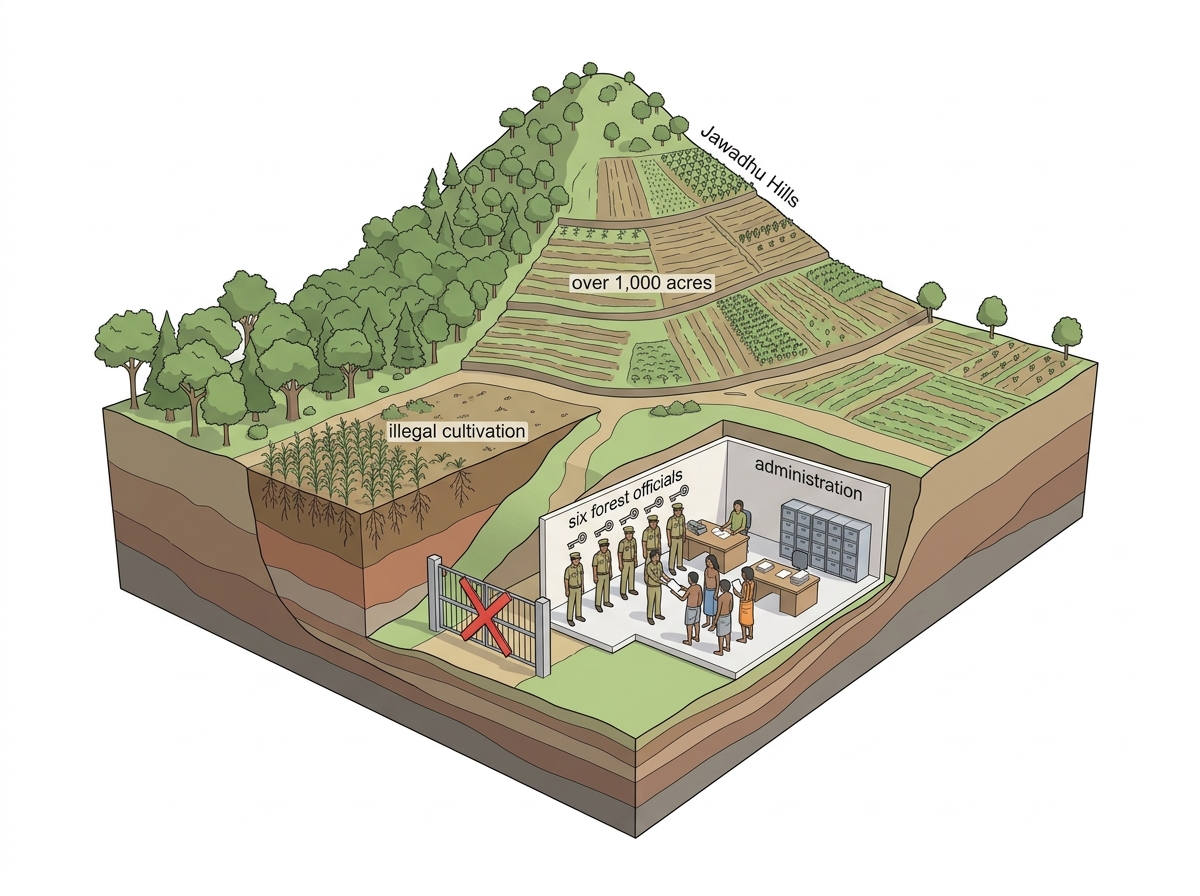
07 Sep Forest officials suspended for illegal tribal land cultivation in Jawadhu Hills
✎ The Forest Rights Act, 2006, recognises individual and community forest rights of Scheduled Tribes and other traditional forest dwellers, but its implementation is undermined by administrative lapses, corruption, and…
Subject Relevance — Where This Topic Fits
- GS Paper II — Governance, Transparency and Accountability | GS Paper III — Environment and Forest Conservation
- Prelims: Forest Rights Act, 2006, Scheduled Tribes and Other Traditional Forest Dwellers (Recognition of Forest Rights) Act, Forest land encroachment, Tribal rights and land titles, Forest administration and corruption, Jawadhu Hills, Tiruvannamalai district, Forest Range Officers, Forest Conservation Act, 1980
- Essay: Forest conservation and tribal rights: Balancing ecological integrity with social justice, Governance failures in natural resource management: Causes and remedies
Quick Revision: The Forest Rights Act, 2006, recognises individual and community forest rights of Scheduled Tribes and other traditional forest dwellers, but its implementation is undermined by administrative lapses, corruption, and encroachment, necessitating stringent enforcement of legal provisions and community-led governance mechanisms.
Why is this in the news?
The suspension of six forest officials in Tiruvannamalai district for allegedly facilitating illegal cultivation of over 1,000 acres of forest land in Jawadhu Hills, coupled with the promise of fraudulent land title deeds under the Forest Rights Act, 2006, underscores systemic governance failures in forest administration. This incident highlights the intersection of tribal rights, land tenure insecurity, and institutional corruption, raising critical questions about the implementation of the Forest Rights Act, 2006, and the mechanisms for preventing encroachment and ensuring accountability in forest governance.
Background
- The Forest Rights Act, 2006 (FRA), enacted to recognise and vest forest rights in Scheduled Tribes and other traditional forest dwellers, aims to redress historical injustices by granting legal titles for land cultivated prior to December 31, 2005, within forest areas.
- Jawadhu Hills, located in Tiruvannamalai district, Tamil Nadu, is a biodiversity-rich region inhabited by at least 150 tribal hamlets, predominantly belonging to the Malayali tribe, a socially and economically developed group.
- The FRA permits individual land titles for forest dwellers, provided cultivation commenced before the stipulated cut-off date of December 31, 2005.
- Illegal encroachment of forest land for cultivation is a persistent challenge in India, often driven by socio-economic pressures, lack of awareness about legal provisions, and collusion between local officials and encroachers.
- The Forest Conservation Act, 1980, prohibits the diversion of forest land for non-forest purposes without prior approval from the Ministry of Environment, Forest and Climate Change (MoEFCC), making any unauthorised cultivation a violation of statutory provisions.
- Institutional corruption in forest departments has been a recurring issue, with instances of officials colluding with encroachers to facilitate illegal land use in exchange for monetary gains.
Forest Rights Act, 2006: Legal Framework, Rights, and Implementation
- The Forest Rights Act, 2006, is a landmark legislation enacted to recognise and vest forest rights in Scheduled Tribes (STs) and other traditional forest dwellers (OTFDs) who have been residing in forest areas for generations.
- The Act provides for two types of rights: (a) Individual rights, which include title to land cultivated prior to December 31, 2005; and (b) Community rights, which include rights over common property resources such as water bodies, grazing lands, and non-timber forest products.
- The FRA mandates the establishment of Forest Rights Committees (FRCs) at the village level, comprising members of the local community, to process and recommend claims for forest rights. These committees are pivotal in ensuring community participation and transparency in the implementation process.
- The Act stipulates that no forest land shall be diverted for non-forest purposes without the consent of the Gram Sabha, ensuring that local communities have a decisive voice in decisions affecting their livelihoods and forest resources.
- The FRA also recognises the rights of forest dwellers to access and use forest resources for subsistence and livelihood, provided such use is sustainable and does not harm the ecological integrity of the forest.
- The Act requires the state governments to conduct a survey and settlement of forest rights within a stipulated timeframe, followed by the issuance of title deeds to eligible claimants. However, implementation has been uneven across states due to administrative bottlenecks, lack of awareness, and resistance from forest departments.
- The FRA is complemented by the Scheduled Tribes and Other Traditional Forest Dwellers (Recognition of Forest Rights) Rules, 2007, which provide procedural guidelines for the implementation of the Act, including the format for claims, the process for verification, and the mechanism for dispute resolution.
- The Act also includes provisions for the protection of wildlife and biodiversity, requiring that any rights granted under the FRA do not adversely impact the ecological balance of the forest or the habitat of endangered species.
Key Features
| Feature | Significance |
|---|---|
| Suspension of forest officials | Demonstrates institutional accountability for dereliction of duty and corruption in forest administration. |
| Illegal cultivation over 1,000 acres | Highlights systemic encroachment on forest land, threatening biodiversity and ecological balance. |
| Bribery and fraudulent title deeds | Exposes collusion between forest staff and tribals, undermining the Forest Rights Act, 2006. |
| Involvement of 600-700 tribals | Indicates widespread participation, suggesting socio-economic pressures and lack of awareness of legal provisions. |
| Forest Rights Act, 2006 (FRA) violations | FRA permits cultivation only on pre-2005 forest land; illegal extension violates statutory limits. |
Why it Matters
Legal and Institutional
- The incident underscores the need for stricter enforcement of the Forest Rights Act, 2006, to prevent fraudulent claims and illegal land use.
- Suspension of officials reflects the administrative response to corruption, though systemic reforms are essential for long-term deterrence.
- The case highlights the role of forest departments in balancing conservation with tribal livelihoods, a core challenge in forest governance.
Ecological
- Encroachment on 1,000+ acres of forest land threatens biodiversity, soil stability, and watershed functions in the ecologically sensitive Jawadhu Hills.
- Unregulated cultivation accelerates deforestation, increasing vulnerability to landslides and climate change impacts in the region.
Socio-Economic
- The involvement of 600-700 tribals suggests economic distress and lack of alternative livelihoods, driving illegal land use despite legal risks.
- The case reveals a gap between tribal aspirations for land security and the procedural safeguards of the FRA, necessitating awareness and capacity-building.
Policy and Governance
- The incident exposes loopholes in the implementation of FRA, particularly in verifying pre-2005 cultivation claims and preventing fraudulent extensions.
- It underscores the need for inter-departmental coordination between forest, revenue, and tribal welfare departments to prevent such violations.
Challenges
1. Enforcement of Forest Rights Act, 2006
- Fraudulent claims and illegal extensions of cultivation undermine the FRA’s objective of securing tribal land rights.
- Weak verification mechanisms allow collusion between forest staff and tribals, enabling large-scale encroachments.
- Lack of awareness among tribals about FRA provisions leads to misplaced reliance on illegal means for land security.
UPSC Link: Forest Rights Act, 2006 – Implementation challenges
2. Corruption in Forest Administration
- Collusion between forest officials and tribals facilitates illegal land use, eroding institutional integrity.
- Monetary incentives for forest staff incentivize dereliction of duty and complicity in encroachments.
- Systemic corruption in forest departments undermines conservation efforts and tribal welfare.
UPSC Link: Corruption in Forest Governance – Causes and Remedies
3. Balancing Conservation and Tribal Livelihoods
- Strict enforcement of forest laws conflicts with tribal aspirations for land security and economic stability.
- Alternative livelihood programs are needed to reduce dependence on forest land for cultivation.
- Sustainable agroforestry models must be promoted to reconcile conservation with tribal needs.
UPSC Link: Forest Conservation vs. Tribal Rights – Policy Dilemmas
4. Land Titling and Record-Keeping
- Fraudulent additions to forest records enable illegal land claims, complicating land governance.
- Outdated and inaccurate land records hinder the verification of pre-2005 cultivation claims under FRA.
- Digital land records and GIS mapping are essential to prevent fraud and ensure transparency.
UPSC Link: Land Titling Reforms – Challenges and Solutions
5. Awareness and Capacity-Building
- Tribals often lack awareness of FRA provisions, making them vulnerable to exploitation by forest staff.
- Capacity-building programs are needed to educate tribals about their rights and legal recourse.
- Community-based monitoring can help prevent fraudulent claims and illegal land use.
UPSC Link: Tribal Rights Awareness – Policy Gaps
Challenges — UPSC Perspective
| Issue | Concern |
|---|---|
| Fraudulent FRA claims | Undermines the Act’s objective of securing tribal land rights through false pre-2005 cultivation claims. |
| Collusion between forest staff and tribals | Facilitates large-scale encroachments and corruption in forest administration. |
| Weak verification mechanisms | Allows fraudulent extensions of cultivation and illegal land use despite statutory limits. |
| Lack of tribal awareness | Leads to misplaced reliance on illegal means for land security and economic stability. |
| Corruption in forest departments | Erodes institutional integrity and undermines conservation efforts. |
| Deforestation and biodiversity loss | Threatens ecological balance and increases vulnerability to climate change impacts. |
Way Forward
- Strengthen verification mechanisms under the Forest Rights Act, 2006, to prevent fraudulent claims and illegal land use.
- Conduct widespread awareness campaigns among tribals to educate them about FRA provisions and legal recourse.
- Implement digital land records and GIS mapping to ensure transparency and accuracy in land titling.
- Promote alternative livelihood programs, such as agroforestry and non-timber forest product (NTFP) cultivation, to reduce dependence on forest land.
- Enhance inter-departmental coordination between forest, revenue, and tribal welfare departments to prevent collusion and encroachments.
- Introduce community-based monitoring systems to track land use and prevent illegal cultivation.
- Strengthen anti-corruption measures in forest departments, including whistleblower protections and regular audits.
- Develop sustainable agroforestry models that reconcile conservation with tribal livelihoods.
UPSC Value Addition
Keywords for Mains Answer-Writing
Forest Rights Act, 2006 · Scheduled Tribes and Other Traditional Forest Dwellers (Recognition of Forest Rights) Act · Jawadhu Hills tribal cultivation · forest land encroachment · forest officials’ administrative accountability · forest rights title deeds · tribal land rights jurisprudence · forest governance and corruption · forest administration in Tamil Nadu · FRA compliance mechanisms · traditional forest dwellers · forest land diversion · forest conservation vs tribal livelihoods · forest officials’ disciplinary action · forest land records and tribal claims
Constitutional & Policy Linkages
- [‘Article 19(1)(g) – Right to Practice Any Profession’, ‘Balancing tribal livelihoods with forest conservation.’]
- [‘Article 21 – Right to Life and Livelihood’, ‘Ensuring land security for tribals without compromising ecological balance.’]
- [‘Fifth Schedule – Tribal Areas Administration’, ‘Governance framework for tribal regions and forest land management.’]
Concept Flow
Forest officials collude with tribals to allow illegal cultivation beyond FRA-permitted limits. → Fraudulent title deeds are promised in exchange for bribes, violating FRA provisions. → Large-scale encroachment (1,000+ acres) occurs, threatening biodiversity and ecological balance. → Preliminary inquiry reveals systemic corruption and widespread participation (600-700 tribals). → Suspension of officials highlights institutional accountability but raises questions about systemic reforms. → Policy gaps in FRA implementation and tribal awareness are exposed, necessitating governance and awareness interventions. → Long-term solutions require balancing conservation, tribal livelihoods, and anti-corruption measures.
Prelims Practice Questions
Q1. Consider the following statements regarding the Forest Rights Act, 2006:
1. The Act recognises the rights of forest-dwelling Scheduled Tribes and other traditional forest dwellers to land and other resources.
2. Individual forest rights can be granted for a maximum of 2.5 acres of forest land per claimant.
3. The Act permits diversion of forest land for non-forest purposes without prior approval from the Gram Sabha.
4. Claims under the Act must be filed before the Gram Sabha, which is the competent authority to process and approve them.
How many of the above statements are correct?
- Only one
- Only two
- Only three
- All four
Answer: Only three — Statements 1, 2, and 4 are correct as per the Forest Rights Act, 2006. Statement 3 is incorrect because diversion of forest land for non-forest purposes requires prior approval from the Gram Sabha and compliance with environmental laws.
Q2. Assertion (A): The Forest Rights Act, 2006, provides for the recognition of individual forest rights to tribal cultivators who have been cultivating forest land prior to December 31, 2005.
Reason (R): The Act aims to balance forest conservation with the livelihood rights of forest-dwelling communities by granting land titles to eligible claimants.
In the context of the above two statements, which of the following is correct?
- Both A and R are true, and R is the correct explanation of A
- Both A and R are true, but R is NOT the correct explanation of A
- A is true, but R is false
- A is false, but R is true
Answer: Both A and R are true, but R is NOT the correct explanation of A — Both Assertion (A) and Reason (R) are true. The Act indeed recognises individual forest rights for tribals cultivating forest land before December 31, 2005, and the primary objective of the Act is to reconcile forest conservation with the livelihood rights of forest-dwelling communities.
Q3. Match the following forest-related provisions with their respective Acts/Regulations:
Column I
A. Recognition of forest rights to Scheduled Tribes and other traditional forest dwellers
B. Prohibition of felling of trees in reserved forests
C. Declaration of Tiger Reserves and regulation of activities within them
D. Regulation of forest produce and forest dwellers’ rights in Scheduled Areas
Column II
1. Forest Conservation Act, 1980
2. Forest Rights Act, 2006
3. Wildlife Protection Act, 1972
4. Panchayats (Extension to Scheduled Areas) Act, 1996 (PESA)
Select the correct match from the options below:
- A-2, B-1, C-3, D-4
- A-1, B-2, C-3, D-4
- A-3, B-1, C-2, D-4
- A-4, B-3, C-1, D-2
Answer: A-2, B-1, C-3, D-4 — A-2 (Forest Rights Act, 2006), B-1 (Forest Conservation Act, 1980), C-3 (Wildlife Protection Act, 1972), D-4 (PESA, 1996).
Mains Practice Question
✍ The Forest Rights Act, 2006, seeks to reconcile forest conservation with the livelihood rights of forest-dwelling communities. In this context, critically examine the challenges in the implementation of the Act, particularly in the context of recent incidents of forest land encroachment and administrative lapses in Tamil Nadu’s Jawadhu Hills. Also, analyse the role of Gram Sabhas in ensuring compliance with the Act’s provisions. (15 Marks)
Approach: MODEL-ANSWER SKELETON:
1. **Introduction (2 marks)**
– Brief overview of the Forest Rights Act, 2006: objectives, key provisions (individual and community rights, Gram Sabha as competent authority, eligibility criteria, and dispute resolution mechanisms).
– Contextualise the issue: recent incidents in Jawadhu Hills involving illegal cultivation of over 1,000 acres of forest land and suspension of forest officials for alleged corruption and administrative lapses.
2. **Challenges in Implementation (6 marks)**
– **Administrative and Governance Issues**: Lack of awareness among forest officials and tribal communities about FRA provisions; procedural delays in processing claims; weak monitoring and enforcement mechanisms.
– **Corruption and Collusion**: Instances of forest officials accepting bribes to allow encroachment or falsify records (as seen in Jawadhu Hills case); systemic failures in accountability.
– **Legal and Procedural Ambiguities**: Overlapping jurisdictions between forest departments, Gram Sabhas, and revenue authorities; ambiguity in defining ‘forest land’ and ‘encroachment’ post-FRA.
– **Balancing Conservation and Livelihoods**: Tensions between forest conservation goals (e.g., Wildlife Protection Act, 1972) and tribal rights; lack of integrated land-use planning.
– **Data and Record-Keeping**: Inadequate or manipulated forest land records; lack of digitisation and transparency in land records.
3. **Role of Gram Sabhas (4 marks)**
– **Statutory Role**: Gram Sabhas as the primary authority for processing and approving forest rights claims under Section 6 of the FRA.
– **Strengths**: Grassroots-level participation; potential to democratise forest governance and ensure local accountability.
– **Limitations**: Limited capacity and awareness among Gram Sabha members; political interference; lack of resources and training.
– **Recent Reforms**: Efforts to strengthen Gram Sabha functions (e.g., through PESA, 1996, and state-level initiatives in Tamil Nadu).
4. **Way Forward (3 marks)**
– **Institutional Reforms**: Strengthening forest department-Gram Sabha coordination; capacity-building for officials and tribal communities.
– **Transparency and Accountability**: Use of technology (e.g., GIS mapping, blockchain for land records) to prevent fraud and ensure real-time monitoring.
– **Community Awareness**: Multi-stakeholder campaigns to educate tribals about their rights and obligations under the FRA.
– **Policy Integration**: Aligning FRA implementation with other forest-related laws (e.g., Forest Conservation Act, 1980; Wildlife Protection Act, 1972) to avoid conflicts.
5. **Conclusion (2 marks)**
– Reiterate the need for a balanced approach that upholds both forest conservation and tribal livelihoods.
– Highlight the importance of political will, administrative reforms, and community participation in ensuring effective FRA implementation.
Source: The Hindu
Generated by AanyaAi for educational purpose.
Related guides on our sites
- Best sociology optional coaching
- Best coaching for sociology optional
- Best sociology optional coaching online
- is sociology good optional

- Forest officials suspended for illegal tribal land cultivation in Jawadhu Hills - September 7, 2026
- केरल सरकार पीएम-एसएचआरआई योजना पर फैसला कब? जानिए राज्य सरकार की रणनीति - September 7, 2026
- Kerala to Decide on PM-SHRI Scheme After Cabinet Panel Report - September 7, 2026

No Comments