


07 Sep Iran to Declare Restricted Zone Near Hormuz Strait: UPSC Geography Analysis
✎ The Strait of Hormuz is a critical chokepoint for global oil transit, and any disruption to its security environment can have cascading effects on energy prices and geopolitical stability, making it a key topic for UPSC…
Subject Relevance — Where This Topic Fits
- GS Paper II — International Relations: Maritime Security and Geopolitics of the Middle East | GS Paper III — Economy: Global Energy Markets and Supply Chain Disruptions
- Prelims: Strait of Hormuz, Hormuz Peace Memorandum, International Maritime Organization (IMO) conventions, UNCLOS, sanctions under UN Security Council Resolutions, anti-ship missiles, naval blockade, insurance clauses in maritime law, chokepoint economics, energy security
- Essay: Energy Geopolitics and Global Stability: The Case of the Strait of Hormuz, Maritime Security in the 21st Century: Challenges to Freedom of Navigation
Quick Revision: The Strait of Hormuz is a critical chokepoint for global oil transit, and any disruption to its security environment can have cascading effects on energy prices and geopolitical stability, making it a key topic for UPSC examinations.
Why is this in the news?
Iran’s announcement of a ‘restricted zone’ near the Strait of Hormuz, coupled with threats of sanctions on non-compliant vessels, represents a significant escalation in regional maritime tensions. This development, framed as a strategic response to perceived U.S. naval encroachment, intersects with critical UPSC syllabus themes including maritime security, international law of the sea, and the geopolitics of energy supply chains. The move also raises questions about compliance with international maritime conventions and the potential for disruption to global oil markets, a topic frequently examined in both Prelims and Mains examinations.
Background
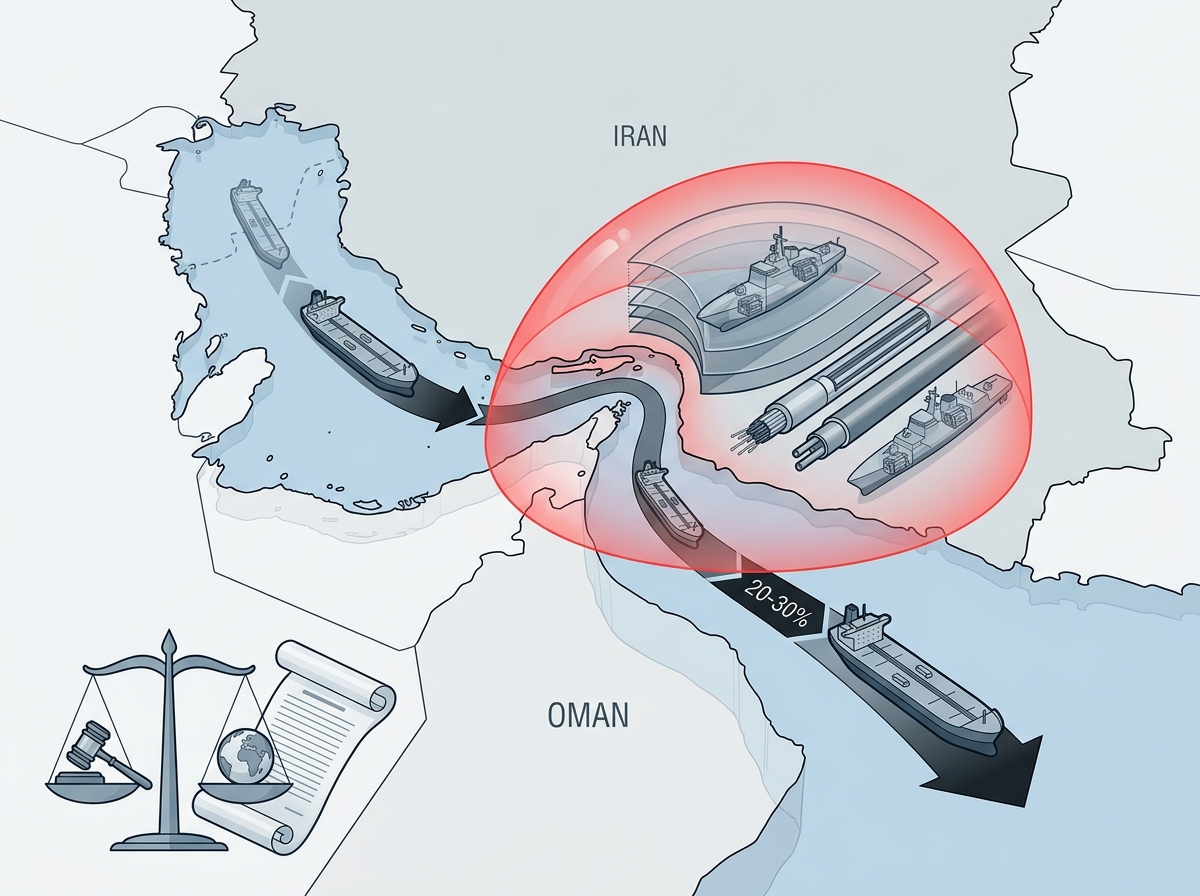
- The Strait of Hormuz, a narrow waterway between Oman and Iran, is a critical chokepoint for global oil transit, with approximately 20-30% of the world’s oil supply passing through it annually, making it a focal point of geopolitical competition.
- The region has witnessed periodic maritime tensions, including the 1980s ‘Tanker War’ during the Iran-Iraq conflict and more recent incidents such as the 2019 attacks on oil tankers in the Gulf of Oman, which were attributed to Iran by the U.S. and its allies.
- Iran has historically asserted control over the strait, citing its obligations under the 1982 United Nations Convention on the Law of the Sea (UNCLOS) to regulate maritime traffic in its territorial waters and exclusive economic zone (EEZ).
- The U.S. has maintained a naval presence in the region to ensure freedom of navigation, particularly in response to Iran’s nuclear program and its support for proxy groups in the Middle East.
What is the ‘Restricted Zone’ Proposed by Iran Near the Strait of Hormuz?
- The proposed ‘restricted zone’ is a designated area outside the Strait of Hormuz where Iran intends to enforce stricter controls on maritime traffic, including mandatory coordination with Iranian authorities for passage.
- Vessels entering the zone without prior coordination with Iran may face sanctions, including restrictions on insurance coverage and future passage through the waterway, as part of Iran’s enforcement mechanism.
- Iran has framed the move as a response to what it perceives as a U.S. naval blockade targeting Iranian ports and coastal areas, which it argues violates international maritime law, particularly UNCLOS.
- The zone is reported to extend from the line where the U.S. naval blockade begins to the Strait of Hormuz and into the Persian Gulf, effectively creating a buffer zone under Iranian oversight.
- Iran has also announced plans to designate a new international corridor for passage through the strait, managed jointly with Oman, though details on its operationalization remain unclear.
- The announcement follows Iran’s test-firing of an anti-ship missile over a U.S. aircraft carrier, described as a demonstration of its military capabilities and a warning against perceived U.S. aggression.
- Iran has asserted that the Strait of Hormuz remains ‘completely closed’ to certain vessels, dismissing claims of continued passage as ‘lies,’ though this contradicts reports of ongoing maritime traffic via alternate routes.
Key Features
| Feature | Significance |
|---|---|
| Declaration of a ‘restricted zone’ near the Strait of Hormuz | Establishes a unilateral maritime jurisdiction claim, potentially altering freedom of navigation norms in a critical chokepoint for global oil trade. |
| Sanctions on non-compliant vessels | Introduces economic coercion measures targeting shipping insurance and future passage rights, escalating geopolitical pressure. |
| Claim of closure of the Strait of Hormuz | Asserts de facto control over a strategically vital waterway, challenging the principle of innocent passage under international maritime law. |
| Domestically developed anti-ship missile test | Demonstrates indigenous military capability and serves as a deterrent signal to adversarial naval forces operating in the region. |
| Proposed Iran-Oman maritime corridor | Proposes an alternative transit route under Iranian management, potentially redefining regional maritime governance structures. |
Why it Matters
Geopolitical Implications
- Reinforces Iran’s assertive maritime posture in response to perceived US-led containment policies, particularly post-February 2026 strikes.
- Undermines the United Nations Convention on the Law of the Sea (UNCLOS) framework by unilaterally restricting navigational freedoms in a high-seas corridor.
- Triggers potential counter-measures from the US and allied naval forces, risking escalation into a broader regional conflict.
- Shifts the balance of power in the Persian Gulf, with implications for India’s energy security and maritime trade routes.
- Tests the resolve of the international community to uphold maritime law and prevent unilateral coercion in critical chokepoints.
Economic Consequences
- Disruption of global oil supply chains, given the Strait of Hormuz’s role as a transit route for ~20-30% of the world’s seaborne oil.
- Increased insurance premiums for vessels transiting the region, raising operational costs for shipping companies.
- Potential rerouting of maritime traffic through alternative, longer routes, increasing transit time and costs for global trade.
- Impact on India’s crude oil imports, which are heavily dependent on the Persian Gulf region, particularly from Iran, Iraq, and Saudi Arabia.
- Volatility in international oil prices, with cascading effects on inflation, fiscal deficits, and economic growth in energy-importing nations.
Legal and Institutional Challenges
- Violation of Article 17 of UNCLOS, which guarantees the right of innocent passage through straits used for international navigation.
- Potential breach of the 1958 Geneva Convention on the High Seas, which prohibits interference with vessels in transit.
- Erosion of trust in multilateral maritime governance institutions, such as the International Maritime Organization (IMO).
- Legal ambiguity surrounding the status of the proposed ‘restricted zone’ and its compatibility with international law.
- Risk of retaliatory measures by affected states, including sanctions or military patrols, further destabilizing the region.
Military and Security Dimensions
- Demonstration of Iran’s asymmetric warfare capabilities, including missile technology and naval blockades, as tools of statecraft.
- Potential for miscalculation or accidental escalation due to the presence of multiple naval forces in the region.
- Shift in the regional military balance, with Iran seeking to counter US naval dominance in the Persian Gulf.
- Impact on India’s maritime security strategy, particularly in the context of its ‘SAGAR’ (Security and Growth for All in the Region) doctrine.
- Increased risk of piracy, smuggling, and other non-state threats in a militarized maritime environment.
Challenges
1. Violation of Maritime Law
- Direct contravention of UNCLOS provisions on freedom of navigation and innocent passage.
- Potential erosion of the principle of ‘mare liberum’ (freedom of the seas) in critical chokepoints.
- Legal challenges at the International Tribunal for the Law of the Sea (ITLOS) or the International Court of Justice (ICJ).
UPSC Link: UNCLOS – Part III, Articles 37-44
2. Disruption of Global Energy Markets
- Volatility in crude oil prices due to supply chain disruptions.
- Impact on India’s energy security and foreign exchange reserves.
- Increased costs for energy-importing nations, exacerbating fiscal deficits.
UPSC Link: Energy Security – GS III
3. Escalation of Regional Tensions
- Risk of military confrontation between Iran and US-led naval coalitions.
- Potential for proxy conflicts or indirect confrontations between regional powers.
- Impact on India’s diplomatic efforts to maintain strategic autonomy in the Persian Gulf.
UPSC Link: Regional Security Architecture – GS II
4. Economic Coercion and Sanctions
- Targeting of non-compliant vessels through insurance bans and future passage restrictions.
- Potential for retaliatory economic measures by affected states.
- Impact on global shipping and insurance industries.
UPSC Link: Economic Diplomacy – GS II
5. Impact on India’s Maritime Strategy
- Threat to India’s energy imports and trade routes through the Persian Gulf.
- Need to reassess the ‘SAGAR’ doctrine and maritime security partnerships.
- Potential for increased piracy or smuggling in a destabilized region.
UPSC Link: Maritime Security – GS III
6. Environmental and Humanitarian Concerns
- Risk of oil spills or environmental damage due to military actions or blockades.
- Impact on coastal communities and ecosystems in the Persian Gulf.
- Humanitarian implications for seafarers and maritime workers.
UPSC Link: Environmental Security – GS III
Challenges — UPSC Perspective
| Issue | Concern |
|---|---|
| Unilateral maritime claim | Erosion of international maritime law and norms of innocent passage. |
| Disruption of oil supply chains | Volatility in global energy markets and economic instability. |
| Military escalation | Risk of conflict between Iran and US-led naval forces. |
| Economic sanctions on vessels | Targeting of global shipping and insurance industries. |
| Impact on India’s energy security | Threat to crude oil imports and trade routes. |
| Legal ambiguity | Uncertainty over the status of the ‘restricted zone’ under international law. |
Way Forward
- Convene an emergency session of the United Nations Security Council to address the unilateral maritime claim and its implications for global peace and security.
- Engage in diplomatic dialogues with Iran and other stakeholders to de-escalate tensions and restore adherence to UNCLOS.
- Strengthen India’s maritime security partnerships in the Persian Gulf, including joint patrols and information-sharing mechanisms.
- Diversify India’s energy import sources to reduce dependence on the Persian Gulf, while maintaining strategic reserves.
- Monitor the situation closely and prepare contingency plans for disruptions to oil supply chains and trade routes.
- Collaborate with the International Maritime Organization (IMO) to address legal and operational challenges arising from the restricted zone.
- Enhance India’s indigenous maritime capabilities, including surveillance and deterrence measures, to safeguard its interests.
- Promote multilateral initiatives to uphold the principle of freedom of navigation and prevent unilateral coercion in critical chokepoints.
UPSC Value Addition
Keywords for Mains Answer-Writing
Strait of Hormuz · maritime security · UN Convention on the Law of the Sea (UNCLOS) · freedom of navigation · geopolitical tensions in West Asia · maritime chokepoints · sanctions under international law · strategic straits · Iran’s nuclear deal (JCPOA) · US-Iran relations · maritime zones under UNCLOS · peaceful passage · restricted maritime zones · maritime interdiction · international maritime corridors
Concept Flow
US-Israeli strikes on Iran (February 2026) → Iran’s retaliatory measures, including naval blockades and missile tests → Declaration of a ‘restricted zone’ near the Strait of Hormuz → Imposition of sanctions on non-compliant vessels → Potential disruption of global oil supply chains → Volatility in energy markets and economic instability → Risk of military escalation and regional conflict → Erosion of international maritime law and norms → Need for diplomatic intervention and multilateral action → Reassessment of India’s maritime security strategy.
Prelims Practice Questions
Q1. Consider the following statements regarding the Strait of Hormuz:
1. It is a narrow waterway connecting the Persian Gulf with the Gulf of Oman.
2. The Strait of Hormuz is classified as a ‘strategic strait’ under the UN Convention on the Law of the Sea (UNCLOS).
3. Under UNCLOS, foreign ships have the right of ‘transit passage’ through international straits.
4. Iran has declared a unilateral ‘restricted zone’ within the Strait of Hormuz, which is legally binding on all nations.
How many of the above statements are correct?
- Only one
- Only two
- Only three
- All
Answer: Only three — Statements 1, 2, and 3 are correct. Statement 4 is incorrect because unilateral declarations of restricted zones by a coastal state within an international strait do not automatically bind other nations under international law unless they are consistent with UNCLOS provisions.
Q2. Assertion (A): The Strait of Hormuz is a critical maritime chokepoint for global oil transit.
Reason (R): Approximately 20% of the world’s crude oil passes through the Strait of Hormuz daily.
Options:
A. Both A and R are true, and R is the correct explanation of A.
B. Both A and R are true, but R is not the correct explanation of A.
C. A is true, but R is false.
D. A is false, but R is true.
Answer: ? — Both the Assertion (A) and Reason (R) are true, and R correctly explains A. The Strait of Hormuz is a vital chokepoint for global oil transit, with approximately 20% of the world’s crude oil passing through it daily.
Q3. Match the following maritime zones under the UN Convention on the Law of the Sea (UNCLOS) with their respective legal regimes:
Column I (Maritime Zone) Column II (Legal Regime)
1. Territorial Sea A. Innocent Passage
2. Contiguous Zone B. Freedom of Navigation
3. Exclusive Economic Zone (EEZ) C. Customs, fiscal, immigration, and sanitary laws
4. International Straits D. Transit Passage
Options:
A. 1-A, 2-C, 3-B, 4-D
B. 1-B, 2-A, 3-C, 4-D
C. 1-A, 2-B, 3-C, 4-D
D. 1-D, 2-C, 3-B, 4-A
Answer: ? — The correct match is: 1-A (Territorial Sea – Innocent Passage), 2-C (Contiguous Zone – Customs, fiscal, immigration, and sanitary laws), 3-B (EEZ – Freedom of Navigation), 4-D (International Straits – Transit Passage).
Mains Practice Question
✍ The unilateral declaration of a ‘restricted zone’ by a coastal state in an international strait raises complex questions under international maritime law. Critically examine the legal validity of such declarations with reference to the Strait of Hormuz, the UN Convention on the Law of the Sea (UNCLOS), and the principle of freedom of navigation. (15 Marks)
Approach: MODEL-ANSWER SKELETON:
1. **Definition and significance of the Strait of Hormuz**: Briefly describe its geographical and strategic importance as a maritime chokepoint for global oil transit.
2. **Relevant provisions of UNCLOS**:
– Art. 37-44 (Transit Passage through international straits).
– Art. 38 (Right of transit passage).
– Art. 42 (Duties of ships and aircraft during transit passage).
– Art. 25 (Right of the coastal State to take necessary steps in its territorial sea).
– Art. 56 (Rights and duties of the coastal State in the EEZ).
3. **Legal framework for restricted zones**:
– Distinguish between territorial sea, contiguous zone, EEZ, and international straits.
– Explain the principle of ‘freedom of navigation’ (Art. 87) and ‘transit passage’ (Art. 38).
– Discuss whether a coastal state can unilaterally impose restrictions in an international strait beyond its territorial sea.
4. **Case law and state practice**:
– Reference the ICJ Advisory Opinion on the Legality of the Use by a State of Nuclear Weapons in Armed Conflict (1996) and the Corfu Channel case (1949) on innocent passage.
– Cite state practice (e.g., Iran’s previous restrictions, US naval operations in the Strait).
5. **Challenges and controversies**:
– Whether such declarations violate UNCLOS or customary international law.
– The role of the UN Security Council or International Tribunal for the Law of the Sea (ITLOS) in resolving disputes.
– Environmental and humanitarian concerns (e.g., risk of collisions, impact on global oil markets).
6. **Conclusion**: Weigh the balance between coastal state sovereignty and the global commons principle. Argue that unilateral restrictions in international straits are legally tenuous unless they comply with UNCLOS or are agreed multilaterally.
Source: orissapost.com
Generated by AanyaAi for educational purpose.
Related guides on our sites
- Best PSIR optional coaching for upsc
- Best PSIR optional teacher for upsc
- Best teacher of PSIR optional for upsc
- Best PSIR optional coaching in delhi for UPSC

- ‘मेरा भारत’ अभियान: ग्रामीण युवाओं ने नशामुक्त समाज के लिए खेल और सेवा का संगम किया - October 24, 2026
- Forex Rule Confusion Delays Service Payments: RBI Clarification Needed - October 24, 2026
- माई भारत अभियान: ग्राम सेवा एवं खेल दिवस के तहत गांवों में Nasha Mukt Yuva Abhiyan - October 24, 2026

No Comments