


08 Sep Justice Gokuldas Report Blames TN Police & Excise for 2024 Kallakurichi Hooch Tragedy
✎ The Kallakurichi hooch tragedy exemplifies the catastrophic consequences of regulatory lapses in methanol monitoring, underscoring the need for robust administrative accountability, preventive vigilance, and disaster preparedness…
Subject Relevance — Where This Topic Fits
- GS Paper II — Governance, Transparency and Accountability | GS Paper III — Disaster Management | GS Paper IV — Ethical Governance and Probity in Public Life
- Prelims: Hooch tragedy, methanol poisoning, Prohibition and Excise Department, administrative accountability, disaster management, illicit liquor trade, Commission of Inquiry, preventive vigilance
- Essay: Administrative accountability in disaster prevention: A case study of the Kallakurichi hooch tragedy, Balancing public health imperatives with economic realities: The challenge of prohibition enforcement
Quick Revision: The Kallakurichi hooch tragedy exemplifies the catastrophic consequences of regulatory lapses in methanol monitoring, underscoring the need for robust administrative accountability, preventive vigilance, and disaster preparedness in public health emergencies.
Why is this in the news?
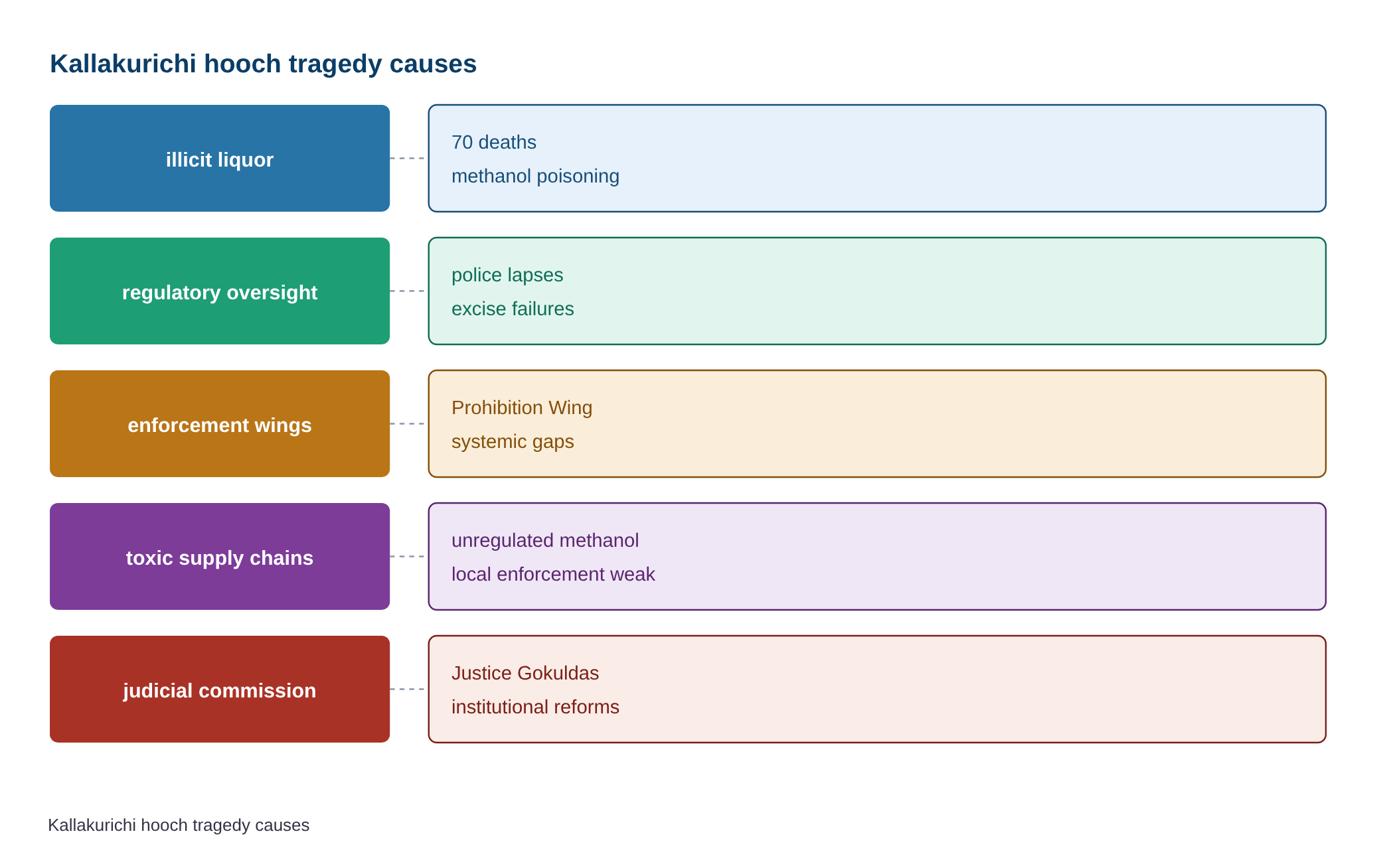
The Justice B. Gokuldas Commission of Inquiry report on the 2024 Kallakurichi hooch tragedy, which resulted in 70 fatalities due to methanol poisoning, has been tabled in the Tamil Nadu Assembly. The report attributes the tragedy to systemic failures in regulatory oversight, identifying lapses by police, excise officials, and local revenue authorities. This development underscores the critical importance of administrative accountability in disaster prevention and mitigation, particularly in the context of illicit liquor trade and public health emergencies.
Background
- The 2024 Kallakurichi hooch tragedy resulted in 70 deaths due to consumption of illicit liquor contaminated with methanol.
- The tragedy highlighted the persistent issue of illicit liquor trade in Tamil Nadu, particularly in regions with challenging terrain such as the Kalvarayan Hills.
- Prior to the tragedy, Tamil Nadu had implemented a partial prohibition policy, with the Prohibition and Excise Department responsible for monitoring the storage, transport, and sale of alcohol, including methanol.
- The state government had established multiple enforcement wings to curb the illicit liquor trade, including the Prohibition Enforcement Wing, but systemic gaps persisted.
- The tragedy occurred amid ongoing debates about the efficacy of prohibition policies and their enforcement mechanisms in India.
- The incident prompted judicial intervention, with the state government constituting a Commission of Inquiry under Justice B. Gokuldas to investigate the causes and circumstances leading to the disaster.
What is the Kallakurichi Hooch Tragedy and the Justice Gokuldas Commission Report?
- The Kallakurichi hooch tragedy refers to a mass poisoning incident in Kallakurichi district, Tamil Nadu, where 70 individuals died after consuming illicit liquor contaminated with methanol.
- Methanol, a highly toxic industrial alcohol, is often used as a substitute in the illicit production of liquor due to its low cost and availability, posing severe health risks including blindness, organ failure, and death.
- The Justice B. Gokuldas Commission of Inquiry was constituted by the Tamil Nadu government to investigate the causes, circumstances, and systemic failures that led to the tragedy.
- The Commission’s report, tabled in the Assembly on 8 September 2026, attributes the tragedy to lapses in regulatory oversight, including failures by police, excise officials, and local revenue authorities in monitoring the storage, transport, and sale of methanol.
- The report identifies specific categories of officials responsible for the tragedy, including Sub-Inspectors, Inspectors, Deputy Superintendents of Police, and officers of the Prohibition Enforcement Wing, as well as Village Administrative Officers and Tahsildars.
- The Commission recommends departmental action against the identified officials, including departmental inquiries for those still in service, to address administrative accountability.
- The report also recommends measures to support the children orphaned by the tragedy, including provision of education, food, and shelter to children orphaned by the death of their parents and offer them government jobs after they complete their education.
- To mitigate future risks, the Commission recommends the establishment of industries in Kallakurichi to provide employment and the creation of a dedicated Prohibition Enforcement Wing for the Kalvarayan Hills.
Key Features
| Feature | Significance |
|---|---|
| Justice Gokuldas Commission of Inquiry | A statutory inquiry constituted to investigate the causes, lapses, and accountability in the Kallakurichi hooch tragedy of 2024, ensuring a formal judicial review of administrative failures. |
| Departmental accountability | Identification of specific cadres (Sub-Inspectors, Tahsildars, Prohibition Enforcement Wing officers) for lapses in monitoring illicit arrack trade, reinforcing the principle of bureaucratic responsibility. |
| Orphaned children welfare measures | Recommendations for education, food, shelter, and government employment for children orphaned by the tragedy, addressing long-term social impact and intergenerational justice. |
| Industrial employment generation | Proposal to establish industries in Kallakurichi to provide livelihood opportunities, reducing economic vulnerabilities that may drive illicit liquor consumption. |
| Enhanced enforcement infrastructure | Recommendation to create a dedicated Prohibition Enforcement Wing for Kalvarayan Hills and upgrade a police station, strengthening institutional capacity for combating illicit trade. |
Why it Matters
Administrative Accountability
- Demonstrates the constitutional obligation of public servants to prevent public harm through diligent enforcement of regulatory frameworks.
- Highlights the role of judicial commissions in scrutinising executive failures and recommending corrective institutional reforms.
- Reinforces the principle that lapses in governance are not merely administrative but have tangible, often fatal, consequences for citizens.
Public Health and Safety
- Exposes systemic vulnerabilities in the regulation of toxic substances (e.g., methanol) that can be exploited for illicit purposes.
- Underscores the need for robust inter-departmental coordination between police, excise, and revenue authorities to prevent such tragedies.
- Emphasises the state’s duty to protect citizens from preventable hazards arising from unregulated markets.
Social Justice and Welfare
- Directs attention to the long-term socio-economic rehabilitation of affected families, particularly children orphaned by the incident.
- Links immediate relief (food, shelter) with sustainable solutions (education, employment) to break cycles of deprivation.
- Highlights the intersection of economic distress and illicit trade, necessitating employment generation as a preventive measure.
Institutional Strengthening
- Advocates for structural reforms in enforcement agencies, including dedicated wings and upgraded infrastructure, to address regional enforcement gaps.
- Demonstrates the role of judicial recommendations in catalysing administrative and legislative action for systemic improvements.
Challenges
1. Regulatory Enforcement Gaps
- Inadequate monitoring of methanol storage, transport, and sale due to lax oversight by excise and police officials.
- Failure of Village Administrative Officers and Revenue Inspectors to detect or report illicit activities in their jurisdictions.
- Limited institutional capacity in the Prohibition Enforcement Wing to cover high-risk regions like Kalvarayan Hills.
UPSC Link: GS-II: Role of Civil Services in Governance
2. Economic Vulnerabilities Driving Illicit Trade
- High unemployment and lack of livelihood opportunities in Kallakurichi may incentivise participation in illicit liquor trade.
- Absence of alternative economic avenues reduces deterrence against engaging in or tolerating such activities.
- Poverty and desperation create fertile ground for exploitation by unscrupulous operators.
UPSC Link: GS-III: Inclusive Growth and Employment
3. Inter-Departmental Coordination Failures
- Lack of seamless information-sharing between police, excise, and revenue departments regarding suspicious activities.
- Absence of a unified enforcement strategy to address the multi-jurisdictional nature of illicit arrack networks.
- Delayed or inadequate response to intelligence inputs due to bureaucratic silos.
UPSC Link: GS-II: Cooperative Federalism and Centre-State Relations
4. Long-Term Rehabilitation of Affected Families
- Orphaned children require sustained support beyond immediate relief, including psychological counselling and educational continuity.
- Economic rehabilitation of affected families is critical to prevent recurrence of vulnerabilities leading to illicit trade.
- Ensuring government job placements post-education may face implementation challenges, including bureaucratic inertia.
UPSC Link: GS-II: Social Sector Schemes and Welfare Measures
5. Judicial Oversight vs. Executive Autonomy
- Balancing judicial recommendations with executive autonomy to avoid overreach or perceived interference in governance.
- Ensuring timely implementation of commission reports to maintain public trust in judicial-legislative accountability.
- Avoiding politicisation of commission findings while addressing legitimate concerns of affected communities.
UPSC Link: GS-II: Separation of Powers and Judicial Activism
Challenges — UPSC Perspective
| Issue | Concern |
|---|---|
| Methanol regulation | Lax oversight in storage, transport, and sale permits diversion to illicit liquor production. |
| Local enforcement failures | Village-level officials (VAOs, Tahsildars) fail to detect or report illicit activities in their jurisdictions. |
| Institutional capacity constraints | Prohibition Enforcement Wing lacks manpower and resources to cover high-risk regions effectively. |
| Economic distress | Unemployment and poverty in Kallakurichi create incentives for participation in illicit trade. |
| Inter-departmental coordination | Silos between police, excise, and revenue departments hinder proactive enforcement. |
| Long-term rehabilitation | Orphaned children and affected families require sustained support beyond immediate relief. |
Government Initiatives — Must-Memorise for Prelims
- {‘name’: ‘Tamil Nadu Prohibition and Excise Department Initiatives’, ‘description’: ‘Departmental reforms recommended by the Commission to strengthen enforcement, including creation of a dedicated wing for Kalvarayan Hills and upgrading police infrastructure.’}
Way Forward
- Constitute a multi-departmental task force to expedite implementation of the Commission’s recommendations, with clear timelines and accountability metrics.
- Enhance training programmes for excise, police, and revenue officials on detecting and preventing illicit arrack trade, with a focus on methanol regulation.
- Establish a dedicated Prohibition Enforcement Wing for Kalvarayan Hills, equipped with modern surveillance and investigation tools.
- Launch employment generation schemes in Kallakurichi, prioritising skill development and industrial investment to reduce economic vulnerabilities.
- Develop a comprehensive rehabilitation package for orphaned children, including psychological support, educational scholarships, and guaranteed government job placements upon completion of education.
- Strengthen inter-departmental coordination through regular joint inspections and shared intelligence platforms between police, excise, and revenue authorities.
- Conduct periodic audits of excise and police stations in high-risk areas to assess compliance with regulatory protocols and address identified gaps.
- Incorporate community participation mechanisms, such as vigilance committees, to enhance local oversight and reporting of illicit activities.
UPSC Value Addition
Keywords for Mains Answer-Writing
Hooch tragedy · Justice Gokuldas Commission of Inquiry · Prohibition and Excise Department · illicit liquor regulation · methanol poisoning · public health governance · departmental accountability · orphaned children welfare · Kalvarayan Hills · Prohibition Enforcement Wing · Tamil Nadu Assembly · administrative negligence · illicit liquor trade · victim compensation
Constitutional & Policy Linkages
- {‘link’: ‘Article 41 – Right to Public Assistance’, ‘note’: ‘State’s duty to provide welfare measures’}
- {‘link’: ‘Article 47 – Duty of State to Raise Nutrition’, ‘note’: ‘Protection from hazardous substances’}
- {‘link’: ‘Article 21 – Right to Life and Personal Liberty’, ‘note’: ‘Protection from preventable harm’}
Concept Flow
Illicit arrack trade flourishes due to unregulated methanol supply chains and weak local enforcement. → Inadequate monitoring by excise and police officials allows toxic methanol to be diverted for illicit liquor production. → Consumption of contaminated hooch results in mass fatalities, exposing systemic regulatory failures. → Judicial commission investigates causes and identifies lapses in governance and enforcement. → Commission recommends departmental action, institutional reforms, and long-term welfare measures for affected families. → State government tables report in Assembly, initiating administrative and legislative responses to prevent recurrence.
Prelims Practice Questions
Q1. Consider the following statements regarding the Justice Gokuldas Commission report on the 2024 Kallakurichi hooch tragedy:
1. The Commission held police officers in the cadre of Sub-Inspectors and Inspectors responsible for the tragedy.
2. The report recommended the creation of a Prohibition Enforcement Wing exclusively for the Kalvarayan Hills.
3. The Commission suggested that the government provide government jobs to children orphaned by the tragedy after their education.
How many of the above statements are correct?
- Only one
- Only two
- All three
- None
Answer: All three — Statements 1 and 3 are correct as per the report. Statement 2 is also correct, as the Commission recommended the creation of a Prohibition Enforcement Wing for the Kalvarayan Hills.
Q2. Assertion (A): The Justice Gokuldas Commission report on the 2024 Kallakurichi hooch tragedy attributed the incident to administrative negligence by excise and police officials.
Reason (R): The report highlighted that diligent monitoring by authorities could have prevented the entry of methanol into the illicit liquor supply chain.
Options:
A. Both A and R are true, and R is the correct explanation of A.
B. Both A and R are true, but R is not the correct explanation of A.
C. A is true, but R is false.
D. A is false, but R is true.
Answer: ? — Both Assertion (A) and Reason (R) are true, and R correctly explains A, as the report explicitly states that diligent monitoring could have prevented the tragedy.
Q3. Match the following officials identified by the Justice Gokuldas Commission report as responsible for the 2024 Kallakurichi hooch tragedy with their respective departments:
Column I
1. Sub-Inspectors of Police
2. Tahsildars
3. Village Administrative Officers
4. Prohibition Enforcement Wing officers
Column II
A. Revenue Department
B. Police Department
C. Prohibition and Excise Department
D. Local Administration Department
- 1-B, 2-A, 3-D, 4-C
- 1-C, 2-A, 3-B, 4-D
- 1-B, 2-D, 3-A, 4-C
- 1-A, 2-D, 3-C, 4-B
Answer: 1-B, 2-A, 3-D, 4-C — Sub-Inspectors of Police belong to the Police Department (B), Tahsildars are part of the Revenue Department (A), Village Administrative Officers fall under Local Administration (D), and Prohibition Enforcement Wing officers are part of the Prohibition and Excise Department (C).
Mains Practice Question
✍ The Justice Gokuldas Commission report on the 2024 Kallakurichi hooch tragedy underscores systemic failures in public health governance and inter-departmental coordination. Critically examine the institutional and administrative lapses that led to the tragedy, with reference to the constitutional and statutory framework governing public health and excise regulation in India. Also, analyse the measures recommended by the Commission to prevent recurrence and strengthen governance in this domain. (15 Marks)
Approach: MODEL-ANSWER SKELETON:
1. **Institutional Lapses**:
– Failure of the Prohibition and Excise Department in monitoring storage, transport, and sale of methanol under the Tamil Nadu Prohibition Act, 1937, and the Narcotic Drugs and Psychotropic Substances Act, 1985.
– Negligence of police officials (Sub-Inspectors, Inspectors, Deputy Superintendents) in enforcement of excise laws and detection of illicit liquor trade.
– Administrative apathy of Village Assistants, Village Administrative Officers, Revenue Inspectors, and Tahsildars in reporting suspicious activities.
2. **Constitutional and Statutory Framework**:
– **Entry 19 (Public Health and Sanitation) and Entry 33 (Trade and Commerce in, and the production, supply and distribution of, the products of any industry) of the State List (7th Schedule)** empower state governments to regulate intoxicants.
– **Article 21 (Right to Life and Personal Liberty)** imposes a positive obligation on the state to ensure public health and safety.
– **Article 47 (Duty of the State to raise the level of nutrition and the standard of living and to improve public health)** directs the state to prohibit the consumption of intoxicants injurious to health.
3. **Commission’s Recommendations**:
– Strengthening the Prohibition Enforcement Wing, including creating a dedicated wing for the Kalvarayan Hills.
– Departmental action against negligent officials under the Tamil Nadu Civil Services (Classification, Control and Appeal) Rules, 1955.
– Provision of education, food, shelter, and government jobs for children orphaned by the tragedy.
– Establishment of industries in Kallakurichi to provide employment and reduce dependence on illicit liquor.
4. **Way Forward**:
– Integration of excise, police, and local administration databases for real-time monitoring.
– Capacity-building of officials on methanol handling and detection of adulterated liquor.
– Public awareness campaigns on the dangers of illicit liquor.
– Strengthening of forensic laboratories for rapid testing of samples.
Balance of views: Acknowledge the challenges of regulating illicit liquor in socio-economically disadvantaged regions while emphasizing the state’s constitutional duty to protect public health.
Source: The Hindu
Generated by AanyaAi for educational purpose.
Related guides on our sites
- Current affairs for upsc 2026
- Best PSIR optional coaching for upsc
- Best economics optional coaching for upsc
- Best PSIR optional teacher for upsc

- Justice Gokuldas Report Blames TN Police & Excise for 2024 Kallakurichi Hooch Tragedy - September 8, 2026
- तमिलनाडु सरकार ने शुरू किया नमक सेवन कम करने का बहुआयामी अभियान, जानिए क्या है योजना - September 8, 2026
- आरबीआई ने सितंबर 2026 में घरों के मुद्रास्फीति अपेक्षा सर्वेक्षण का शुभारंभ किया - September 8, 2026

No Comments