


08 Sep UPSC Alert: Puri Temple Wins IPR for ‘Shree Mandira’, ‘Ratna Bhandar’ & More
✎ The registration of trademarks for sacred names and symbols under the Trademarks Act, 1999, confers exclusive rights to the owner to prevent unauthorised commercial use, thereby safeguarding cultural heritage from exploitation.
Subject Relevance — Where This Topic Fits
- GS Paper II — Polity and Governance (Constitutional provisions, statutory bodies, and governance of religious institutions) | GS Paper III — Economy (Intellectual Property Rights, trademarks, and commercialisation of cultural heritage)
- Prelims: Intellectual Property Rights (IPR), Trademarks Act 1999, Trade Marks Registry, Geographical Indications (GI), Cultural Heritage Preservation, Shree Jagannath Temple Administration (SJTA), Ratna Bhandar, Shree Mandira, Shree Nahar
- Essay: The intersection of cultural heritage and intellectual property rights: Balancing tradition and modernity, Preserving sacred symbols: The role of legal frameworks in safeguarding intangible cultural assets
Quick Revision: The registration of trademarks for sacred names and symbols under the Trademarks Act, 1999, confers exclusive rights to the owner to prevent unauthorised commercial use, thereby safeguarding cultural heritage from exploitation.
Why is this in the news?
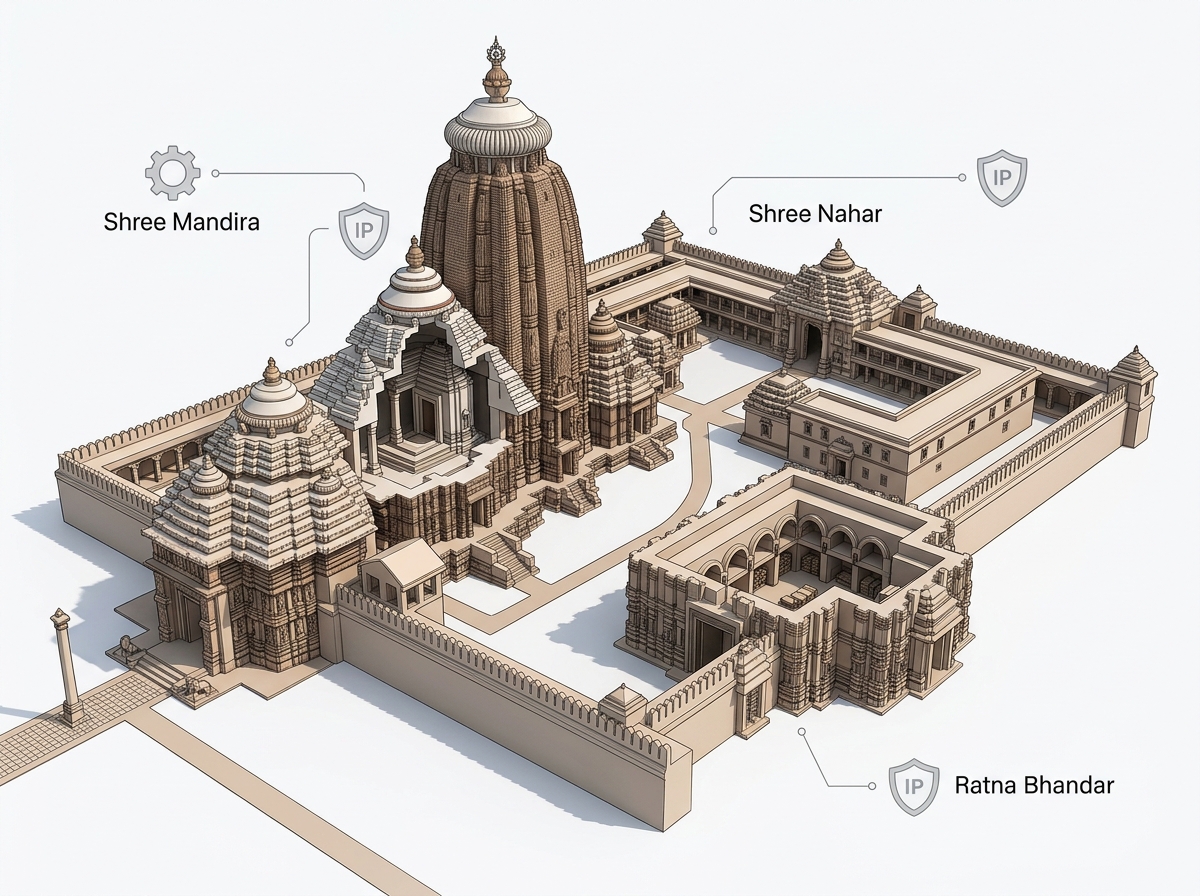
The Shree Jagannath Temple Administration (SJTA) has secured intellectual property protection for three distinctive names associated with the 12th-century Shree Jagannath Temple in Puri—’Shree Mandira’, ‘Shree Nahar’, and ‘Ratna Bhandar’—under the Trademarks Act, 1999. This development underscores the growing intersection of cultural heritage preservation and commercial law, as the temple administration seeks to prevent unauthorised commercial exploitation of sacred names and symbols linked to the temple’s spiritual and institutional identity.
Background
- The Shree Jagannath Temple in Puri, Odisha, is one of India’s most revered Vaishnavite pilgrimage sites, dating back to the 12th century and administered by the Shree Jagannath Temple Administration (SJTA).
- The temple’s management has historically faced challenges related to the unauthorised commercial use of its sacred names, symbols, and rituals, including the sale of merchandise bearing temple-associated names without permission.
- The SJTA had earlier applied for protection of 29 names and items associated with the Jagannath Temple.
- The Trade Marks Registry, under the aegis of the Controller General of Patents, Designs and Trademarks (CGPDTM), operates under the provisions of the Trademarks Act, 1999, and the Trade Marks Rules, 2002, to regulate the registration of trademarks in India.
- The protection of cultural heritage through IPR mechanisms aligns with India’s obligations under international treaties such as the Paris Convention for the Protection of Industrial Property and the Agreement on Trade-Related Aspects of Intellectual Property Rights (TRIPS).
- The SJTA’s efforts reflect a broader trend in India where religious and cultural institutions are leveraging legal frameworks to safeguard their heritage from commercial exploitation and misappropriation.
What is Intellectual Property Protection for Sacred Names and Symbols?
- Intellectual Property Rights (IPR) are legal protections granted to creators or owners of intangible assets, including trademarks, copyrights, patents, and geographical indications, to prevent unauthorised use and ensure economic benefits.
- A trademark is a distinctive sign, symbol, word, or combination thereof that identifies and distinguishes the goods or services of one entity from another, as defined under the Trademarks Act, 1999.
- The Trade Marks Registry, established under the CGPDTM, is the statutory authority responsible for registering trademarks in India and maintaining the Register of Trademarks, as per the provisions of the Trademarks Act, 1999.
- The registration of a trademark confers exclusive rights to the owner to use the mark in connection with the specified goods or services and to take legal action against infringement or unauthorised use, as per Sections 28 and 29 of the Trademarks Act, 1999.
- Cultural heritage IPR protection involves safeguarding intangible cultural assets—such as names, symbols, rituals, and traditions—associated with religious or cultural institutions from commercial exploitation or misappropriation.
- The Trademarks Act, 1999, provides a legal framework for the registration of trademarks, including those related to cultural and religious heritage, provided they meet the criteria of distinctiveness, non-deceptiveness, and non-contrary to public order or morality.
- The protection of sacred names and symbols through trademarks is distinct from copyright or geographical indication (GI) protection, as it focuses on preventing unauthorised commercial use rather than protecting creative works or regional origin.
- The SJTA’s initiative to register trademarks for names like ‘Shree Mandira’, ‘Shree Nahar’, and ‘Ratna Bhandar’ is a proactive measure to preserve the temple’s cultural and spiritual identity while ensuring that commercial entities cannot exploit its sacred associations for profit.
Key Features
| Feature | Significance |
|---|---|
| Shree Mandira | Distinctive name of the Puri Jagannath Temple, now protected under Trademark Classes 19 and 45 to prevent commercial misuse and preserve religious identity. |
| Ratna Bhandar | Sacred repository of temple valuables, registered under Trademark Classes 14 and 45 to safeguard its unique cultural and institutional heritage. |
| Shree Nahar | Term associated with the temple’s traditional water sources, protected under Trademark Class 19 to prevent unauthorised exploitation. |
| Nilachakra Logo | Iconic symbol of the temple, previously approved for trademark protection to curb inappropriate commercial representations. |
| Mahaprasada | Sacred food offering of the temple, registered to protect its cultural and spiritual significance from commercial dilution. |
Why it Matters
Cultural Heritage Protection
- Intellectual Property Rights (IPR) protection for sacred names and symbols ensures the preservation of Odisha’s intangible cultural heritage under Article 29 of the Constitution.
- Prevents unauthorised commercialisation of religious and cultural identities, maintaining the sanctity of temple-associated terms.
- Strengthens institutional ownership of the Shree Jagannath Temple Administration (SJTA) over its heritage assets.
Economic Implications
- Trademark registration enables revenue generation through authorised licensing of temple-associated products and services.
- Protects temple-owned enterprises (e.g., prasadam, handicrafts) from counterfeit competition, enhancing local economic sustainability.
- Potential for brand valuation and monetisation of temple-linked intellectual property in tourism and hospitality sectors.
Legal and Institutional Framework
- Demonstrates the application of the Trade Marks Act, 1999, in safeguarding religious and cultural identities, setting a precedent for similar institutions.
- Highlights the role of the Shree Jagannath Temple Managing Committee (SJTMC) in governance and heritage protection.
- Showcases coordination between temple authorities and the Intellectual Property India (IP India) for IPR enforcement.
Precedent for Other Institutions
- Establishes a model for other religious and cultural institutions (e.g., Tirupati Balaji, Somnath) to secure IPR protection for sacred names and symbols.
- Encourages systematic documentation and registration of intangible heritage assets across India.
- Promotes awareness of IPR among religious institutions to prevent exploitation by third parties.
Challenges
1. Enforcement of Trademark Rights
- Risk of infringement by unauthorised entities despite registration, necessitating vigilant monitoring and legal action.
- Challenges in cross-border enforcement, particularly for digital and global commercial misuse of sacred terms.
- Need for institutional capacity-building in SJTA for effective IPR management and litigation.
UPSC Link: GS-II: Role of institutions in governance
2. Balancing Commercialisation and Sanctity
- Risk of over-commercialisation of temple-associated terms, potentially diluting their spiritual significance.
- Ethical considerations in licensing temple-linked IPR to private entities while maintaining cultural integrity.
- Need for clear guidelines on permissible and prohibited uses of registered trademarks.
UPSC Link: GS-IV: Ethical governance
3. Resource Constraints
- Limited financial and technical resources for SJTA to pursue all 29 trademark applications and subsequent enforcement.
- Dependence on external legal and IPR expertise for registration and litigation processes.
- Potential delays in securing protection for remaining terms due to bureaucratic and procedural hurdles.
UPSC Link: GS-II: Government policies and interventions
4. Public Awareness and Participation
- Low awareness among devotees and local communities about the importance of IPR protection for temple heritage.
- Need for community engagement to report misuse and support enforcement efforts.
- Risk of public backlash against perceived commercialisation of religious symbols.
UPSC Link: GS-II: Citizen-centric governance
5. Inter-Institutional Coordination
- Coordination challenges between SJTA, SJTMC, and IP India for seamless IPR registration and enforcement.
- Potential conflicts between temple authorities, state government, and central agencies over jurisdiction.
- Need for a unified framework to streamline IPR-related governance for religious institutions.
UPSC Link: GS-II: Federalism and inter-state relations
Challenges — UPSC Perspective
| Issue | Concern |
|---|---|
| Infringement Monitoring | Difficulty in tracking unauthorised commercial use of registered trademarks globally. |
| Ethical Licensing | Balancing revenue generation with maintaining the sanctity of sacred terms. |
| Resource Allocation | Limited SJTA capacity to pursue all trademark applications and enforcement. |
| Public Perception | Risk of backlash against perceived commercialisation of religious heritage. |
| Cross-Border Enforcement | Challenges in preventing misuse of trademarks in international markets. |
| Legal Complexity | Need for specialised legal expertise to handle IPR disputes and litigation. |
Way Forward
- Constitute a dedicated IPR cell within SJTA to oversee registration, monitoring, and enforcement of trademarks.
- Develop a public awareness campaign to educate devotees and local stakeholders on the importance of IPR protection.
- Collaborate with state and central agencies (e.g., IP India, National Culture Fund) for technical and financial support.
- Formulate clear guidelines on permissible uses of registered trademarks to prevent over-commercialisation.
- Establish a grievance redressal mechanism for reporting misuse of temple-associated terms and symbols.
- Explore partnerships with academic institutions for research on IPR management in cultural heritage.
- Pursue international trademark registration for key terms to prevent cross-border misuse.
- Conduct periodic audits of licensed uses to ensure compliance with ethical and cultural standards.
UPSC Value Addition
Keywords for Mains Answer-Writing
Intellectual Property Rights · Geographical Indications · Trademark Registration · Cultural Heritage Protection · Traditional Knowledge · Sacred Symbols and Names · Intellectual Property India · Trade Marks Registry · Jagannath Temple Heritage · Preventing Commercial Misuse · Intellectual Property Rights in Temples · Protection of Religious and Cultural Identities
Constitutional & Policy Linkages
- Article 29: Protection of cultural and educational rights of minorities (applicable to religious institutions).
- Article 51A(f): Fundamental duty to value and preserve the rich heritage of composite culture.
Concept Flow
Identification of sacred names and symbols associated with Shree Jagannath Temple. → Assessment of commercial misuse and threats to cultural heritage. → Filing of trademark applications under the Trade Marks Act, 1999, by SJTA. → Examination and approval by the Trade Marks Registry (IP India). → Publication of approved trademarks in the Trademarks Journal for opposition. → Registration and enforcement of trademarks to prevent unauthorised use. → Monitoring and legal action against infringements to protect heritage assets.
Prelims Practice Questions
Q1. Consider the following statements regarding intellectual property rights (IPR) in India:
1. Trademarks are granted under the Trade Marks Act, 1999.
2. The Trade Marks Registry is responsible for the registration of trademarks in India.
3. Geographical Indications (GI) are protected under the Copyright Act, 1957.
4. The Intellectual Property India is the nodal agency for IPR-related matters in India.
How many of the above statements are correct?
- Only one
- Only two
- Only three
- All
Answer: All — Statements 1, 2, and 4 are correct. Statement 3 is incorrect because Geographical Indications are protected under the Geographical Indications of Goods (Registration and Protection) Act, 1999, not the Copyright Act, 1957.
Q2. Assertion (A): The Jagannath Temple Administration (SJTA) has secured trademark protection for names like ‘Shree Mandira’ and ‘Ratna Bhandar’ to prevent commercial misuse.
Reason (R): Trademark registration under the Trade Marks Act, 1999, confers exclusive rights to the owner to use the mark in relation to the goods or services for which it is registered.
Options:
A. Both A and R are true, and R is the correct explanation of A.
B. Both A and R are true, but R is not the correct explanation of A.
C. A is true, but R is false.
D. A is false, but R is true.
Answer: ? — Both A and R are true. The assertion correctly states the SJTA’s objective, and the reason accurately explains the legal consequence of trademark registration under the Trade Marks Act, 1999.
Q3. Match the following terms related to intellectual property rights with their respective legal frameworks:
Column I | Column II
———————————-|———————————-
A. Trademark | 1. Geographical Indications of Goods (Registration and Protection) Act, 1999
B. Geographical Indication | 2. Trade Marks Act, 1999
C. Copyright | 3. Copyright Act, 1957
D. Patent | 4. Patents Act, 1970
Options:
A. A-2, B-1, C-3, D-4
B. A-1, B-2, C-3, D-4
C. A-3, B-1, C-2, D-4
D. A-4, B-2, C-1, D-3
Answer: ? — The correct matching is: A-2 (Trademark under Trade Marks Act, 1999), B-1 (Geographical Indication under GI Act, 1999), C-3 (Copyright under Copyright Act, 1957), D-4 (Patent under Patents Act, 1970).
Mains Practice Question
✍ The protection of sacred names, symbols, and cultural heritage associated with religious institutions through intellectual property rights has gained prominence in contemporary India. Critically examine the legal and policy dimensions of such protection, with specific reference to the recent trademark registrations secured by the Shree Jagannath Temple Administration (SJTA) for terms like ‘Shree Mandira’ and ‘Ratna Bhandar’. Also, discuss the potential challenges in enforcing these rights and their implications for the preservation of cultural heritage. (15 Marks)
Approach: MODEL-ANSWER SKELETON:
1. **Introduction (2 marks)**
– Define Intellectual Property Rights (IPR) and their types (Trademarks, Copyrights, Patents, GI).
– Contextualise the issue: rising commercial misuse of sacred symbols/names (e.g., Jagannath Temple case).
– State the directive: critically examine legal/policy dimensions and challenges in enforcement.
2. **Legal Framework for Trademark Protection (4 marks)**
– **Trade Marks Act, 1999**: Sections 2(1)(m) (definition of trademark), 9 (absolute grounds for refusal), 11 (relative grounds for refusal), and 29 (infringement).
– **Role of Intellectual Property India and Trade Marks Registry**: Process of registration, opposition, and enforcement.
– **Geographical Indications (GI) Act, 1999**: Distinguish GI from trademarks; relevance for cultural heritage (e.g., ‘Darjeeling Tea’).
– **Constitutional Basis**: Article 29 (Protection of interests of minorities) and Article 49 (Protection of monuments and places of national importance) as indirect supports.
3. **Policy and Institutional Dimensions (4 marks)**
– **Objective of SJTA**: Prevent unauthorised commercial use of sacred names/symbols; align with cultural heritage preservation.
– **Institutional Mechanisms**: Role of SJTA, Shree Jagannath Temple Managing Committee (SJTMC), and central agencies (Intellectual Property India).
– **Comparison with Global Practices**: Examples from other countries (e.g., Vatican’s IP protection for ‘Pope Francis’, Japan’s protection of ‘Washoku’).
– **Balancing IPR with Public Interest**: Ensuring IPR does not stifle religious freedom (Article 25) or access to cultural heritage.
4. **Challenges in Enforcement (3 marks)**
– **Jurisdictional Issues**: Overlap between civil courts, IPR tribunals (e.g., Intellectual Property Appellate Board), and administrative bodies.
– **Proving Infringement**: Demonstrating likelihood of confusion (Section 29 of Trade Marks Act) or dilution of distinctiveness.
– **Cross-border Enforcement**: Difficulties in preventing misuse online or in foreign jurisdictions.
– **Resource Constraints**: Limited capacity of temple administrations or government agencies to monitor and litigate.
5. **Implications for Cultural Heritage Preservation (2 marks)**
– **Positive Outcomes**: Deterrence of commercial exploitation, recognition of cultural significance, and economic benefits for communities.
– **Potential Risks**: Over-commercialisation under the guise of IPR, exclusion of local communities from traditional knowledge, or conflicts with religious practices.
– **Sustainable Approach**: Need for multi-stakeholder governance (government, religious institutions, civil society) to balance IPR with heritage conservation.
6. **Conclusion (1 mark)**
– Summarise the legal/policy analysis and reiterate the need for a balanced, inclusive approach to IPR in cultural heritage protection.
Source: orissapost.com
Generated by AanyaAi for educational purpose.
Related guides on our sites
- UPSC EPFO syllabus
- Gs Paper 1 Syllabus
- How to prepare for GS paper 1 for UPSC CSE mains exam
- Best UPSC coaching for IFOS exam

- Gurugram’s groundwater extraction exceeds limit by 212%; HC seeks ban - October 4, 2026
- स्वतंत्रता सेनानी श्यामजी कृष्ण वर्मा की जन्म जयंती पर पीएम का श्रद्धांजलि - October 4, 2026
- KWML’s Feasibility Reports for Water Metro in 18 Cities: UPSC & PCS Insights - October 3, 2026

No Comments