


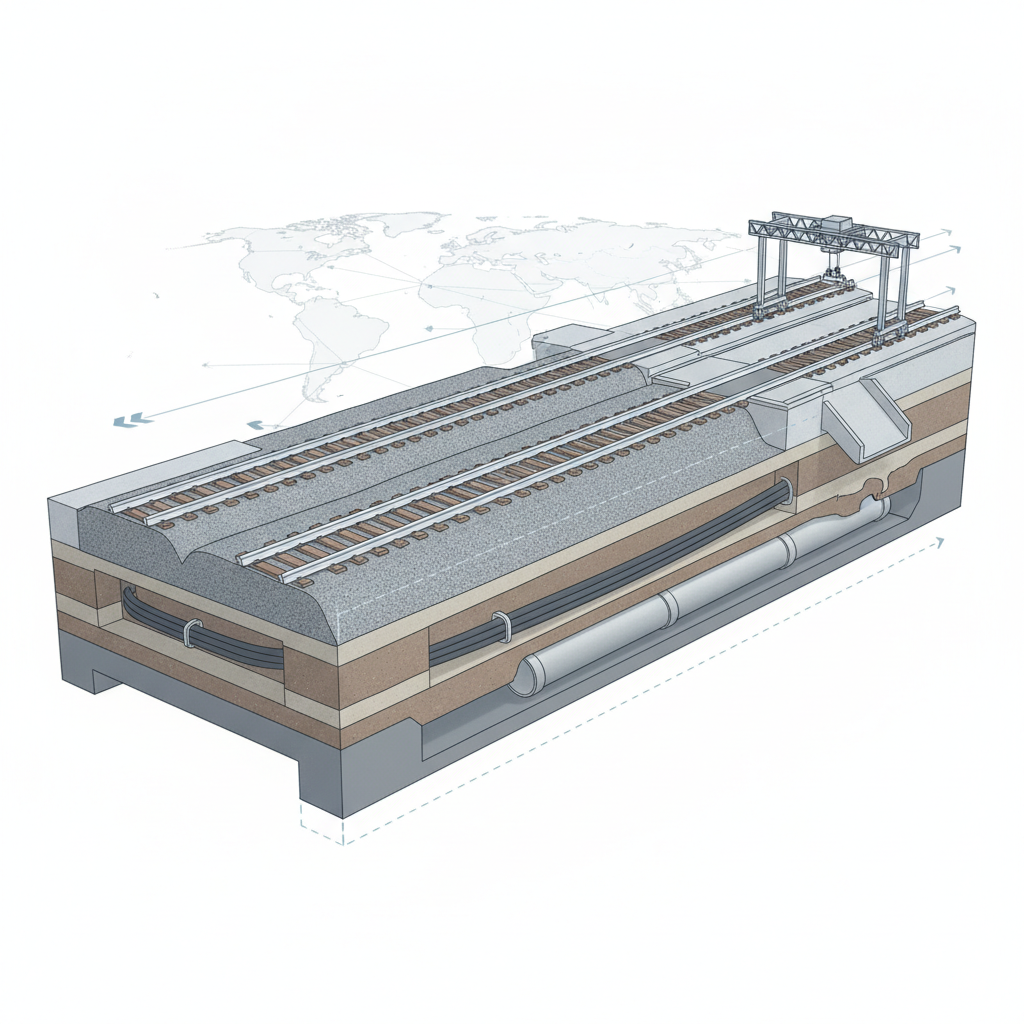
09 Sep Cabinet Approves 540 km Multi-Tracking Rail Projects in 4 Southern States
✎ Multi-tracking projects enhance railway capacity by adding parallel tracks, reducing congestion, and improving logistics efficiency, with an estimated 47 MTPA freight capacity addition and significant environmental benefits.
Subject Relevance — Where This Topic Fits
- GS Paper III — Infrastructure: Energy, Ports, Roads, Airports, Railways
- Prelims: Multi-tracking, Railway infrastructure, PM Gati Shakti Mission, Logistics cost reduction, Carbon footprint mitigation
- Essay: Infrastructure as a catalyst for regional development, Balancing economic growth with environmental sustainability in transport sector
Quick Revision: Multi-tracking projects enhance railway capacity by adding parallel tracks, reducing congestion, and improving logistics efficiency, with an estimated 47 MTPA freight capacity addition and significant environmental benefits.
Why is this in the news?
The Union Cabinet, chaired by the Prime Minister, has approved five multi-tracking railway projects spanning 540 km across 17 districts in Tamil Nadu, Andhra Pradesh, Karnataka, and Telangana. With an estimated cost of ₹10,021 crore and completion target by 2029-30, these projects aim to enhance operational efficiency, reduce congestion, and augment freight capacity by 47 million tonnes per annum (MTPA), aligning with the PM Gati Shakti National Master Plan for integrated multi-modal connectivity.
Background
- Indian Railways operates the world’s fourth-largest rail network, with over 68,000 route km, but faces challenges of congestion, mixed-traffic operations, and suboptimal freight logistics.
- Multi-tracking involves adding additional lines to existing routes, enabling segregation of passenger and freight traffic, thereby improving safety, speed, and throughput.
- The PM Gati Shakti National Master Plan (2021) seeks to achieve integrated planning across ministries, states, and stakeholders to enhance multi-modal connectivity and logistics efficiency.
- Southern India’s rail network is critical for freight movement of coal, cement, iron & steel, and agricultural produce, with high demand for passenger connectivity to pilgrimage and tourism hubs.
- Railways contribute to ~2% of India’s GDP and account for ~27% of freight transport, with a target to increase its share to 45% by 2030 under the National Rail Plan.
- Environmental considerations are increasingly integrated into rail expansion, given railways’ lower carbon intensity (0.6 kg CO₂ per tonne-km) compared to road transport.
What are Multi-Tracking Railway Projects?
- Multi-tracking refers to the construction of additional parallel tracks alongside existing ones to segregate passenger and freight traffic, reducing bottlenecks and improving line capacity.
- These projects enhance operational efficiency by enabling higher train speeds, reduced delays, and improved scheduling, particularly in high-density corridors.
- The approved projects include segments such as Arakkonam–Renigunta (77 km), Whitefield–Bangarapet (47 km), Hosur–Omalur (147 km), Salem–Karur–Dindigul (159 km), and Secunderabad–Kazipet (110 km).
- Capacity augmentation through multi-tracking directly supports India’s logistics cost reduction goals, currently estimated at 13-14% of GDP, compared to global averages of 8-10%.
- The projects are designed to integrate with existing and proposed Dedicated Freight Corridors (DFCs), such as the Eastern and Western DFCs, to create a seamless freight network.
- Environmental benefits include reduced carbon emissions (42 crore kg CO₂ annually) and lower fuel consumption (~8 crore litres of diesel), equivalent to the carbon sequestration capacity of 2 crore trees.
- The projects align with the National Rail Plan (2030) and the Vision 2024 for Indian Railways, which prioritises decongestion, modernization, and freight growth.
Key Features
| Feature | Significance |
|---|---|
| Total Track Addition | Expansion of Indian Railways network by approximately 540 km, enhancing connectivity across 17 districts in Tamil Nadu, Andhra Pradesh, Karnataka, and Telangana. |
| Project Cost | Total estimated expenditure of ₹10,021 crore, demonstrating significant public investment in railway infrastructure modernization. |
| Completion Timeline | Scheduled for completion by 2029-30, aligning with long-term infrastructure development goals. |
| Multi-Tracking Focus | Conversion of single/double tracks to third/fourth lines in key corridors, reducing congestion and improving operational efficiency. |
| Connectivity Enhancement | Improved access to 2,121 villages with a population of ~52 lakh, linking major tourism and industrial hubs. |
Why it Matters
Economic Integration
- Strengthens regional economic corridors by facilitating seamless movement of goods (coal, cement, iron & steel, automobiles, petroleum) and passengers, reducing logistics costs.
- Enhances supply chain resilience for industries in South India, particularly in Tamil Nadu’s automotive and Karnataka’s manufacturing hubs.
Strategic Infrastructure
- Augments railway capacity by ~47 million tonnes per annum (MTPA), reducing dependency on road transport and improving modal shift efficiency.
- Supports multi-modal connectivity under the PM Gati Shakti National Master Plan, integrating rail with other transport networks for holistic logistics planning.
Environmental and Climate Benefits
- Promotes energy-efficient transport, reducing carbon emissions by ~42 crore kg annually, equivalent to carbon sequestration by ~2 crore trees.
- Lowers fuel consumption (~8 crore litres of oil equivalent) by shifting freight from road to rail, contributing to India’s climate commitments.
Tourism and Social Development
- Improves rail access to major pilgrimage sites (Tirupati, Subramanyam Swamy Temple) and tourist destinations (Hogenakkal Falls, Kodaikanal Hills), boosting local economies.
- Enhances intra-state and inter-state mobility for ~52 lakh residents, fostering socio-economic inclusion in rural and peri-urban areas.
Operational Efficiency
- Reduces congestion on existing routes, enabling higher train frequency and punctuality, thereby improving service reliability for passengers.
- Facilitates dedicated freight corridors and passenger express trains, optimizing asset utilization across the Southern Railway network.
Challenges
1. Land Acquisition and R&R
- Complexity in acquiring land for new tracks, particularly in densely populated or ecologically sensitive areas (e.g., Western Ghats, urban peripheries).
- Need for transparent and time-bound rehabilitation and resettlement (R&R) policies to mitigate local opposition and ensure project timelines.
UPSC Link: Land Acquisition Act, 2013
2. Financing and Cost Overruns
- Large capital outlay (₹10,021 crore) requires robust financial planning, including public-private partnerships (PPPs) and multi-lateral funding to avoid delays.
- Risk of cost escalation due to inflation, material shortages, or geopolitical factors impacting steel and fuel prices.
UPSC Link: Public Accounts Committee reports on infrastructure financing
3. Technical and Engineering Constraints
- Geological challenges in hilly terrains (e.g., Salem-Karur-Dindigul route) necessitate advanced tunneling and slope stabilization techniques.
- Integration of new tracks with existing signaling and electrification systems to ensure seamless interoperability.
UPSC Link: National Rail Plan (2030)
4. Environmental Clearances
- Stringent compliance with environmental norms (Forest Rights Act, 2006; Wildlife Protection Act, 1972) for projects traversing eco-sensitive zones.
- Balancing developmental imperatives with biodiversity conservation, particularly in regions like the Western Ghats.
UPSC Link: Environment Impact Assessment (EIA) 2006
5. Stakeholder Coordination
- Coordination among multiple state governments (Tamil Nadu, Andhra Pradesh, Karnataka, Telangana) for unified implementation and resource allocation.
- Alignment with local urban planning and industrial policies to maximize socio-economic returns.
UPSC Link: Inter-State Council provisions
6. Maintenance and Safety
- Post-completion maintenance of new tracks requires sustained investment in railway infrastructure management systems (RIMS).
- Risk of safety incidents during construction (e.g., track laying, electrification) necessitating stringent safety protocols.
UPSC Link: Railway Safety Review Committee (2012)
Challenges — UPSC Perspective
| Issue | Concern |
|---|---|
| Land Acquisition Delays | Potential project slowdowns due to disputes or legal challenges under the Right to Fair Compensation and Transparency in Land Acquisition Act, 2013. |
| Funding Gaps | Dependency on budgetary allocations may lead to underutilization of allocated funds or delays in disbursement. |
| Environmental Compliance | Risk of project halts or modifications due to non-compliance with environmental clearances in ecologically sensitive zones. |
| Technical Integration | Challenges in synchronizing new tracks with existing railway signaling, electrification, and telecommunication systems. |
| Stakeholder Alignment | Need for inter-state coordination to ensure uniform implementation standards and avoid regional disparities. |
| Public Opposition | Local resistance in urban or rural areas due to perceived displacement or environmental degradation. |
Way Forward
- Ensure time-bound land acquisition and R&R under the Land Acquisition Act, 2013, with transparent grievance redressal mechanisms.
- Leverage multi-lateral funding (e.g., World Bank, ADB) and PPP models to supplement budgetary allocations and mitigate financial risks.
- Adopt advanced geotechnical surveys and modular construction techniques to address terrain-specific challenges in hilly regions.
- Strengthen inter-state coordination through the Inter-State Council to align project timelines, resource sharing, and policy frameworks.
- Prioritize environmental clearances by engaging with local communities and environmental agencies early in the project lifecycle.
- Invest in railway safety audits and digital monitoring systems (e.g., real-time track condition tracking) to preempt operational risks.
- Integrate these projects with the PM Gati Shakti National Master Plan to ensure seamless multi-modal connectivity and logistics optimization.
- Establish a dedicated project monitoring cell under the Ministry of Railways to track progress, address bottlenecks, and ensure accountability.
UPSC Value Addition
Keywords for Mains Answer-Writing
Multi-tracking railway projects · Gati Shakti National Master Plan · Railway network expansion · Logistics efficiency · Railway operational capacity · Regional connectivity · Sustainable transport · Carbon emission reduction · Railway freight capacity · Multi-modal connectivity
Constitutional & Policy Linkages
- [‘Article 298: Trade and Commerce (Union and States)’, ‘Empowers the Union to undertake infrastructure projects of national significance.’]
- [‘Seventh Schedule: Union List (Entry 24 – Railways)’, ‘Constitutional basis for railway infrastructure development and regulation.’]
- [‘Article 263: Inter-State Council’, ‘Facilitates coordination among states for unified implementation of multi-state projects.’]
Concept Flow
Expansion of rail network (540 km) → Increased track capacity → Reduced congestion → Higher operational efficiency → Improved passenger and freight services. → Multi-tracking projects → Enhanced connectivity to 2,121 villages (~52 lakh people) → Socio-economic upliftment → Regional development. → PM Gati Shakti National Master Plan → Integrated planning → Multi-modal connectivity → Logistics cost reduction → Competitive advantage. → Railway capacity augmentation (~47 MTPA) → Shift from road to rail → Lower carbon emissions (~42 crore kg CO₂) → Climate action alignment. → Infrastructure investment (₹10,021 crore) → Economic multiplier effect → Job creation → Industrial growth in South India. → Environmental clearances → Sustainable development → Biodiversity conservation → Long-term project viability. → Land acquisition and R&R → Social justice → Inclusive growth → Stakeholder buy-in for project sustainability.
Prelims Practice Questions
Q1. Consider the following statements regarding the Gati Shakti National Master Plan:
1. It aims to enhance multi-modal connectivity and logistics efficiency in India.
2. The plan is implemented under the aegis of the Ministry of Railways exclusively.
3. It seeks to reduce logistics costs and improve supply chain resilience.
How many of the above statements are correct?
- Only one
- Only two
- All
- None
Answer: Only two — Statement 1 and 3 are correct as the Gati Shakti National Master Plan focuses on multi-modal connectivity and logistics efficiency, including cost reduction. Statement 2 is incorrect because the plan is an inter-ministerial initiative, not exclusive to the Ministry of Railways.
Q2. Assertion (A): Multi-tracking railway projects enhance operational efficiency by reducing congestion and increasing line capacity.
Reason (R): The expansion of railway lines allows for segregated passenger and freight traffic, thereby improving punctuality and throughput.
- Both A and R are true, and R is the correct explanation of A
- Both A and R are true, but R is NOT the correct explanation of A
- A is true, but R is false
- A is false, but R is true
Answer: Both A and R are true, and R is the correct explanation of A — Both the assertion and reason are correct. Multi-tracking projects reduce congestion and increase line capacity, and the reason correctly explains the mechanism by which this is achieved through segregated traffic.
Q3. Match the following railway projects with their respective states:
Column I (Project) | Column II (State)
——————-|——————
A. Arrakonam – Renigunta | 1. Karnataka
B. Whitefield – Bangarpet | 2. Andhra Pradesh
C. Salem – Karur – Dindigul | 3. Tamil Nadu
D. Secunderabad – Kazipet | 4. Telangana
- A-3, B-1, C-2, D-4
- A-2, B-1, C-3, D-4
- A-3, B-1, C-4, D-2
- A-2, B-3, C-1, D-4
Answer: A-3, B-1, C-2, D-4 — A. Arrakonam – Renigunta is in Tamil Nadu (3), B. Whitefield – Bangarpet is in Karnataka (1), C. Salem – Karur – Dindigul is in Tamil Nadu (3), and D. Secunderabad – Kazipet is in Telangana (4).
Mains Practice Question
✍ The expansion of the railway network through multi-tracking projects is a critical component of India’s logistics and transport strategy. Critically examine the role of such projects in enhancing multi-modal connectivity, reducing logistics costs, and contributing to sustainable development goals. Also, analyse how these projects align with the Gati Shakti National Master Plan. (15 Marks)
Approach: MODEL-ANSWER SKELETON:
1. **Introduction (2 Marks)**
– Define multi-tracking projects and their objective: increasing line capacity, reducing congestion, and segregating passenger/freight traffic.
– Contextualise within India’s logistics challenges: high logistics costs (~14-16% of GDP vs. global average of ~8%), infrastructure gaps, and the need for sustainable transport.
2. **Enhancing Multi-Modal Connectivity (3 Marks)**
– Explain how multi-tracking projects integrate with other modes (road, waterways, air) under the Gati Shakti National Master Plan.
– Highlight the role of the National Rail Plan (2030) and PM Gati Shakti’s digital platform in synchronising infrastructure development.
– Cite examples: Salem-Karur-Dindigul (Tamil Nadu) connecting industrial hubs; Secunderabad-Kazipet (Telangana) improving freight corridors.
3. **Reducing Logistics Costs and Improving Efficiency (4 Marks)**
– Quantify potential gains: Additional freight capacity (~47 MT/year), reduced dwell time, and improved turnaround ratios.
– Discuss operational benefits: Increased punctuality, reduced delays, and enhanced reliability for industries (e.g., coal, steel, automobiles).
– Link to economic competitiveness: Lower logistics costs (~$160 billion annually) and alignment with the National Logistics Policy (2022).
4. **Contribution to Sustainable Development Goals (SDGs) (3 Marks)**
– Environmental benefits: Reduced carbon emissions (~42 crore kg/year), equivalent to ~2 crore tree plantations; lower oil imports (~8 crore litres/year).
– Social equity: Improved connectivity for ~2,121 villages (~52 lakh population), including rural and tribal areas in Tamil Nadu, Karnataka, and Andhra Pradesh.
– Alignment with SDG 9 (Industry, Innovation, Infrastructure) and SDG 13 (Climate Action).
5. **Challenges and Critical Examination (3 Marks)**
– Implementation bottlenecks: Land acquisition, environmental clearances, and coordination among multiple stakeholders.
– Financial sustainability: High capital expenditure (~₹10,021 crore) and the need for public-private partnerships (PPPs) or viability gap funding.
– Trade-offs: Balancing passenger and freight priorities, regional disparities in connectivity gains, and long-term maintenance costs.
6. **Conclusion (2 Marks)**
– Summarise the transformative potential of multi-tracking projects in India’s transport ecosystem.
– Emphasise the need for integrated planning, technological adoption (e.g., digital twins, AI-driven traffic management), and periodic review to ensure alignment with national goals.
Source: PIB (Press Information Bureau)
Andhra Pradesh PCS (APPSC) — State PCS Practice
Prelims: Which of the following states is NOT included in the five multi-tracking projects recently approved by the Union Cabinet that span across South Indian states?
- Andhra Pradesh
- Telangana
- Kerala
- Karnataka
Answer: Kerala — The five multi-tracking projects approved by the Union Cabinet cover Tamil Nadu, Andhra Pradesh, Karnataka, and Telangana, but not Kerala.
Mains: Discuss the significance of the Union Cabinet’s approval of multi-tracking projects for Andhra Pradesh, highlighting how these projects align with the state’s developmental priorities and address regional connectivity challenges.
Generated by AanyaAi for educational purpose.
Related guides on our sites
- Best PSIR optional coaching for upsc
- Best PSIR optional teacher for upsc
- Best teacher of PSIR optional for upsc
- Best PSIR optional coaching in delhi for UPSC

- Gurugram’s groundwater extraction exceeds limit by 212%; HC seeks ban - October 4, 2026
- स्वतंत्रता सेनानी श्यामजी कृष्ण वर्मा की जन्म जयंती पर पीएम का श्रद्धांजलि - October 4, 2026
- KWML’s Feasibility Reports for Water Metro in 18 Cities: UPSC & PCS Insights - October 3, 2026

No Comments