


09 Sep NHAI tightens tree plantation norms for highway project completion
✎ NHAI’s revised tree plantation norms mandate 80% coverage and 90% survival rate of saplings along national highways before issuance of Provisional Completion Certificate, integrating environmental sustainability into highway…
Subject Relevance — Where This Topic Fits
- GS Paper III — Environment and Biodiversity | GS Paper III — Infrastructure: Roads and Highways | GS Paper III — Government Policies and Interventions for Development in various sectors
- Prelims: National Highways Authority of India (NHAI), Provisional Completion Certificate (PCC), Green Highways Policy 2015, IRC:SP:21-2009, Road Transport and Highways Ministry, Build-Operate-Transfer (BOT), Hybrid Annuity Model (HAM), Right of Way (RoW), Survival rate of plants, Environmental Impact Assessment (EIA)
- Essay: Balancing Infrastructure Development and Environmental Sustainability, The Role of Regulatory Frameworks in Achieving Sustainable Development Goals
Quick Revision: NHAI’s revised tree plantation norms mandate 80% coverage and 90% survival rate of saplings along national highways before issuance of Provisional Completion Certificate, integrating environmental sustainability into highway project compliance frameworks.
Why is this in the news?
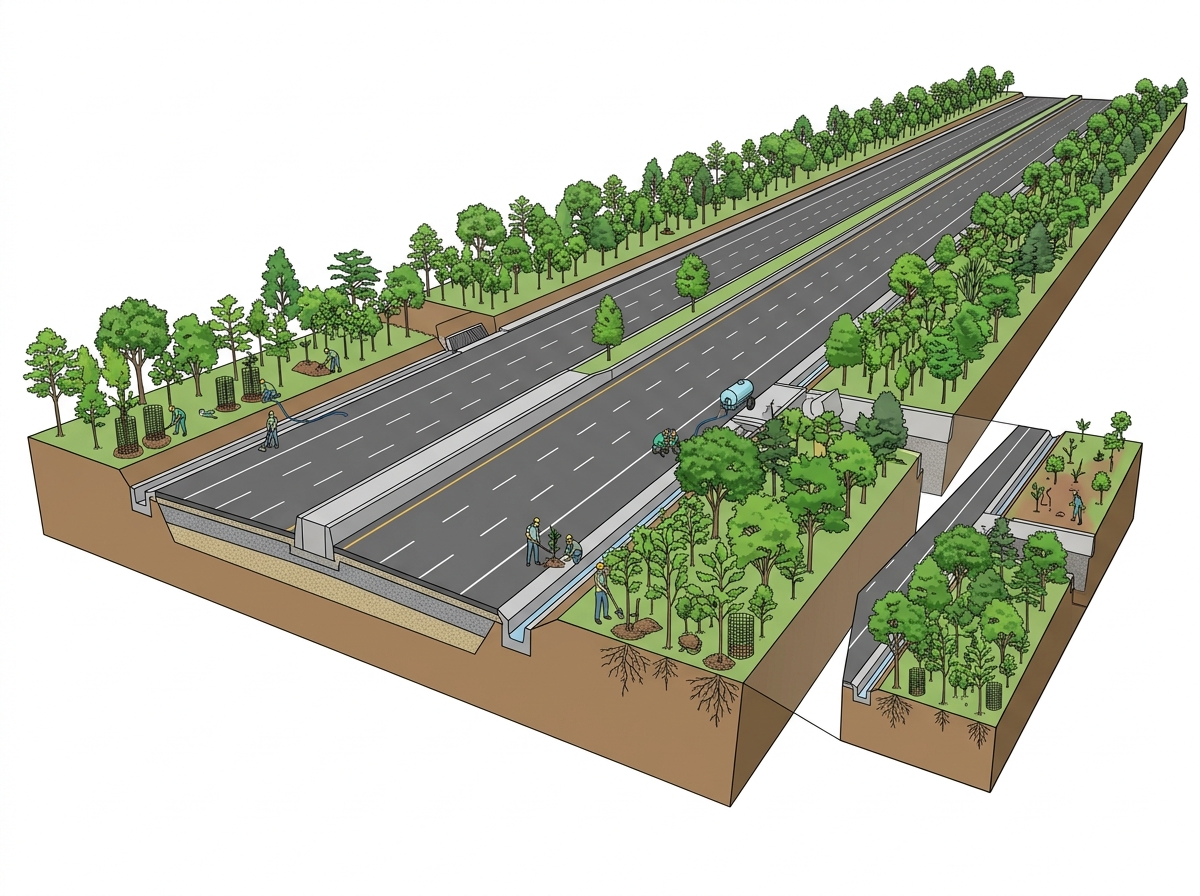
On 9 September 2026, the National Highways Authority of India (NHAI) issued revised guidelines to enforce stricter compliance with tree plantation norms before the issuance of Provisional Completion Certificates (PCC) for national highway projects. These guidelines mandate a minimum of 80% plantation coverage and a 90% survival rate of planted saplings along highway corridors, integrating environmental sustainability into the core operational and maintenance frameworks of highway projects.
Background
- The National Highways Authority of India (NHAI) is the apex body responsible for the development, maintenance, and management of National Highways in India under the Ministry of Road Transport and Highways.
- Tree plantation along national highways has been a contractual obligation under various project agreements, including Build-Operate-Transfer (BOT), Engineering Procurement and Construction (EPC), and Hybrid Annuity Model (HAM) projects.
- The Green Highways Policy, 2015, was introduced to promote greening of highway corridors and to ensure environmental sustainability in highway development.
- The Indian Roads Congress (IRC) standard IRC:SP:21-2009 provides guidelines for roadside plantation and landscaping in highway projects.
- Prior to the revised guidelines, compliance with tree plantation norms was often inadequately enforced, leading to suboptimal environmental outcomes despite contractual obligations.
What are the Revised Tree Plantation Norms for National Highways?
- NHAI has introduced stringent compliance criteria for tree plantation along national highways, applicable to all project modes including EPC, HAM, and BOT.
- A minimum of 80% of the designated Right of Way (RoW) must be covered with plantation, ensuring a continuous green corridor along highways.
- The survival rate of planted saplings must be at least 90% at the time of inspection for the issuance of the Provisional Completion Certificate (PCC) or Provisional Commercial Operation Date (PCOD).
- Non-compliance with the 80% plantation coverage will trigger financial deductions in payments under the contract until full compliance is achieved.
- For projects under the Operations and Maintenance (O&M) phase, a minimum 90% survival rate of planted saplings must be maintained to release O&M or annuity payments.
- The guidelines mandate the replacement of dead or damaged saplings with plants of similar age and growth potential to maintain uniformity and continuity of the green corridor.
- NHAI will engage environmental and plantation experts to verify compliance at the field level before certifying maintenance payments or compliance status.
- The revised norms integrate environmental sustainability into the project lifecycle, from construction to long-term maintenance, ensuring alignment with the Green Highways Policy, 2015, and IRC:SP:21-2009 standards.
Key Features
| Feature | Significance |
|---|---|
| Mandatory 80% plantation coverage on ROW | Ensures uniform green cover along national highways, enhancing ecological balance and aesthetic continuity. |
| 90% plant survival rate threshold | Guarantees sustainability of afforestation efforts, preventing short-term failures in environmental compliance. |
| Financial deductions for non-compliance | Incentivises contractors to adhere to environmental obligations through monetary penalties for incomplete or failed plantations. |
| Integration with PCC/PCOO issuance | Links environmental compliance directly to project completion certification, reinforcing accountability in infrastructure delivery. |
| O&M phase survival rate (90%) | Maintains ecological integrity during the operational phase, ensuring long-term environmental benefits of highway projects. |
| Expert verification for compliance | Utilises technical oversight to validate plantation standards, reducing subjective errors in assessment. |
Why it Matters
Environmental Governance
- Elevates environmental sustainability from a peripheral activity to a core contractual obligation in highway projects.
- Aligns with India’s commitments under international environmental agreements (e.g., Paris Agreement) and national policies like the Green Highways Policy, 2015.
- Promotes biodiversity conservation by mandating structured afforestation along linear infrastructure corridors.
Institutional Accountability
- Strengthens the role of NHAI as a regulator-cum-implementer in environmental governance of infrastructure projects.
- Introduces third-party verification (environmental experts) to ensure objective compliance assessment.
- Establishes a precedent for integrating environmental safeguards into project lifecycle management.
Economic Efficiency
- Reduces long-term costs associated with compensatory afforestation or penalties for non-compliance.
- Enhances asset value by improving the ecological and aesthetic appeal of national highways.
- Optimises resource allocation by linking financial disbursements to measurable environmental outcomes.
Policy Integration
- Bridges gaps between construction-phase obligations and operational-phase maintenance, ensuring continuity in environmental compliance.
- Harmonises with existing guidelines (IRC:SP:21-2009, MoRTH directives) to create a cohesive regulatory framework.
Challenges
1. Contractor Compliance Gaps
- Historical under-prioritisation of afforestation obligations in highway contracts may lead to resistance or delayed adherence.
- Variability in regional climatic conditions could affect plant survival rates, necessitating adaptive strategies.
UPSC Link: GS-III: Infrastructure – Environmental Impact
2. Monitoring and Verification Bottlenecks
- Large-scale highway networks pose logistical challenges in real-time compliance monitoring.
- Dependence on expert verification may introduce delays or subjectivity in assessments.
UPSC Link: GS-III: Infrastructure – Project Management
3. Resource Allocation Constraints
- High initial costs for quality saplings, irrigation, and maintenance may deter contractors from fulfilling obligations.
- Limited availability of indigenous species suited to diverse agro-climatic zones.
UPSC Link: GS-III: Infrastructure – Funding Mechanisms
4. Inter-Agency Coordination
- Coordination between NHAI, state forest departments, and contractors is critical but often fragmented.
- Divergent priorities (e.g., speed of construction vs. environmental compliance) may create conflicts.
UPSC Link: GS-II: Centre-State Relations
Challenges — UPSC Perspective
| Issue | Concern |
|---|---|
| Climatic Variability | Adverse weather conditions (droughts, floods) may reduce plant survival rates despite contractor efforts. |
| Contractor Incentives | Short-term profit motives may discourage investment in long-term environmental compliance. |
| Species Selection | Inappropriate species for local conditions may lead to high mortality rates. |
| Monitoring Infrastructure | Inadequate field-level monitoring tools (e.g., remote sensing, drones) for large-scale verification. |
| Legal Enforcement | Delays in penalising non-compliance due to contractual ambiguities or appeals processes. |
Way Forward
- Conduct regional workshops to sensitise contractors and state agencies on revised afforestation guidelines and survival rate targets.
- Develop a digital dashboard for real-time tracking of plantation coverage and survival rates across NHAI projects.
- Establish a dedicated fund for procurement of high-survival-rate saplings and post-plantation maintenance.
- Collaborate with agricultural universities and forestry institutes to identify region-specific species for optimal survival.
- Introduce performance-based incentives (e.g., bonus payments) for contractors exceeding survival rate thresholds.
- Strengthen inter-agency coordination through joint monitoring committees involving NHAI, MoRTH, and state forest departments.
- Publish quarterly compliance reports to enhance transparency and public accountability in environmental governance.
UPSC Value Addition
Keywords for Mains Answer-Writing
National Highways Authority of India (NHAI) · Green Highways Policy 2015 · Provisional Completion Certificate (PCC) · Environmental Management · Afforestation on National Highways · Contractual Compliance · Sustainable Infrastructure · Roadside Plantation · Survival Rate of Plants · Operational and Maintenance (O&M) Period · Environmental Sustainability in Infrastructure Projects · IRC:SP:21-2009 · Public-Private Partnership (PPP) in Highways · Climate Resilience · Ecosystem Services · Biodiversity Conservation · National Highway Development · Environmental Impact Assessment (EIA) · Roadside Greening · Green Cover Density
Concept Flow
National Highway Projects → Contractual Obligations (Afforestation) → Compliance Monitoring → Financial Disbursements (PCC/PCOO) → Environmental Standards (80% coverage, 90% survival) → Contractor Adherence → Verification (Expert Assessment) → Certification → Operational Phase (O&M) → Survival Rate Maintenance → Financial Payments → Long-Term Ecological Benefits → Policy Framework (Green Highways Policy, 2015) → Institutional Roles (NHAI, MoRTH) → Regulatory Enforcement → Climatic and Regional Challenges → Adaptive Strategies → Resource Allocation → Sustainable Infrastructure Development
Prelims Practice Questions
Q1. Consider the following statements regarding the Green Highways Policy, 2015:
1. It mandates a minimum 80% plantation coverage on the Right of Way (RoW) of national highways.
2. It requires a minimum 90% survival rate of planted saplings during the Operational and Maintenance (O&M) period.
3. The policy is implemented by the Ministry of Environment, Forest and Climate Change.
How many of the above statements are correct?
- Only one
- Only two
- All three
- None
Answer: Only two — Statement 1 is correct as per the NHAI guidelines. Statement 2 is correct as it aligns with the survival rate requirement during O&M. Statement 3 is incorrect as the policy is implemented by the Ministry of Road Transport and Highways (MoRTH), not the Ministry of Environment, Forest and Climate Change.
Q2. Assertion (A): The National Highways Authority of India (NHAI) has revised its guidelines to ensure stricter compliance with afforestation norms before issuing Provisional Completion Certificates (PCC).
Reason (R): The new guidelines aim to integrate environmental sustainability into the operational and maintenance framework of national highway projects.
In the context of the above two statements, which one of the following is correct?
- Both A and R are true, and R is the correct explanation of A
- Both A and R are true, but R is NOT the correct explanation of A
- A is true, but R is false
- A is false, but R is true
Answer: Both A and R are true, but R is NOT the correct explanation of A — Assertion (A) is true as NHAI has indeed revised guidelines for stricter afforestation compliance. Reason (R) is also true and correctly explains the purpose of the revision, which is to integrate environmental sustainability into O&M frameworks.
Q3. Match the following columns related to the National Highways Authority of India (NHAI) and its environmental compliance norms:
Column I (Guidelines/Policies)
A. Green Highways Policy, 2015
B. IRC:SP:21-2009
C. NHAI Guidelines for Afforestation (2026)
D. EIA Notification, 2006
Column II (Key Provisions)
1. Mandates 80% plantation coverage on RoW
2. Provides technical standards for roadside plantation
3. Ensures 90% survival rate during O&M
4. Regulates environmental impact of highway projects
Select the correct match:
- A-1, B-2, C-3, D-4
- A-2, B-1, C-4, D-3
- A-3, B-4, C-1, D-2
- A-4, B-3, C-2, D-1
Answer: A-1, B-2, C-3, D-4 — A-1: Green Highways Policy, 2015 mandates 80% plantation coverage. B-2: IRC:SP:21-2009 provides technical standards for roadside plantation. C-3: NHAI Guidelines for Afforestation (2026) ensure 90% survival rate during O&M. D-4: EIA Notification, 2006 regulates environmental impact of highway projects.
Mains Practice Question
✍ Critically examine the significance of the National Highways Authority of India’s (NHAI) revised afforestation guidelines for national highway projects. How do these guidelines integrate environmental sustainability into the operational and maintenance (O&M) framework? Also, discuss the potential challenges in enforcing these norms in a federal polity like India. (15 Marks)
Approach: MODEL-ANSWER SKELETON:
1. **Introduction (2 Marks)**
– Briefly introduce NHAI’s role in national highway development and the importance of environmental sustainability in infrastructure projects.
– Mention the Green Highways Policy, 2015, and its objectives.
2. **Key Provisions of the Revised Guidelines (4 Marks)**
– **80% Plantation Coverage**: Mandate for plantation on Right of Way (RoW) and its alignment with environmental goals.
– **90% Survival Rate**: Requirement for survival rate during O&M, ensuring long-term ecological benefits.
– **Contractual Compliance**: Financial deductions for non-compliance and time-bound rectification.
– **Technical Standards**: Reference to IRC:SP:21-2009 and other relevant norms.
3. **Integration with O&M Framework (4 Marks)**
– **Operational and Maintenance (O&M) Period**: How survival rate and plantation density are monitored during this phase.
– **Role of Environmental Experts**: NHAI’s engagement of specialists for verification and compliance.
– **Link to PPP Models**: How O&M payments in BOT, HAM, and EPC projects are tied to compliance.
4. **Significance for Environmental Sustainability (3 Marks)**
– **Climate Resilience**: Contribution to carbon sequestration and mitigation of urban heat islands.
– **Biodiversity Conservation**: Enhancement of green corridors and ecosystem services.
– **Public Health**: Reduction in air pollution and noise pollution along highways.
5. **Challenges in Enforcement (2 Marks)**
– **Federalism**: Coordination between central (NHAI/MoRTH) and state governments for land acquisition and compliance.
– **Contractor Accountability**: Ensuring adherence by private contractors in PPP models.
– **Monitoring Mechanisms**: Limitations in real-time monitoring and third-party audits.
– **Climate Variability**: Impact of extreme weather events on survival rates.
6. **Conclusion (2 Marks)**
– Reiterate the importance of these guidelines in balancing infrastructure development with environmental sustainability.
– Suggest measures such as capacity building, technological interventions (e.g., drone monitoring), and stakeholder engagement to address challenges.
Source: PIB (Press Information Bureau)
Generated by AanyaAi for educational purpose.
Related guides on our sites
- Best PSIR optional coaching for upsc
- Best PSIR optional teacher for upsc
- Best teacher of PSIR optional for upsc
- Best PSIR optional coaching in delhi for UPSC

- Gurugram’s groundwater extraction exceeds limit by 212%; HC seeks ban - October 4, 2026
- स्वतंत्रता सेनानी श्यामजी कृष्ण वर्मा की जन्म जयंती पर पीएम का श्रद्धांजलि - October 4, 2026
- KWML’s Feasibility Reports for Water Metro in 18 Cities: UPSC & PCS Insights - October 3, 2026

No Comments