


09 Sep ASI probes Sambhal mosque amid UP mosque scrutiny ahead of polls
✎ Any action against a religious structure must adhere to the principles of natural justice, statutory compliance, and constitutional safeguards, with land revenue records serving as the primary evidence for determining legality.
Subject Relevance — Where This Topic Fits
- GS Paper II — Fundamental Rights and Constitutional Provisions | GS Paper II — Functions and Responsibilities of the Union and the States | GS Paper III — Land Revenue and Land Reforms
- Prelims: Article 25-28 (Freedom of Religion), Archaeological Survey of India (ASI), Unauthorised Construction, Land Revenue Records, Right to Property (Article 300A), Uttar Pradesh Urban Planning and Development Act, 1973
- Essay: Ethical governance and the rule of law in regulating religious and cultural spaces
Quick Revision: Any action against a religious structure must adhere to the principles of natural justice, statutory compliance, and constitutional safeguards, with land revenue records serving as the primary evidence for determining legality.
Why is this in the news?
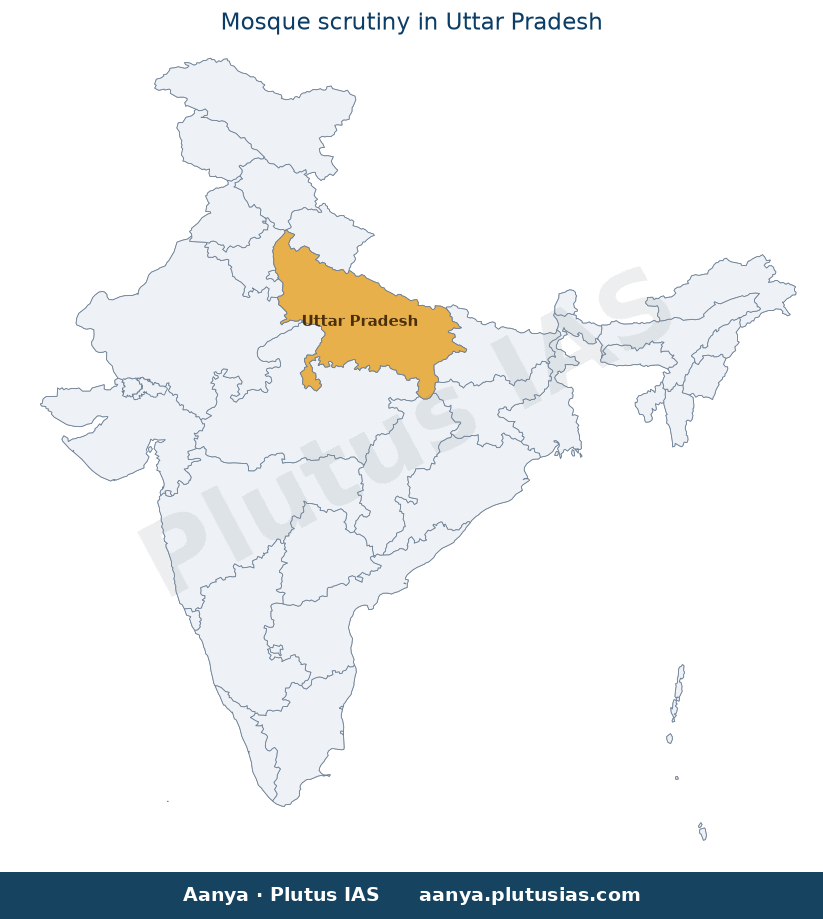
Recent regulatory actions by the Archaeological Survey of India (ASI) and local authorities in Uttar Pradesh against certain mosques, including Baba Bahauddin Shah Masjid in Sambhal and Mustafa Masjid in Moradabad, have brought into focus the legal and procedural mechanisms governing the construction and maintenance of religious structures. These developments follow the demolition of a mosque in Saharanpur, underscoring the need for clarity on the interplay between land records, religious freedoms, and urban planning regulations.
Background
- Article 25 of the Constitution guarantees the right to freedom of conscience and the right to freely profess, practise, and propagate religion, subject to public order, morality, and health.
- Article 26 protects the right of religious denominations to manage their own affairs in matters of religion, including the right to own and acquire property.
- Article 300A of the Constitution states that no person shall be deprived of their property save by authority of law, implying that any action against a religious structure must be backed by valid legal provisions.
- The Archaeological Survey of India (ASI) is statutorily empowered under the Ancient Monuments and Archaeological Sites and Remains Act, 1958, to protect and preserve monuments of national importance.
- Urban planning and development in Uttar Pradesh is governed by the Uttar Pradesh Urban Planning and Development Act, 1973, which mandates approval for construction and ensures compliance with building bye-laws.
- Land revenue records, maintained under state revenue laws, serve as prima facie evidence of ownership and are critical in determining the legality of constructions on disputed or encroached land.
Regulatory and Legal Framework Governing Religious Structures in India
- The construction or alteration of religious structures is subject to compliance with local building bye-laws, town planning schemes, and environmental regulations, as prescribed under state-specific legislation such as the Uttar Pradesh Urban Planning and Development Act, 1973.
- The ASI’s role is limited to the protection and preservation of monuments declared as of national importance under the Ancient Monuments and Archaeological Sites and Remains Act, 1958. It does not regulate the construction of religious structures unless they fall within the ambit of protected monuments.
- Land revenue records, maintained by state revenue departments, are the primary documentary evidence to determine ownership and legality of land use. Any construction on land not recorded in the name of the builder or religious institution may be deemed unauthorised.
- Unauthorised constructions, including religious structures, may be demolished or regularised only after due process of law, including issuance of notices, opportunity for representation, and judicial review where necessary.
- The Supreme Court, in landmark judgments such as *M. Ismail Farooqui v. Union of India* (1994), has reiterated that the state must act within the framework of the Constitution and cannot infringe upon religious freedoms arbitrarily.
- The principle of *audi alteram partem* (right to be heard) is a fundamental tenet of administrative justice, requiring authorities to provide a fair hearing before taking any coercive action against a religious structure.
- Disputes over religious structures often involve complex issues of land ownership, historical usage, and community rights, necessitating a nuanced approach that balances legal compliance with constitutional guarantees.
Key Features
| Feature | Significance |
|---|---|
| ASI Inquiry in Sambhal | Examines alleged illegal construction on land claimed by Jama Masjid; highlights role of ASI in heritage and land-use disputes. |
| Moradabad Development Authority Notice | Seeks construction records of Mustafa Masjid to verify compliance with building regulations and approved plans. |
| Saharanpur Mosque Demolition Context | Provides precedent for legal enforcement against unauthorised religious structures, setting a reference point for ongoing inquiries. |
| Police Deployment during ASI Visit | Ensures law-and-order during site inspections, reflecting sensitivity of religious and community sentiments. |
| Revenue Records Dispute in Sambhal | Reveals conflict between private claims and communal land records, necessitating forensic verification by ASI. |
Why it Matters
Legal and Governance
- Demonstrates the application of land-use and construction laws to religious structures, irrespective of community ownership.
- Highlights the procedural role of the Archaeological Survey of India (ASI) in verifying historical and structural claims.
- Illustrates the interaction between revenue records, judicial orders, and administrative notices in resolving land disputes.
Administrative Process
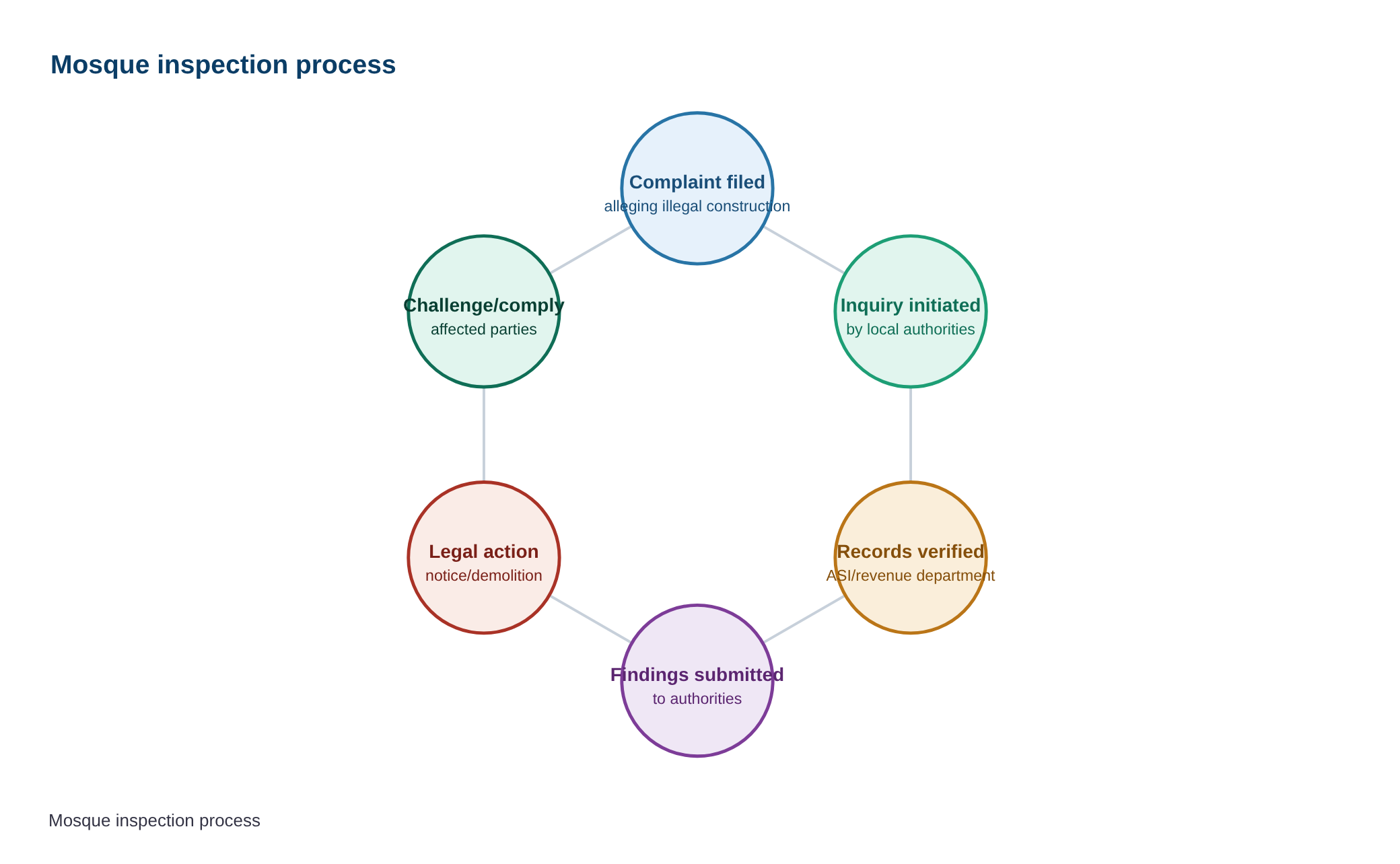
- Showcases the sequence of complaint filing, site inspection, record verification, and potential legal action in land-use enforcement.
- Emphasises the importance of due process in administrative actions to avoid perceptions of arbitrariness.
- Reveals the coordination required between local authorities (SDM, MDA), police, and heritage agencies (ASI).
Social and Communal
- Underscores the sensitivity surrounding religious structures and land disputes, particularly in the context of electoral cycles.
- Demonstrates the potential for disputes to escalate into broader communal or political narratives.
- Highlights the need for transparent and evidence-based enforcement to maintain public trust.
Challenges
1. Legal Ambiguity in Land Records
- Discrepancies between revenue records, community claims, and private ownership create fertile ground for disputes.
- Forensic verification (e.g., by ASI) is often required to resolve conflicting claims, delaying justice.
- Lack of digitised, unified land records exacerbates disputes and complicates enforcement.
UPSC Link: Land Reforms & Record Management
2. Enforcement Without Perception of Bias
- Actions against religious structures risk being perceived as targeting specific communities, necessitating strict adherence to due process.
- Political narratives can distort the factual basis of disputes, complicating administrative responses.
- Balancing law enforcement with community sentiments requires calibrated communication and transparency.
UPSC Link: Administrative Ethics
3. Inter-Agency Coordination Gaps
- Delays in sharing records or site access between revenue departments, local bodies, and heritage agencies hinder timely resolution.
- Ambiguity in roles (e.g., ASI vs. local authorities) can lead to overlapping or conflicting actions.
- Need for a unified protocol for handling land-use disputes involving religious structures.
UPSC Link: Governance & Inter-State Relations
4. Public Trust in Administrative Actions
- Perceived haste or lack of transparency in demolitions or notices can erode faith in institutions.
- Citizens may challenge actions in courts, prolonging disputes and creating legal uncertainty.
- Proactive engagement with affected communities can mitigate backlash and improve compliance.
UPSC Link: Citizen-Centric Governance
Challenges — UPSC Perspective
| Issue | Concern |
|---|---|
| Conflicting Land Records | Disputes arise from discrepancies between revenue records, community claims, and private ownership. |
| Delayed Verification | Forensic or administrative verification (e.g., by ASI) often takes time, delaying resolution. |
| Perception of Targeting | Actions against religious structures may be misconstrued as discriminatory, requiring transparent processes. |
| Political Overtones | Disputes can be amplified during electoral cycles, complicating administrative responses. |
| Inter-Agency Coordination | Gaps between revenue, local bodies, and heritage agencies hinder swift resolution. |
| Legal Challenges | Citizens or communities may challenge actions in courts, prolonging disputes. |
Way Forward
- Constitute a state-level task force comprising revenue, local governance, and heritage agencies to standardise protocols for handling land-use disputes involving religious structures.
- Digitise and integrate land records across departments to reduce discrepancies and expedite verification.
- Mandate pre-emptive public consultations for any action against religious structures to address community concerns transparently.
- Strengthen inter-agency coordination mechanisms to ensure timely sharing of records and site access during inquiries.
- Establish a grievance redressal mechanism for citizens to challenge administrative actions while ensuring adherence to due process.
- Conduct periodic audits of land-use enforcement to identify systemic gaps and areas requiring reform.
- Promote awareness campaigns to educate communities on legal rights and procedural safeguards in land disputes.
UPSC Value Addition
Keywords for Mains Answer-Writing
Archaeological Survey of India (ASI) · Religious structures and land disputes · Constitutional provisions on religious freedom (Articles 25-28) · State action on unauthorised constructions · Land revenue records and religious institutions · Judicial review of executive actions · Public order and religious harmony (Article 25(1)) · Cultural heritage conservation (ASI mandate) · Procedural fairness in administrative actions · Interplay between property rights and religious rights
Constitutional & Policy Linkages
- [‘Article 26 (Freedom to Manage Religious Affairs)’, ‘Guarantees right to manage religious institutions subject to public order and morality.’]
Concept Flow
Complaint filed alleging illegal construction on disputed land → Local authorities (SDM/MDA) initiate inquiry → ASI or revenue department verifies records and site → Findings submitted to administrative/legal authorities → Potential notice, demolition, or legal action based on evidence → Affected parties challenge or comply → Resolution or judicial intervention.
Prelims Practice Questions
Q1. Consider the following statements regarding the Archaeological Survey of India (ASI):
1. The ASI is a statutory body established under the Ancient Monuments and Archaeological Sites and Remains Act, 1958.
2. The ASI has the power to prohibit construction activities within a 100-metre radius of protected monuments.
3. The ASI can only conduct inquiries into religious structures if a complaint is filed by a state government.
How many of the above statements are correct?
- Only one
- Only two
- All
- None
Answer: Only two — Statement 1 is correct (ASI is governed by the Ancient Monuments and Archaeological Sites and Remains Act, 1958). Statement 2 is correct (the Act prohibits construction within 100 metres of protected monuments). Statement 3 is incorrect (ASI can act on complaints from any source, including individuals).
Q2. Assertion (A): The demolition of unauthorised religious structures does not violate the fundamental right to freedom of religion under Article 25 of the Constitution.
Reason (R): The State is empowered to regulate secular activities associated with religious practices under Article 25(2).
Options:
A. Both A and R are true, and R is the correct explanation of A.
B. Both A and R are true, but R is not the correct explanation of A.
C. A is true, but R is false.
D. A is false, but R is true.
Answer: ? — A is true: unauthorised structures can be demolished as they fall under secular regulation. R is true and correctly explains A: Article 25(2) allows the State to regulate secular activities linked to religion.
Q3. Match the following constitutional provisions with their correct descriptions:
Column I (Provision)
A. Article 25
B. Article 26
C. Article 29
D. Article 30
Column II (Description)
1. Right of minorities to establish and administer educational institutions
2. Freedom of conscience and free profession, practice, and propagation of religion
3. Protection of interests of minorities
4. Freedom to manage religious affairs
- A-2, B-4, C-3, D-1
- A-1, B-3, C-2, D-4
- A-3, B-2, C-4, D-1
- A-4, B-1, C-2, D-3
Answer: A-2, B-4, C-3, D-1 — Correct matches: A (Article 25) → 2 (Freedom of religion), B (Article 26) → 4 (Freedom to manage religious affairs), C (Article 29) → 3 (Protection of minority interests), D (Article 30) → 1 (Right to establish educational institutions).
Mains Practice Question
✍ The regulation of religious structures by the State, including through inquiries and demolitions, raises complex questions about the balance between public order, property rights, and religious freedom. Critically examine the constitutional and legal framework governing such actions, with particular reference to the role of the Archaeological Survey of India (ASI) and judicial review. (15 Marks)
Approach: MODEL-ANSWER SKELETON:
1. **Constitutional Framework (4 marks)**
– Articles 25-28: Freedom of religion, public order, morality, and health as limits.
– Article 25(1): Guarantees freedom of conscience and religion but subject to public order, morality, and health.
– Article 26: Freedom to manage religious affairs (subject to public order).
– Article 29-30: Minority rights and cultural autonomy.
– Land Revenue Records and Property Rights: State’s power to regulate unauthorised constructions under land laws (e.g., UP Urban Planning and Development Act, 1973).
2. **ASI’s Mandate and Powers (3 marks)**
– ASI’s role under the Ancient Monuments and Archaeological Sites and Remains Act, 1958: Protection of monuments and regulation of activities within 100m radius.
– Power to conduct inquiries (Section 16) and prohibit constructions that threaten heritage.
– Distinction between religious structures and protected monuments: ASI’s jurisdiction is limited to protected sites unless land disputes arise.
3. **Procedural Safeguards and Judicial Review (4 marks)**
– Doctrine of fairness and natural justice: State action must be procedurally fair (Maneka Gandhi v. Union of India, 1978).
– Judicial review of executive actions: Courts examine legality, proportionality, and adherence to procedure (e.g., demolition orders must follow due process).
– Recent judicial trends: Courts have stayed demolitions pending inquiries (e.g., in cases of disputed land records).
4. **Contemporary Challenges and Balancing Tests (3 marks)**
– Tension between religious rights and secular regulation: State must avoid arbitrary actions that disproportionately target religious structures.
– Role of land revenue records: Disputes over ownership (e.g., Jama Masjid vs. private land) require thorough inquiry before action.
– Need for transparent processes: Complaints must be examined objectively, and demolitions should be a last resort.
5. **Conclusion (1 mark)**
– Emphasise the need for a balanced approach: State must act within constitutional limits, ensuring that actions are proportionate, procedurally fair, and non-discriminatory.
Source: The Indian Express
Generated by AanyaAi for educational purpose.
Related guides on our sites
- Sociology vs History
- Best history optional coaching in delhi
- UPSC History optional
- Is history a good optional for upsc exam

- Gurugram’s groundwater extraction exceeds limit by 212%; HC seeks ban - October 4, 2026
- स्वतंत्रता सेनानी श्यामजी कृष्ण वर्मा की जन्म जयंती पर पीएम का श्रद्धांजलि - October 4, 2026
- KWML’s Feasibility Reports for Water Metro in 18 Cities: UPSC & PCS Insights - October 3, 2026

No Comments