


09 Sep Karnataka HC Challenges 2% Welfare Cess on Movie Tickets: UPSC Polity Analysis
✎ The constitutional validity of state levies like the 2% welfare cess hinges on legislative competence, procedural compliance, and the absence of conflict with central legislation such as the Code on Social Security, 2020.
Subject Relevance — Where This Topic Fits
- GS Paper II — Functions and Responsibilities of the Union and the States, Issues and Challenges Pertaining to the Federal Structure | GS Paper III — Issues Relating to Taxation, Government Budgeting
- Prelims: Cess, Concurrent List, Doctrine of Pith and Substance, Legislative Competence, Article 246, Article 254, Social Security Code 2020, GST Council, Fiscal Federalism
- Essay: Federalism and Fiscal Autonomy: Balancing State and Central Powers in Taxation, Judicial Review and Legislative Overreach: Safeguarding Constitutional Boundaries
Quick Revision: The constitutional validity of state levies like the 2% welfare cess hinges on legislative competence, procedural compliance, and the absence of conflict with central legislation such as the Code on Social Security, 2020.
Why is this in the news?
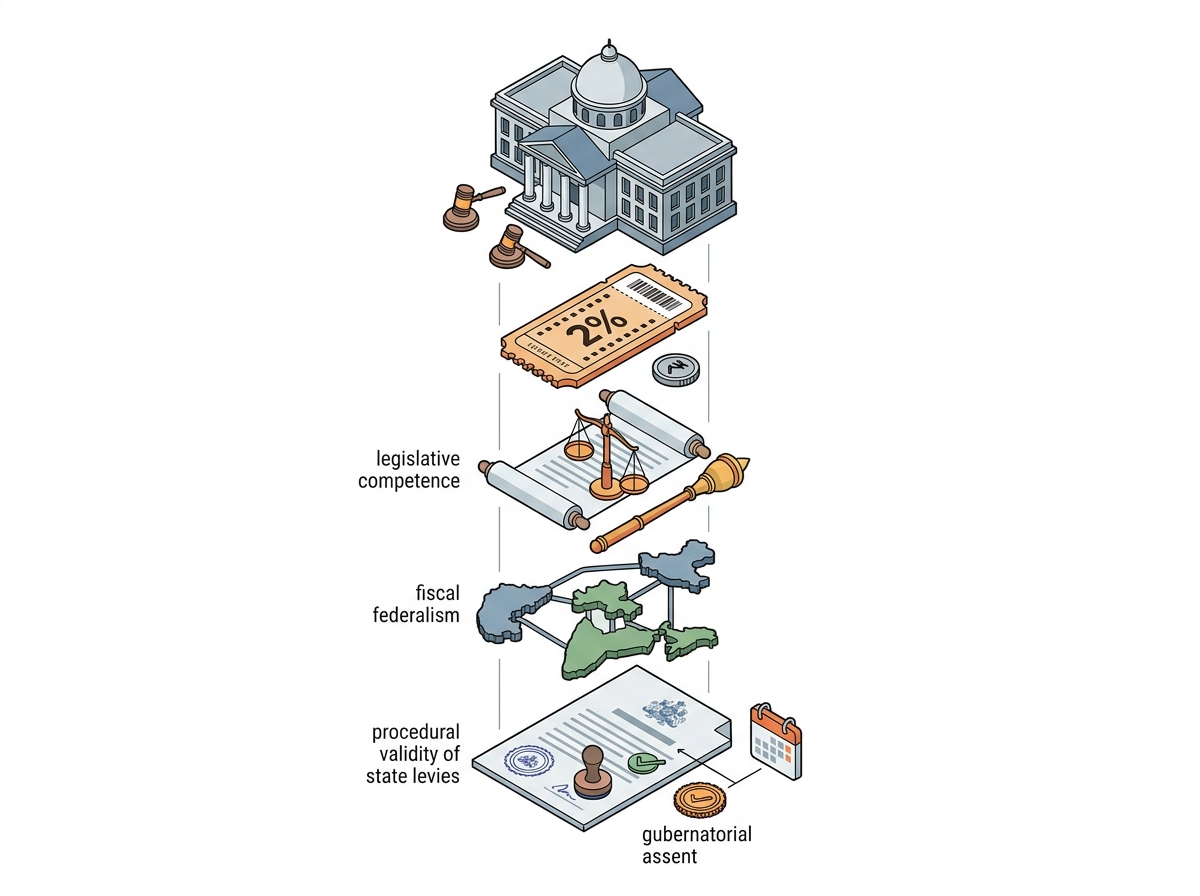
The Karnataka High Court has sought the State government’s response on a petition challenging the legality of a 2% welfare cess imposed on cinema ticket revenues under the Karnataka Cine and Cultural Activists (Welfare) Act, 2024. The petitioners, including the Multiplex Association of India and PVR INOX Ltd., argue that the cess is constitutionally invalid as it lacks legislative competence, violates fiscal federalism, and is not notified for enforcement despite receiving gubernatorial assent. The case raises critical questions about the scope of state taxation powers, the overlap with central legislation, and the procedural validity of state levies.
Background
- The Karnataka Cine and Cultural Activists (Welfare) Act, 2024, received the Governor’s assent on 23 September 2024 and was published in the gazette, but its enforcement date has not been notified, rendering it inoperative as per Section 1(2) of the Act.
- The Act introduces a 2% welfare cess on cinema ticket revenues to fund welfare schemes for cine and cultural workers, including artistes, technicians, and support staff.
- The petitioners contend that the cess is in substance a tax, which the state legislature lacks competence to impose, as Parliament has enacted the Code on Social Security, 2020, which occupies the field relating to social security of workers, including cine workers.
- The petitioners also argue that the cess is unreasonable, as multiplexes have no direct relationship with the intended beneficiaries, and that the state has issued notices for collection without a gazette notification bringing the Act into force.
- The case highlights the tension between state fiscal autonomy and the principle of legislative competence, particularly in areas where central legislation may have pre-emptive effect.
- The Karnataka High Court’s intervention underscores the judiciary’s role in adjudicating disputes between state and central legislative powers, ensuring compliance with constitutional provisions.
What is the Karnataka Cine and Cultural Activists (Welfare) Act, 2024, and the 2% Welfare Cess?
- The Karnataka Cine and Cultural Activists (Welfare) Act, 2024, is state legislation enacted to provide welfare measures for cine and cultural workers, including artistes, technicians, and support staff, through a dedicated fund.
- The Act mandates a 2% cess on the revenue generated from cinema ticket sales, which is to be deposited into the Cine and Cultural Activists Welfare Fund, to finance welfare schemes such as health insurance, housing, education, and skill development for eligible workers.
- The cess is levied on the sale of cinema tickets, with multiplexes and cinema operators designated as collection agents responsible for deducting and remitting the cess to the state government.
- The Act received the Governor’s assent on 23 September 2024 and was published in the gazette, but its enforcement is contingent upon a separate gazette notification specifying the date of commencement, as per Section 1(2) of the Act.
- The petitioners argue that the cess is constitutionally invalid on multiple grounds: (a) lack of legislative competence, (b) violation of fiscal federalism, (c) procedural non-compliance, and (d) substantive nature as a tax without constitutional backing.
- The Code on Social Security, 2020, enacted by Parliament, provides a comprehensive framework for social security schemes for unorganised workers, including cine workers, which may pre-empt state legislation in this domain.
- The doctrine of pith and substance may be invoked to determine whether the state legislation encroaches upon a field occupied by central legislation, particularly in matters of social security and taxation.
- The case also raises questions about the reasonableness of the cess, as multiplexes are not directly connected to the welfare of cine workers, challenging the nexus between the levy and its intended purpose.
Key Features
| Feature | Significance |
|---|---|
| Karnataka Cine and Cultural Activists (Welfare) Act, 2024 | Establishes a statutory framework for welfare measures for cine and cultural workers in Karnataka, including provisions for a cess on revenue sources. |
| 2% Welfare Cess on Movie Tickets | Intended to fund welfare schemes for cine and cultural workers, but contested as a tax by the petitioners. |
| Section 1(2) of the Act | Specifies that the Act comes into force only upon a gazette notification by the State government, which has not been issued. |
| Code on Social Security, 2020 | Central legislation governing social security for workers, including cine workers, raising questions of legislative competence. |
| Gazette Notification Requirement | Constitutional mandate for laws to specify commencement dates via official gazette notifications to ensure transparency and legal certainty. |
Why it Matters
Economic
- The levy of a 2% cess on cinema ticket revenues represents a direct fiscal burden on the entertainment industry, potentially affecting revenue streams and pricing structures.
- The outcome of this legal challenge may set a precedent for the imposition of similar cess-based welfare levies in other states, influencing inter-state fiscal policies.
- If upheld, the cess could generate significant revenue for welfare schemes, but its economic impact on multiplex operators and consumers remains a concern.
Legal and Constitutional
- The petition raises critical questions about the legislative competence of the State legislature to impose a cess when Parliament has enacted a comprehensive social security code.
- The requirement of a gazette notification for the Act’s enforcement underscores the importance of procedural compliance in the implementation of laws.
- The classification of the cess as a ‘tax’ challenges the State’s power to impose levies under the guise of welfare measures, testing the boundaries of fiscal federalism.
Administrative
- The State government’s issuance of notices and circulars without a commencement notification demonstrates administrative lapses in the enforcement of newly enacted legislation.
- The legal challenge highlights the need for clarity in the drafting and notification processes of welfare schemes to avoid procedural ambiguities.
Industry Impact
- The entertainment industry, particularly multiplex operators, faces uncertainty due to the contested levy, which may deter investment and expansion.
- The challenge reflects broader industry concerns about the proliferation of state-specific levies that could complicate compliance and operational costs.
Challenges
1. Legislative Competence
- The petition argues that the State legislature lacks the power to impose a cess on cinema tickets, as Parliament has enacted the Code on Social Security, 2020, which occupies the field.
- This raises questions about the division of legislative powers between the Union and State governments under the Constitution.
UPSC Link: 7th Schedule, Union List vs State List
2. Constitutional Validity of the Cess
- The petitioners contend that the 2% levy is a ‘tax’ in substance, which must comply with constitutional requirements such as Article 265 (no tax shall be levied except by authority of law).
- The classification of the cess as a tax challenges its legal basis under the guise of a welfare measure.
UPSC Link: Article 265
3. Procedural Compliance
- The Act of 2024 specifies that it comes into force only upon a gazette notification, which has not been issued, rendering the levy legally unsound.
- The State government’s issuance of notices without a commencement notification demonstrates administrative negligence.
UPSC Link: Article 297
4. Industry Burden and Reasonableness
- The petitioners argue that multiplexes, which have no direct relationship with cine workers, should not bear the financial burden of the cess.
- This raises questions about the proportionality and reasonableness of the levy under constitutional principles.
UPSC Link: Article 14
5. Fiscal Federalism
- The dispute highlights tensions between State and Central legislative powers, particularly in the realm of social security and revenue generation.
- The outcome could influence the balance of fiscal federalism in India.
UPSC Link: 7th Schedule, Concurrent List
Challenges — UPSC Perspective
| Issue | Concern |
|---|---|
| Legislative Competence | Whether the State legislature has the power to impose a cess on cinema tickets when Parliament has enacted a central social security code. |
| Constitutional Validity | Whether the 2% cess is a tax in substance and complies with constitutional requirements such as Article 265. |
| Procedural Compliance | Failure to issue a gazette notification for the commencement of the Act, rendering the levy legally unsound. |
| Industry Burden | Whether the levy is reasonable and proportionate, given the lack of direct relationship between multiplexes and cine workers. |
| Fiscal Federalism | Potential conflicts between State and Central legislative powers in the imposition of welfare levies. |
Way Forward
- The Karnataka High Court must examine the legislative competence of the State legislature to impose the cess, considering the Code on Social Security, 2020.
- A clear gazette notification must be issued by the State government to specify the commencement date of the Act, ensuring procedural compliance.
- The State government should review the reasonableness of the levy, particularly its impact on the entertainment industry and its alignment with constitutional principles.
- Parliament and State legislatures should clarify the division of powers in the imposition of welfare levies to avoid future disputes.
- The entertainment industry should engage in dialogue with the State government to explore alternative funding mechanisms for cine worker welfare.
- Legal precedents on the classification of cess as a tax should be examined to strengthen the petitioners’ arguments.
- The outcome of this case may necessitate legislative amendments to ensure clarity in the imposition and enforcement of welfare levies.
UPSC Value Addition
Keywords for Mains Answer-Writing
Karnataka Cine and Cultural Activists (Welfare) Act, 2024 · welfare cess · cinema ticket revenues · constitutional validity of cess · legislative competence · Code on Social Security, 2020 · tax vs cess distinction · Karnataka High Court · gazette notification · doctrine of pith and substance · State List vs Concurrent List · welfare of cine workers · judicial review of fiscal legislation · commencement of statute · Parliamentary sovereignty in fiscal matters
Constitutional & Policy Linkages
- [‘Article 265’, ‘No tax shall be levied except by authority of law.’]
- [‘Article 14’, ‘Equality before law and equal protection of laws.’]
- [‘7th Schedule’, ‘Division of legislative powers between Union and States.’]
Concept Flow
Enactment of Karnataka Cine and Cultural Activists (Welfare) Act, 2024 by State legislature → Inclusion of provision for 2% welfare cess on cinema ticket revenues → Governor’s assent and publication in gazette, but no commencement notification issued → State government issues notices and circulars to collect cess from September 1, 2026 → Multiplex Association of India and PVR INOX Ltd. challenge the levy in Karnataka High Court → Petitioners argue lack of gazette notification, legislative competence, and classification of cess as a tax → High Court seeks State government’s response, adjourning hearing to September 10, 2026
Prelims Practice Questions
Q1. Consider the following statements regarding the Karnataka Cine and Cultural Activists (Welfare) Act, 2024:
1. The Act received the Governor’s assent on September 23, 2024.
2. The Act provides for a 2% welfare cess on cinema ticket revenues.
3. The Act came into force immediately upon receiving the Governor’s assent.
4. The Act empowers the State government to appoint a date for its commencement through a gazette notification.
How many of the above statements are correct?
- Only one
- Only two
- Only three
- All four
Answer: Only three — Statements 1, 2, and 4 are correct. Statement 3 is incorrect because Section 1(2) of the Act specifies that it comes into force only on a date notified by the State government, which has not yet been done.
Q2. Assertion (A): The Parliament’s Code on Social Security, 2020 occupies the field relating to social security of workers, including cine workers, thereby limiting the State legislature’s competence to impose a welfare cess.
Reason (R): The Constitution of India empowers Parliament to legislate on matters in the Concurrent List, including social security, which prevails over State laws under Article 254(1).
- Both A and R are true, and R is the correct explanation of A
- Both A and R are true, but R is not the correct explanation of A
- A is true but R is false
- A is false but R is true
Answer: Both A and R are true, and R is the correct explanation of A — Both A and R are true. The Code on Social Security, 2020, being a Parliamentary enactment on a Concurrent List subject, prevails over State laws under Article 254(1) of the Constitution, which could limit the State’s competence to impose additional fiscal levies.
Q3. Match the following provisions of the Constitution of India with their respective entries in the legislative lists:
Column I (Provision)
A. Social security including employment insurance and provident funds
B. Taxes on entertainment and amusements
C. Welfare of labour including conditions of work
D. Regulation of cinematograph films
Column II (Legislative List)
1. Union List
2. State List
3. Concurrent List
Select the correct match:
Answer: ? —
Mains Practice Question
✍ The imposition of a 2% welfare cess on cinema ticket revenues under the Karnataka Cine and Cultural Activists (Welfare) Act, 2024 has been challenged in the Karnataka High Court on grounds of constitutional validity. Critically examine the legal and constitutional issues involved, with reference to the doctrine of legislative competence, the distinction between tax and cess, and the procedural requirements for the commencement of statutes. (15 Marks)
Approach: MODEL-ANSWER SKELETON:
1. **Legislative Competence**:
– Examine the distribution of powers under the Seventh Schedule (State List vs Concurrent List).
– Discuss the Parliament’s Code on Social Security, 2020, and its potential pre-emptive effect under Article 254(1).
– Reference: Doctrine of pith and substance and the principle of federal supremacy in fiscal matters.
2. **Tax vs Cess Distinction**:
– Define ‘cess’ and ‘tax’ under constitutional jurisprudence (e.g., Supreme Court judgments in *K.S. Easwaran v. State of Kerala*).
– Analyse whether the 2% levy meets the criteria of a ‘cess’ (specific purpose, non-recurring) or is a ‘tax’ (general revenue).
3. **Procedural Requirements**:
– Examine Section 1(2) of the Karnataka Act and the necessity of a gazette notification for commencement.
– Discuss the significance of procedural compliance in the enforcement of statutes (e.g., *State of Punjab v. Amar Nath Goyal*).
4. **Judicial Review and Balance of Powers**:
– Outline the role of the judiciary in reviewing fiscal legislation (e.g., *IRC v. McFadyean*).
– Weigh the State’s welfare objectives against constitutional constraints.
5. **Conclusion**:
– Summarise the legal and procedural gaps highlighted by the petitioners.
– Offer a balanced view on the likely judicial outcome, citing relevant precedents.
Source: The Hindu
Karnataka PCS (KPSC) — State PCS Practice
Prelims: The Multiplex Association of India has recently moved the Karnataka High Court against which of the following state government policies related to the entertainment sector?
- 1% entertainment tax on movie tickets
- 2% welfare cess on movie tickets
- 5% GST on multiplex services
- 10% luxury tax on premium movie tickets
Answer: 2% welfare cess on movie tickets — The Multiplex Association of India challenged the Karnataka government’s imposition of a 2% welfare cess on movie tickets in the Karnataka High Court.
Mains: Critically analyze the legal and economic implications of the Karnataka government’s decision to impose a 2% welfare cess on movie tickets, with specific reference to its impact on the entertainment industry and revenue generation in the state.
Generated by AanyaAi for educational purpose.
Related guides on our sites
- Current affairs for upsc 2026
- Best PSIR optional coaching for upsc
- Best PSIR optional teacher for upsc
- Best teacher of PSIR optional for upsc

- Gurugram’s groundwater extraction exceeds limit by 212%; HC seeks ban - October 4, 2026
- स्वतंत्रता सेनानी श्यामजी कृष्ण वर्मा की जन्म जयंती पर पीएम का श्रद्धांजलि - October 4, 2026
- KWML’s Feasibility Reports for Water Metro in 18 Cities: UPSC & PCS Insights - October 3, 2026

No Comments