


09 Sep Himachal PSC Declares Political Science Teacher Recruitment Result 2026: Key Details
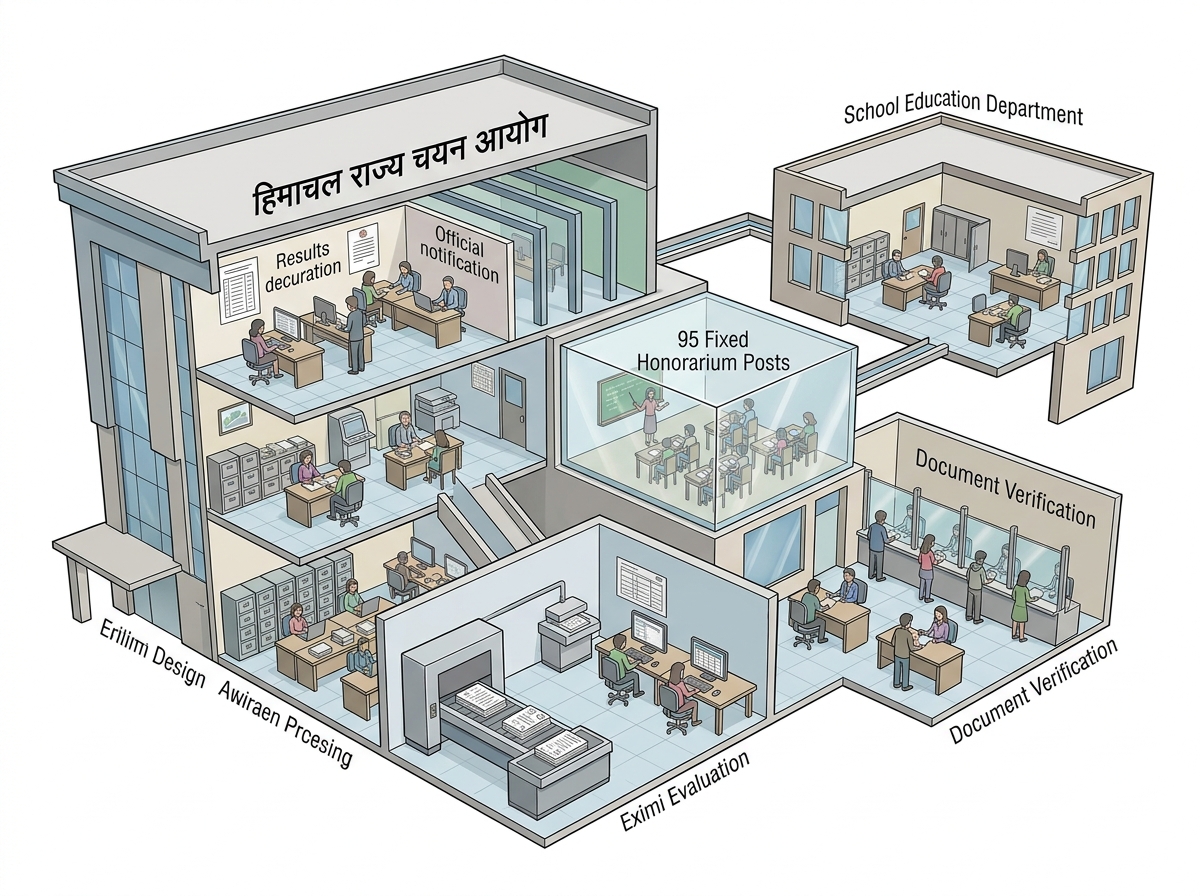
✎ This recruitment, conducted for 95 fixed honorarium posts in the School Education Department, highlights the procedural aspects of teacher appointments, including examination evaluation, result declaration, and the critical stage…
Subject Relevance — Where This Topic Fits
- GS Paper II — Governance, Constitution, and Polity | GS Paper III — Issues related to Human Resource Development
- Prelims: Himachal Pradesh State Selection Commission (HPSCS), Computer-Based Screening Test (CBT), Document Verification, Fixed Honorarium Posts, School Education Department
- Essay: Role of Public Institutions in Educational Recruitment, Challenges in Teacher Recruitment and Governance
Why is this in the news?
This recruitment, conducted for 95 fixed honorarium posts in the School Education Department, highlights the procedural aspects of teacher appointments, including examination evaluation, result declaration, and the critical stage of document verification. The development underscores the importance of transparent and efficient recruitment mechanisms in the public education system.
Background
- Fixed honorarium posts are temporary positions created to address immediate staffing needs, often filled through contractual or ad-hoc arrangements.
- The School Education Department in Himachal Pradesh is tasked with ensuring quality education, including the recruitment of subject-matter experts like Political Science teachers.
- The recruitment process for teachers in government schools is governed by state-specific rules and regulations, ensuring fairness and meritocracy.
- Document verification is a critical step in recruitment to confirm the eligibility and authenticity of candidates’ claims regarding qualifications, experience, and identity.
- The use of Computer-Based Screening Tests (CBT) has become a standard practice in public sector recruitment to streamline the selection process and reduce biases.
What is the Himachal Pradesh State Selection Commission (HPSCS) and its role in teacher recruitment?
- The examination process typically includes a written test (CBT), followed by document verification and, in some cases, an interview or practical assessment.
- Fixed honorarium posts are often created to address temporary staffing shortages, particularly in subjects where regular recruitment may be delayed due to administrative or budgetary constraints.
- The document verification stage ensures that candidates meet the eligibility criteria, including educational qualifications, age limits, and other statutory requirements.
Key Features
| Feature | Significance |
|---|---|
| Computer-Based Screening Test (CBT) | Ensures standardized, transparent, and efficient initial screening of candidates for teaching positions in Political Science. |
| Fixed Honorarium Basis | Temporary contractual appointments for 95 posts, highlighting the state’s approach to addressing immediate staffing needs in education. |
| Document Verification Process | Mandatory step to validate eligibility, qualifications, and authenticity of candidates before final selection. |
| E-mail Notification for Candidates | Digitally streamlined communication reduces administrative delays and ensures timely dissemination of information. |
| Strict Adherence to Schedule | Absence during document verification results in forfeiture of candidature, emphasizing procedural discipline in recruitment. |
Why it Matters
Governance and Public Administration
- Demonstrates the operationalization of state-level recruitment mechanisms for educational institutions under the School Education Department.
- Highlights the role of the Himachal Pradesh State Selection Commission (HPSSC) in conducting transparent and merit-based selection processes.
- Reflects the state’s commitment to filling critical teaching vacancies through structured and legally compliant procedures.
Education Sector Reforms
- Underscores the importance of subject-specific teacher recruitment in maintaining academic standards in Political Science at the school level.
- Illustrates the use of technology (CBT) in modernizing recruitment processes for educational positions.
- Reinforces the need for timely and efficient staffing solutions to address shortages in specialized subjects.
Administrative Efficiency
- Showcases the integration of digital tools (email notifications, online result dissemination) in reducing bureaucratic inefficiencies.
- Emphasizes the importance of strict adherence to timelines in recruitment processes to prevent procedural delays.
Challenges
1. Ensuring Transparency in Temporary Appointments
- Temporary contractual appointments may raise concerns about job security and long-term career prospects for selected candidates.
- Risk of perceptions regarding favoritism or lack of objectivity in selection, despite standardized testing.
- Need for clear communication to stakeholders about the temporary nature of these positions and future recruitment plans.
UPSC Link: GS2: Role of State Public Service Commissions
2. Managing Large-Scale Document Verification
- Logistical challenges in verifying documents for 239 candidates within a single day, including coordination and infrastructure requirements.
- Potential delays or errors in document submission due to candidates’ unfamiliarity with procedural requirements.
- Ensuring the authenticity of documents to prevent malpractices in the recruitment process.
UPSC Link: GS2: Administrative Reforms
3. Addressing Subject-Specific Teacher Shortages
- Persistent challenge in attracting qualified Political Science teachers, particularly in remote or less developed regions of Himachal Pradesh.
- Need for long-term strategies such as incentivizing subject-specific teacher training programs or improving working conditions.
- Balancing immediate staffing needs with sustainable solutions to avoid recurring shortages.
UPSC Link: GS1: Education System in India
4. Digital Divide and Accessibility
- Reliance on digital communication (email notifications) may exclude candidates from remote areas with limited internet access.
- Ensuring equitable access to information and resources for all applicants, regardless of their geographic or socio-economic background.
- Training and support for candidates unfamiliar with digital platforms to prevent exclusion.
UPSC Link: GS2: E-Governance Initiatives
5. Procedural Discipline and Accountability
- Strict adherence to timelines and procedural rules may lead to unintended exclusion of deserving candidates due to minor oversights.
- Need for grievance redressal mechanisms to address candidate grievances related to recruitment processes.
- Ensuring accountability of recruitment agencies in maintaining fairness and transparency.
UPSC Link: GS4: Probity in Governance
Challenges — UPSC Perspective
| Issue | Concern |
|---|---|
| Temporary Nature of Appointments | Lack of job security may deter qualified candidates from accepting positions. |
| Document Verification Logistics | Large-scale verification within a short timeframe may lead to bottlenecks or errors. |
| Digital Communication Gaps | Exclusion of candidates without reliable internet access or digital literacy. |
| Perception of Favoritism | Risk of undermining public trust in the recruitment process despite standardized testing. |
| Subject-Specific Teacher Shortages | Long-term challenge in attracting and retaining qualified Political Science teachers. |
Way Forward
- Conduct post-verification feedback sessions to identify procedural bottlenecks and improve future recruitment processes.
- Explore hybrid models of recruitment (e.g., online and offline document verification) to enhance accessibility for all candidates.
- Develop long-term strategies to address subject-specific teacher shortages, such as targeted training programs or incentives.
- Strengthen grievance redressal mechanisms to address candidate concerns and ensure transparency in the selection process.
- Publish detailed guidelines and FAQs for candidates to clarify procedural requirements and reduce errors in document submission.
- Assess the feasibility of converting temporary positions into permanent roles based on performance and institutional needs.
- Enhance digital infrastructure in remote areas to ensure equitable access to recruitment-related information and resources.
- Monitor and evaluate the impact of this recruitment drive on improving educational outcomes in Political Science.
UPSC Value Addition
Keywords for Mains Answer-Writing
Himachal Pradesh State Selection Commission (HPSSC) · Computer-Based Screening Test (CBT) · Document Verification in Recruitment · Fixed Honorarium Posts in Education · Recruitment Process for Teachers · Public Sector Recruitment Mechanisms · Transparency in Government Examinations · Constitutional Provisions for Public Employment · Right to Equality (Article 14) · Merit-based Selection in Civil Services · Role of State Public Service Commissions · Regulatory Framework for Teacher Recruitment · Accountability in Recruitment Agencies
Constitutional & Policy Linkages
- Article 320: Functions of Public Service Commissions (in the context of state-level recruitment processes).
- Article 29: Protection of interests of minorities (if recruitment policies address inclusivity).
- Article 16: Equality of opportunity in matters of public employment (ensuring non-discrimination in selection).
Concept Flow
State-level recruitment need arises due to vacancies in Political Science teaching positions. → Himachal Pradesh State Selection Commission (HPSSC) issues advertisement for 95 posts on fixed honorarium basis. → Computer-Based Screening Test (CBT) conducted to shortlist candidates based on merit. → Results declared, and 239 candidates shortlisted for document verification. → Document verification process ensures eligibility and authenticity of candidates. → Final selection based on verified documents, leading to temporary appointments. → Post-recruitment monitoring to assess impact on educational outcomes and institutional needs.
Prelims Practice Questions
Q1. Consider the following statements regarding the Himachal Pradesh State Selection Commission (HPSSC):
1. The HPSSC conducts recruitment examinations for fixed honorarium posts in the state’s education department.
2. The Computer-Based Screening Test (CBT) is a mandatory stage in the selection process for political science teachers.
3. The HPSSC is constitutionally mandated to conduct all recruitment examinations for state government posts.
How many of the above statements are correct?
- Only one
- Only two
- Only three
- None
Answer: Only two — Statement 1 is correct as HPSSC conducts recruitment for fixed honorarium posts in education. Statement 2 is correct as CBT is explicitly mentioned as a stage in the selection process. Statement 3 is incorrect because the HPSSC is not constitutionally mandated for all state government posts; its jurisdiction is defined by state legislation.
Q2. Assertion (A): The Himachal Pradesh State Selection Commission (HPSSC) declared the results of a Computer-Based Screening Test (CBT) for political science teacher recruitment.
Reason (R): The HPSSC follows a merit-based selection process for all government posts in the state.
In the context of the above two statements, which one of the following is correct?
- Both A and R are true, and R is the correct explanation of A
- Both A and R are true, but R is NOT the correct explanation of A
- A is true, but R is false
- A is false, but R is true
Answer: A is true, but R is false — Assertion (A) is factually correct as per the news report. Reason (R) is true in principle but is not the correct explanation of (A) because the HPSSC’s jurisdiction is limited to specific posts (e.g., fixed honorarium posts) and not all government posts in the state.
Q3. Match the following columns related to recruitment processes in India:
Column I (Recruitment Body) Column II (Function)
A. Union Public Service Commission (UPSC) 1. Conducts recruitment for Group A and Group B posts in the Central Government
B. State Public Service Commissions (SPSCs) 2. Conducts recruitment for state government posts as per state legislation
C. Himachal Pradesh State Selection Commission (HPSSC) 3. Conducts recruitment for fixed honorarium posts in education
D. Staff Selection Commission (SSC) 4. Conducts recruitment for Group C and Group D posts in the Central Government
Select the correct match:
- A-1, B-2, C-3, D-4
- A-2, B-1, C-3, D-4
- A-1, B-4, C-2, D-3
- A-4, B-2, C-1, D-3
Answer: A-1, B-2, C-3, D-4 — The correct matches are: A-1 (UPSC conducts recruitment for Group A and B posts), B-2 (SPSCs conduct recruitment for state government posts), C-3 (HPSSC conducts recruitment for fixed honorarium posts in education), and D-4 (SSC conducts recruitment for Group C and D posts).
Mains Practice Question
✍ The recruitment process for teachers in India, exemplified by the Himachal Pradesh State Selection Commission’s (HPSSC) recent Computer-Based Screening Test (CBT) for political science teachers, reflects the evolving framework of merit-based public employment. Critically examine the constitutional and institutional safeguards that ensure transparency, fairness, and accountability in such recruitment processes. Also, discuss the challenges faced in maintaining these standards in contemporary India. (15 Marks)
Approach: MODEL-ANSWER SKELETON:
1. **Constitutional Safeguards**:
– **Right to Equality (Article 14)**: Ensures non-discrimination and equal opportunity in public employment.
– **Article 16(1)**: Guarantees equality of opportunity in matters of public employment.
– **Article 323**: Provides for the establishment of Public Service Commissions (PSCs) at the Union and State levels to conduct examinations for appointments.
– **Judicial Precedents**: Cases such as *Indra Sawhney v. Union of India* (1992) and *Ajay Hasia v. Khalid Mujib Sehravardi* (1981) reinforce the principles of meritocracy and anti-discrimination.
2. **Institutional Mechanisms**:
– **Role of State Public Service Commissions (SPSCs)**: Conduct recruitment examinations, ensure transparency, and maintain meritocracy (e.g., HPSSC’s CBT and document verification process).
– **Fixed Honorarium Posts**: Highlight the need for standardized selection processes to prevent favoritism (as seen in the HPSSC’s recruitment for political science teachers).
– **Document Verification**: Acts as a critical stage to validate eligibility and prevent malpractices (e.g., the HPSSC’s strict adherence to deadlines and requirements).
3. **Challenges in Contemporary India**:
– **Political Interference**: Potential for external pressures to influence recruitment processes, undermining meritocracy.
– **Lack of Uniformity**: Variations in recruitment standards across states (e.g., differences in examination patterns, eligibility criteria).
– **Corruption and Malpractices**: Instances of leakage of question papers, impersonation, or manipulation of results (e.g., recent controversies in certain state-level examinations).
– **Digital Divide**: Unequal access to technology for Computer-Based Tests (CBTs), particularly in rural areas.
– **Fixed Honorarium vs. Permanent Posts**: Debates over the fairness and sustainability of fixed honorarium posts in education.
4. **Balancing Act**:
– **Transparency**: Ensuring public access to examination processes, results, and grievance redressal mechanisms.
– **Accountability**: Holding recruitment agencies accountable for lapses (e.g., through judicial review or legislative oversight).
– **Inclusivity**: Addressing regional, gender, and socio-economic disparities in recruitment.
5. **Conclusion**:
– The HPSSC’s process exemplifies the need for a robust, transparent, and accountable framework for teacher recruitment.
– While constitutional and institutional safeguards exist, their effective implementation remains a challenge, requiring continuous reform and vigilance.
Source: amarujala.com
Himachal Pradesh PCS (HPPSC (HAS)) — State PCS Practice
Prelims: Recently, the Himachal Pradesh State Selection Commission (HPSSC) declared the results for the recruitment examination of Political Science teachers. Which of the following is the next step in the recruitment process as per the official announcement?
- A. Final merit list preparation
- B. Document verification
- C. Interview round
- D. Physical fitness test
Answer: B. Document verification — The HPSSC has declared the results and set the date for document verification as the next step in the recruitment process.
Mains: Discuss the significance of the Himachal Pradesh State Selection Commission (HPSSC) in ensuring transparency and efficiency in the recruitment of teachers for state government schools. Highlight the role of document verification in maintaining the integrity of the selection process.
Generated by AanyaAi for educational purpose.
Related guides on our sites
- Current affairs for upsc 2026
- Best PSIR optional teacher for upsc
- Best teacher of PSIR optional for upsc
- Best PSIR optional teacher

- Gurugram’s groundwater extraction exceeds limit by 212%; HC seeks ban - October 4, 2026
- स्वतंत्रता सेनानी श्यामजी कृष्ण वर्मा की जन्म जयंती पर पीएम का श्रद्धांजलि - October 4, 2026
- KWML’s Feasibility Reports for Water Metro in 18 Cities: UPSC & PCS Insights - October 3, 2026

No Comments