


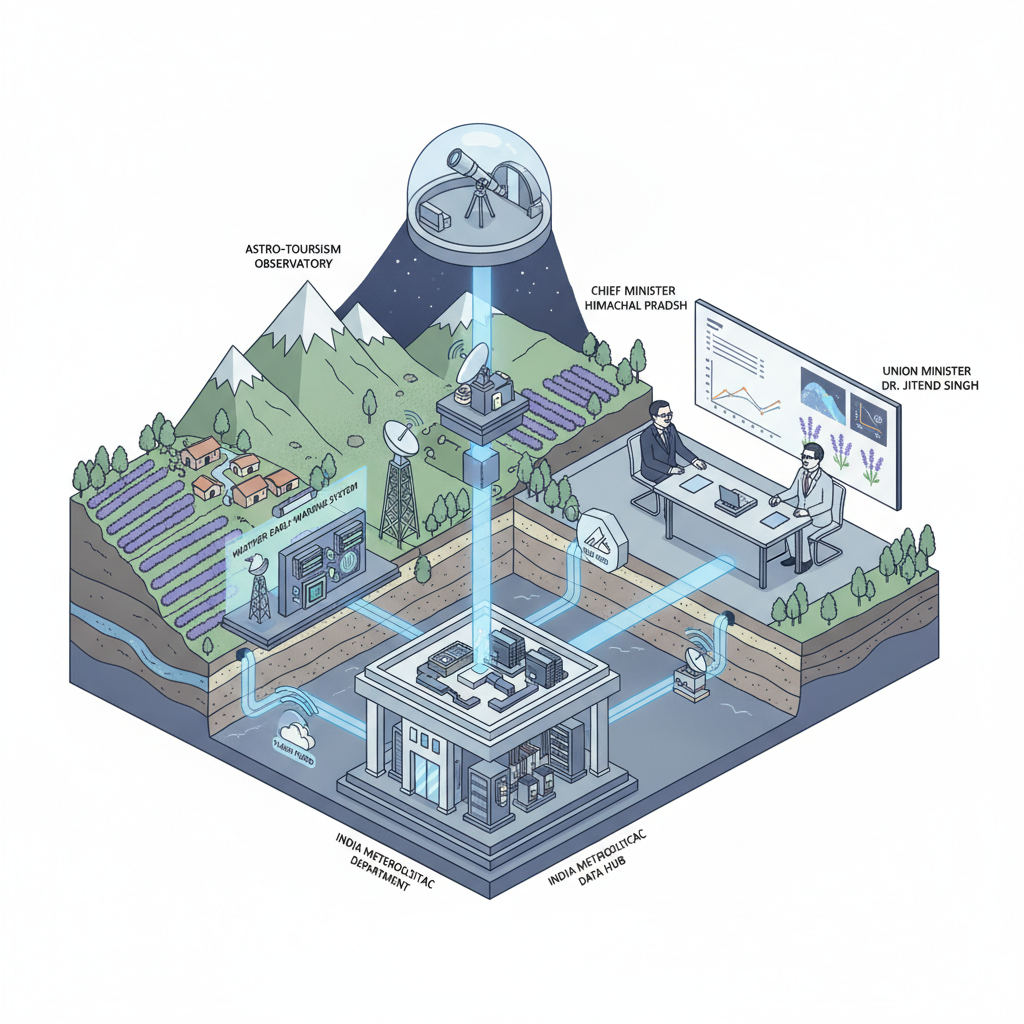
09 Sep Himachal CM meets Union Minister: Key Discussions on Weather Radar, Lavender & Astro-Tourism
✎ The **Doppler Weather Radar network** and **CSIR Aroma Mission** exemplify India’s integrated approach to climate adaptation, agricultural diversification, and rural livelihood enhancement, with Himachal Pradesh serving as a…
Subject Relevance — Where This Topic Fits
- GS Paper III — Disaster Management | GS Paper III — Agriculture | GS Paper III — Environment and Climate Change | GS Paper III — Science and Technology
- Prelims: Doppler Weather Radar (DWR), CSIR Aroma Mission, IMD’s Mausamgram initiative, Agro-climatic zones of Himachal Pradesh, Lavender cultivation, Astro-tourism, Hydro-meteorological hazards, Radio-sonde observation
- Essay: Climate resilience and sustainable agriculture: Balancing innovation with tradition, Tourism as a catalyst for regional development: Case of Himachal Pradesh
Quick Revision: The **Doppler Weather Radar network** and **CSIR Aroma Mission** exemplify India’s integrated approach to climate adaptation, agricultural diversification, and rural livelihood enhancement, with Himachal Pradesh serving as a model for mountainous states.
Why is this in the news?
The meeting between the Chief Minister of Himachal Pradesh and the Union Minister of State (Independent Charge) for Science and Technology highlighted collaborative efforts to enhance weather forecasting infrastructure, expand high-value agricultural practices, and promote astro-tourism in the state. These initiatives are critical for climate adaptation, agricultural diversification, and sustainable livelihoods in a mountainous region vulnerable to hydro-meteorological risks.
Background
- Himachal Pradesh, a Himalayan state, is highly susceptible to hydro-meteorological hazards such as landslides, flash floods, and cloudbursts due to its rugged terrain and extreme weather variability.
- The India Meteorological Department (IMD) operates a network of automated weather stations and Doppler Weather Radars (DWRs) across the state to monitor and forecast weather events, but gaps persist in coverage, especially in remote and high-altitude regions like Lahaul-Spiti and Kinnaur.
- The CSIR Aroma Mission, launched in 2016, aims to promote cultivation of aromatic and medicinal plants to enhance farmers’ income and reduce dependency on traditional crops.
- Lavender cultivation has emerged as a successful model under the Aroma Mission in Mandi district, with demonstrated economic viability and scalability potential.
- Astro-tourism, leveraging high-altitude clear skies, is being explored as a niche tourism segment to diversify the state’s economy and promote scientific engagement among youth.
- The Union Government has prioritized climate-resilient infrastructure development, including expansion of weather observation networks, to mitigate risks in ecologically fragile regions.
Key Initiatives Discussed: Weather Forecasting, Aromatic Agriculture, and Astro-Tourism
- The IMD’s **Mausamgram initiative** delivers village-level weather forecasts via gram panchayats, enabling farmers and local communities to make informed decisions on sowing, irrigation, and disaster preparedness. This decentralized approach enhances climate resilience at the grassroots level.
- The IMD’s existing network includes 28 Automatic Weather Stations (AWS), 64 Automatic Rain Gauges (ARG), and 84 daily rainfall monitoring stations, with plans to expand to 48 AWS, 88 ARG, 21 automatic snow gauges, and a Radio-Sonde/Radio-Wind system for upper-air observations.
- **CSIR Aroma Mission**: A flagship program under the Council of Scientific and Industrial Research (CSIR), the Aroma Mission promotes cultivation of aromatic crops such as lavender, rosemary, and mint to enhance farm incomes and promote agro-based industries. Phase III has successfully introduced lavender cultivation in Upper Bhambla, Mandi district, covering 20,000 plants.
- **Astro-Tourism Potential**: Himachal Pradesh’s high-altitude regions, particularly Spiti Valley, offer pristine skies with minimal light pollution, making them ideal for astronomical observations. Proposals include setting up high-altitude astronomical observatories to attract tourists, students, and researchers, fostering scientific literacy and economic diversification.
Key Features
| Feature | Significance |
|---|---|
| Five Doppler weather radars (including two new in Lahaul-Spiti and Kinnaur) | Enhances real-time weather monitoring and early warning systems in ecologically fragile Himalayan terrain, reducing disaster risks for vulnerable communities. |
| Village-level weather forecasting (Mausamgram service) | Provides hyper-localised weather data to farmers and rural populations, enabling informed agricultural and livelihood decisions. |
| CSIR Aroma Mission (Phase III & IV expansion in Himachal Pradesh) | Promotes high-value aromatic crop cultivation (lavender) for diversification of farm incomes and rural employment generation. |
| High-altitude astronomical observatory in Spiti | Leverages Himachal Pradesh’s pristine sky conditions for astro-tourism and scientific research, fostering STEM education and local economic growth. |
| Automated weather stations, rain gauges, and snow gauges | Strengthens climate data collection for hydrological modelling, avalanche prediction, and water resource management in mountainous regions. |
Why it Matters
Disaster Risk Reduction
- Improves early warning capabilities for landslides, flash floods, and avalanches in Himachal Pradesh’s disaster-prone Himalayan districts.
- Supports the Sendai Framework for Disaster Risk Reduction by enhancing community resilience through timely alerts.
- Integrates with the National Disaster Management Authority’s (NDMA) early warning protocols.
Agricultural Transformation
- Facilitates climate-smart agriculture by providing precise weather data for crop planning and pest management.
- Promotes diversification into high-value aromatic crops (lavender) under the CSIR Aroma Mission, aligning with the National Mission on Sustainable Agriculture.
- Enhances farm incomes through value addition (essential oil distillation units) and market linkages.
Scientific and Technological Advancement
- Expands India’s meteorological infrastructure in high-altitude regions, complementing the IMD’s network.
- Supports astro-science research and astro-tourism, positioning Himachal Pradesh as a hub for astronomical studies.
- Strengthens interdisciplinary research in Himalayan ecology, climate science, and rural innovation.
Economic Diversification
- Leverages Himachal Pradesh’s natural and cultural assets (e.g., Spiti’s clear skies, lavender fields) for sustainable tourism and agro-based industries.
- Creates employment opportunities in meteorology, agriculture, and astro-tourism sectors.
- Aligns with the Himachal Pradesh Vision 2030 for green and inclusive growth.
Challenges
1. Technical Constraints in Radar Deployment
- Beam obstruction issues in Lahaul-Spiti and Kinnaur due to rugged terrain, necessitating careful site selection.
- High-altitude locations pose logistical challenges for installation, maintenance, and power supply.
- Requires coordination between IMD, state agencies, and local communities for optimal placement.
UPSC Link: GS-III: Disaster Management
2. Climate Data Gaps and Monitoring Limitations
- Incomplete coverage of automated weather stations in remote Himalayan regions, leading to data sparsity.
- Snow and avalanche monitoring remains underdeveloped despite high vulnerability in districts like Lahaul-Spiti.
- Need for integration of traditional knowledge with modern meteorological tools for holistic forecasting.
UPSC Link: GS-III: Environment & Ecology
3. Market and Supply Chain Bottlenecks for Aromatic Crops
- Limited access to distillation units and value-addition infrastructure for lavender farmers in Himachal Pradesh.
- Dependence on external markets for essential oil trade, exposing farmers to price volatility.
- Lack of farmer cooperatives and collective marketing mechanisms for bulk sales.
UPSC Link: GS-III: Agriculture
4. Balancing Development and Ecological Sustainability
- Risk of over-tourism in Spiti’s pristine locations, threatening fragile ecosystems and cultural heritage.
- Need for sustainable land-use planning to prevent degradation from agricultural expansion (e.g., lavender cultivation).
- Ensuring equitable benefits for local communities in astro-tourism and agro-based industries.
UPSC Link: GS-III: Environment & Ecology
5. Institutional Coordination and Governance
- Fragmented implementation between central agencies (IMD, CSIR), state government, and local bodies.
- Delays in approvals and funding disbursement for multi-agency projects.
- Capacity-building needs for state meteorological departments and agricultural extension services.
UPSC Link: GS-II: Governance
Challenges — UPSC Perspective
| Issue | Concern |
|---|---|
| Beam obstruction in radar deployment | Technical challenges in Lahaul-Spiti and Kinnaur due to mountainous terrain. |
| Inadequate automated weather stations | Limited climate data coverage in remote Himalayan regions. |
| Market access for lavender farmers | Dependence on external buyers and price fluctuations for essential oils. |
| Ecological impact of astro-tourism | Risk of environmental degradation in Spiti’s fragile ecosystems. |
| Institutional delays in project implementation | Coordination gaps between central and state agencies. |
Government Initiatives — Must-Memorise for Prelims
- CSIR Aroma Mission (Phase III & IV)
- National Mission for Sustainable Agriculture (NMSA)
- Sendai Framework for Disaster Risk Reduction (implemented via NDMA)
- Himachal Pradesh Vision 2030 (Green and Inclusive Growth)
Way Forward
- Accelerate site selection and deployment of two additional Doppler radars in Lahaul-Spiti and Kinnaur, addressing technical constraints through geospatial surveys.
- Expand the Mausamgram service to gram panchayat level in all Himalayan districts, integrating it with the IMD’s mobile app for real-time alerts.
- Strengthen the CSIR Aroma Mission by establishing decentralised distillation units and linking farmers to cooperative societies for bulk marketing.
- Develop a sustainable astro-tourism policy for Spiti, including stargazing infrastructure, dark-sky preservation, and community-based tourism models.
- Enhance snow and avalanche monitoring networks in high-altitude districts, collaborating with the Snow and Avalanche Study Establishment (SASE).
- Conduct capacity-building programmes for state meteorological departments and agricultural extension workers on climate-smart practices.
- Establish a multi-stakeholder coordination committee (central-state-local) to streamline project implementation and resolve governance bottlenecks.
- Promote public-private partnerships (PPPs) for funding and maintaining meteorological and astro-tourism infrastructure.
UPSC Value Addition
Keywords for Mains Answer-Writing
Disaster Risk Reduction · Atmospheric Monitoring · Doppler Weather Radar · CSIR Aroma Mission · Lavender Cultivation · Agro-based Industries · Astro-tourism · Mountain Ecosystem · Himalayan States · Science and Technology Collaboration · Meteorological Services · Grampanchayat-level Weather Forecasting · Value Addition in Agriculture · Sustainable Livelihoods · High-altitude Observatories
Constitutional & Policy Linkages
- Article 21 (Right to Life and Personal Liberty) — Ensuring protection from climate-induced disasters.
- Article 39(b) (Directive Principles of State Policy) — Equitable distribution of resources for agricultural and ecological sustainability.
Concept Flow
Himachal Pradesh’s vulnerability to Himalayan disasters (landslides, flash floods) → Need for advanced early warning systems → Deployment of Doppler radars and automated weather stations → Integration with IMD’s Mausamgram service → Enhanced disaster preparedness and community resilience. → Climate change impacts on Himalayan agriculture → Diversification into high-value crops (lavender) under CSIR Aroma Mission → Expansion of distillation units and market linkages → Increased farm incomes and rural employment. → Principles of sustainable development → Balancing astro-tourism development with ecological preservation in Spiti → Policy frameworks for dark-sky preservation and community-based tourism. → Technological advancements in meteorology → High-altitude radar deployment → Improved hydrological and avalanche prediction models → Informed policy-making for disaster risk reduction. → Interdisciplinary collaboration → IMD, CSIR, state agencies, and local communities → Integrated governance for climate adaptation and rural development.
Prelims Practice Questions
Q1. Consider the following statements regarding the Doppler Weather Radar (DWR) network in India: 1. The DWR provides real-time data on precipitation intensity and wind velocity. 2. DWRs are primarily used for long-term climate forecasting rather than short-term weather prediction. 3. The India Meteorological Department (IMD) operates a network of DWRs across the country to enhance early warning systems. How many of the above statements are correct?
- Only one
- Only two
- All three
- None
Answer: All three — Statements 1 and 3 are correct. DWRs provide high-resolution real-time data on precipitation intensity, wind velocity, and storm structure, which are critical for short-term weather prediction and early warning systems. Statement 2 is incorrect as DWRs are not designed for long-term climate forecasting.
Q2. Assertion (A): The CSIR Aroma Mission aims to promote agro-based industries through the cultivation of aromatic and medicinal plants. Reason (R): The Mission provides distillation units to farmers to enhance value addition and improve livelihoods.
- Both A and R are true, and R is the correct explanation of A
- Both A and R are true, but R is NOT the correct explanation of A
- A is true, but R is false
- A is false, but R is true
Answer: Both A and R are true, but R is NOT the correct explanation of A — The CSIR Aroma Mission is designed to promote the cultivation of aromatic and medicinal plants (e.g., lavender) and support agro-based industries. The Mission also provides distillation units to farmers, enabling value addition and improving livelihoods. Thus, both A and R are true, and R correctly explains A.
Q3. Match the following initiatives with their respective objectives: Column I: (1) Doppler Weather Radar (DWR) (2) Grampanchayat-level Weather Forecasting (3) CSIR Aroma Mission (4) Astro-tourism Column II: (A) Enhancing early warning systems for disasters (B) Promoting agro-based industries through aromatic plant cultivation (C) Providing location-specific weather information at the grassroots level (D) Developing high-altitude observatories for scientific research and tourism
- 1-A, 2-C, 3-B, 4-D
- 1-B, 2-A, 3-C, 4-D
- 1-D, 2-C, 3-A, 4-B
- 1-A, 2-D, 3-B, 3-C
Answer: 1-A, 2-C, 3-B, 4-D — The correct matches are: (1) Doppler Weather Radar (DWR) → (A) Enhancing early warning systems for disasters; (2) Grampanchayat-level Weather Forecasting → (C) Providing location-specific weather information at the grassroots level; (3) CSIR Aroma Mission → (B) Promoting agro-based industries through aromatic plant cultivation; (4) Astro-tourism → (D) Developing high-altitude observatories for scientific research and tourism.
Mains Practice Question
✍ The integration of advanced meteorological infrastructure, agro-based industrial initiatives, and niche tourism models is critical for sustainable development in mountain ecosystems. In this context, critically examine the role of Doppler Weather Radars, the CSIR Aroma Mission, and astro-tourism in enhancing resilience and livelihoods in Himalayan states like Himachal Pradesh. (15 Marks)
Approach: MODEL-ANSWER SKELETON:
1. **Doppler Weather Radars (DWRs)**:
– Define DWRs and their role in real-time weather monitoring (precipitation intensity, wind velocity, storm tracking).
– Cite the Himachal Pradesh example: 5 DWRs (3 operational, 2 under installation), including proposed sites in Lahaul-Spiti and Kinnaur.
– Link to disaster risk reduction (DRR): Early warning for cloudbursts, flash floods, and landslides—key for Himalayan states vulnerable to climate-induced disasters.
– Mention IMD’s Grampanchayat-level weather forecasting (Mausamgram) for localized alerts.
2. **CSIR Aroma Mission**:
– Define the mission: Promotion of aromatic and medicinal plants (e.g., lavender) to diversify agriculture and create agro-based industries.
– Himachal Pradesh case: Expansion of lavender cultivation in Mandi district (20,000 plants, 150 farmers) under CSIR-IIIM Jammu.
– Value addition: Distillation units proposed in Phase 4 to enhance farmer incomes.
– Broader impact: Model replicable in other Himalayan states (Uttarakhand, Arunachal Pradesh) for sustainable livelihoods.
3. **Astro-tourism**:
– Define: Niche tourism leveraging high-altitude, low-light pollution locations for astronomical observations.
– Himachal Pradesh’s Spiti Valley: Proposed high-altitude observatory to attract students, researchers, and tourists.
– Synergy with science: Promotes STEM education and research while diversifying local economies.
4. **Sustainable Development in Mountain Ecosystems**:
– Interlinkages: How DWRs (DRR), Aroma Mission (agro-industries), and astro-tourism (economic diversification) collectively enhance resilience.
– Challenges: Technical constraints (beam obstruction in DWR site selection), climate vulnerabilities, and need for multi-stakeholder collaboration.
– Conclusion: These initiatives exemplify a balanced approach to climate adaptation, economic growth, and ecological sustainability in fragile Himalayan ecosystems.
Source: PIB (Press Information Bureau)
Himachal Pradesh PCS (HPPSC (HAS)) — State PCS Practice
Prelims: Which of the following initiatives was NOT discussed during the meeting between Himachal Pradesh Chief Minister Sukhwinder Singh Sukhu and Union Minister Dr. Jitendra Singh?
- A. Implementation of an advanced weather early warning system in Himachal Pradesh
- B. Expansion of lavender cultivation under the ‘Purple Revolution’ initiative
- C. Launch of a new hydroelectric power project in Kinnaur district
- D. Strengthening of the ‘One District, One Product’ (ODOP) scheme for Himachal Pradesh
Answer: C. Launch of a new hydroelectric power project in Kinnaur district — The meeting focused on weather early warning systems, lavender cultivation, and ODOP, but no mention was made of a new hydroelectric project in Kinnaur.
Mains: Discuss the significance of the ‘Purple Revolution’ initiative in Himachal Pradesh and its potential socio-economic impact on the state’s rural economy. Suggest measures to further promote lavender cultivation under this scheme.
Generated by AanyaAi for educational purpose.
Related guides on our sites
- Current affairs for upsc 2026
- How to prepare for GS paper 1 for UPSC CSE mains exam
- Best UPSC coaching for IFOS exam
- Best mentorship programme for upsc

- Gurugram’s groundwater extraction exceeds limit by 212%; HC seeks ban - October 4, 2026
- स्वतंत्रता सेनानी श्यामजी कृष्ण वर्मा की जन्म जयंती पर पीएम का श्रद्धांजलि - October 4, 2026
- KWML’s Feasibility Reports for Water Metro in 18 Cities: UPSC & PCS Insights - October 3, 2026

No Comments