


10 Sep UPSC Alert: Panchayat Reps’ Role in Rural Development & Scheme Implementation
✎ Panchayati Raj Institutions (PRIs) are constitutional bodies under the 73rd Amendment Act, 1992, responsible for local governance, welfare delivery, and participatory development; their effective functioning requires continuous…
Subject Relevance — Where This Topic Fits
- GS Paper II — Constitutional, Statutory, Regulatory and Various Quasi-Judicial Bodies | GS Paper II — Functions and Responsibilities of the Union and the States | GS Paper II — Government Policies and Interventions for Development in Various Sectors | GS Paper III — Issues Relating to Development and Management of Social Sector/Services relating to Health, Education, Human Resources | GS Paper III — Development Processes and the Development Industry — the Role of NGOs, SHGs, Various Groups and Associations, Donors, Charities, Institutional and Other Stakeholders
- Prelims: Panchayati Raj Institutions (PRIs), 73rd Constitutional Amendment Act, 1992, Gram Sabha, District Planning Committee, Convergence of Schemes, Social Audit, Capacity Building of Elected Representatives
- Essay: Role of Local Governance in Sustainable Rural Development, Institutional Strengthening and Democratic Decentralisation
Quick Revision: Panchayati Raj Institutions (PRIs) are constitutional bodies under the 73rd Amendment Act, 1992, responsible for local governance, welfare delivery, and participatory development; their effective functioning requires continuous capacity-building of elected representatives to ensure last-mile inclusion and transparency.
Why is this in the news?
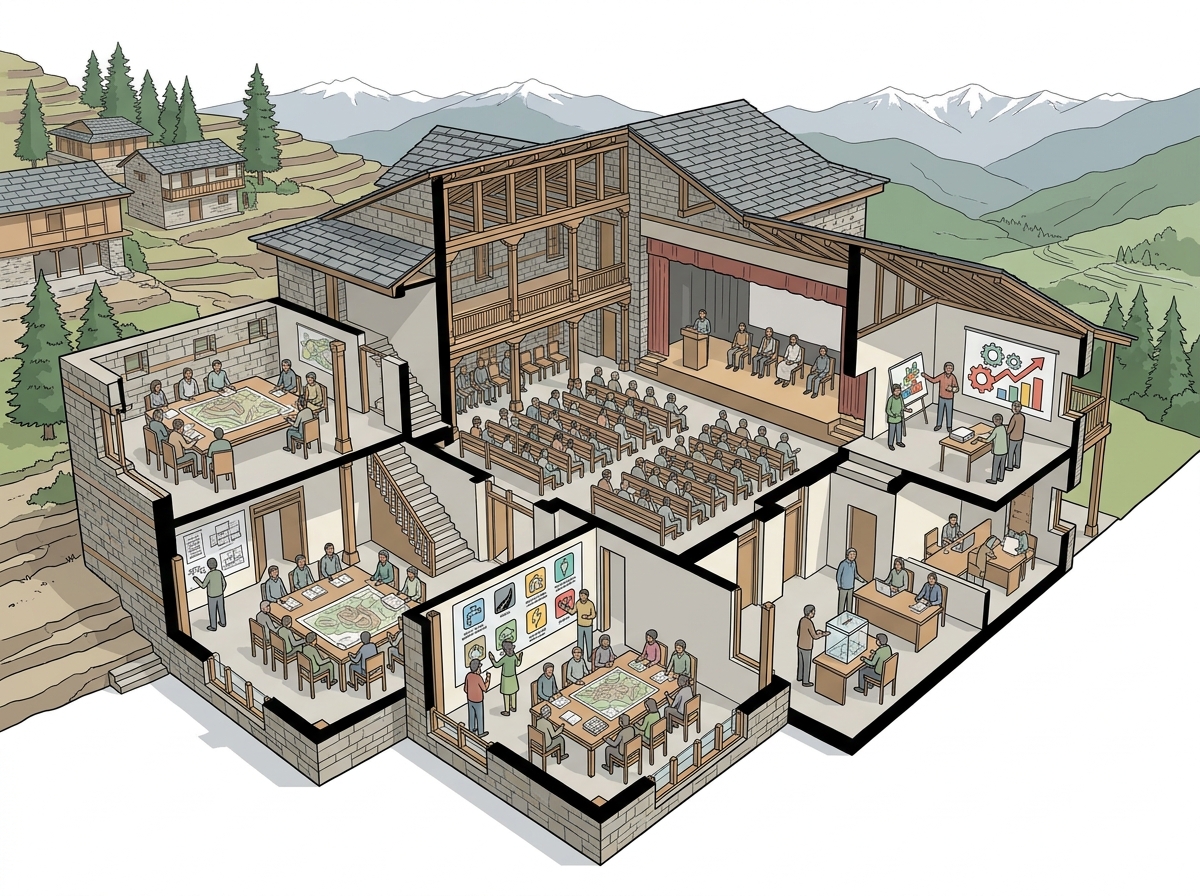
The news reports the conclusion of a four-day capacity-building training programme for newly elected Panchayat representatives in Dharampur Block, Mandi District, Himachal Pradesh, organised by the Rural Development Department. The Sub-Divisional Magistrate (SDM) and Block Development Officer (BDO) underscored the critical role of Panchayati Raj Institutions (PRIs) in ensuring the effective delivery of welfare schemes, accelerating rural development, and fostering transparent governance at the grassroots level. This initiative highlights the institutional mechanisms for capacity enhancement of elected local representatives, which is a key governance reform under the 73rd Constitutional Amendment Act.
Background
- The 73rd Constitutional Amendment Act, 1992, introduced Part IX to the Constitution, establishing a three-tier Panchayati Raj system (Gram Panchayat, Panchayat Samiti, and Zila Parishad) to promote decentralised governance and rural development.
- The amendment mandated the reservation of seats for women (at least one-third), Scheduled Castes (SCs), and Scheduled Tribes (STs) in Panchayats, ensuring inclusive participation in local governance.
- The Act also introduced mandatory functions, funds, and functionaries for PRIs, devolving subjects such as agriculture, rural housing, water supply, and social welfare to local bodies.
- Himachal Pradesh, a mountainous state with significant rural population, has been actively promoting participatory planning through Gram Sabhas and convergence of central and state welfare schemes at the Panchayat level.
What is the Capacity-Building Programme for Panchayat Representatives?
- The programme is a structured training initiative designed to equip newly elected Panchayat representatives with the knowledge and skills required to discharge their constitutional and statutory duties effectively.
- Key focus areas include: (i) understanding the legal and institutional framework of PRIs; (ii) convergence of welfare schemes; (iii) participatory planning and prioritisation of development works; (iv) financial management and utilisation of funds; (v) social audit and transparency mechanisms; and (vi) coordination with line departments for effective implementation.
- The training integrates theoretical inputs with practical exercises, including case studies, group discussions, and interactive sessions with district and block-level officials.
- The programme emphasises the role of Gram Sabhas as platforms for participatory decision-making, where villagers can identify local needs, prioritise schemes, and monitor implementation.
- Capacity-building modules often cover: (a) the Panchayat Extension to Scheduled Areas (PESA) Act, 1996, for tribal areas; (b) the Mahatma Gandhi National Rural Employment Guarantee Scheme (MGNREGS); (c) Pradhan Mantri Awas Yojana (Gramin); and (d) Swachh Bharat Mission (Gramin).
- The programme aims to foster a culture of accountability, transparency, and citizen-centric governance by enabling representatives to bridge the gap between government schemes and beneficiary households.
Key Features
| Feature | Significance |
|---|---|
| Four-day training camp for newly elected Panchayat representatives | Enhances institutional capacity of grassroots democratic bodies to implement rural development programmes effectively. |
| Focus on identifying local development priorities | Ensures resource allocation aligns with actual community needs, preventing misallocation of public funds. |
| Emphasis on transparency and accountability in scheme implementation | Reduces leakages and strengthens public trust in welfare delivery mechanisms. |
| Coordination between Panchayat representatives and district administration | Facilitates seamless flow of information and expedites administrative approvals for rural projects. |
| Practical guidance on administrative procedures and grievance redressal | Empowers representatives to navigate bureaucratic processes independently, reducing dependency on intermediaries. |
Why it Matters
Institutional Strengthening
- Reinforces the constitutional mandate of Panchayati Raj Institutions (PRIs) under Article 243G, enhancing their functional autonomy and decision-making capacity.
- Bridges the knowledge gap among newly elected representatives, ensuring continuity in rural governance despite electoral turnover.
- Promotes participatory planning by equipping representatives with tools to assess local needs and prioritise interventions.
Governance Efficiency
- Accelerates the pace of rural development by streamlining scheme delivery through localised implementation frameworks.
- Reduces administrative delays by clarifying roles, responsibilities, and procedural workflows for Panchayat-level functionaries.
- Enhances the effectiveness of flagship programmes (e.g., MGNREGA, PM-KISAN) by improving last-mile connectivity between beneficiaries and government services.
Social Inclusion
- Ensures equitable access to welfare benefits by identifying and reaching out to marginalised households, including SC/ST and women-led families.
- Strengthens social audits and community monitoring mechanisms, fostering accountability in resource utilisation.
- Encourages gender-sensitive planning by sensitising representatives to the specific needs of women and other vulnerable groups in rural areas.
Economic Impact
- Stimulates local economies by expediting infrastructure projects (e.g., roads, water supply, sanitation) that create employment opportunities.
- Improves agricultural productivity through timely disbursal of subsidies and access to credit under rural development schemes.
- Reduces rural-urban migration by enhancing the attractiveness of village economies through targeted development interventions.
Challenges
1. Low Awareness Among Beneficiaries
- Many rural households remain unaware of their entitlements under government schemes due to limited outreach and digital illiteracy.
- Training programmes often fail to translate into ground-level awareness, necessitating sustained community engagement post-training.
UPSC Link: GS-II: Governance, GS-III: Rural Development
2. Bureaucratic Delays and Red Tape
- Panchayat-level projects face approval bottlenecks due to overlapping jurisdictions between district administration and local bodies.
- Lack of standardised timelines for administrative processes (e.g., fund releases, tendering) hampers project implementation.
UPSC Link: GS-II: Governance, GS-III: Infrastructure
3. Resource Constraints and Fiscal Federalism
- Panchayats often lack adequate financial resources to match their developmental responsibilities, leading to dependency on higher tiers of government.
- Disparities in resource allocation across Panchayats exacerbate regional inequalities in rural development outcomes.
UPSC Link: GS-II: Federalism, GS-III: Resource Mobilisation
4. Political Interference and Corruption
- Local power structures may influence scheme implementation, diverting resources away from intended beneficiaries.
- Lack of transparency in fund utilisation and procurement processes creates opportunities for rent-seeking and malpractice.
UPSC Link: GS-II: Governance, GS-IV: Ethics
5. Skill Gaps and Capacity Deficits
- Newly elected representatives often lack administrative or technical expertise to manage complex rural development projects.
- Frequent turnover of Panchayat members disrupts institutional memory and continuity in project execution.
UPSC Link: GS-II: Governance, GS-III: Skill Development
Challenges — UPSC Perspective
| Issue | Concern |
|---|---|
| Limited digital literacy among rural populations | Hampers access to online portals for scheme registration and monitoring. |
| Absence of standardised performance metrics for Panchayats | Obscures accountability in measuring developmental outcomes. |
| Overlapping mandates between Panchayats and line departments | Leads to duplication of efforts and administrative confusion. |
| Inadequate grievance redressal mechanisms at the local level | Delays resolution of beneficiary complaints, eroding trust in governance. |
| Seasonal migration of rural youth | Reduces the availability of skilled labour for local development projects. |
Government Initiatives — Must-Memorise for Prelims
- Pradhan Mantri Gram Sadak Yojana (PMGSY)
- Mahatma Gandhi National Rural Employment Guarantee Scheme (MGNREGS)
- Pradhan Mantri Awas Yojana – Gramin (PMAY-G)
- National Rural Livelihood Mission (NRLM)
Way Forward
- Conduct periodic refresher training sessions for Panchayat representatives to update them on evolving schemes and administrative reforms.
- Strengthen the role of District Planning Committees (DPCs) in aligning Panchayat-level priorities with district-level development strategies.
- Leverage technology (e.g., mobile apps, SMS alerts) to disseminate scheme-related information and track beneficiary outreach in real time.
- Establish a dedicated grievance redressal portal at the Panchayat level, with provisions for escalation to higher authorities if unresolved within stipulated timelines.
- Introduce mandatory social audits for all Panchayat-funded projects, with participation from local communities and civil society organisations.
- Promote convergence between central and state schemes to avoid duplication and maximise resource utilisation in rural areas.
- Encourage Panchayats to adopt outcome-based budgeting, linking fund allocation to measurable developmental targets.
- Facilitate partnerships between Panchayats and vocational training institutions to align local skill development with market demands.
UPSC Value Addition
Keywords for Mains Answer-Writing
Panchayati Raj Institutions · 73rd Constitutional Amendment Act · Role of Gram Panchayats · Decentralised Governance · Capacity Building of Elected Representatives · Rural Development Schemes · Mahatma Gandhi National Rural Employment Guarantee Scheme (MGNREGS) · Pradhan Mantri Awas Yojana – Gramin (PMAY-G) · Local Self-Government · District Planning Committee · Convergence of Schemes · Social Audit · Participatory Rural Appraisal · Institutional Mechanisms for Rural Development
Constitutional & Policy Linkages
- Article 243G: Functions of Panchayats (Constitutional mandate for local self-government).
- Article 40: Organisation of village Panchayats (Directive Principle of State Policy).
- 73rd Constitutional Amendment Act, 1992: Framework for decentralised governance.
Concept Flow
Constitutional mandate for decentralised governance (Article 40, 73rd Amendment) → Establishment of Panchayati Raj Institutions (PRIs) → Training of elected representatives → Enhanced institutional capacity → Improved scheme implementation → Accelerated rural development → Social and economic inclusion.
Prelims Practice Questions
Q1. Consider the following statements regarding the 73rd Constitutional Amendment Act, 1992:
1. It mandates the reservation of seats for women in Panchayati Raj Institutions.
2. It provides for the establishment of a three-tier system of Panchayati Raj.
3. It empowers the State Election Commission to conduct elections to Panchayati Raj Institutions.
4. It grants constitutional status to Panchayats.
How many of the above statements are correct?
- Only one
- Only two
- Only three
- All four
Answer: All four — Statements 1, 2, 3, and 4 are all correct. The 73rd Amendment Act mandates 33% reservation for women, establishes a three-tier system (Gram Panchayat, Panchayat Samiti, Zilla Parishad), empowers the State Election Commission for elections, and grants constitutional status to Panchayats.
Q2. Assertion (A): The Gram Sabha acts as a platform for direct democracy at the village level.
Reason (R): The Gram Sabha is a statutory body under the 73rd Constitutional Amendment Act and includes all registered voters of the Panchayat area.
Options:
A. Both A and R are true, and R is the correct explanation of A.
B. Both A and R are true, but R is not the correct explanation of A.
C. A is true, but R is false.
D. A is false, but R is true.
Answer: ? — Both Assertion (A) and Reason (R) are true. The Gram Sabha, as a statutory body under the 73rd Amendment, includes all registered voters and serves as a platform for direct democracy by enabling participatory decision-making in rural governance.
Q3. Match the following schemes with their respective implementing agencies:
Column I (Scheme) | Column II (Implementing Agency)
1. MGNREGS | A. Ministry of Rural Development
2. PMAY-G | B. Ministry of Housing and Urban Affairs
3. National Rural Livelihood Mission (NRLM) | C. Ministry of Rural Development
4. Deendayal Antyodaya Yojana – National Rural Livelihoods Mission (DAY-NRLM) | D. Ministry of Rural Development
Options:
A. 1-A, 2-B, 3-C, 4-D
B. 1-A, 2-B, 3-D, 4-C
C. 1-A, 2-D, 3-C, 4-B
D. 1-D, 2-B, 3-A, 4-C
- A
- B
- C
- D
Answer: A — The correct matches are: 1. MGNREGS – Ministry of Rural Development (A), 2. PMAY-G – Ministry of Housing and Urban Affairs (B), 3. NRLM – Ministry of Rural Development (C), 4. DAY-NRLM – Ministry of Rural Development (D).
Mains Practice Question
✍ The capacity-building of elected representatives in Panchayati Raj Institutions is critical for the effective implementation of rural development schemes. Critically examine the institutional mechanisms and challenges in ensuring that these representatives fulfil their roles as envisaged under the 73rd Constitutional Amendment Act. Also, suggest measures to enhance their effectiveness in delivering grassroots governance. (15 Marks)
Approach: MODEL-ANSWER SKELETON:
1. **Institutional Mechanisms for Capacity Building:**
– **Constitutional Provisions:** Article 243G (Functions of Panchayats) and Article 243ZD (District Planning Committee) mandate devolution of powers and functions to Panchayats.
– **Training Programmes:** Reference the training initiatives by the Ministry of Panchayati Raj (e.g., ‘National Initiative for Panchayat Capacity Building’ or NIPCCD programmes).
– **Role of State Election Commission and State Governments:** Conduct of elections and administrative support for capacity-building.
– **Convergence with Rural Development Schemes:** Linkages with MGNREGS, PMAY-G, and other schemes for grassroots delivery.
2. **Challenges in Effective Implementation:**
– **Lack of Awareness:** Limited understanding of schemes, rights, and duties among elected representatives.
– **Resource Constraints:** Inadequate financial and human resources at the Panchayat level.
– **Political Interference:** Influence of local power structures in decision-making.
– **Low Participation:** Limited engagement of marginalised groups (women, SCs, STs) in governance.
– **Monitoring and Accountability:** Weak social audit mechanisms and lack of transparency.
3. **Measures to Enhance Effectiveness:**
– **Continuous Training:** Regular, context-specific training programmes (as highlighted in the news article) with a focus on practical implementation.
– **Technology Integration:** Use of e-governance tools (e.g., Gram Panchayat Development Plans, online monitoring of schemes).
– **Strengthening Gram Sabhas:** Ensuring Gram Sabhas function as platforms for participatory decision-making.
– **Institutional Support:** Strengthening the role of District Planning Committees and State Finance Commissions.
– **Social Audits:** Mandatory social audits of schemes to ensure accountability and transparency.
4. **Conclusion:**
– Emphasise the need for a multi-pronged approach combining constitutional mandates, institutional support, and grassroots participation to realise the vision of decentralised governance.
Source: amarujala.com
Himachal Pradesh PCS (HPPSC (HAS)) — State PCS Practice
Prelims: Under the recent initiative by the Mandi district administration to ensure that welfare schemes reach every eligible household, which of the following steps is NOT directly associated with this campaign?
- A. Conducting door-to-door surveys to identify beneficiaries
- B. Organizing awareness camps in Gram Panchayats for local participation
- C. Introducing a new state-level tax on agricultural land
- D. Accelerating the pace of development works through timely fund release
Answer: C. Introducing a new state-level tax on agricultural land — The initiative focuses on ensuring welfare schemes reach eligible households and accelerating development works, excluding unrelated tax measures.
Mains: Discuss the role of Gram Panchayat representatives in ensuring the effective implementation of welfare schemes in Himachal Pradesh, with special reference to the recent directives issued by the Mandi district administration. Suggest measures to further strengthen grassroots governance in the state.
Generated by AanyaAi for educational purpose.
Related guides on our sites
- Current affairs for upsc 2026
- Best PSIR optional coaching for upsc
- Best PSIR optional teacher for upsc
- Best teacher of PSIR optional for upsc

- पशुपालन विभाग ‘विशेष अभियान 6’ में करेगा शामिल, जानिए लक्ष्य और तैयारी - September 16, 2026
- UPSC Alert: DAHD’s Success in Special Campaign 5.0 & Special Campaign 6.0 Prep - September 16, 2026
- पीएम विश्वकर्मा योजना के तीन वर्ष: 30 लाख कारीगरों को मिला लाभ, जानें प्रमुख उपलब्धियां - September 16, 2026

No Comments