


11 Sep Shivraj Singh Chouhan on Transforming Drylands into Agricultural Powerhouses
✎ Dryland agriculture in India, spanning 40% of the geographical area, demands climate-resilient crop varieties, water-efficient technologies, and market linkages to ensure food security, nutrition security, and sustainable…
Subject Relevance — Where This Topic Fits
- GS Paper III — Agriculture, Food Security, and Climate Change | GS Paper III — Science and Technology in Agriculture | GS Paper I — Salient Features of Indian Society and Regional Diversity
- Prelims: Dryland farming, Agro-climatic zones, ICAR, ICRISAT, National Agricultural Science Centre (NASC), Climate-resilient crops, Food and Nutrition Security, Sustainable Agriculture, Agro-biodiversity
- Essay: Climate change and sustainable agriculture: Balancing productivity with ecological resilience, Innovation in agriculture: Bridging the gap between science, policy, and market
Quick Revision: Dryland agriculture in India, spanning 40% of the geographical area, demands climate-resilient crop varieties, water-efficient technologies, and market linkages to ensure food security, nutrition security, and sustainable livelihoods for over 200 million people.
Why is this in the news?
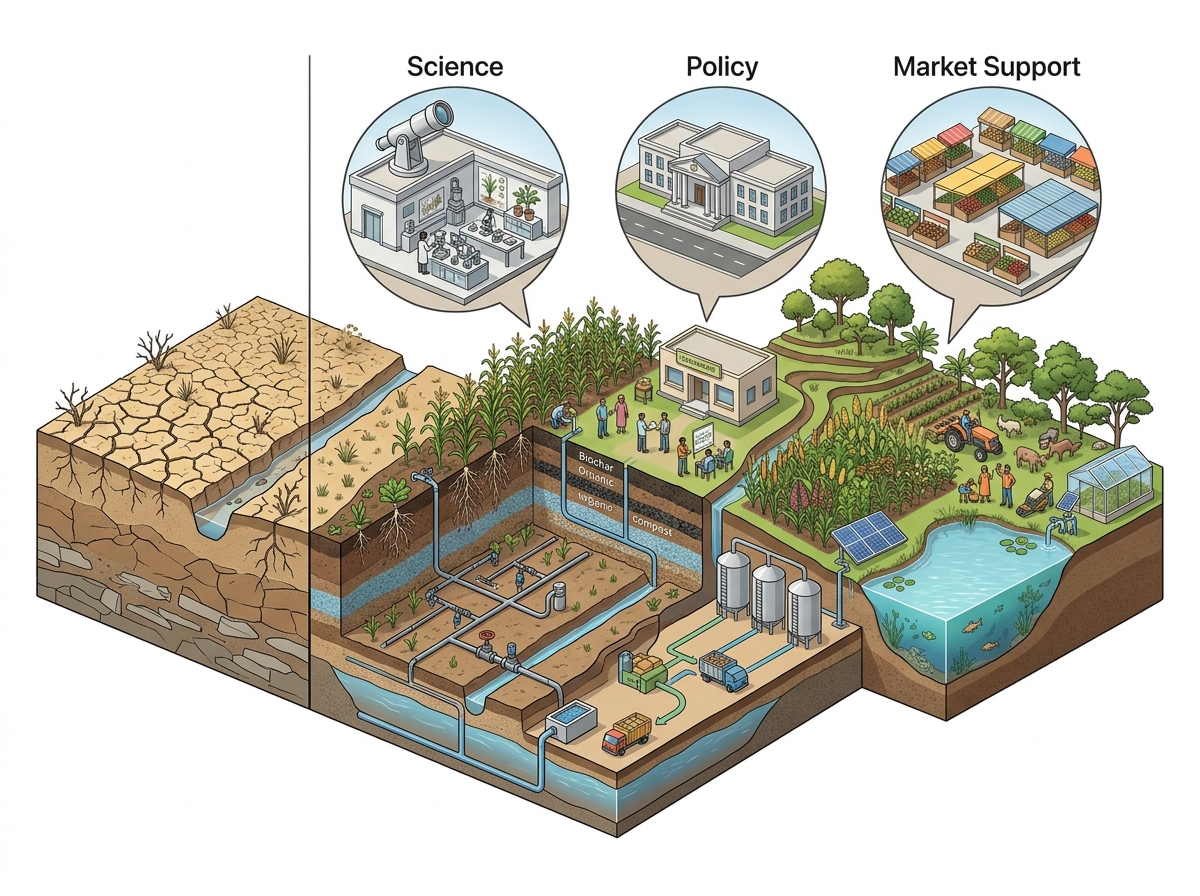
The Union Minister for Agriculture and Farmers’ Welfare and Rural Development, Shri Shivraj Singh Chouhan, inaugurated the ‘Dryland Congress 2026’ in New Delhi, emphasizing the need for a holistic approach—integrating science, policy, and market support—to transform drylands into productive and resilient agricultural systems. The three-day international conference, attended by over 800 delegates from 25 countries, underscores the urgency of addressing dryland agriculture as a critical component of India’s food security, nutrition security, and farmer livelihoods in the face of climate change.
Background
- Drylands cover approximately 40% of India’s geographical area and support livelihoods for over 200 million people, predominantly small and marginal farmers.
- India’s dryland regions, including parts of Rajasthan, Gujarat, Maharashtra, Karnataka, Andhra Pradesh, and Telangana, face recurring droughts, erratic rainfall, and soil degradation, exacerbating food insecurity and rural distress.
- The National Mission for Sustainable Agriculture (NMSA) under the National Action Plan on Climate Change (NAPCC) prioritizes dryland farming through climate-resilient agricultural practices and integrated watershed management.
- The Indian Council of Agricultural Research (ICAR) and the International Crops Research Institute for the Semi-Arid Tropics (ICRISAT) have been at the forefront of developing drought-tolerant crop varieties, soil moisture conservation techniques, and agroforestry models for dryland ecosystems.
- The United Nations Sustainable Development Goals (SDGs) 2 (Zero Hunger), 12 (Responsible Consumption and Production), and 13 (Climate Action) emphasize the need for sustainable dryland agriculture to achieve global food security.
What is Dryland Agriculture and Why is it Critical?
- Dryland agriculture refers to farming systems practiced in regions with limited and erratic rainfall, typically less than 750 mm annually, where water availability is the primary constraint for crop production.
- Drylands are characterized by low soil fertility, high evapotranspiration rates, and vulnerability to desertification, making them highly sensitive to climate variability and extreme weather events.
- Dryland farming is practiced across diverse agro-climatic zones in India, including the arid and semi-arid tracts of Rajasthan, Gujarat, Maharashtra, Karnataka, and the Deccan Plateau, where traditional crops like millets, pulses, and oilseeds dominate.
- The success of dryland agriculture depends on the adoption of climate-resilient crop varieties, water-efficient irrigation methods (e.g., micro-irrigation, rainwater harvesting), conservation agriculture, and integrated pest management systems.
- Dryland ecosystems play a crucial role in biodiversity conservation, carbon sequestration, and maintaining ecological balance, particularly through agroforestry and conservation of native plant species.
- India’s dryland regions are home to rich agro-biodiversity, including indigenous crop varieties such as pearl millet (bajra), sorghum (jowar), finger millet (ragi), and minor millets, which are nutritionally superior and drought-resistant.
- The economic viability of dryland farming is closely linked to market access, value addition, and farmer collectives, which enable smallholders to negotiate better prices and reduce post-harvest losses.
- Transforming drylands requires a ‘Whole-of-Government’ and ‘Whole-of-Society’ approach, integrating scientific research, policy frameworks, financial incentives, and community participation to ensure sustainability and inclusivity.
Key Features
| Feature | Significance |
|---|---|
| Holistic multi-stakeholder approach (Whole-of-System, Whole-of-Society, Whole-of-Government) | Ensures integration of scientific, policy, and market interventions for sustainable dryland agriculture. |
| Focus on climate-resilient crop varieties | Enhances agricultural productivity in arid and semi-arid regions by reducing vulnerability to drought. |
| Emphasis on nutrition security | Addresses malnutrition in dryland farming communities through nutrient-dense crop diversification. |
| Market linkages for dryland produce | Improves farmer income by connecting them to value chains and demand-driven agricultural markets. |
| International collaboration (25+ countries, 800+ delegates) | Facilitates knowledge exchange and global best practices for dryland agriculture. |
Why it Matters
Economic
- Transforms dryland regions from low-productivity zones into economic assets through scientific and market interventions.
- Enhances farmer livelihoods by integrating dryland agriculture with high-value crop systems and export markets.
- Reduces rural-urban migration by creating sustainable income opportunities in dryland farming communities.
Strategic
- Strengthens food and nutrition security in India’s arid and semi-arid regions, reducing import dependency.
- Contributes to global food systems resilience by addressing dryland agriculture challenges in Africa and other regions.
- Supports India’s climate adaptation goals by promoting drought-resistant agricultural practices.
Environmental
- Promotes sustainable land management in dryland ecosystems, reducing soil degradation and desertification.
- Encourages water-efficient farming techniques, aligning with climate-resilient agricultural policies.
- Supports biodiversity conservation through traditional and improved dryland crop varieties.
Institutional
- Fosters multi-institutional collaboration (ICAR, ICARDA, CGIAR, and international partners) for research and innovation.
- Strengthens India’s role as a knowledge hub for dryland agriculture through global partnerships like the Dryland Congress.
- Enhances capacity-building for scientists, policymakers, and farmers in dryland agricultural systems.
Challenges
1. Climate Vulnerability in Drylands
- Erratic rainfall and prolonged droughts reduce crop yields, threatening food security.
- Increased frequency of extreme weather events exacerbates land degradation in dryland regions.
UPSC Link: Geography: Climate Change & Agriculture
2. Market Access and Price Volatility
- Poor market linkages for dryland produce lead to low farmer incomes and exploitation by middlemen.
- Lack of value addition and processing infrastructure reduces profitability for dryland farmers.
UPSC Link: Economy: Agricultural Marketing & Supply Chain
3. Technological and Knowledge Gaps
- Limited adoption of climate-resilient crop varieties due to lack of awareness and extension services.
- Insufficient research on high-yielding, drought-tolerant crop varieties tailored to local conditions.
UPSC Link: Science & Tech: Agricultural Innovation
4. Policy and Institutional Constraints
- Fragmented policy frameworks for dryland agriculture hinder integrated implementation.
- Inadequate funding and resource allocation for dryland-specific agricultural programs.
UPSC Link: Governance: Policy Implementation & Public Finance
5. Socio-Economic Barriers
- Small landholdings and resource-poor farmers face higher risks in adopting new technologies.
- Gender disparities in access to resources, training, and decision-making in dryland farming.
UPSC Link: Social Issues: Gender & Rural Development
Challenges — UPSC Perspective
| Issue | Concern |
|---|---|
| Climate variability | Increased droughts and erratic rainfall reduce crop productivity. |
| Market fragmentation | Poor value chains limit farmer access to profitable markets. |
| Technological lag | Low adoption of drought-resistant crop varieties due to knowledge gaps. |
| Policy incoherence | Fragmented schemes fail to address dryland-specific needs. |
| Resource constraints | Smallholder farmers lack capital for climate-resilient interventions. |
Way Forward
- Scale up research on climate-resilient crop varieties through ICAR and international partnerships (e.g., CGIAR).
- Strengthen agricultural extension services to disseminate best practices for dryland farming.
- Develop market linkages for dryland produce by promoting cooperatives and agri-startups.
- Integrate dryland agriculture into national climate adaptation and food security policies.
- Enhance farmer training programs on water-efficient irrigation and soil conservation techniques.
- Promote public-private partnerships for investment in dryland agriculture infrastructure.
- Facilitate gender-inclusive policies to ensure equitable access to resources and benefits.
UPSC Value Addition
Keywords for Mains Answer-Writing
Shushk Bhoomi Krishi (Dryland Agriculture) · ICRISAT · ICAR · Dryland Congress 2026 · National Agricultural Science Complex (NASC) · Food and Nutritional Security · Climate-Resilient Crops · Sustainable Agriculture · Agri-Food Systems Transformation · Scientific Interventions in Agriculture · Policy Framework for Dryland Farming · Market Support Mechanisms · Livelihood Enhancement in Agriculture · Nutrition-Sensitive Agriculture · Holistic Approach to Agriculture
Concept Flow
Dryland regions face climate variability and resource constraints → Reduced agricultural productivity and farmer livelihoods. → Government and scientific institutions propose holistic, multi-stakeholder interventions → Integration of science, policy, and markets. → Adoption of climate-resilient crop varieties and sustainable land management practices → Enhanced productivity and income. → Strengthened market linkages and value addition → Improved farmer profitability and rural economic growth. → Implementation of gender-inclusive and resource-efficient policies → Sustainable and equitable dryland development.
Prelims Practice Questions
Q1. Consider the following statements regarding the Dryland Congress 2026: 1. The Dryland Congress 2026 is being organised by the Indian Council of Agricultural Research (ICAR) and the International Crops Research Institute for the Semi-Arid Tropics (ICRISAT). 2. The Congress aims to discuss science, technology, and policy-based solutions for sustainable dryland agriculture. 3. The event is being held in Mumbai with participation from only Indian delegates. How many of the above statements are correct?
- Only one
- Only two
- All three
- None
Answer: Only two — Statement 1 is correct as ICAR and ICRISAT are key organisers of the event. Statement 2 is correct as the Congress focuses on science, technology, and policy for dryland agriculture. Statement 3 is incorrect as the event is being held in New Delhi with participation from over 25 countries.
Q2. Assertion (A): The Dryland Congress 2026 emphasises the importance of climate-resilient crop varieties in addressing food and nutritional security. Reason (R): The Congress advocates for a holistic approach integrating science, policy, and market support to transform dryland agriculture.
- Both A and R are true, and R is the correct explanation of A.
- Both A and R are true, but R is not the correct explanation of A.
- A is true, but R is false.
- A is false, but R is true.
Answer: Both A and R are true, and R is the correct explanation of A. — Both the assertion and reason are correct. The Congress indeed highlights climate-resilient crops (A), and the holistic approach (R) is the framework proposed to achieve this goal.
Q3. Match the following initiatives with their respective organisations:
Column I:
A. Dryland Congress 2026
B. Transforming the Drylands: The ICRISAT Journey
C. National Agricultural Science Complex (NASC)
Column II:
1. Indian Council of Agricultural Research (ICAR)
2. International Crops Research Institute for the Semi-Arid Tropics (ICRISAT)
3. Ministry of Agriculture and Farmers’ Welfare
- A-3, B-2, C-1; A-2, B-1, C-3; A-1, B-2, C-3; A-2, B-3, C-1
- answer_string_map_indexed_pairs_to_options_indexed_pairs_0
- explain_0_to_3_pairs_in_order
- format_match
Answer: A-3, B-2, C-1; A-2, B-1, C-3; A-1, B-2, C-3; A-2, B-3, C-1 — A. Dryland Congress 2026 is organised by ICAR and ICRISAT (3). B. ‘Transforming the Drylands: The ICRISAT Journey’ is a publication by ICRISAT (2). C. NASC is an institution under the Ministry of Agriculture and Farmers’ Welfare (1).
Mains Practice Question
✍ Critically examine the role of science, policy, and market support in transforming dryland agriculture in India. How far can a holistic approach address the challenges of food and nutritional security, livelihood enhancement, and climate resilience in these regions? (15 Marks)
Approach: MODEL-ANSWER SKELETON:
1. **Introduction**: Define dryland agriculture and its significance in India (e.g., covers ~60% of the country’s cultivated area, supports livelihoods of millions). Highlight the challenges: low productivity, climate vulnerability, market access issues, and nutritional deficits.
2. **Role of Science**:
– **Crop Breeding**: Discuss the development of climate-resilient crop varieties (e.g., drought-tolerant millets, pulses) by institutions like ICAR and ICRISAT.
– **Technology Adoption**: Mention precision agriculture, soil moisture conservation techniques, and digital tools for farm management.
– **Research Institutions**: Reference ICAR’s All India Coordinated Research Projects and ICRISAT’s global partnerships.
3. **Role of Policy**:
– **National Missions**: Link to schemes like National Mission on Sustainable Agriculture (NMSA), Pradhan Mantri Fasal Bima Yojana (PMFBY), and Mission for Integrated Development of Horticulture (MIDH).
– **Policy Frameworks**: Discuss the National Policy for Farmers (2007) and the need for integrated policy interventions.
– **Governance**: Highlight the role of the Ministry of Agriculture and Farmers’ Welfare in coordinating multi-stakeholder efforts.
4. **Role of Market Support**:
– **Value Chains**: Explain the importance of market linkages for dryland produce (e.g., millets, oilseeds) to enhance farmer incomes.
– **Institutional Mechanisms**: Discuss the role of Farmer Producer Organisations (FPOs), e-NAM, and public-private partnerships.
– **Nutrition-Sensitive Markets**: Highlight the demand for nutri-cereals and the role of government procurement (e.g., MSP for millets).
5. **Holistic Approach**:
– **Integrated Framework**: Explain the ‘whole-of-system, whole-of-society, whole-of-government’ approach as proposed in the Dryland Congress 2026.
– **Multi-Stakeholder Collaboration**: Emphasise the role of scientists, policymakers, farmers, and industry in addressing dryland challenges.
– **Sustainability**: Discuss the need for balancing productivity, ecological sustainability, and economic viability.
6. **Challenges and Limitations**:
– **Implementation Gaps**: Acknowledge issues like low adoption of technologies, policy fragmentation, and market inefficiencies.
– **Climate Change**: Highlight the exacerbating impact of climate change on dryland agriculture.
7. **Conclusion**: Summarise the transformative potential of a science-policy-market nexus in dryland agriculture while acknowledging the need for sustained efforts and adaptive strategies.
Source: PIB (Press Information Bureau)
Generated by AanyaAi for educational purpose.
Related guides on our sites
- Best PSIR optional coaching for upsc
- Best PSIR optional teacher for upsc
- Best teacher of PSIR optional for upsc
- Best PSIR optional coaching in delhi for UPSC

- Gurugram’s groundwater extraction exceeds limit by 212%; HC seeks ban - October 4, 2026
- स्वतंत्रता सेनानी श्यामजी कृष्ण वर्मा की जन्म जयंती पर पीएम का श्रद्धांजलि - October 4, 2026
- KWML’s Feasibility Reports for Water Metro in 18 Cities: UPSC & PCS Insights - October 3, 2026

No Comments