


12 Sep Climate Change as Economic Risk: KSPCB Chairman’s Warning for UPSC/PCS
✎ Climate change is now a systemic economic risk requiring businesses to embed climate intelligence into governance and strategy, transforming ESG from a compliance agenda to a core driver of competitiveness and resilience.
Subject Relevance — Where This Topic Fits
- GS Paper III — Environment, Economic Development, and Sustainability | GS Paper III — Disaster Management | GS Paper III — Indian Economy and Issues Relating to Planning, Mobilization of Resources, Growth, Development and Employment | GS Paper IV — Ethics, Integrity and Aptitude (Environmental Ethics and Corporate Governance)
- Prelims: Climate risk, ESG (Environmental, Social, and Governance) framework, Carbon pricing, Green finance, Resilience in supply chains, Boardroom governance, Karnataka State Pollution Control Board (KSPCB), CII Karnataka ESG Summit 2026
- Essay: Climate change as a multiplier of economic vulnerabilities: Challenges and opportunities for sustainable development, Corporate governance in the age of climate crisis: Balancing profitability and planetary boundaries
Quick Revision: Climate change is now a systemic economic risk requiring businesses to embed climate intelligence into governance and strategy, transforming ESG from a compliance agenda to a core driver of competitiveness and resilience.
Why is this in the news?
The statement by the Chairman of the Karnataka State Pollution Control Board (KSPCB) at the CII Karnataka ESG Summit 2026 underscores the paradigm shift in perceiving climate change—not merely as an environmental concern but as a critical economic risk requiring integration into business strategy and governance frameworks. This reflects a growing consensus among policymakers, industry leaders, and sustainability experts on the necessity of embedding climate intelligence into boardroom decisions to ensure long-term competitiveness and resilience.
Background
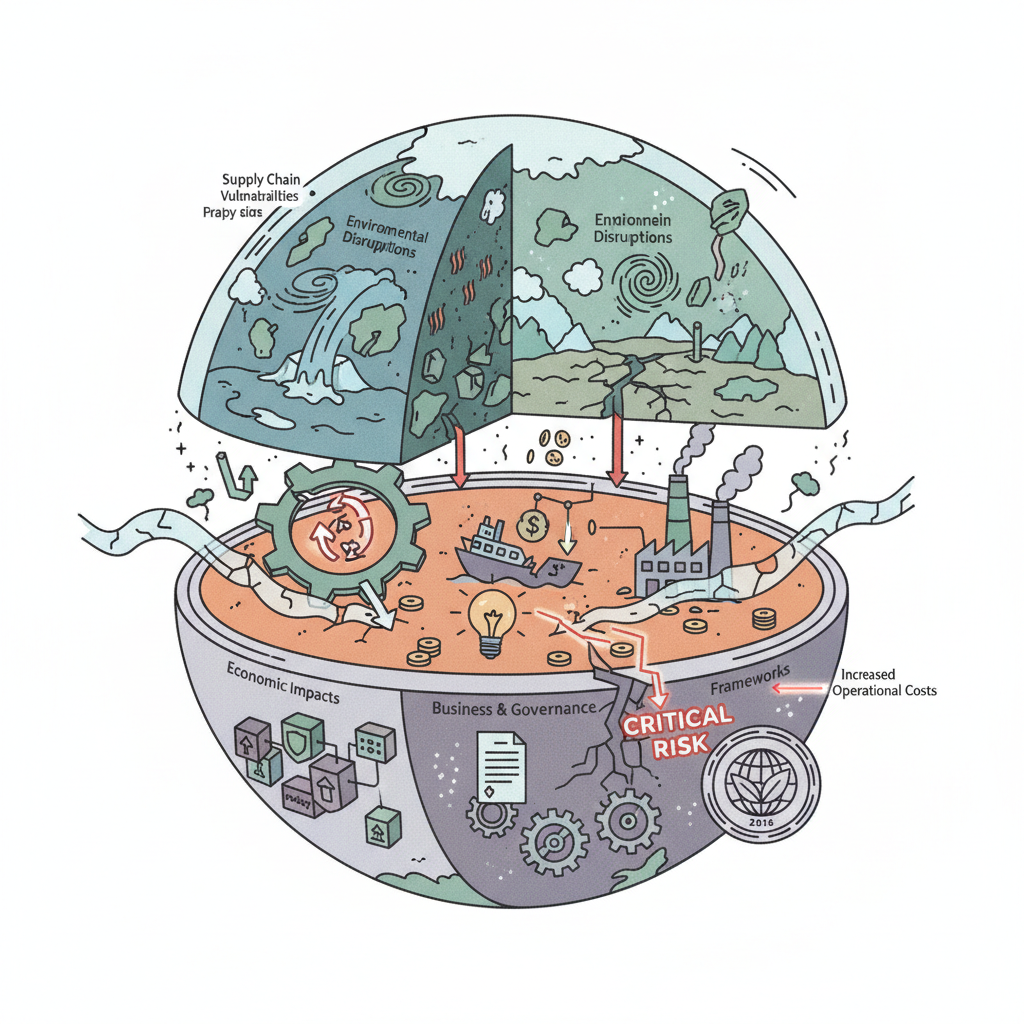
- The Intergovernmental Panel on Climate Change (IPCC) has repeatedly highlighted the economic disruptions caused by climate change, including supply chain vulnerabilities, energy insecurity, and increased operational costs.
- India’s commitment under the Paris Agreement (2016) to reduce emissions intensity by 33-35% by 2030 and achieve net-zero emissions by 2070 necessitates systemic integration of climate considerations into economic and industrial policies.
- The Securities and Exchange Board of India (SEBI) has mandated Business Responsibility and Sustainability Reports (BRSR) for top 1,000 listed companies, mandating disclosure of ESG performance, reflecting regulatory pressure on businesses to adopt sustainable practices.
- The CII Karnataka ESG Summit 2026, themed around ‘Building Climate-Resilient and Competitive Businesses,’ signifies the alignment of industry with global sustainability trends, particularly in the context of geopolitical shifts and technological disruptions.
- Karnataka, as an industrial hub, faces unique challenges from climate-induced water scarcity, air pollution, and energy transitions, necessitating proactive governance measures.
- The evolution of ESG from a compliance-driven agenda to a strategic imperative underscores the need for businesses to adopt climate-resilient models to mitigate risks and capitalize on emerging opportunities.
What is Climate Risk and ESG Integration?
- Climate risk refers to the potential financial losses, operational disruptions, and reputational damage that businesses and economies face due to climate change impacts such as extreme weather events, regulatory shifts, and market transitions.
- ESG (Environmental, Social, and Governance) framework is a structured approach for businesses to assess and manage non-financial risks and opportunities, including climate change, social equity, and corporate governance practices.
- Climate intelligence involves the systematic incorporation of climate-related data, scenario analysis, and risk assessments into strategic decision-making processes, enabling businesses to anticipate and adapt to climate impacts.
- Boardroom governance in the context of climate risk entails embedding sustainability into corporate strategy, ensuring that climate considerations are evaluated alongside traditional financial metrics such as land, labour, capital, and finance.
- Resilience in supply chains refers to the ability of businesses to withstand and recover from disruptions caused by climate events, geopolitical shifts, or technological changes, ensuring continuity and competitive advantage.
- Green finance encompasses financial instruments and mechanisms designed to support sustainable projects, including green bonds, sustainability-linked loans, and carbon pricing mechanisms, facilitating the transition to low-carbon economies.
- The integration of climate risk into business models is not merely a risk mitigation strategy but also an opportunity to innovate, access new markets, and enhance long-term value creation.
- Regulatory frameworks, such as SEBI’s BRSR and the National Green Tribunal’s directives, provide the legal and institutional backbone for enforcing ESG compliance and climate risk disclosure.
Key Features
| Feature | Significance |
|---|---|
| Integration of climate considerations into boardroom decisions | Signals a paradigm shift where climate intelligence is treated as a core business input, alongside traditional factors like land, labour, capital, and finance. |
| Evolution of ESG from compliance to opportunity agenda | Highlights the transition from viewing ESG solely as a regulatory burden to recognising it as a driver of innovation, market creation, and long-term business growth. |
| Emphasis on resilience as a business imperative | Stresses the need for organisations to adapt to interconnected risks such as climate change, supply chain disruptions, and geopolitical shifts to remain competitive. |
| Collaborative platforms like CII Karnataka ESG Summit 2026 | Demonstrates multi-stakeholder engagement among industry, policymakers, academia, and technology providers to address systemic challenges through shared solutions. |
| Climate risk as an economic risk | Underscores the material impact of climate change on economic stability, operational continuity, and financial performance, necessitating proactive mitigation strategies. |
Why it Matters
Economic
- Climate change is increasingly recognised as a material economic risk, affecting asset valuations, insurance premiums, and credit ratings, thereby influencing investment decisions and capital allocation.
- Businesses incorporating climate resilience into their strategies can unlock new revenue streams through green technologies, circular economy models, and sustainable supply chains.
- ESG adoption is transitioning from a cost centre to a value driver, enhancing brand reputation, customer loyalty, and access to green financing instruments such as sustainability-linked loans and green bonds.
Strategic
- The interconnected nature of climate risks, geopolitical shifts, and supply chain vulnerabilities necessitates a holistic strategic approach rather than isolated risk management.
- Resilience-building requires long-term planning, cross-sectoral collaboration, and investment in adaptive technologies to mitigate systemic disruptions.
- Global supply chains are reconfiguring in response to climate risks, creating both challenges and opportunities for businesses to localise and diversify sourcing strategies.
Regulatory and Governance
- Regulatory frameworks are evolving to mandate climate-related disclosures, such as the Securities and Exchange Board of India’s (SEBI) Business Responsibility and Sustainability Report (BRSR) requirements.
- Corporate governance norms are being strengthened to embed climate risk oversight within board-level decision-making processes.
- Environmental, Social, and Governance (ESG) criteria are increasingly used by investors and rating agencies to assess corporate performance and sustainability.
Technological
- Advancements in climate modelling, data analytics, and AI are enabling businesses to better predict and manage climate-related risks and opportunities.
- Innovation in green technologies, such as renewable energy, energy storage, and carbon capture, is creating new markets and business models aligned with sustainability goals.
- Digitalisation and Industry 4.0 technologies are facilitating the integration of ESG metrics into operational and supply chain management systems.
Challenges
1. Measurement and Disclosure of Climate Risks
- Lack of standardised methodologies for quantifying climate-related financial risks across sectors and geographies.
- Inconsistent ESG reporting frameworks and data gaps hinder comparability and reliability of sustainability disclosures.
- Need for robust climate scenario analysis to assess physical and transition risks under different warming pathways.
UPSC Link: GS3: Environmental Impact Assessment
2. High Transition Costs and Capital Constraints
- Significant upfront investments required for decarbonisation, adaptation, and green technology adoption.
- Small and medium enterprises (SMEs) face disproportionate challenges in accessing finance for ESG initiatives due to higher perceived risks.
- Balancing short-term profitability with long-term sustainability goals remains a critical strategic dilemma for businesses.
UPSC Link: GS3: Indian Economy and Issues Relating to Planning, Mobilisation of Resources
3. Supply Chain Vulnerabilities
- Climate-induced disruptions, such as extreme weather events and resource scarcity, threaten the resilience of global supply chains.
- Over-reliance on single-source suppliers or regions exacerbates exposure to climate risks and geopolitical uncertainties.
- Need for diversified, localised, and circular supply chain models to enhance adaptability and reduce environmental footprint.
UPSC Link: GS3: Effects of Liberalisation on the Economy
4. Regulatory and Policy Uncertainty
- Rapidly evolving ESG regulations and reporting requirements create compliance burdens and operational uncertainties for businesses.
- Divergence in global ESG standards (e.g., EU Taxonomy vs. SEBI BRSR) complicates cross-border operations and investment decisions.
- Lack of harmonised policies on carbon pricing, subsidies, and incentives for green transitions.
UPSC Link: GS2: Government Policies and Interventions for Development
5. Technological and Skill Gaps
- Limited availability of affordable and scalable green technologies in certain sectors (e.g., heavy industry, agriculture).
- Shortage of skilled workforce with expertise in ESG integration, climate risk assessment, and sustainable business practices.
- Need for upskilling and reskilling initiatives to align human capital with evolving ESG and climate-resilience demands.
UPSC Link: GS3: Science and Technology- Developments and their Applications
Challenges — UPSC Perspective
| Issue | Concern |
|---|---|
| Climate Data and Metrics | Inconsistent and incomplete climate risk data impedes accurate assessment and management. |
| Access to Green Finance | High costs and limited availability of financing for SMEs and emerging sectors hinder ESG adoption. |
| Regulatory Fragmentation | Divergent ESG standards across jurisdictions create compliance complexities for multinational corporations. |
| Supply Chain Resilience | Climate-induced disruptions threaten the continuity and reliability of global supply networks. |
| Technological Readiness | Gaps in green technology deployment and innovation constrain decarbonisation efforts. |
| Workforce Capabilities | Shortage of skilled professionals in ESG, climate risk, and sustainability domains limits implementation. |
Way Forward
- Strengthen climate risk assessment frameworks by adopting globally recognised standards such as the Task Force on Climate-related Financial Disclosures (TCFD) recommendations.
- Enhance ESG disclosures through mandatory reporting under SEBI’s Business Responsibility and Sustainability Report (BRSR) and alignment with international frameworks like the Global Reporting Initiative (GRI).
- Promote public-private partnerships to accelerate investment in green technologies, particularly in hard-to-abate sectors like steel, cement, and aviation.
- Develop sector-specific climate adaptation and resilience plans, integrating climate considerations into urban planning, infrastructure development, and industrial policies.
- Establish dedicated green financing mechanisms, including green bonds, sustainability-linked loans, and climate funds, to support SMEs and startups in ESG transitions.
- Invest in skill development programmes to build a workforce proficient in ESG integration, climate risk management, and sustainable business practices.
- Encourage industry-led initiatives to standardise ESG metrics and reporting, ensuring consistency and comparability across sectors and geographies.
- Foster international collaboration to harmonise ESG regulations and carbon pricing mechanisms, reducing trade barriers and operational complexities.
UPSC Value Addition
Keywords for Mains Answer-Writing
Climate change and economic risk · Environmental, Social, and Governance (ESG) framework · Climate-resilient business models · Corporate governance and sustainability · Supply chain disruptions and geopolitical shifts · Boardroom integration of climate considerations · Karnataka State Pollution Control Board (KSPCB) · CII Karnataka ESG Summit 2026 · Resilience as a business imperative · Sustainability as a core business strategy
Concept Flow
Climate change → Economic risk → Material impact on business operations and financial performance → Recognition of climate risk → Integration into corporate governance and boardroom decisions → ESG evolution → From compliance to opportunity agenda → Focus on resilience and innovation → Multi-stakeholder collaboration → CII ESG Summit → Policy-industry-academia interface → Implementation challenges → Measurement gaps, regulatory uncertainty, supply chain vulnerabilities → Strategic response → Green financing, technology adoption, workforce upskilling → Outcome → Climate-resilient, competitive, and sustainable business models
Prelims Practice Questions
Q1. Consider the following statements regarding the integration of climate considerations in corporate governance:
1. The KSPCB chairman has urged that climate intelligence must become business intelligence.
2. ESG frameworks are evolving from compliance requirements to opportunities for long-term business sustainability.
3. The CII Karnataka ESG Summit 2026 focused exclusively on environmental compliance without addressing economic risks.
How many of the above statements are correct?
- Only one
- Only two
- All
- None
Answer: Only two — Statement 1 and 2 are correct as per the article. Statement 3 is incorrect because the summit addressed economic risks, supply chain disruptions, and geopolitical shifts alongside ESG commitments.
Q2. Assertion (A): Climate change has transitioned from an environmental concern to a critical economic risk for businesses.
Reason (R): The KSPCB chairman emphasized embedding climate considerations in boardroom decisions to mitigate financial vulnerabilities.
Options:
A. Both A and R are true, and R is the correct explanation of A.
B. Both A and R are true, but R is not the correct explanation of A.
C. A is true, but R is false.
D. A is false, but R is true.
- A
- B
- C
- D
Answer: A — Both A and R are true, and R correctly explains A, as the economic risks of climate change are being framed as requiring boardroom-level strategic responses.
Q3. Match the following pairs related to ESG frameworks and their evolving roles in contemporary business practices:
Column I (Concept) | Column II (Description)
1. ESG as compliance | A. A foundation for long-term business sustainability and growth
2. ESG as opportunity | B. Embedding climate intelligence in boardroom decisions
3. ESG as core strategy | C. Creating new markets and business models
4. ESG as risk management | D. Meeting regulatory requirements and reporting standards
Options:
1-A, 2-B, 3-C, 4-D
1-D, 2-C, 3-B, 4-A
1-B, 2-A, 3-D, 4-C
1-C, 2-D, 3-A, 4-B
- 1-D, 2-C, 3-B, 4-A
- 1-A, 2-B, 3-C, 4-D
- 1-B, 2-A, 3-D, 4-C
- 1-C, 2-D, 3-A, 4-B
Answer: 1-D, 2-C, 3-B, 4-A — The correct match is: ESG as compliance (1-D), ESG as opportunity (2-C), ESG as core strategy (3-B), and ESG as risk management (4-A).
Mains Practice Question
✍ Critically examine the proposition that climate change has evolved from an environmental concern to a critical economic risk for businesses, necessitating the integration of climate considerations into corporate governance. Also, discuss the role of the ESG framework in enabling businesses to build climate-resilient and competitive models. (15 Marks)
Approach: MODEL-ANSWER SKELETON:
1. **Introduction (2 Marks)**: Define climate change as an economic risk, referencing contemporary reports or statements (e.g., KSPCB chairman’s remarks at CII Karnataka ESG Summit 2026). Outline the shift from environmental compliance to strategic business integration.
2. **Economic Risks of Climate Change (4 Marks)**:
– **Direct Financial Impacts**: Supply chain disruptions, asset stranding, and operational inefficiencies due to extreme weather events.
– **Regulatory and Compliance Risks**: Carbon pricing, emissions regulations, and mandatory ESG disclosures (e.g., SEBI’s Business Responsibility and Sustainability Report (BRSR) framework).
– **Market and Reputational Risks**: Investor scrutiny, consumer preferences, and access to capital for non-compliant businesses.
– **Geopolitical and Technological Shifts**: Energy transitions, resource nationalism, and the cost of adopting green technologies.
3. **ESG Framework as a Strategic Tool (5 Marks)**:
– **Evolution of ESG**: From compliance-driven reporting to a core business strategy (cite CII Karnataka ESG Summit 2026 themes).
– **Boardroom Integration**: Embedding climate intelligence in governance (e.g., board-level ESG committees, TCFD-aligned disclosures).
– **Opportunity Creation**: New markets (e.g., renewable energy, circular economy), innovation in sustainable products, and cost efficiencies through resource optimization.
– **Resilience as a Competitive Advantage**: Case examples of companies leveraging ESG for long-term growth (e.g., Volvo Group’s supply chain realignment, Bosch’s sustainable manufacturing).
4. **Challenges and Criticisms (3 Marks)**:
– **Greenwashing Risks**: Superficial ESG commitments without tangible action.
– **Data and Measurement Gaps**: Lack of standardized metrics for ESG performance.
– **Short-term vs. Long-term Trade-offs**: Balancing immediate profitability with sustainability investments.
5. **Conclusion (1 Mark)**: Reiterate that climate-resilient business models are no longer optional but essential for economic viability, with ESG serving as a bridge between sustainability and profitability. Highlight the need for regulatory support, technological innovation, and stakeholder collaboration.
Source: The Hindu
Generated by AanyaAi for educational purpose.
Related guides on our sites
- Best economics optional coaching for upsc
- Best economics optional teacher for upsc
- How to prepare for GS paper 1 for UPSC CSE mains exam
- Best UPSC coaching for IFOS exam

- UPSC Civil Services (Main) Examination 2026 — Sanskrit Literature Paper II: Question Paper | Plutus IAS - September 21, 2026
- चीनी राष्ट्रपति शी जिनपिंग अमेरिका दौरे पर, ट्रंप से मिलेंगे वार्ता हेतु - September 21, 2026
- Xi Jinping’s US Visit: Key Takeaways for UPSC & State PCS Aspirants - September 21, 2026

No Comments