


14 Sep Gujarat Action Plan for Great Indian Bustard Conservation: Key UPSC Focus
✎ The Gujarat Action Plan for Great Indian Bustard Conservation represents a paradigm shift from species-specific to landscape-scale restoration, integrating habitat rehabilitation, community engagement, and scientific…
Subject Relevance — Where This Topic Fits
- GS Paper III — Environment, Ecology, Biodiversity and Climate Change | GS Paper IV — Environmental Ethics and Conservation
- Prelims: Great Indian Bustard (GIB), Project Cheetah, Kutch Grasslands, Wildlife Institute of India (WII), National CAMPA, Open Natural Ecosystems (ONEs), Habitat fragmentation, Invasive species management, Community-based conservation, Ex-situ conservation, Soft release strategy
- Essay: The interplay between development and conservation: Balancing ecological integrity with human aspirations, Grasslands: India’s forgotten biodiversity hotspots
Quick Revision: The Gujarat Action Plan for Great Indian Bustard Conservation represents a paradigm shift from species-specific to landscape-scale restoration, integrating habitat rehabilitation, community engagement, and scientific interventions to secure a viable population of this Critically Endangered bird.
Why is this in the news?
The Union Minister for Environment, Forest and Climate Change, Shri Bhupender Yadav, chaired a high-level review meeting in Bhuj, Kutch (Gujarat) on 13 September 2026 to assess the conservation status of the Critically Endangered Great Indian Bustard (GIB), grassland restoration initiatives, and progress under Project Cheetah. The event marked the release of the Gujarat Action Plan for GIB Conservation, a science-based roadmap aimed at securing a minimum viable population of 30+ birds and restoring 200–500 sq km of sustainable habitat in the Lala–Rawa landscape. The meeting underscored India’s transition toward landscape-scale conservation, integrating habitat restoration, community participation, and technological interventions.
Background
- The Great Indian Bustard (Ardeotis nigriceps) is a Critically Endangered bird species endemic to the Indian subcontinent, with fewer than 150 individuals remaining in the wild, primarily in Rajasthan and Gujarat.
- The species is threatened by habitat loss due to agricultural expansion, infrastructure development (e.g., power lines, wind turbines), and invasive plant species such as Prosopis juliflora.
- The Kutch region of Gujarat hosts a small, isolated GIB population, making it a critical but vulnerable stronghold for the species.
- India’s conservation efforts are increasingly aligning with global commitments under the Convention on Biological Diversity (CBD) and the Kunming-Montreal Global Biodiversity Framework (GBF), which emphasize ecosystem-based approaches.
What is the Great Indian Bustard (GIB) Conservation Gujarat Action Plan?
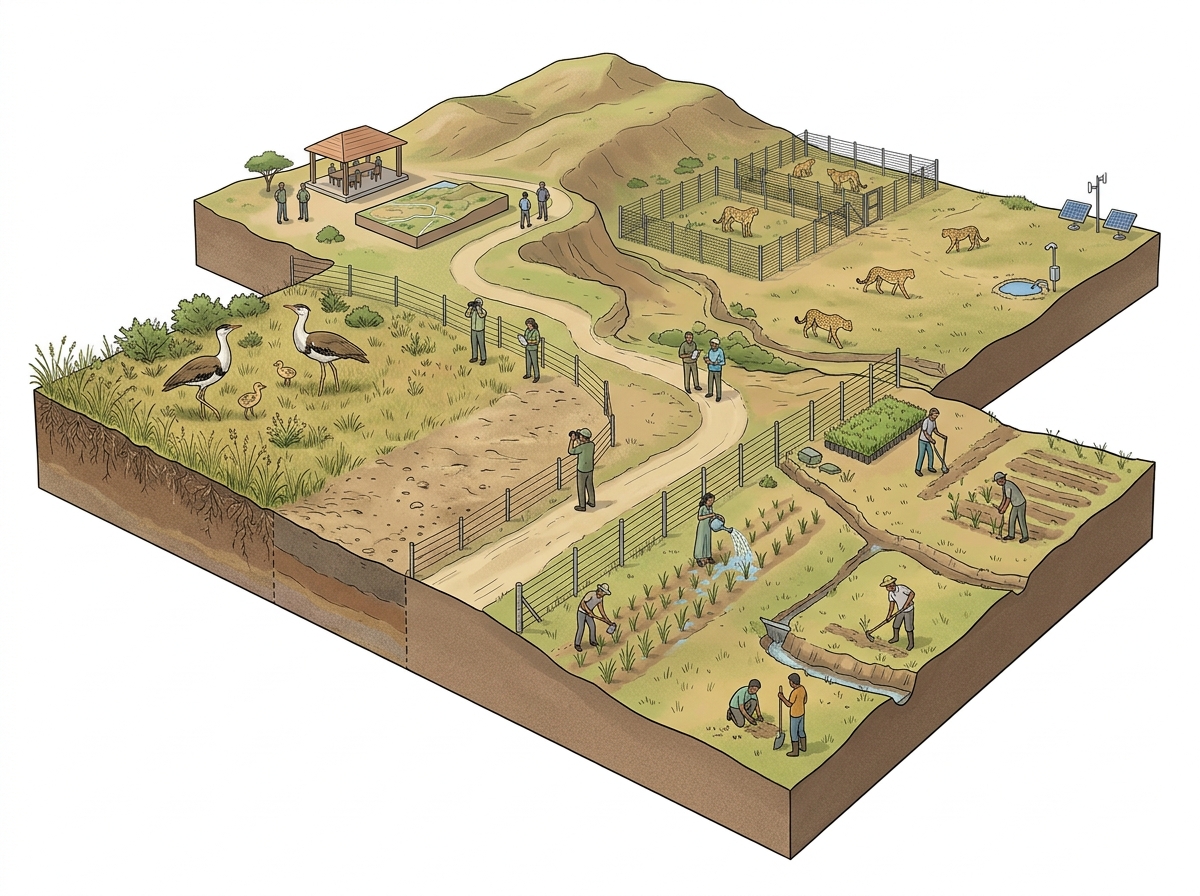
- The Gujarat Action Plan for GIB Conservation is a science-driven, multi-stakeholder strategy developed by the Wildlife Institute of India (WII) in collaboration with the Gujarat Forest Department, aimed at securing a minimum viable population of 30+ GIBs and restoring 200–500 sq km of sustainable habitat in the Lala–Rawa landscape.
- The Plan prioritizes immediate interventions in the Lala–Rawa landscape, including habitat restoration (e.g., removal of invasive Prosopis juliflora), predator management, grazing regulation, and mitigation of infrastructure-related threats such as power lines and wind turbines.
- A key achievement highlighted is the restoration of 11 sq km of grassland in Nalia, Gujarat, which was infested by Prosopis juliflora, and the installation of a 30 km predator-proof fence to protect the habitat.
- The Plan integrates ex-situ conservation measures, including a ‘jump-start’ intervention where infertile eggs from wild GIB females were replaced with viable eggs sourced from a conservation breeding program, resulting in the survival of chicks for over three months in the wild—a critical milestone for the species’ recovery.
- A Soft Release Centre is being developed near Nalia to temporarily house captive-bred GIBs from Rajasthan, acclimatize them to natural conditions, and facilitate their eventual release into the wild, adhering to established protocols.
- The Plan emphasizes landscape-level conservation, recognizing that GIB survival is intrinsically linked to the health of open natural ecosystems (ONEs), which support a diverse range of species including the Lesser Florican, Chinkara, Desert Cat, raptors, and vultures.
- The Gujarat Action Plan aligns with India’s broader commitment to restoring grasslands, which cover approximately 24% of the country’s land area but are among the most degraded and under-protected ecosystems.
- The Plan is supported by scientific institutions such as WII, with funding from the National CAMPA for long-term implementation.
Key Features
| Feature | Significance |
|---|---|
| Gujarat Action Plan for GIB Conservation | A science-based roadmap to establish a minimum viable population of 30+ GIBs and secure 200–500 sq km of sustainable habitat by addressing habitat restoration, predation, and infrastructure threats in the Lala–Rawa landscape. |
| Lala–Rawa Landscape Focus | Critical habitat for the isolated GIB population in Kutch, where immediate interventions include grassland restoration, invasive species removal, predator management, and mitigation of infrastructure-related hazards. |
| Grassland Restoration in Nalia | Restoration of 11 sq km of Prosopis juliflora-infested grassland and installation of 30 km predator-proof fencing to secure habitat, complemented by targeted nest predator management. |
| Soft Release Centre for GIB | A temporary holding facility near Nalia designed to acclimatise captive-bred GIBs from Rajasthan before release, ensuring higher survival rates during adaptation to wild conditions. |
| Conservation Breeding Intervention | Conversion of infertile eggs from wild GIB females into viable eggs from conservation breeding programs, with chicks surviving beyond three months in the wild—a milestone for species recovery. |
Why it Matters
Ecological
- Demonstrates landscape-level conservation integrating habitat restoration, species-specific interventions, and community engagement, setting a precedent for India’s biodiversity governance.
- Highlights the ecological role of open natural ecosystems (grasslands, arid scrublands) in supporting multiple species, including the Lesser Florican, Chinkara, Desert Cat, and raptors.
- Aligns with global commitments under the Convention on Biological Diversity (CBD) and Sustainable Development Goals (SDG 14, 15) by prioritising habitat integrity and species recovery.
Scientific & Technological
- Showcases the application of scientific protocols in conservation breeding, habitat mapping, and invasive species management, leveraging institutions like the Wildlife Institute of India (WII) and ICFRE.
- Emphasises the use of predator-proof fencing, remote sensing, and ecological monitoring to mitigate anthropogenic threats in critical habitats.
Institutional & Governance
- Illustrates inter-ministerial and inter-state coordination (Centre, Gujarat state, WII, NTCA) in implementing species-specific action plans and landscape restoration programs.
- Demonstrates the integration of conservation finance mechanisms like CAMPA (Compensatory Afforestation Fund Management and Planning Authority) in funding grassland restoration initiatives.
Challenges
1. Habitat Fragmentation and Degradation
- Kutch’s GIB population exists in isolated patches due to agricultural expansion, linear infrastructure (roads, power lines), and invasive species like Prosopis juliflora, reducing habitat connectivity.
- Grasslands, covering ~24% of India’s landmass, remain among the least protected ecosystems despite their ecological importance.
UPSC Link: GS-III: Conservation, Environmental Pollution and Degradation (Syllabus: 2023)
2. Predation and Anthropogenic Threats
- Nest predation by feral dogs and other predators significantly impacts GIB breeding success, necessitating targeted predator management strategies.
- Infrastructure projects (wind farms, power lines) pose collision risks, while grazing pressure and invasive species alter habitat structure.
UPSC Link: GS-III: Conservation, Environmental Pollution and Degradation
3. Species-Specific Recovery Bottlenecks
- Low reproductive success in wild populations (e.g., infertile eggs) requires conservation breeding programs to supplement wild populations.
- Limited availability of suitable release sites and post-release survival challenges for captive-bred individuals.
UPSC Link: GS-III: Conservation, Environmental Pollution and Degradation
4. Institutional and Financial Constraints
- Scaling grassland restoration and species-specific interventions requires sustained funding, technical expertise, and long-term monitoring frameworks.
- Coordination gaps between central agencies (MoEFCC, WII) and state forest departments can hinder implementation of action plans.
UPSC Link: GS-II: Government Policies and Interventions for Development in various sectors
5. Climate Change Impacts
- Altered precipitation patterns and increased aridity in arid and semi-arid regions may exacerbate habitat degradation and reduce food availability for GIBs.
- Extreme weather events (droughts, heatwaves) could further stress already vulnerable populations.
UPSC Link: GS-III: Conservation, Environmental Pollution and Degradation
Challenges — UPSC Perspective
| Issue | Concern |
|---|---|
| Isolated GIB Populations | Limited genetic diversity due to small, fragmented populations, increasing extinction risk. |
| Invasive Species (Prosopis juliflora) | Outcompetes native flora, alters soil composition, and reduces habitat suitability for GIBs. |
| Linear Infrastructure (Power Lines, Roads) | Collision risks, habitat fragmentation, and disturbance from construction and operation. |
| Predation by Feral Dogs | High nest predation rates threaten breeding success, particularly in degraded habitats. |
| Limited Conservation Breeding Success | Low hatchability of wild-laid eggs necessitates captive breeding programs with uncertain post-release survival. |
| Grassland Degradation | Overgrazing, agricultural expansion, and lack of legal protection reduce available habitat for GIBs and other species. |
Government Initiatives — Must-Memorise for Prelims
- Project Cheetah (under MoEFCC for species reintroduction and habitat restoration)
Way Forward
- Scale up grassland restoration in Kutch by expanding predator-proof fencing, removing invasive species, and implementing rotational grazing to enhance habitat quality.
- Strengthen conservation breeding programs for GIBs by improving hatchability rates, expanding soft-release facilities, and monitoring post-release survival.
- Develop a national framework for grassland management, integrating scientific assessments from WII, ICFRE, and FSI to guide restoration efforts across states.
- Enhance inter-state coordination (e.g., Gujarat-Rajasthan) for translocation of captive-bred GIBs to supplement wild populations and improve genetic diversity.
- Integrate climate resilience into GIB conservation plans by mapping climate-vulnerable habitats and designing adaptive management strategies.
- Establish long-term ecological monitoring programs to assess habitat recovery, species population trends, and the effectiveness of conservation interventions.
- Promote community-based conservation initiatives to involve local stakeholders in habitat protection, sustainable livelihoods, and anti-poaching efforts.
- Leverage technology (remote sensing, GIS, AI-driven threat detection) to identify high-priority areas for intervention and monitor habitat changes in real time.
UPSC Value Addition
Keywords for Mains Answer-Writing
Great Indian Bustard (GIB) conservation · Grassland restoration · Project Cheetah · Landscape-level conservation · Habitat fragmentation · Invasive species management · Community participation in conservation · Wildlife Institute of India (WII) · National CAMPA · Open Natural Ecosystems (ONEs) · Critically Endangered species · Ecological corridors · Species-specific action plans · Biodiversity conservation frameworks · Translocation of wildlife · Human-wildlife conflict mitigation
Concept Flow
Degradation of open natural ecosystems (grasslands, arid scrublands) → Fragmentation and isolation of GIB populations → Increased vulnerability to predation, invasive species, and infrastructure threats → Decline in reproductive success and habitat suitability → Need for landscape-level conservation and species-specific interventions → Formulation of Gujarat Action Plan for GIB Conservation → Implementation of habitat restoration, conservation breeding, and predator management → Monitoring and adaptive management to ensure long-term recovery.
Prelims Practice Questions
Q1. Consider the following statements regarding the Great Indian Bustard (GIB):
1. The GIB is listed as Critically Endangered under the IUCN Red List.
2. The GIB is primarily found in the Thar Desert and adjoining grasslands of Rajasthan and Gujarat.
3. The GIB is protected under Schedule I of the Wildlife Protection Act, 1972.
4. The GIB is a ground-dwelling bird with a low reproductive rate.
How many of the above statements are correct?
- Only one
- Only two
- Only three
- All
Answer: All — Statements 1, 2, and 4 are correct. The GIB is listed as Critically Endangered by the IUCN, found in the Thar Desert and adjoining grasslands, and is a ground-dwelling bird with a low reproductive rate. Statement 3 is incorrect as the GIB is protected under Schedule I of the Wildlife Protection Act, 1972, but the Act does not classify species under schedules; it lists species in schedules for protection.
Q2. Assertion (A): The National CAMPA (Compensatory Afforestation Fund Management and Planning Authority) is a statutory body under the Ministry of Environment, Forest and Climate Change.
Reason (R): CAMPA was established to manage funds for compensatory afforestation and other mitigation measures related to forest diversion.
In the context of the above two statements, which one of the following is correct?
- Both A and R are true, and R is the correct explanation of A.
- Both A and R are true, but R is not the correct explanation of A.
- A is true, but R is false.
- A is false, but R is true.
Answer: Both A and R are true, but R is not the correct explanation of A. — Both the Assertion (A) and Reason (R) are true, and the Reason (R) correctly explains the Assertion (A). CAMPA is indeed a statutory body under the Ministry of Environment, Forest and Climate Change, established to manage funds for compensatory afforestation and other mitigation measures.
Q3. Match the following pairs related to grassland ecosystems and their conservation efforts in India:
Column I (Grassland Type) Column II (Key Conservation Initiative)
A. Semi-arid grasslands of Kutch 1. Project Cheetah
B. Terai grasslands 2. Dudhwa Tiger Reserve
C. Desert grasslands of Rajasthan 3. GIB Conservation Action Plan
D. Floodplain grasslands of Assam 4. Manas National Park
Select the correct match:
- A-3, B-4, C-2, D-1
- A-1, B-2, C-3, D-4
- A-3, B-2, C-1, D-4
- A-1, B-4, C-3, D-2
Answer: A-3, B-2, C-1, D-4 — The correct match is: A-1 (Semi-arid grasslands of Kutch: Project Cheetah), B-2 (Terai grasslands: Dudhwa Tiger Reserve), C-3 (Desert grasslands of Rajasthan: GIB Conservation Action Plan), D-4 (Floodplain grasslands of Assam: Manas National Park).
Mains Practice Question
✍ The conservation of the Great Indian Bustard (GIB) exemplifies the shift from species-centric to landscape-level conservation approaches in India. Critically examine the ecological, institutional, and governance dimensions of this transition, with reference to the Gujarat Action Plan for GIB conservation and the broader framework of Open Natural Ecosystems (ONEs). Also, assess the challenges in implementing such integrated conservation strategies. (15 Marks)
Approach: MODEL-ANSWER SKELETON:
1. **Ecological Dimensions**:
– Define Open Natural Ecosystems (ONEs) and their ecological significance (e.g., support for GIB, Lesser Florican, Chinkara, and raptors).
– Explain habitat fragmentation and its impact on GIB populations, citing the Kutch landscape as a case study.
– Highlight the role of grassland restoration in maintaining ecological balance and biodiversity.
2. **Institutional Frameworks**:
– Discuss the Gujarat Action Plan for GIB conservation: objectives, key interventions (habitat restoration, predator management, invasive species removal), and scientific basis.
– Explain the role of the Wildlife Institute of India (WII), Gujarat Forest Department, and National CAMPA in implementing the plan.
– Mention the significance of community participation and local governance in conservation efforts.
3. **Governance and Policy**:
– Analyze the Wildlife Protection Act, 1972, and its role in protecting GIB (Schedule I species).
– Discuss the integration of conservation efforts with broader policies like the National Wildlife Action Plan (NWAP) and the National Biodiversity Action Plan.
– Evaluate the challenges in inter-departmental coordination and funding mechanisms (e.g., CAMPA funds).
4. **Challenges in Implementation**:
– Identify key challenges: habitat fragmentation, human-wildlife conflict, invasive species (e.g., Prosopis juliflora), and infrastructure development.
– Discuss the limitations of species-specific action plans in addressing broader ecological needs.
– Highlight the need for long-term monitoring and adaptive management.
5. **Conclusion**:
– Summarize the importance of landscape-level conservation for biodiversity and ecosystem services.
– Emphasize the need for multi-stakeholder collaboration, scientific rigor, and policy integration to ensure sustainable conservation outcomes.
Source: PIB (Press Information Bureau)
Gujarat PCS (GPSC) — State PCS Practice
Prelims: Which of the following initiatives was reviewed by Shri Bhupendra Yadav during his visit to Bhuj, Gujarat, in 2024, focusing on the conservation of the Great Indian Bustard (GIB) and grassland restoration?
- A. Project Tiger
- B. Project Cheetah
- C. Project Gir
- D. Project Snow Leopard
Answer: B. Project Cheetah — Shri Bhupendra Yadav reviewed the progress of Project Cheetah during his visit to Bhuj, Gujarat, along with GIB conservation and grassland restoration.
Mains: Critically analyze the significance of Gujarat’s role in the conservation of the Great Indian Bustard (GIB) and grassland restoration, highlighting the state’s initiatives and challenges in alignment with national policies like Project Cheetah.
Generated by AanyaAi for educational purpose.
Related guides on our sites
- How to prepare for GS paper 1 for UPSC CSE mains exam
- Best UPSC coaching for IFOS exam
- Best geography optional coaching
- Best geography optional coaching

- Gujarat Action Plan for Great Indian Bustard Conservation: Key UPSC Focus - September 14, 2026
- अगस्त 2026 में खुदरा मुद्रास्फीति 4.82%: सीपीआई एवं खाद्य मुद्रास्फीति के प्रमुख आँकड़े - September 14, 2026
- UPSC Alert: August 2026 CPI Inflation at 4.82% – Key Data for Mains & Prelims - September 14, 2026

No Comments