


15 Sep Odisha’s Fiscal Deficit Crosses Rs 23.6K Crore: Key Reasons & UPSC Analysis
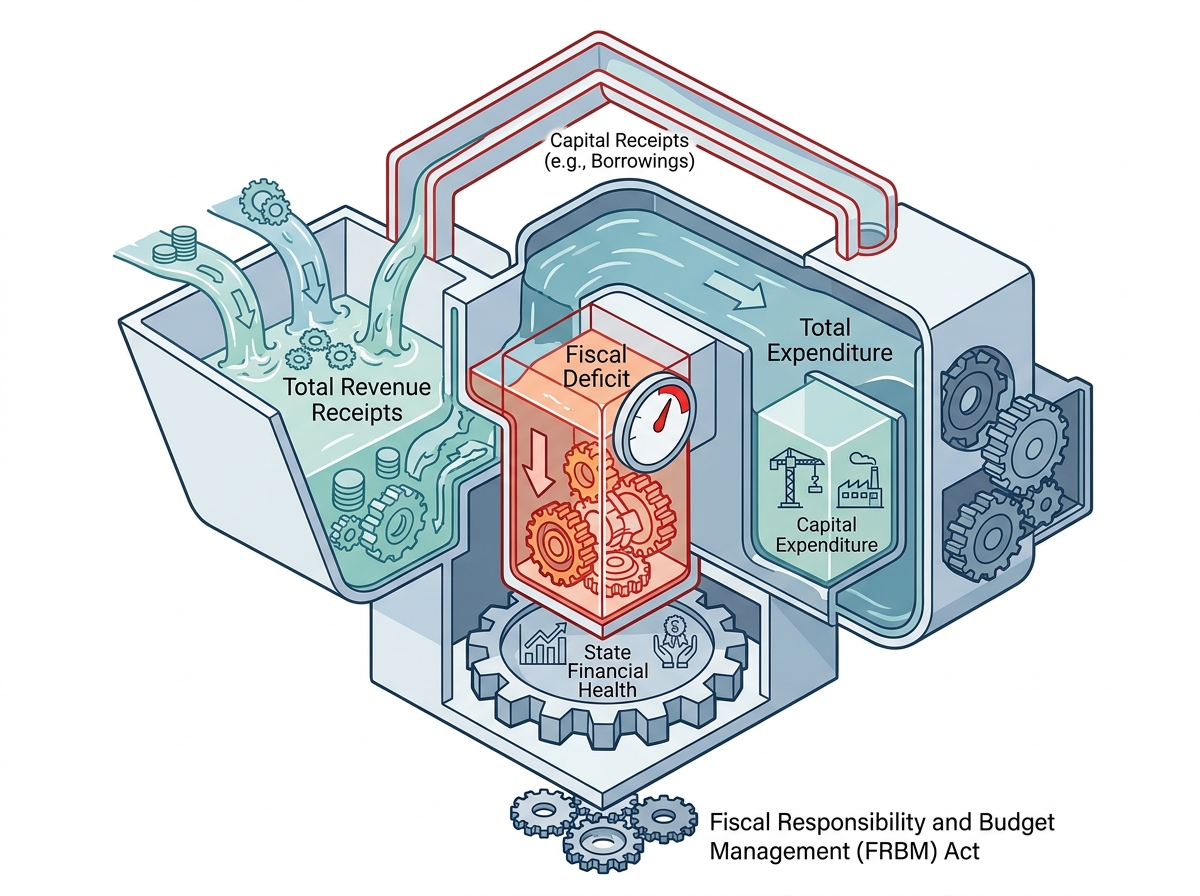
✎ Fiscal Deficit = Total Expenditure – (Revenue Receipts + Capital Receipts excluding Borrowings); it is financed through borrowings and reflects the state’s borrowing requirement for the year.
Subject Relevance — Where This Topic Fits
- GS Paper III — Indian Economy: Issues relating to Planning, Mobilisation of Resources, Growth, Development and Employment | GS Paper III — Government Budgeting and Fiscal Policy
- Prelims: Fiscal Deficit, Revenue Deficit, Revenue Surplus, Capital Expenditure, Revenue Expenditure, Fiscal Responsibility and Budget Management (FRBM) Act, Public Debt, Central Transfers, Gross Fiscal Deficit (GFD), Net Borrowings
- Essay: Fiscal Federalism in India: Challenges and the Way Forward, Balancing Development and Fiscal Prudence: A Case Study of State Finances
Quick Revision: Fiscal Deficit = Total Expenditure – (Revenue Receipts + Capital Receipts excluding Borrowings); it is financed through borrowings and reflects the state’s borrowing requirement for the year.
Why is this in the news?
The fiscal deficit of Odisha for the financial year 2025-26 has been reported at ₹23,650.89 crore, marginally lower than the previous year’s ₹25,042 crore. This development is significant as it reflects the state’s ongoing fiscal challenges despite revenue surplus, driven by declining central grants, suboptimal revenue mobilisation, and substantial capital expenditure. The situation underscores the complexities of state-level fiscal management in India, particularly in the context of developmental imperatives and fiscal discipline.
Background
- Fiscal deficit is the difference between a state’s total revenue receipts and total expenditure, excluding capital receipts such as borrowings. It is a critical indicator of a state’s financial health and sustainability.
- The Fiscal Responsibility and Budget Management (FRBM) Act, 2003, and its subsequent amendments, mandate states to adhere to fiscal deficit targets to ensure fiscal prudence and debt sustainability.
- Odisha, like other states, relies significantly on central transfers (devolution of taxes and grants-in-aid) for revenue receipts, which have been declining in recent years due to fiscal consolidation at the Centre.
- Revenue expenditure includes day-to-day administrative costs, salaries, pensions, and subsidies, while capital expenditure is directed towards asset creation, infrastructure development, and long-term growth.
- The state’s revenue mobilisation efforts have consistently fallen short of budgetary targets, reflecting challenges in tax buoyancy, compliance, and economic diversification.
- Public debt, including internal and external borrowings, plays a pivotal role in financing developmental expenditure but contributes to the fiscal deficit when net borrowings exceed repayments.
What is Fiscal Deficit and How is it Calculated?
- Fiscal Deficit represents the excess of total expenditure over total revenue receipts (excluding borrowings) in a financial year. It is calculated as: Fiscal Deficit = Total Expenditure – (Revenue Receipts + Capital Receipts excluding Borrowings).
- It is a broader measure than the revenue deficit, which only accounts for the difference between revenue receipts and revenue expenditure.
- Fiscal deficit is financed through borrowings, which increases the state’s public debt. Sustainable fiscal deficit levels are essential to avoid debt traps and ensure inter-generational equity.
- The FRBM Act prescribes fiscal deficit targets for states, typically set at 3% of Gross State Domestic Product (GSDP) with a glide path to achieve fiscal consolidation.
- Revenue surplus, as seen in Odisha’s case, does not necessarily eliminate fiscal deficit because capital expenditure and net loans/advances are not covered under revenue receipts.
- Capital expenditure, such as infrastructure projects, is critical for long-term growth but contributes to the fiscal deficit as it is not financed through revenue receipts.
- Central transfers, including the Finance Commission’s devolution and centrally sponsored schemes, form a significant portion of state revenue receipts but are subject to fiscal constraints at the Centre.
- Public debt sustainability is assessed using metrics such as debt-to-GSDP ratio, interest payments-to-revenue receipts ratio, and fiscal deficit-to-GSDP ratio.
Key Features
| Feature | Significance |
|---|---|
| Fiscal Deficit (Rs 23,650.89 crore) | Exceeds statutory limits under FRBM Act, indicating unsustainable expenditure vis-à-vis revenue receipts. |
| Revenue Collection Shortfall (85% of target) | Reveals structural gaps in tax administration and economic base expansion. |
| Capital Expenditure (Rs 42,398.35 crore) | Drives long-term growth but increases fiscal deficit due to higher borrowings. |
| Declining Central Grants (Rs 21,011 crore → Rs 16,042 crore) | Reduces fiscal space, forcing reliance on state’s own resources and debt. |
| Revenue Surplus (Rs 21,785.69 crore) | Masks fiscal stress as capital outlays and net loans/advances widen deficit. |
Why it Matters
Fiscal Federalism
- Demonstrates the tension between state autonomy in expenditure and central resource transfers, governed by Article 275 and Finance Commission recommendations.
- Highlights the impact of declining central grants on state developmental capacity, particularly in infrastructure and social sectors.
Public Debt Management
- Net increase in public debt (Rs 10,829.55 crore) reflects the state’s reliance on borrowings to bridge fiscal gaps, raising concerns about debt sustainability.
- Loans and advances extended (Rs 3,854.97 crore) may strain future budgets if recoveries remain suboptimal.
Revenue Mobilisation
- Shortfall in own tax and non-tax revenue (15% below target) underscores the need for tax base expansion and efficiency improvements in revenue administration.
- Dependence on central transfers (16,042 crore in 2025-26) limits policy flexibility and exposes vulnerability to fiscal shocks.
Developmental Expenditure
- Capital expenditure (42,398.35 crore) is critical for long-term growth but increases fiscal deficit, necessitating a balance between growth and fiscal prudence.
- Underutilisation of budgetary allocations for development programmes risks inefficiency and delays in infrastructure creation.
Challenges
1. Declining Central Transfers
- Reduction in central grants from Rs 21,011 crore (2023-24) to Rs 16,042 crore (2025-26) constrains fiscal capacity.
- Limits the state’s ability to fund social sector schemes and infrastructure projects without increasing debt.
UPSC Link: Finance Commission recommendations on grants-in-aid
2. Revenue Collection Shortfall
- Actual revenue collection (85% of target) indicates systemic inefficiencies in tax administration and economic base limitations.
- Affects the state’s ability to meet expenditure commitments without resorting to borrowings.
UPSC Link: Tax buoyancy and GST implementation challenges
3. Fiscal Deficit Management
- Fiscal deficit crossing Rs 23,650.89 crore violates FRBM Act norms, risking fiscal discipline and macroeconomic stability.
- High capital expenditure and net loans/advances exacerbate the deficit, necessitating urgent corrective measures.
UPSC Link: Fiscal Responsibility and Budget Management Act
4. Debt Sustainability
- Net increase in public debt (Rs 10,829.55 crore) raises concerns about future debt servicing and fiscal space.
- Loans and advances extended (Rs 3,854.97 crore) may lead to contingent liabilities if recoveries are inadequate.
UPSC Link: Public debt management and FRBM Act guidelines
5. Capital Expenditure Efficiency
- High capital outlay (Rs 42,398.35 crore) must be utilised effectively to avoid wastage and ensure developmental outcomes.
- Underutilisation of allocations risks inefficiency and delays in critical infrastructure projects.
UPSC Link: Infrastructure financing and budget utilisation
Challenges — UPSC Perspective
| Issue | Concern |
|---|---|
| Declining Central Grants | Reduces fiscal capacity and limits developmental expenditure. |
| Revenue Collection Shortfall | Undermines fiscal autonomy and increases reliance on borrowings. |
| High Fiscal Deficit | Violates FRBM norms and risks macroeconomic instability. |
| Increasing Public Debt | Raises debt servicing burden and constrains future budgets. |
| Capital Expenditure Efficiency | Risk of underutilisation and inefficiency in infrastructure projects. |
Way Forward
- Enhance tax administration efficiency to improve revenue collection and reduce dependence on central grants.
- Diversify revenue sources through expansion of GST base and non-tax revenue streams (e.g., user charges for infrastructure).
- Prioritise capital expenditure on high-impact infrastructure projects with clear timelines and monitoring mechanisms.
- Strengthen fiscal discipline by adhering to FRBM Act targets and reducing non-essential expenditure.
- Explore innovative financing models (e.g., public-private partnerships) to fund infrastructure without excessive borrowing.
- Improve utilisation of budgetary allocations through real-time monitoring and performance-based audits.
- Conduct a comprehensive review of loans and advances extended to ensure timely recoveries and reduce contingent liabilities.
UPSC Value Addition
Keywords for Mains Answer-Writing
Fiscal Deficit · State Finances · Revenue Surplus · Capital Expenditure · Public Debt · Central Grants · Revenue Receipts · Revenue Expenditure · Fiscal Responsibility and Budget Management (FRBM) · Intergovernmental Fiscal Transfers · Union-State Financial Relations · Public Finance Management · Budgetary Allocations · Fiscal Consolidation · Development Expenditure
Constitutional & Policy Linkages
- Article 275 – Grants-in-aid to states for specified purposes.
- Article 280 – Finance Commission recommendations on resource transfers.
Concept Flow
Decline in central grants → Reduced fiscal capacity → Increased reliance on state borrowings → Rising public debt. → Revenue collection shortfall → Lower own resources → Higher fiscal deficit despite revenue surplus. → High capital expenditure → Increased developmental outlay → Widening fiscal deficit. → Net loans and advances extended → Contingent liabilities → Further pressure on future budgets. → Underutilisation of allocations → Inefficiency in infrastructure projects → Delayed developmental outcomes.
Prelims Practice Questions
Q1. Consider the following statements regarding fiscal deficit in the context of Indian states:
1. Fiscal deficit is the difference between total revenue receipts and total revenue expenditure of a state.
2. A revenue surplus implies that a state’s fiscal deficit must necessarily be zero.
3. Capital expenditure is excluded from the calculation of fiscal deficit.
How many of the above statements are correct?
- Only one
- Only two
- All three
- None
Answer: Only one — Statement 1 is incorrect: Fiscal deficit is the difference between total expenditure (revenue + capital) and total receipts (revenue + capital) excluding borrowings. Statement 2 is incorrect: A revenue surplus does not preclude fiscal deficit if capital expenditure exceeds net capital receipts. Statement 3 is incorrect: Capital expenditure is included in fiscal deficit calculation.
Q2. Assertion (A): The Fiscal Responsibility and Budget Management (FRBM) Act mandates states to reduce their fiscal deficit to 3% of GSDP by 2023-24.
Reason (R): The FRBM Act, 2003, was amended in 2018 to align with the recommendations of the Fourteenth Finance Commission.
- Both A and R are true, and R is the correct explanation of A
- Both A and R are true, but R is not the correct explanation of A
- A is true but R is false
- A is false but R is true
Answer: A is false but R is true — Assertion (A) is false: The FRBM Act does not prescribe a uniform 3% fiscal deficit target for all states; targets are set by the Finance Commission and vary by state. Reason (R) is true: The FRBM Act was amended in 2018 to incorporate recommendations of the Fourteenth Finance Commission, including flexible fiscal deficit targets for states.
Q3. Match the following pairs related to fiscal transfers in India:
Column I (Type of Transfer) Column II (Description)
A. Statutory Grants 1. Transfers mandated by the Constitution to states as per the recommendations of the Finance Commission
B. Discretionary Grants 2. Transfers made by the Union to states for specific schemes or projects
C. Devolution of Taxes 3. Share of central taxes distributed to states as per constitutional provisions
D. Centrally Sponsored Schemes 4. Transfers based on the discretion of the Union Government for special needs
- A-1, B-4, C-3, D-2; A-2, B-1, C-4, D-3; A-3, B-2, C-1, D-4; A-4, B-3, C-2, D-1
- answer_array_indexes_to_match_pairs_only_in_code_so_skip_this
- answer_array_indexes_to_match_pairs_only_in_code_so_skip_this
- answer_array_indexes_to_match_pairs_only_in_code_so_skip_this
Answer: ? — A-1: Statutory grants are mandated by the Constitution and recommended by the Finance Commission. B-4: Discretionary grants are provided at the Union’s discretion for special needs. C-3: Devolution of taxes refers to the constitutional share of central taxes distributed to states. D-2: Centrally Sponsored Schemes are specific projects funded by the Union with state participation.
Mains Practice Question
✍ The fiscal deficit of a state is not merely a numerical outcome but a reflection of its developmental priorities and fiscal management. Critically examine this statement with reference to the fiscal position of Odisha in 2025-26. Also, analyse the implications of declining central grants on state finances. (15 Marks)
Approach: 1. Define fiscal deficit and its components (revenue deficit, capital expenditure, public debt) with reference to Odisha’s data (Rs 23,650.89 crore deficit, revenue surplus of Rs 21,785.69 crore, capital expenditure of Rs 42,398.35 crore).
2. Explain how developmental priorities (infrastructure, investment attraction) drive capital expenditure and contribute to fiscal deficit despite revenue surplus.
3. Discuss the role of FRBM Act and state-level fiscal rules in managing deficits; cite Odisha’s fiscal trajectory (declining central grants from Rs 21,011 crore in 2023-24 to Rs 16,042 crore in 2025-26).
4. Analyse the implications of declining central grants: reduced fiscal space, pressure on own revenue mobilization, and constraints on social sector spending.
5. Evaluate the trade-offs between developmental expenditure and fiscal consolidation; cite examples of states with similar challenges (e.g., Kerala, Punjab).
6. Conclude with a balanced view: fiscal deficit as a tool for growth vs. fiscal prudence, and the need for long-term planning and revenue diversification.
Source: orissapost.com
Generated by AanyaAi for educational purpose.
Related guides on our sites
- Current affairs for upsc 2026
- Best economics optional coaching for upsc
- Best economics optional teacher for upsc
- How to prepare for GS paper 1 for UPSC CSE mains exam

- एल नीनो की मार: आंध्र के फूलों का बगीचा सूखा, उत्पादन 40% घटा - September 18, 2026
- El Niño’s Impact: Kuppam’s Flower Output Drops 40% in Andhra Pradesh - September 18, 2026
- कर्नाटक: सीएम शिवकुमार की पश्चिमी घाट रिपोर्ट पर बैठक के चलते तीन शिक्षण संस्थानों में छुट्टी - September 18, 2026

No Comments