


17 Sep UPSC Alert: Himachal’s Manimahesh Yatra Suspended Due to Extreme Weather
✎ The temporary suspension of the Manimahesh Yatra in Himachal Pradesh due to extreme weather events exemplifies the need for adaptive disaster risk management in Himalayan pilgrimages, balancing religious practices with the safety…
Subject Relevance — Where This Topic Fits
- GS Paper II — Governance, Administration and Challenges — Disaster Management | GS Paper III — Environment and Disaster Management — Climate Change and Himalayan Ecology
- Prelims: Manimahesh Yatra, Himalayan glaciers, Glacial Lake Outburst Flood (GLOF), Disaster Risk Reduction (DRR), Himalayan Ecosystem, Extreme Weather Events, District Administration, Chamba District, Himachal Pradesh
- Essay: Climate Change and Human Resilience: Lessons from Himalayan Pilgrimages, Governance in the Face of Natural Disasters: Balancing Faith and Safety
Quick Revision: The temporary suspension of the Manimahesh Yatra in Himachal Pradesh due to extreme weather events exemplifies the need for adaptive disaster risk management in Himalayan pilgrimages, balancing religious practices with the safety of devotees in climate-vulnerable regions.
Why is this in the news?
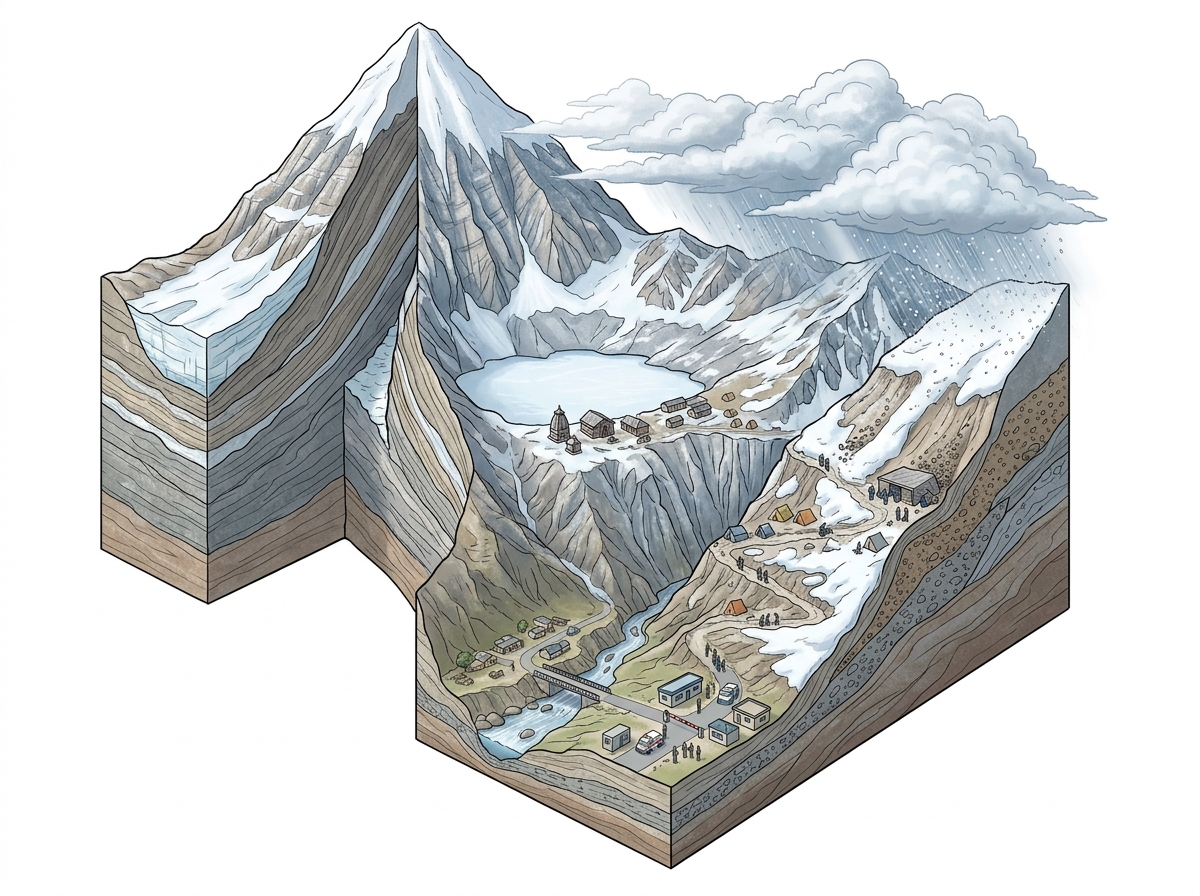
The Manimahesh Yatra in Himachal Pradesh was temporarily suspended on 17 September 2026 due to extreme weather conditions, including continuous rainfall and snowfall at high-altitude locations such as Dal Lake, Manimahesh Peak, Gaurikund, and Sundarsi. The district administration, prioritising the safety of pilgrims, imposed a temporary halt to prevent risks associated with slippery terrain, avalanches, and unpredictable weather patterns. This decision highlights the challenges of managing high-altitude pilgrimages in the context of climate-induced disasters and the role of administrative discretion in disaster risk reduction.
Background
- The Manimahesh Yatra is an annual Hindu pilgrimage held in the Chamba district of Himachal Pradesh, centred around the sacred Manimahesh Lake and the Manimahesh Peak, situated at an altitude of approximately 4,180 metres.
- The yatra typically takes place during the months of August and September, coinciding with the Hindu calendar month of Bhadrapada or the full moon (Purnima) of the same month.
- Himalayan regions, including Himachal Pradesh, are highly vulnerable to extreme weather events such as heavy rainfall, snowfall, landslides, and Glacial Lake Outburst Floods (GLOFs) due to climate change and fragile geological conditions.
- The Chamba district, part of the Western Himalayas, experiences significant seasonal variations, with high-altitude areas prone to sudden weather shifts and natural hazards.
- Disaster management in pilgrimage sites requires coordinated efforts between local administrations, state disaster management authorities, and religious institutions to ensure the safety of devotees.
- The suspension of the yatra underscores the need for adaptive governance frameworks to address climate-induced risks in religious and cultural practices.
What is the Manimahesh Yatra and its significance?
- The Manimahesh Yatra is a prominent Hindu pilgrimage in the Chamba district of Himachal Pradesh, dedicated to Lord Shiva, with the primary site being the sacred Manimahesh Lake (also known as Dal Lake) and the adjacent Manimahesh Peak.
- The yatra is conducted annually during the months of August and September, with the peak being the full moon day (Purnima) of the Hindu month of Bhadrapada, attracting thousands of devotees from across India.
- The pilgrimage involves a challenging trek from Hadsar village to the Manimahesh Lake, passing through high-altitude terrain, including glaciers and steep slopes, making it physically demanding and weather-sensitive.
- Manimahesh is considered one of the holiest Shiva sites in the Himalayas, comparable to other significant pilgrimages such as Amarnath and Kedarnath, and holds deep cultural and religious significance for the local community.
- The yatra is not only a religious event but also an economic activity for the region, generating livelihood opportunities for local vendors, porters, and service providers.
- The pilgrimage site is located in a seismically active and ecologically fragile zone, necessitating stringent safety protocols, especially during the monsoon and early winter months.
- The temporary suspension of the yatra due to extreme weather events reflects the broader challenges of managing high-altitude pilgrimages in the context of climate change and disaster risk reduction.
Key Features
| Feature | Significance |
|---|---|
| Temporary suspension of Manimahesh Yatra | Ensures safety of pilgrims during adverse weather conditions, preventing accidents and fatalities in high-altitude regions. |
| Administrative oversight by District Administration Chamba | Demonstrates the role of local governance in crisis management and pilgrim protection. |
| Real-time weather monitoring | Critical for decision-making in high-risk pilgrimage routes where weather can change rapidly. |
| Public advisory through official channels | Prevents misinformation and ensures pilgrims rely on verified sources for updates. |
| Safety protocols for high-altitude pilgrimage | Highlights the need for pre-emptive measures in ecologically sensitive and hazardous terrains. |
Why it Matters
Economic
- Pilgrimage tourism contributes significantly to local economies in Himachal Pradesh, particularly in Chamba district, through revenue from accommodation, food, and transport services.
- Temporary suspension may lead to short-term economic losses for local businesses dependent on pilgrim activities.
- Long-term sustainability of pilgrimage routes requires balancing economic benefits with environmental and safety considerations.
Environmental
- High-altitude regions like Manimahesh are ecologically fragile; weather disruptions can accelerate soil erosion and affect biodiversity.
- Sustainable pilgrimage management must integrate climate resilience to mitigate long-term environmental degradation.
Administrative
- Showcases the role of district administrations in managing natural disasters and ensuring public safety during religious events.
- Highlights the importance of inter-departmental coordination (e.g., meteorology, disaster management, local police) in crisis response.
Social
- Religious pilgrimages are socio-cultural events that foster community cohesion and spiritual tourism.
- Administrative interventions must balance religious sentiments with safety imperatives to maintain public trust.
Challenges
1. Adverse Weather Conditions in High-Altitude Pilgrimages
- Rapid weather changes in Himalayan regions pose life-threatening risks to pilgrims due to landslides, avalanches, and hypothermia.
- Limited infrastructure in remote areas complicates rescue and relief operations during emergencies.
- Climate change is exacerbating weather unpredictability, necessitating adaptive management strategies.
UPSC Link: GS-III: Disaster Management
2. Balancing Pilgrim Safety with Religious Sentiments
- Administrative decisions to suspend yatras may face resistance from devotees prioritising religious obligations over safety advisories.
- Ensuring compliance with official directives requires effective communication and community engagement.
UPSC Link: GS-IV: Ethics in Governance
3. Infrastructure Gaps in Remote Pilgrimage Routes
- Poor road connectivity, lack of medical facilities, and inadequate shelter infrastructure increase vulnerability during disruptions.
- Long-term investment in resilient infrastructure is essential for sustainable pilgrimage management.
UPSC Link: GS-III: Infrastructure
4. Misinformation and Rumour Management
- Unofficial sources often spread unverified information, leading to panic or non-compliance with safety protocols.
- Robust communication strategies are required to disseminate accurate updates promptly.
UPSC Link: GS-IV: Citizen Centric Governance
Challenges — UPSC Perspective
| Issue | Concern |
|---|---|
| Rapid weather deterioration | Increased risk of accidents, loss of life, and logistical challenges in rescue operations. |
| Limited emergency response capacity | Remote locations hinder quick deployment of medical aid and relief materials. |
| Public resistance to administrative directives | Potential for conflict between safety protocols and religious commitments. |
| Climate change impacts | Long-term unpredictability of weather patterns necessitates adaptive governance frameworks. |
| Infrastructure deficits | Inadequate roads, shelters, and communication networks exacerbate crisis vulnerabilities. |
Way Forward
- Strengthen real-time weather monitoring systems with automated sensors and AI-driven predictive analytics for high-altitude regions.
- Develop pre-emptive evacuation plans and establish temporary shelters with medical facilities along pilgrimage routes.
- Enhance inter-departmental coordination between district administrations, meteorological departments, and disaster management authorities.
- Launch public awareness campaigns to educate pilgrims on safety protocols and the importance of adhering to official advisories.
- Invest in climate-resilient infrastructure, including all-weather roads, drainage systems, and communication networks in ecologically sensitive areas.
- Establish a grievance redressal mechanism to address concerns of pilgrims while ensuring transparency in decision-making.
- Collaborate with local communities and religious leaders to foster trust in administrative interventions during crises.
UPSC Value Addition
Keywords for Mains Answer-Writing
Disaster Management · Administrative Discretion · Temporary Suspension of Religious Yatras · Extreme Weather Events · Public Safety and Governance · Himachal Pradesh Administration · Religious Tourism Regulation · Climate Change and Pilgrimage Sites · Constitutional Provisions for Public Order · Administrative Measures for Crisis Mitigation
Concept Flow
Adverse weather conditions (rain, snow) in high-altitude regions → Increased risk of accidents and fatalities → District Administration Chamba assesses situation → Temporary suspension of Manimahesh Yatra → Public advisory issued via official channels → Pilgrims advised to await further instructions → Safety protocols enforced → Coordination with meteorological and disaster management agencies → Review of weather conditions → Decision on resumption of yatra based on real-time data → Long-term planning for resilient pilgrimage management → Integration of climate adaptation strategies
Prelims Practice Questions
Q1. Consider the following statements regarding the constitutional framework for regulating religious yatras in India:
1. The state government can impose temporary restrictions on religious yatras under Article 25(1) of the Constitution to maintain public order.
2. The Supreme Court in the case of Commissioner, Hindu Religious Endowments, Madras v. Sri Lakshmindra Thirtha Swamiar (1954) held that religious practices can be regulated if they are prejudicial to public order, morality, or health.
3. The Union Government has exclusive power to regulate all religious yatras under Entry 97 of the Union List.
How many of the above statements are correct?
- Only one
- Only two
- All three
- None
Answer: Only two — Statement 1 is correct as Article 25(1) allows the state to regulate religious activities in the interest of public order, morality, and health. Statement 2 is correct as the Supreme Court in the cited case established the principle of reasonable restrictions on religious practices. Statement 3 is incorrect because the regulation of religious yatras falls under the state list (Entry 32 of the State List) and not exclusively under the Union List.
Q2. Assertion (A): The Himachal Pradesh Administration’s decision to temporarily suspend the Manimahesh Yatra due to adverse weather conditions is an exercise of administrative discretion under the Disaster Management Act, 2005.
Reason (R): The Disaster Management Act, 2005 empowers the district administration to suspend public gatherings and religious activities in the event of a natural disaster or extreme weather conditions to ensure public safety.
In the context of the above two statements, which one of the following is correct?
- Both A and R are true, and R is the correct explanation of A
- Both A and R are true, but R is NOT the correct explanation of A
- A is true, but R is false
- A is false, but R is true
Answer: Both A and R are true, and R is the correct explanation of A — Both the Assertion (A) and Reason (R) are true. The Disaster Management Act, 2005, under Section 35, empowers the district administration to take measures to mitigate disasters, including the suspension of public gatherings. The Reason (R) correctly explains the Assertion (A) as the administrative action is directly grounded in the statutory framework of the Act.
Q3. Match the following pairs related to disaster management and governance in India:
Column I (Provisions/Acts) | Column II (Purpose)
1. Disaster Management Act, 2005 | A. Empowers the President to proclaim a national disaster
2. National Disaster Response Fund (NDRF) | B. Provides financial assistance for disaster relief
3. Article 355 of the Constitution | C. Mandates the preparation of disaster management plans
4. National Disaster Management Authority (NDMA) | D. Ensures the safety and security of the states
Select the correct match:
- 1-C, 2-B, 3-D, 4-A
- 1-A, 2-B, 3-D, 4-C
- 1-C, 2-D, 3-B, 4-A
- 1-D, 2-A, 3-C, 4-B
Answer: 1-C, 2-B, 3-D, 4-A — The correct matches are: 1-C (Disaster Management Act, 2005 mandates disaster management plans under Section 6), 2-B (NDRF provides financial assistance for disaster relief), 3-D (Article 355 ensures the safety and security of the states), and 4-A (NDMA is headed by the Prime Minister and is the apex body for disaster management).
Mains Practice Question
✍ The administration’s decision to temporarily suspend the Manimahesh Yatra in Himachal Pradesh due to adverse weather conditions exemplifies the delicate balance between religious freedom and public safety. Critically examine the constitutional and statutory provisions that enable such administrative actions. Also, discuss the challenges faced by authorities in regulating religious yatras in the context of climate change and extreme weather events. (15 Marks)
Approach: MODEL-ANSWER SKELETON:
1. **Constitutional Framework**:
– Article 25(1) of the Constitution guarantees the right to freedom of religion but allows reasonable restrictions in the interest of public order, morality, and health.
– The Supreme Court in *Commissioner, Hindu Religious Endowments, Madras v. Sri Lakshmindra Thirtha Swamiar* (1954) established that religious practices can be regulated if they are prejudicial to public order.
– Article 26(b) allows religious denominations to manage their affairs but is subject to public order and health.
2. **Statutory Provisions**:
– **Disaster Management Act, 2005**: Under Section 35, district authorities can take measures to mitigate disasters, including suspending public gatherings. Section 12 mandates the preparation of disaster management plans.
– **Code of Criminal Procedure, 1973**: Section 144 empowers magistrates to prohibit assemblies or processions in the interest of public safety.
– **Himachal Pradesh Disaster Management Rules, 2013**: Provide specific guidelines for managing disasters, including yatras.
3. **Administrative Discretion**:
– The decision to suspend the yatra is an exercise of administrative discretion under the Disaster Management Act, 2005, and the Code of Criminal Procedure.
– The principle of *proportionality* must be adhered to—restrictions must be reasonable and necessary.
4. **Challenges in Regulation**:
– **Climate Change**: Increased frequency of extreme weather events (e.g., heavy rainfall, snowfall) complicates yatra planning.
– **Religious Sentiment**: Balancing public safety with religious sentiments is a delicate task.
– **Logistical Constraints**: Ensuring the safety of pilgrims in remote, high-altitude areas requires robust infrastructure and real-time monitoring.
– **Legal Challenges**: Petitions may be filed challenging the suspension on grounds of religious freedom or discrimination.
5. **Way Forward**:
– Strengthening early warning systems and real-time monitoring.
– Collaborating with meteorological departments and local communities for risk assessment.
– Sensitizing pilgrims about safety protocols and weather advisories.
6. **Conclusion**:
– The suspension of the Manimahesh Yatra is a justified exercise of administrative discretion aimed at safeguarding public safety. However, long-term solutions require a multi-stakeholder approach, including climate adaptation strategies and community engagement.
Source: amarujala.com
Himachal Pradesh PCS (HPPSC (HAS)) — State PCS Practice
Prelims: Which of the following is NOT a primary reason for the Himachal Pradesh administration imposing a temporary halt on the Manimahesh Yatra due to adverse weather conditions?
- A. Heavy rainfall leading to landslides
- B. Snowfall disrupting the pilgrimage route
- C. Overcrowding of devotees at the Manimahesh Lake
- D. Risk of flash floods in the region
Answer: C. Overcrowding of devotees at the Manimahesh Lake — The temporary halt was imposed due to heavy rainfall, snowfall, and associated risks like landslides and flash floods, not overcrowding.
Mains: Discuss the significance of the Manimahesh Yatra in Himachal Pradesh’s cultural and religious landscape. How does the administration balance the spiritual importance of the yatra with the safety of devotees during extreme weather conditions? Suggest measures to mitigate risks while preserving the yatra’s sanctity.
Generated by AanyaAi for educational purpose.
Related guides on our sites
- Current affairs for upsc 2026
- Best PSIR optional coaching for upsc
- Best PSIR optional teacher for upsc
- Best teacher of PSIR optional for upsc

- विकलांग सैन्य कैडेटों को पेंशन देने से रोक रही सरकार की नीति: केंद्र ने सुप्रीम कोर्ट में बताया - September 23, 2026
- Centre Tells SC: Policy Blocks Disability Pension for Outboarded Cadets - September 23, 2026
- यूपीएससी तैयारी: स्कूलों में स्वच्छता सुविधाओं की कमी, 5 करोड़ बच्चे प्रभावित - September 23, 2026

No Comments