


18 Sep CCI Approves Acquisition of Rajasthan Royals & Two Global Cricket Franchises

✎ The Competition Commission of India (CCI) approves mergers and acquisitions under the Competition Act, 2002, to prevent anti-competitive practices and ensure a level playing field in markets, including the sports industry.
Subject Relevance — Where This Topic Fits
- GS Paper II — Governance, Transparency and Accountability | GS Paper III — Competition Policy, Regulatory Mechanisms and Sports Economy
- Prelims: Competition Commission of India (CCI), Merger and Acquisition (M&A), Indian Premier League (IPL), Anti-competitive practices, Corporate governance in sports
- Essay: The role of regulatory bodies in fostering fair competition in emerging sectors, Balancing economic growth with regulatory oversight in the sports industry
Quick Revision: The Competition Commission of India (CCI) approves mergers and acquisitions under the Competition Act, 2002, to prevent anti-competitive practices and ensure a level playing field in markets, including the sports industry.
Why is this in the news?
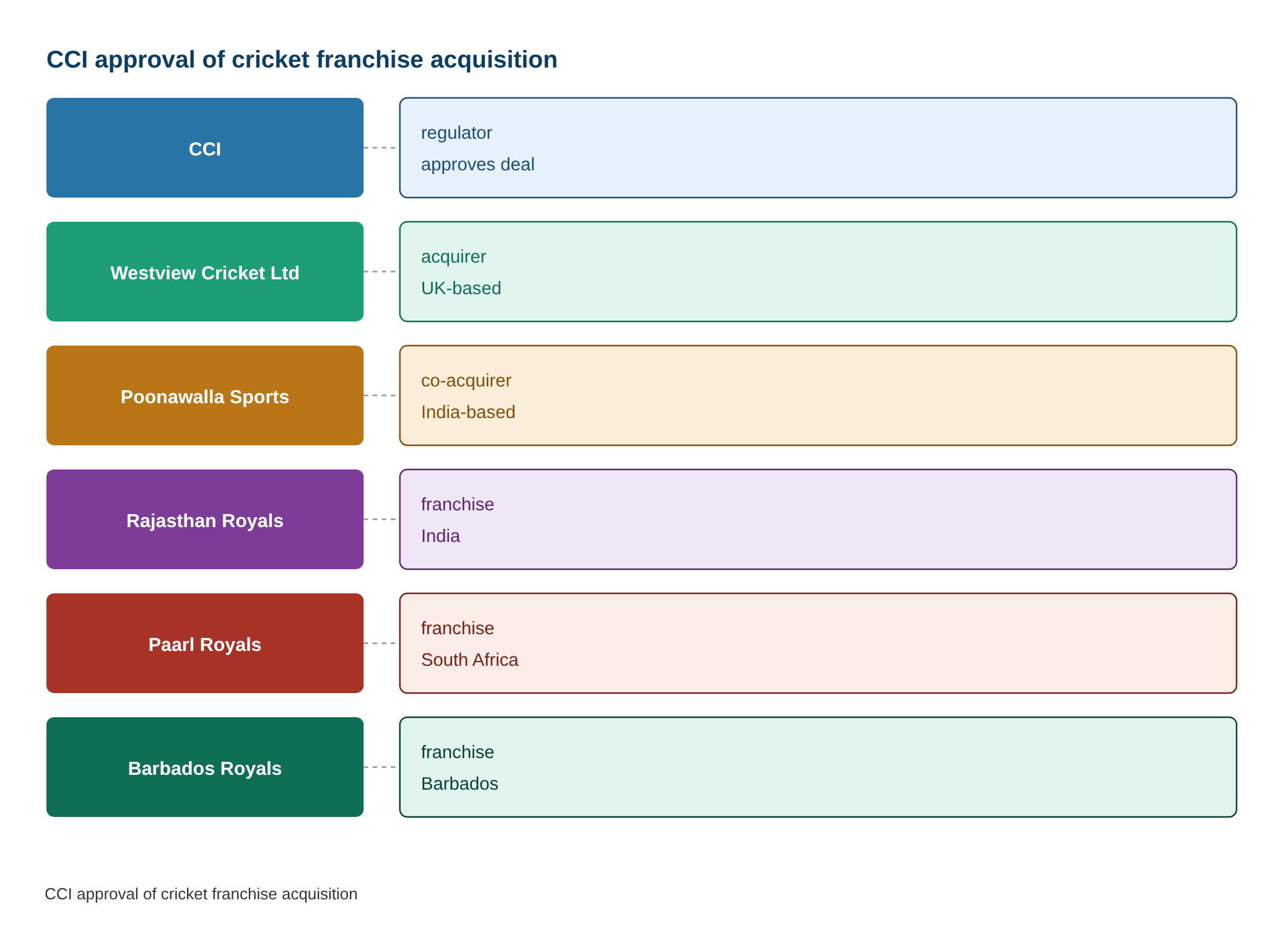
The Competition Commission of India (CCI) has approved the acquisition of three professional cricket franchises—Rajasthan Royals (India), Paarl Royals (South Africa), and Barbados Royals (Barbados)—by Westview Cricket Limited and Poonawalla Sports and Fitness Private Limited. This decision underscores the CCI’s role in scrutinising cross-border mergers and acquisitions in the sports sector to prevent anti-competitive practices and ensure a level playing field.
Background
- The Indian Premier League (IPL), governed by the Board of Control for Cricket in India (BCCI), is a globally recognised Twenty20 cricket league with significant commercial and sporting implications.
- The acquisition involves entities registered in multiple jurisdictions, including the United Kingdom, India, and Mauritius, highlighting the transnational nature of modern sports business models.
- The CCI’s mandate under the Competition Act, 2002, includes regulating mergers and acquisitions to prevent practices that may adversely affect competition in India or impact Indian markets.
- The franchises involved—Rajasthan Royals (IPL), Paarl Royals (South Africa), and Barbados Royals (West Indies)—operate within different cricketing boards but share a common ownership structure post-acquisition.
- The approval follows the CCI’s assessment of potential anti-competitive effects, including market dominance, cross-subsidisation, and vertical integration in the sports and entertainment sector.
What is the Competition Commission of India (CCI)?
- The CCI is a statutory body established under the Competition Act, 2002, to enforce competition laws in India and promote fair competition in markets.
- Its primary functions include regulating mergers and acquisitions (M&A), investigating anti-competitive agreements, and penalising abuse of dominant market positions.
- The CCI operates independently of the executive, with a Chairperson and six Members appointed by the Central Government.
- Under Section 31 of the Competition Act, the CCI is empowered to approve or reject combinations (M&A) that exceed specified thresholds, ensuring no adverse impact on competition.
- The CCI’s jurisdiction extends to both domestic and international transactions if they have a ‘significant adverse effect’ on competition within India or involve Indian entities.
- The approval process involves a phased review, including a prima facie assessment, detailed investigation, and public consultation to gauge stakeholder impact.
- The CCI’s decisions are subject to judicial review, with appeals lying to the National Company Law Appellate Tribunal (NCLAT) and subsequently to the Supreme Court.
- In the sports sector, the CCI has previously scrutinised M&A deals involving franchise ownership, broadcasting rights, and sponsorship agreements to prevent monopolistic practices.
Key Features
| Feature | Significance |
|---|---|
| Acquisition of three professional cricket franchises | Facilitates consolidation of ownership across multiple international T20 leagues, potentially enhancing cross-border synergies in sports governance and commercial operations. |
| Involvement of two acquiring entities: Westview Cricket Ltd. (UK) and Poonawalla Sports Pvt. Ltd. (India) | Demonstrates the internationalization of sports franchise ownership, with Indian and UK-based entities collaborating in a multi-jurisdictional transaction. |
| Regulatory approval by the Competition Commission of India (CCI) | Ensures compliance with India’s competition law, preventing anti-competitive practices such as monopolistic control over multiple franchises across different leagues. |
| Ownership structure via EM Sporting Holdings Ltd. (Mauritius) | Highlights the use of offshore holding companies in sports franchise acquisitions, a common practice for tax efficiency and cross-border investments in the sports industry. |
| Franchises involved: Rajasthan Royals (IPL, India), Paarl Royals (South Africa), Barbados Royals (Barbados) | Represents a strategic expansion of franchise ownership into multiple T20 leagues, aligning with the global growth of T20 cricket and cross-league partnerships. |
Why it Matters
Economic and Commercial
- This acquisition underscores the increasing commercialization and financialization of professional sports, particularly in T20 cricket, where franchises are treated as valuable assets with revenue streams from broadcasting, sponsorships, and merchandise.
- The consolidation of ownership across multiple leagues may lead to economies of scale in operations, talent acquisition, and marketing, potentially increasing the profitability of the franchises.
- The transaction reflects the growing attractiveness of sports franchises as investment vehicles for high-net-worth individuals and corporate entities, driven by the lucrative nature of T20 leagues.
Regulatory and Governance
- The CCI’s approval of the acquisition highlights the role of competition regulators in overseeing mergers and acquisitions in the sports sector, ensuring that such transactions do not stifle competition or harm consumer interests.
- The involvement of a multi-jurisdictional ownership structure (UK, India, Mauritius) raises questions about regulatory oversight, tax compliance, and transparency in cross-border sports investments.
- The transaction may set a precedent for future acquisitions in the sports industry, influencing how competition authorities and sports governing bodies (e.g., BCCI, CSA, CWI) regulate franchise ownership.
Sports Industry Dynamics
- The acquisition aligns with the global expansion of T20 cricket, where franchises are increasingly seen as platforms for talent development, cross-league collaborations, and international brand building.
- The involvement of Indian investors (Poonawalla Sports) in acquiring franchises outside India reflects the growing influence of Indian capital in global sports, particularly in cricket-dominated markets.
- The transaction may facilitate knowledge transfer and best practices between leagues, enhancing the overall quality and competitiveness of T20 cricket globally.
Challenges
1. Regulatory Scrutiny and Compliance
- The CCI’s detailed order, yet to be released, will be critical in determining whether the acquisition raises concerns about monopolistic practices or anti-competitive behavior in the sports sector.
- Cross-border transactions involving sports franchises often face scrutiny from multiple competition authorities, requiring meticulous compliance with local and international regulations.
UPSC Link: Competition Act, 2002
2. Tax and Financial Transparency
- The use of offshore holding companies (e.g., EM Sporting Holdings Ltd. in Mauritius) may attract scrutiny over tax evasion, money laundering risks, or lack of transparency in financial dealings.
- The transaction highlights the need for robust financial disclosures and anti-money laundering measures in sports investments to ensure compliance with global financial regulations.
UPSC Link: Black Money (Undisclosed Foreign Income and Assets) and Imposition of Tax Act, 2015
3. Governance and Conflict of Interest
- The consolidation of ownership across multiple franchises may raise concerns about conflicts of interest, particularly if the acquiring entities have influence over league operations, player transfers, or broadcasting rights.
- Sports governing bodies (e.g., BCCI, CSA) may need to strengthen their governance frameworks to prevent undue influence by franchise owners in league decisions.
UPSC Link: Corporate Governance in Sports
4. Sustainability of Franchise Model
- The financial viability of franchises in multiple leagues depends on consistent revenue generation, which can be challenging due to market saturation, player salaries, and economic uncertainties.
- The acquisition may test the sustainability of the franchise model in smaller or emerging markets (e.g., Barbados), where commercial viability is often limited.
UPSC Link: Sports Economics and Franchise Valuation
5. Ethical and Social Responsibilities
- Franchise owners must balance commercial interests with ethical responsibilities, such as ensuring fair play, promoting grassroots cricket, and addressing social issues like gender parity and inclusivity in sports.
- The acquisition raises questions about the role of private entities in shaping the future of cricket, particularly in terms of accessibility, affordability, and community engagement.
UPSC Link: Ethics in Sports Governance
Challenges — UPSC Perspective
| Issue | Concern |
|---|---|
| Monopolistic control over franchises | Risk of anti-competitive practices if a single entity gains excessive influence over multiple leagues. |
| Tax evasion and financial opacity | Potential misuse of offshore entities for tax avoidance or money laundering in sports investments. |
| Conflict of interest in league governance | Possibility of franchise owners influencing league decisions to favor their own teams. |
| Sustainability of franchise model | Financial viability of franchises in smaller or emerging markets with limited revenue streams. |
| Ethical responsibilities of owners | Balancing commercial gains with social and community responsibilities in sports. |
| Regulatory oversight across jurisdictions | Complexity of complying with competition laws and financial regulations in multiple countries. |
Way Forward
- Conduct a detailed analysis of the CCI’s order to understand the regulatory implications of the acquisition and its impact on competition in the sports sector.
- Strengthen governance frameworks in sports leagues to prevent conflicts of interest and ensure transparency in franchise ownership and operations.
- Enhance tax compliance and financial transparency in cross-border sports investments by mandating robust disclosures and audits.
- Promote sustainable business models for franchises by diversifying revenue streams and investing in grassroots cricket development.
- Encourage collaboration between sports governing bodies to establish common standards for ethical conduct, fair play, and social responsibility in franchise ownership.
- Monitor the financial performance of the acquired franchises to assess the long-term viability of the franchise model in multiple leagues.
- Develop guidelines for offshore investments in sports to mitigate risks of tax evasion, money laundering, and financial irregularities.
UPSC Value Addition
Keywords for Mains Answer-Writing
Competition Commission of India (CCI) · Combination Regulations under the Competition Act, 2002 · Anti-competitive practices in sports governance · Cross-border mergers and acquisitions in the sports industry · Regulation of franchise ownership in professional cricket · Economic impact of sports franchises on local economies · Corporate governance in sports entities · Competition law and public interest considerations · Horizontal and vertical combinations in antitrust law · Role of holding companies in sports franchises
Concept Flow
Acquisition of franchises by Westview Cricket Ltd. and Poonawalla Sports Pvt. Ltd. → Use of offshore holding company (EM Sporting Holdings Ltd.) for cross-border ownership. → Regulatory scrutiny by Competition Commission of India (CCI) for compliance with competition law. → Potential consolidation of ownership across multiple T20 leagues. → Risk of anti-competitive practices and conflicts of interest in league governance. → Need for strengthened governance, tax compliance, and ethical standards in sports investments. → Impact on sustainability of franchise model and financial viability of leagues.
Prelims Practice Questions
Q1. Consider the following statements regarding the Competition Commission of India (CCI):
1. The CCI is a statutory body established under the Competition Act, 2002.
2. The CCI has the power to approve or reject combinations (mergers, acquisitions, or amalgamations) that exceed specified thresholds.
3. The CCI can suo motu initiate inquiries into anti-competitive agreements or abuse of dominant position.
4. The CCI’s decisions are final and binding and cannot be appealed against.
How many of the above statements are correct?
- Only one
- Only two
- Only three
- All
Answer: Only three — Statements 1, 2, and 3 are correct. The CCI is indeed a statutory body under the Competition Act, 2002, and it regulates combinations and initiates inquiries suo motu. Statement 4 is incorrect as decisions of the CCI can be appealed to the National Company Law Appellate Tribunal (NCLAT).
Q2. Assertion (A): The Competition Commission of India (CCI) must approve all mergers and acquisitions in the sports industry, regardless of their size or economic impact.
Reason (R): The CCI’s jurisdiction extends to all economic activities in India, including sports, to prevent anti-competitive practices and protect consumer welfare.
In the context of the above two statements, which one of the following is correct?
- Both A and R are true, and R is the correct explanation of A.
- Both A and R are true, but R is not the correct explanation of A.
- A is true, but R is false.
- A is false, but R is true.
Answer: A is true, but R is false. — The CCI’s jurisdiction is not absolute; it applies only to combinations that exceed specified thresholds of assets or turnover. While the CCI does regulate economic activities to prevent anti-competitive practices, not all mergers and acquisitions in the sports industry require its approval.
Q3. Match the following provisions of the Competition Act, 2002 with their respective descriptions:
Column I (Provision) | Column II (Description)
1. Section 5 | A. Defines ‘agreement’ under the Act
2. Section 6 | B. Specifies the thresholds for combinations requiring CCI approval
3. Section 3 | C. Prohibits anti-competitive agreements
4. Section 4 | D. Prohibits abuse of dominant position
Select the correct match:
- 1-B, 2-C, 3-A, 4-D; 1-A, 2-B, 3-C, 4-D; 1-B, 2-D, 3-A, 4-C; 1-D, 2-B, 3-A, 4-C
- answer
- explain
- format
- match
Answer: 1-B, 2-C, 3-A, 4-D; 1-A, 2-B, 3-C, 4-D; 1-B, 2-D, 3-A, 4-C; 1-D, 2-B, 3-A, 4-C —
Mains Practice Question
✍ The Competition Commission of India (CCI) plays a pivotal role in regulating combinations in the sports industry, including franchises. Critically examine the regulatory framework governing such combinations under the Competition Act, 2002, with specific reference to the recent approval granted to the acquisition of three professional cricket franchises. (15 Marks)
Approach: MODEL-ANSWER SKELETON:
1. **Introduction (2 marks)**: Define the Competition Act, 2002, and its objectives. Briefly introduce the CCI and its mandate under Section 18 of the Act.
2. **Regulatory Framework for Combinations (4 marks)**:
– Explain Section 5 and 6 of the Act, which define ‘combination’ and specify thresholds (assets/turnover) for CCI approval.
– Discuss the types of combinations: horizontal, vertical, and conglomerate, and their potential anti-competitive effects.
– Highlight the CCI’s role in assessing combinations under Section 31, balancing competition concerns with public interest.
3. **Application to Sports Franchises (4 marks)**:
– Explain how the acquisition of cricket franchises (e.g., Rajasthan Royals, Paarl Royals, Barbados Royals) constitutes a combination under Section 5.
– Discuss the potential anti-competitive effects: concentration of ownership, impact on competition in the sports market, and consumer welfare.
– Reference the CCI’s approval process, including the submission of Form I or Form II, depending on the size of the combination.
4. **Public Interest and Competition Law (3 marks)**:
– Examine the role of public interest in the CCI’s decision-making process, particularly in the sports industry.
– Discuss whether the approval of such combinations aligns with the broader objectives of the Competition Act, 2002, such as promoting innovation and consumer choice.
5. **Conclusion (2 marks)**: Summarize the key points and provide a balanced view on the CCI’s regulatory role in the sports industry, emphasizing the need for a nuanced approach that balances competition and public interest.
Source: PIB (Press Information Bureau)
Rajasthan PCS (RPSC / RAS) — State PCS Practice
Prelims: The Competition Commission of India (CCI) recently approved the acquisition of a stake in which three professional cricket franchises by Westview Cricket Limited and Poonawalla Sports and Fitness Private Limited?
- A. Rajasthan Royals, Punjab Kings, and Chennai Super Kings
- B. Rajasthan Royals, Punjab Kings, and Delhi Capitals
- C. Rajasthan Royals, Punjab Kings, and Mumbai Indians
- D. Rajasthan Royals, Punjab Kings, and Royal Challengers Bangalore
Answer: B. Rajasthan Royals, Punjab Kings, and Delhi Capitals — CCI approved the acquisition of stakes in Rajasthan Royals, Punjab Kings, and Delhi Capitals by Westview Cricket Limited and Poonawalla Sports and Fitness Private Limited.
Mains: Analyze the potential economic and sporting implications of the CCI-approved acquisition of stakes in Rajasthan Royals, Punjab Kings, and Delhi Capitals by Westview Cricket Limited and Poonawalla Sports and Fitness Private Limited, with a focus on Rajasthan’s cricket ecosystem and its broader impact on the Indian Premier League (IPL).
Generated by AanyaAi for educational purpose.
Related guides on our sites
- Best Law optional coaching for upsc
- Best law optional teacher for upsc
- How to prepare for GS paper 1 for UPSC CSE mains exam
- Best UPSC coaching for IFOS exam

- CCI Approves Acquisition of Rajasthan Royals & Two Global Cricket Franchises - September 18, 2026
- दक्षिणी राज्यों के कृषि रोडमैप: शिवराज सिंह चौहान का लक्ष्य-निर्धारण और परिणामों पर जोर - September 18, 2026
- Shivraj Singh Chouhan Urges Southern States to Fast-Track Agricultural Reforms for UPSC 2026 - September 18, 2026

No Comments