


19 Sep 100-सप्ताह ‘नशा मुक्त युवा अभियान’ का राष्ट्रीय संकल्प समारोह शुरू
✎ The 'Drug-Free Youth Campaign' is a 100-week national initiative under the 'Drug-Free Youth for a Developed India' programme, launched on 18 September 2026, to prevent substance abuse among youth through multi-modal engagement…
Subject Relevance — Where This Topic Fits
- GS Paper II — Social Justice and Welfare Schemes | GS Paper III — Issues relating to development and management of Social Sector/Services relating to Health, Education, Human Resources
- Prelims: National Service Scheme (NSS), Substance Abuse Prevention, Youth Empowerment, Public Health Campaigns, National Youth Policy
- Essay: The Role of Youth in Nation-Building: Challenges and Opportunities, Public Health and Social Responsibility: A Framework for Collective Action
Quick Revision: The ‘Drug-Free Youth Campaign’ is a 100-week national initiative under the ‘Drug-Free Youth for a Developed India’ programme, launched on 18 September 2026, to prevent substance abuse among youth through multi-modal engagement, institutional partnerships, and phased thematic focus areas.
Why is this in the news?
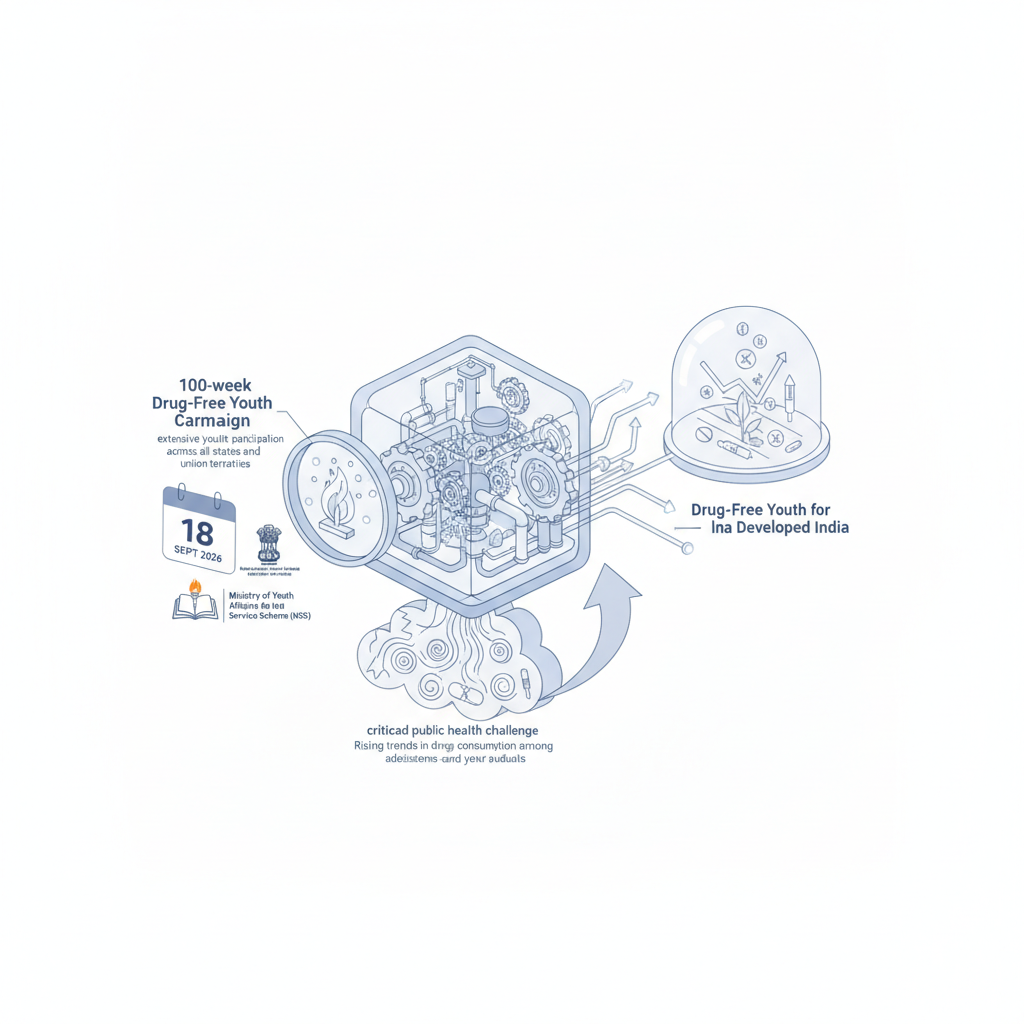
On 18 September 2026, the Ministry of Youth Affairs and Sports launched the ‘National Resolution Ceremony’ as the inaugural event of the 100-week ‘Drug-Free Youth Campaign’ under the broader initiative ‘Drug-Free Youth for a Developed India’. The ceremony, conducted in collaboration with the ‘My India-National Service Scheme’ (NSS), witnessed extensive youth participation across all states and union territories, marking the beginning of a sustained public health and social awareness drive aimed at substance abuse prevention among the youth.
Background
- Substance abuse among youth remains a critical public health challenge in India, with studies indicating rising trends in drug consumption, particularly among adolescents and young adults, necessitating targeted interventions.
- The National Youth Policy (2014) emphasizes the importance of fostering a healthy and productive youth population, with specific focus areas including health, fitness, and life skills development.
- The National Service Scheme (NSS), operational since 1969, is a centrally sponsored flagship programme under the Ministry of Youth Affairs and Sports, aimed at developing the personality and character of student volunteers through community service and social engagement.
- Public health campaigns targeting substance abuse have historically employed multi-modal strategies, including awareness drives, community engagement, and institutional partnerships, to achieve behavioural change.
- The ‘Drug-Free Youth Campaign’ aligns with the broader national vision of ‘Viksit Bharat’ (Developed India) by 2047, which prioritizes holistic youth development and societal well-being.
- The 100-week duration of the campaign reflects a phased, long-term approach to ensure sustained engagement and measurable outcomes in substance abuse prevention.
What is the ‘Drug-Free Youth Campaign’?
- A 100-week national initiative launched under the ‘Drug-Free Youth for a Developed India’ programme, aimed at preventing substance abuse among youth through awareness, education, and community engagement.
- The campaign is structured around four thematic phases: ‘Mera Swasthya, Mera Gaurav’ (My Health, My Pride), ‘Fit Yuva’ (Fit Youth), ‘Nasha-Mukt Yuva’ (Drug-Free Youth), and ‘Jeevan Kaushal Mah’ (Life Skills Month), each focusing on distinct aspects of youth development and well-being.
- The inaugural ‘National Resolution Ceremony’ served as a symbolic launch, featuring collective oath-taking, signature campaigns, creative expressions, and discussions to galvanize youth participation and commitment to a drug-free lifestyle.
- The campaign leverages the National Service Scheme (NSS) network, engaging 259 institutions across 28 states and 8 union territories, with over 1.47 lakh participants in the first day alone, demonstrating its scale and reach.
- Activities under the campaign include awareness drives, interactive sessions, street plays, and leadership-led discussions, designed to foster peer-to-peer learning and collective responsibility.
- The campaign emphasizes prevention through education, encouraging youth to adopt healthy and positive lifestyle choices while strengthening their participation in community and national development.
- The 100-week duration is structured to ensure continuous engagement, with weekly activities and events culminating in a sustained movement rather than a one-time awareness drive.
Key Features
| Feature | Significance |
|---|---|
| 100-week campaign structure | Ensures sustained engagement and systematic progression of activities, moving beyond episodic awareness drives to a long-term behavioural change framework. |
| Multi-modal participation (oaths, signatures, street plays, discussions) | Leverages diverse psychological and social mechanisms to reinforce commitment and collective identity among youth. |
| Collaboration with My Bharat-NSS | Institutionalises youth participation through an existing national volunteer network, enhancing scalability and grassroots reach. |
| State-UT coverage (28 states, 8 UTs) | Demonstrates uniform national outreach, addressing regional disparities in youth engagement and substance-use prevention. |
| Focus on prevention in Phase 1 | Aligns with WHO’s evidence-based approach, prioritising primary prevention over curative measures in substance abuse control. |
Why it Matters
Public Health and Social Well-being
- Addresses the high burden of substance abuse among Indian youth (NFHS-5 reports 1.2% of 15-29-year-olds using opioids, 2.8% using cannabis), contributing to mental health crises and reduced productivity.
- Promotes holistic well-being by integrating fitness, life skills, and mental health awareness under a unified campaign framework.
- Reduces intergenerational transmission of addiction by fostering peer-led behavioural change in educational and community settings.
Governance and Policy Implementation
- Demonstrates the Union Government’s commitment to the National Youth Policy 2021 (NYP-2021), which prioritises substance abuse prevention as a key youth development objective.
- Leverages the National Service Scheme (NSS) as a delivery mechanism, showcasing the role of voluntary organisations in public health governance.
- Aligns with the Sustainable Development Goals (SDG 3.5: Strengthen the prevention and treatment of substance abuse) and India’s global commitments.
Youth Empowerment and Civic Engagement
- Encourages active citizenship by transforming youth from passive recipients of welfare to active agents of social change through structured participation.
- Builds social capital by fostering collective efficacy and shared responsibility in addressing a societal challenge.
- Provides a platform for youth to articulate aspirations for a ‘developed India’ (Viksit Bharat 2047), linking individual behaviour to national development goals.
Behavioural Science and Communication Strategy
- Uses commitment devices (oaths, signatures) and social proof (public participation metrics) to enhance adherence to pro-health behaviours.
- Employs participatory arts (street plays, discussions) to normalise conversations on substance use, reducing stigma and increasing openness to intervention.
- Incorporates gamification elements (100-week structure) to sustain motivation and track progress, aligning with nudge theory principles.
Challenges
1. Sustaining Long-Term Engagement
- Maintaining momentum beyond the initial launch phase, particularly in regions with low baseline youth participation in civic activities.
- Balancing the campaign’s intensity with the risk of fatigue among volunteers and participants over a 100-week timeline.
UPSC Link: GS-II: Role of Civil Society in Governance
2. Regional Disparities in Implementation
- Ensuring equitable resource allocation and activity density across states/UTs, especially in remote and tribal areas with limited institutional support.
- Addressing cultural and socio-economic variations in substance use patterns and prevention strategies.
UPSC Link: GS-II: Federalism and Centre-State Relations
3. Measuring Impact and Outcome
- Developing robust monitoring and evaluation frameworks to assess changes in youth behaviour, substance use prevalence, and community norms.
- Avoiding over-reliance on self-reported data, which may be susceptible to social desirability bias.
UPSC Link: GS-IV: Ethics in Governance (Transparency and Accountability)
4. Integration with Existing Health Systems
- Coordinating with primary healthcare centres (PHCs) and district mental health programmes to ensure continuity of care for at-risk youth.
- Avoiding duplication of efforts with ongoing schemes like the Nasha Mukt Bharat Abhiyaan (NMBA) and Ayushman Bharat.
UPSC Link: GS-II: Health Sector Reforms
5. Addressing Stigma and Social Norms
- Challenging entrenched cultural attitudes that normalise substance use (e.g., peer pressure, experimentation) or stigmatise those seeking help.
- Ensuring inclusivity for marginalised youth groups (e.g., LGBTQ+, persons with disabilities) who may face additional barriers to participation.
UPSC Link: GS-I: Social Empowerment and Inclusion
Challenges — UPSC Perspective
| Issue | Concern |
|---|---|
| Resource Constraints | Limited funding for sustained activities, training of volunteers, and procurement of materials across diverse regions. |
| Digital Divide | Unequal access to online platforms for virtual engagement, particularly in rural and tribal areas. |
| Cultural Sensitivity | Risk of misalignment with local customs or resistance to campaign messaging in conservative communities. |
| Partnership Fatigue | Potential burnout among collaborating institutions (NGOs, educational bodies) due to prolonged coordination demands. |
| Policy Coherence | Need for alignment with state-level youth policies and health programmes to avoid fragmentation. |
Government Initiatives — Must-Memorise for Prelims
- Nasha Mukt Bharat Abhiyaan (NMBA)
- Ayushman Bharat – Health and Wellness Centres (AB-HWCs)
- Rashtriya Kishor Swasthya Karyakram (RKSK)
Way Forward
- Develop a tiered monitoring framework with real-time dashboards for district-level officials to track participation and activity outcomes.
- Institutionalise peer-review mechanisms for campaign materials to ensure cultural sensitivity and scientific accuracy.
- Partner with mass media (DD News, AIR, digital platforms) to amplify reach and normalise anti-substance messaging in entertainment content.
- Integrate the campaign with existing school/college curricula through life-skills modules to ensure continuity beyond extracurricular activities.
- Conduct baseline and endline surveys using validated tools (e.g., ASSIST, CRAFFT) to measure changes in youth behaviour and substance use patterns.
- Establish a grievance redressal system for participants to report challenges in implementation or seek support for at-risk individuals.
- Leverage alumni networks of NSS and other youth organisations to sustain engagement post-campaign through mentorship and community projects.
UPSC Value Addition
Keywords for Mains Answer-Writing
Nasha Mukti Yuva Abhiyan · National Service Scheme (NSS) · Youth engagement · Substance abuse prevention · Public health governance · Collective pledges · Community participation · 100-week campaign · Healthy lifestyle promotion · National Integration Camp · Preventive health measures · Youth empowerment · Behavioral change communication · National Youth Policy · Ministry of Youth Affairs and Sports
Constitutional & Policy Linkages
- Article 51A (Fundamental Duties) – Duty to promote harmony and the spirit of common brotherhood.
- Article 47 (Directive Principles of State Policy) – Duty of the State to raise the level of nutrition and public health.
Concept Flow
Substance abuse among Indian youth → Recognition of public health burden → Formulation of National Youth Policy 2021 → Launch of Nasha Mukt Yuva Abhiyaan → Collaboration with NSS for outreach → National Sankalp Samaroh for mass mobilisation → Multi-modal activities (oaths, signatures, street plays) → Sustained 100-week campaign → Behavioural change and social norm shift → Reduced prevalence of substance use → Contribution to Viksit Bharat 2047.
Prelims Practice Questions
Q1. Consider the following statements regarding the ‘Nasha Mukti Yuva Abhiyan’:
1. The campaign is a 100-week initiative launched by the Ministry of Youth Affairs and Sports.
2. It is implemented in collaboration with the National Service Scheme (NSS).
3. The campaign includes activities such as collective oath-taking, signature campaigns, and street plays.
4. The primary focus of the campaign is on curative measures for substance abuse rather than preventive ones.
How many of the above statements are correct?
- Only one
- Only two
- Only three
- All
Answer: Only three — Statements 1, 2, and 3 are correct as per the PIB release. Statement 4 is incorrect because the campaign emphasizes preventive measures, including awareness and healthy lifestyle promotion.
Q2. Assertion (A): The ‘National Sankalp Samaroh’ under the Nasha Mukti Yuva Abhiyan aims to foster collective commitment among youth through participatory activities.
Reason (R): The campaign is designed to run for 100 weeks, ensuring sustained engagement and awareness generation among youth.
Options:
A. Both A and R are true, and R is the correct explanation of A.
B. Both A and R are true, but R is not the correct explanation of A.
C. A is true, but R is false.
D. A is false, but R is true.
Answer: ? — Both Assertion (A) and Reason (R) are true. The ‘National Sankalp Samaroh’ indeed aims to foster collective commitment through participatory activities, and the 100-week duration ensures sustained engagement. R correctly explains A.
Q3. Match the following activities under the ‘Nasha Mukti Yuva Abhiyan’ with their respective objectives:
Column I (Activity) Column II (Objective)
A. Collective Oath-Taking 1. To promote healthy lifestyle choices
B. Signature Campaign 2. To express collective commitment
C. Street Plays 3. To raise awareness through participatory mediums
D. Youth-Led Discussions 4. To document public support
Options:
A. A-2, B-4, C-3, D-1
B. A-1, B-2, C-3, D-4
C. A-2, B-1, C-4, D-3
D. A-4, B-2, C-3, D-1
Answer: ? — A-2 (Collective Oath-Taking expresses commitment), B-4 (Signature Campaign documents public support), C-3 (Street Plays raise awareness through participatory mediums), D-1 (Youth-Led Discussions promote healthy lifestyle choices).
Mains Practice Question
✍ The ‘Nasha Mukti Yuva Abhiyan’ represents a multi-dimensional public health governance initiative aimed at fostering youth engagement in substance abuse prevention. Critically examine the role of participatory governance models in addressing behavioral health challenges among youth in India. (15 Marks)
Approach: MODEL-ANSWER SKELETON:
1. **Introduction (2 Marks)**
– Define participatory governance in public health: citizen engagement, co-creation of solutions, and shared responsibility.
– Contextualize with the Nasha Mukti Yuva Abhiyan: 100-week campaign, collaboration with NSS, and focus on preventive health.
2. **Role of Participatory Governance in Behavioral Health (6 Marks)**
– **Empowerment and Ownership**: Youth-led activities (e.g., street plays, discussions) foster ownership and reduce stigma (cite WHO’s definition of youth engagement in health).
– **Behavioral Change Communication**: Collective pledges and signature campaigns leverage social norms to reinforce abstinence (refer to Bandura’s Social Learning Theory).
– **Multi-Stakeholder Collaboration**: Integration of institutions (NSS, educational bodies) ensures scalability and reach (link to National Youth Policy 2021’s emphasis on youth participation).
– **Data-Driven Insights**: Real-time feedback from activities informs policy adjustments (cite examples from the campaign’s first-day statistics).
3. **Challenges and Limitations (4 Marks)**
– **Sustainability**: Ensuring long-term engagement post-campaign (discuss challenges in maintaining momentum).
– **Regional Disparities**: Uneven participation across states/UTs (reference the 28 states and 8 UTs covered, but highlight gaps).
– **Cultural Sensitivity**: Tailoring messages to diverse socio-cultural contexts (link to India’s pluralistic society).
– **Resource Constraints**: Limited funding or institutional support for grassroots activities.
4. **Comparative Perspective (2 Marks)**
– Contrast with top-down approaches (e.g., government-led awareness drives without youth involvement).
– Highlight successes of participatory models in other public health domains (e.g., Swachh Bharat Mission’s community-led sanitation).
5. **Conclusion (1 Mark)**
– Participatory governance is effective but requires institutional backing, cultural adaptability, and sustained effort to address behavioral health challenges among youth. Emphasize the need for integrating such models into broader public health frameworks.
Source: PIB (Press Information Bureau)
Generated by AanyaAi for educational purpose.
Related guides on our sites
- Best PSIR optional coaching for upsc
- Best PSIR optional teacher for upsc
- Best teacher of PSIR optional for upsc
- Best PSIR optional coaching in delhi for UPSC

- एनसीएल द्वारा शुरू हुआ ‘विशेष अभियान 6.0’: स्वच्छता और ई-कचरा प्रबंधन पर जोर - September 19, 2026
- NCERT & NCL Launch ‘Special Campaign 6.0’ for Clean Governance: Key Details for UPSC - September 19, 2026
- ‘नशा मुक्त युवा अभियान’: 100 सप्ताह के राष्ट्रव्यापी अभियान का शुभारंभ, जानिए प्रमुख तथ्य - September 19, 2026

No Comments