


19 Sep RBI to Auction ₹24,000 Crore T-Bills: Key Dates & Process for UPSC Aspirants
✎ Treasury Bills are short-term, zero-coupon government securities issued through auctions by the RBI, with tenors of 91, 182, and 364 days, facilitating liquidity management and fiscal deficit financing.
Subject Relevance — Where This Topic Fits
- GS Paper III — Indian Economy and Issues Relating to Planning, Mobilisation of Resources, Growth, Development and Employment
- Prelims: Treasury Bills (T-Bills), Money Market Instruments, Public Debt Management, RBI Core Banking Solution (E-Kuber), Retail Direct Portal, Non-Competitive Bidding, Competitive Bidding, Multiple Price Method, Public Debt Office
- Essay: Role of Government Securities in Fiscal Policy and Economic Stability
Quick Revision: Treasury Bills are short-term, zero-coupon government securities issued through auctions by the RBI, with tenors of 91, 182, and 364 days, facilitating liquidity management and fiscal deficit financing.
Why is this in the news?
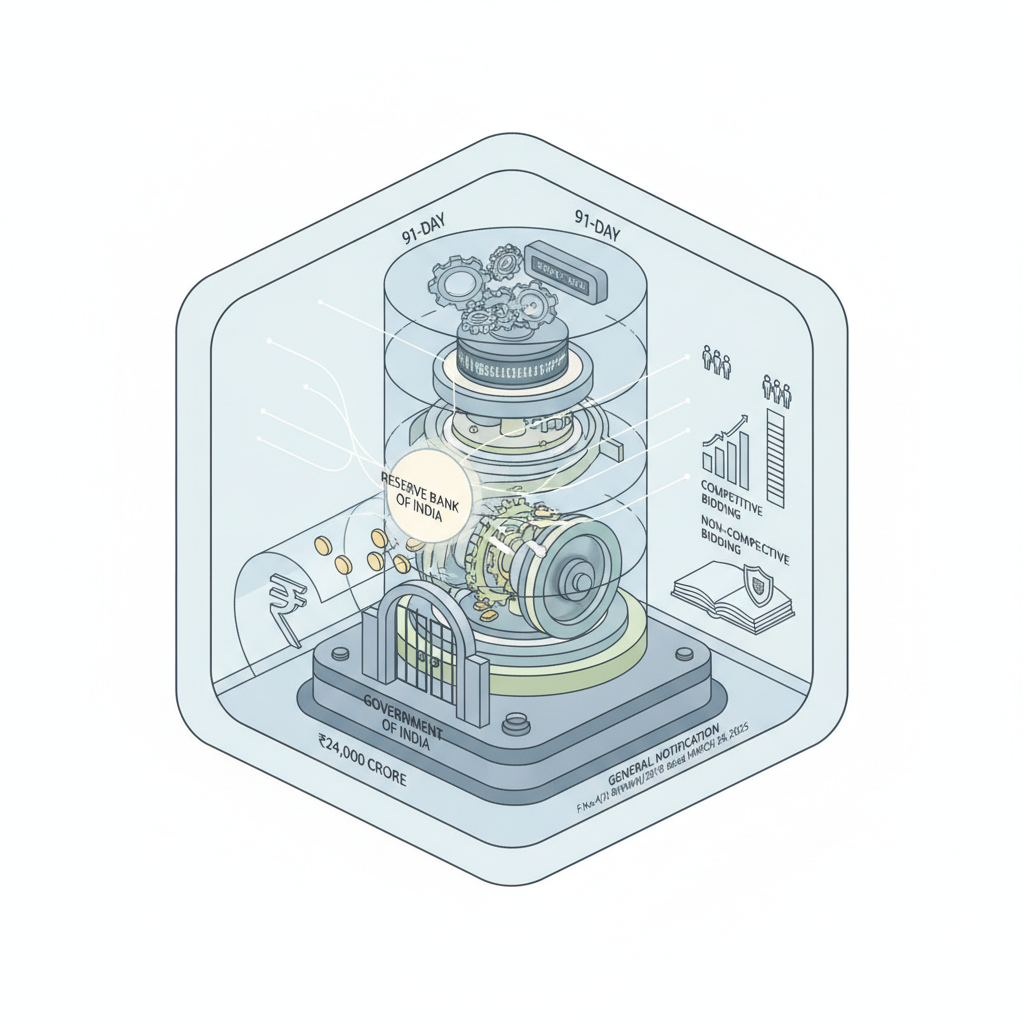
The Reserve Bank of India (RBI) announced the auction of 91-day, 182-day, and 364-day Treasury Bills (T-Bills) for a notified amount of ₹24,000 crore on September 23, 2026. This auction is a routine exercise in public debt management, aimed at financing the Government of India’s fiscal deficit while maintaining liquidity in the money market. The auction’s structure, including competitive and non-competitive bidding windows, reflects the RBI’s role in ensuring efficient resource mobilisation and market participation.
Background
- Treasury Bills are short-term government securities issued by the Government of India to meet its immediate cash requirements and manage fiscal deficits.
- The RBI conducts these auctions on behalf of the Government under the authority vested by the General Notification F.No.4(2)-B(W&M)/2018 dated March 26, 2025, as amended periodically.
- T-Bills are issued in three tenors: 91 days (3 months), 182 days (6 months), and 364 days (1 year), catering to varying investor preferences and liquidity needs.
- The auction mechanism ensures transparency and market-determined pricing, aligning with the principles of public debt management outlined in the Fiscal Responsibility and Budget Management (FRBM) Act, 2003.
- Retail investors can participate through the RBI Retail Direct portal, enhancing financial inclusion and broadening the investor base for government securities.
- The RBI’s Core Banking Solution (E-Kuber) system facilitates electronic bidding, ensuring efficiency and reducing operational risks in the auction process.
What are Treasury Bills?
- Treasury Bills (T-Bills) are zero-coupon securities issued by the Government of India, meaning they are issued at a discount to their face value and redeemed at par upon maturity, with the difference representing the interest earned.
- They are money market instruments with maturities of less than one year, specifically 91 days, 182 days, and 364 days, making them highly liquid instruments.
- T-Bills are issued through auctions conducted by the RBI on behalf of the Government, where investors bid for the securities, and the allotment is based on the yield determined by market demand.
- The auction process employs a multiple price method, where successful bidders pay the price they bid, ensuring efficient price discovery and allocation.
- T-Bills are eligible for inclusion in the Statutory Liquidity Ratio (SLR) for banks, making them attractive to institutional investors such as banks, insurance companies, and provident funds.
- Retail investors can participate in non-competitive bidding, where they are allotted securities at the weighted average rate of accepted competitive bids, capped at 5% of the notified amount for individuals.
- The RBI’s Retail Direct portal allows individual investors to participate in government securities auctions directly, democratising access to sovereign debt instruments.
- T-Bills serve as a benchmark for short-term interest rates in the economy and are a key tool for the Government to manage its cash flows and fiscal deficit without resorting to long-term borrowing.
Key Features
| Feature | Significance |
|---|---|
| Maturity Tenors (91-Day, 182-Day, 364-Day) | Facilitates short-term liquidity management for the Government of India, aligning with varying fiscal and monetary policy horizons. |
| Notified Amount (₹24,000 crore) | Represents a calibrated issuance to meet the Centre’s short-term borrowing requirements while maintaining market stability. |
| Multiple Price Auction Method | Ensures price discovery through competitive bidding, reflecting market sentiment and demand for sovereign paper. |
| Non-Competitive Bidding (Retail & Institutional) | Enhances retail investor participation in government securities, democratising access to risk-free sovereign debt. |
| Electronic Bidding via E-Kuber System | Modernises the auction process, ensuring efficiency, transparency, and real-time settlement. |
Why it Matters
Monetary Policy Transmission
- Short-term Treasury Bills serve as a benchmark for interbank lending rates, influencing the broader interest rate spectrum.
- Auction outcomes inform the Reserve Bank of India’s liquidity operations, including Open Market Operations (OMOs) and Standing Deposit Facility (SDF).
- Yield curves derived from these auctions guide monetary policy decisions on repo rates and liquidity adjustments.
Fiscal Management
- Provides the Government of India with a cost-effective mechanism to meet temporary cash flow mismatches without resorting to long-term debt.
- Reduces reliance on Ways and Means Advances (WMAs) from the RBI, preserving monetary sovereignty.
- Enhances the Centre’s ability to manage fiscal deficits within the FRBM Act framework.
Market Development
- Strengthens the secondary market for government securities by ensuring regular issuances and liquidity.
- Encourages participation from diverse investors, including provident funds, foreign central banks, and retail investors.
- Supports the development of a yield curve for sovereign debt, critical for pricing corporate bonds and other financial instruments.
Investor Protection & Access
- Non-competitive bidding for retail investors (via Retail Direct Portal) promotes financial inclusion and reduces systemic risk from concentrated holdings.
- Transparent auction process mitigates information asymmetry, ensuring fair pricing for all participants.
- Settlement guarantees (T+1) enhance investor confidence in sovereign paper.
Challenges
1. Market Volatility and Yield Spikes
- Sudden shifts in investor sentiment or macroeconomic shocks (e.g., inflation, geopolitical tensions) can lead to erratic bidding patterns and elevated yields.
- Excessive reliance on short-term debt may expose the Centre to refinancing risks if global liquidity conditions tighten.
- Volatility in yields can disrupt monetary policy transmission, complicating the RBI’s liquidity management.
UPSC Link: GS-III: Monetary Policy & Inflation
2. Retail Investor Participation Gaps
- Despite the Retail Direct Portal, awareness and financial literacy barriers may limit participation among small investors.
- Concentration of retail bids in non-competitive segments could reduce price discovery efficiency.
- Regulatory safeguards (e.g., bid limits) may inadvertently restrict liquidity in the secondary market.
UPSC Link: GS-II: Financial Inclusion
3. Technological and Operational Risks
- System failures in the E-Kuber platform or Retail Direct Portal could disrupt auction timelines and settlement processes.
- Cybersecurity threats targeting government securities platforms pose systemic risks to market integrity.
- Dependence on digital infrastructure may exclude marginalised investor segments lacking access to technology.
UPSC Link: GS-III: Digital Economy
Challenges — UPSC Perspective
| Issue | Concern |
|---|---|
| Sudden Yield Surges | Disrupts fiscal planning and increases borrowing costs for the Centre. |
| Liquidity Fragmentation | Excessive issuance in short tenors may crowd out private sector borrowing. |
| Retail Investor Apathy | Low participation undermines the democratisation goal of sovereign debt markets. |
| Technical Glitches | System downtime risks delay in settlement and erode market confidence. |
| Regulatory Arbitrage | Loopholes in non-competitive bidding may lead to mispricing or speculative activity. |
Way Forward
- Enhance investor education campaigns to boost retail participation in Treasury Bills via the Retail Direct Portal.
- Strengthen cybersecurity protocols for the E-Kuber system to mitigate operational risks in digital auctions.
- Introduce staggered issuances of Treasury Bills to smoothen liquidity absorption and reduce market volatility.
- Expand the investor base by onboarding more provident funds and foreign central banks through bilateral agreements.
- Monitor yield curve dynamics closely to pre-empt refinancing risks and align with the RBI’s liquidity management strategy.
- Leverage Treasury Bill auctions as a tool for calibrating the yield curve, supporting the development of corporate bond markets.
- Conduct periodic reviews of non-competitive bidding limits to balance inclusivity with market efficiency.
UPSC Value Addition
Keywords for Mains Answer-Writing
Treasury Bills · Money Market Instruments · Government Securities · Public Debt Management · Reserve Bank of India · Auction Mechanism · Non-Competitive Bidding · Retail Investors · Multiple Price Method · Fiscal Policy · Debt Instruments · E-Kuber System · Public Debt Office · Government of India Securities
Concept Flow
Government of India identifies short-term borrowing needs → RBI announces Treasury Bill auction → Investors submit competitive/non-competitive bids → Auction results determine yields and allocations → Successful bidders settle payments (T+1) → Proceeds credited to Centre’s account → Secondary market trading of T-Bills commences → Yield curve informs monetary policy decisions → RBI adjusts liquidity tools (OMOs, SDF) → Market liquidity and interest rates stabilise.
Prelims Practice Questions
Q1. Consider the following statements regarding the auction of Treasury Bills in India:
1. Treasury Bills are issued by the Government of India to meet short-term financial requirements.
2. The auction of Treasury Bills is conducted by the Reserve Bank of India (RBI) on behalf of the Government of India.
3. Retail investors can participate in the auction of Treasury Bills only through competitive bidding.
4. The allocation for non-competitive bids is made outside the notified amount in the auction.
How many of the above statements are correct?
- Only one
- Only two
- Only three
- All
Answer: Only three — Statements 1, 2, and 4 are correct. Statement 3 is incorrect because retail investors can participate in non-competitive bidding, not exclusively through competitive bidding.
Q2. Assertion (A): The Reserve Bank of India (RBI) conducts auctions for Treasury Bills using the multiple price method.
Reason (R): The multiple price method ensures that all successful bidders pay the same price for the Treasury Bills, regardless of their bid rate.
Options:
A. Both A and R are true, and R is the correct explanation of A.
B. Both A and R are true, but R is not the correct explanation of A.
C. A is true, but R is false.
D. A is false, but R is true.
Answer: ? — Assertion (A) is true: RBI uses the multiple price method for Treasury Bill auctions. Reason (R) is false: the multiple price method means successful bidders pay their bid rates, not a uniform price.
Q3. Match the following columns related to Treasury Bills in India:
Column I (Treasury Bill Tenure) | Column II (Characteristic)
1. 91-Day Treasury Bill | A. Issued for a period of 1 year
2. 182-Day Treasury Bill | B. Issued for a period of 6 months
3. 364-Day Treasury Bill | C. Issued for a period of 3 months
Options:
A. 1-C, 2-B, 3-A
B. 1-A, 2-B, 3-C
C. 1-B, 2-A, 3-C
D. 1-C, 2-A, 3-B
Answer: ? — Correct match: 1-C (91-Day TB = 3 months), 2-B (182-Day TB = 6 months), 3-A (364-Day TB = 1 year).
Mains Practice Question
✍ The auction mechanism for Treasury Bills in India serves as a critical tool for Public Debt Management and fiscal policy implementation. Critically examine the role of Treasury Bills in India’s financial system, with reference to their auction process, participation mechanisms, and implications for macroeconomic stability. (15 Marks)
Approach: MODEL-ANSWER SKELETON:
1. **Introduction** (2 marks): Define Treasury Bills as short-term government securities and their role in financing fiscal deficits and liquidity management.
2. **Auction Process and Mechanism** (4 marks): Explain the multiple price method, competitive vs. non-competitive bidding, notified amounts, and settlement timelines. Reference the RBI’s E-Kuber system and the role of the Public Debt Office.
3. **Participation and Inclusivity** (3 marks): Discuss eligibility for participation (State Governments, Provident Funds, retail investors) and the 5% cap for retail investors. Highlight the Retail Direct portal as a democratising mechanism.
4. **Macroeconomic Implications** (4 marks): Analyse how Treasury Bills influence interest rates, liquidity, and monetary policy transmission. Discuss their role in benchmarking the yield curve and attracting foreign investment.
5. **Challenges and Reforms** (2 marks): Briefly mention potential challenges such as market depth, volatility, and the need for secondary market development. Conclude with the importance of transparency and efficiency in the auction process.
Source: RBI
Generated by AanyaAi for educational purpose.
Related guides on our sites
- Current affairs for upsc 2026
- Best PSIR optional coaching for upsc
- Best PSIR optional teacher for upsc
- Best teacher of PSIR optional for upsc

- यूपीएससी तैयारी: आरबीआई द्वारा 91, 182 और 364 दिनों के ट्रेजरी बिलों की नीलामी - September 19, 2026
- RBI to Auction ₹24,000 Crore T-Bills: Key Dates & Process for UPSC Aspirants - September 19, 2026
- संयुक्त राष्ट्र महासभा अध्यक्ष का Rohingya संकट से सीख: विश्वास और AI पर बल - September 19, 2026

No Comments