


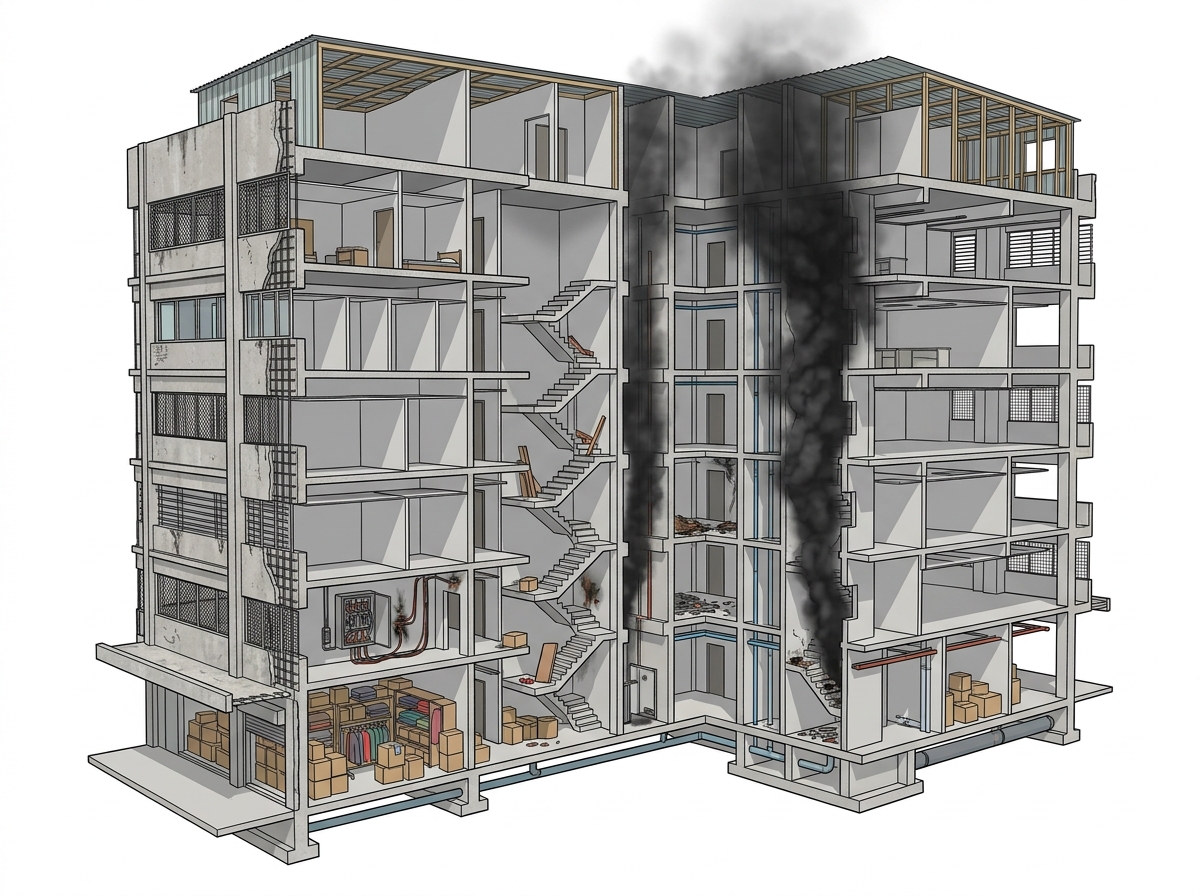
23 Sep AliGanj Fire Tragedy: SIT Files Report on 51 Illegal Buildings in Supreme Court
✎ The Supreme Court’s intervention in the Aliganj fire case exemplifies the judiciary’s role in enforcing compliance with the National Building Code 2016 and the Disaster Management Act 2005, ensuring accountability of urban local…
Subject Relevance — Where This Topic Fits
- GS Paper II — Judiciary and Constitutional Framework | GS Paper III — Disaster Management and Urban Governance
- Prelims: Supreme Court, Special Investigation Team (SIT), Illegal Construction, Fire Safety Norms, Urban Local Bodies, Disaster Management Act 2005, National Building Code of India 2016
- Essay: Role of Judiciary in Ensuring Public Safety and Accountability in Governance
Quick Revision: The Supreme Court’s intervention in the Aliganj fire case exemplifies the judiciary’s role in enforcing compliance with the National Building Code 2016 and the Disaster Management Act 2005, ensuring accountability of urban local bodies in disaster-prone urban governance.
Why is this in the news?
The Supreme Court has taken suo motu cognisance of the Aliganj fire incident in Lucknow, where 15 lives were lost due to a fire in an illegally constructed commercial complex. A Special Investigation Team (SIT) and a Supreme Court-constituted Special Team submitted reports to the Court, identifying 51 illegal buildings in Aliganj and other areas. This case underscores the judiciary’s proactive role in enforcing compliance with building safety and urban planning regulations, particularly in the context of recurring urban disasters.
Background
- On 22 June 2026, a fire in an illegally constructed commercial complex in Aliganj, Lucknow, resulted in the deaths of 15 individuals, highlighting systemic failures in urban governance and fire safety compliance.
- The Supreme Court, acting under its constitutional jurisdiction (Article 32 and Article 142), directed the constitution of a Special Investigation Team (SIT) and a Special Team to investigate illegal constructions and lapses in enforcement by urban local bodies.
- The SIT and Special Team conducted on-ground inspections in Aliganj and adjacent areas, including Gomti Nagar, over two days (5–6 September 2026), to assess violations of building bye-laws and fire safety norms.
- The next hearing in the case is scheduled for 23 November 2026, where the Court will deliberate on the reports submitted by the investigating teams.
- Preliminary investigations have implicated several officials of the Lucknow Development Authority (LDA) and engineers for alleged dereliction of duty in permitting and overseeing illegal constructions.
What is the Legal and Institutional Framework Governing Fire Safety and Illegal Construction in Urban Areas?
- The **National Building Code of India (NBC) 2016**, issued by the Bureau of Indian Standards (BIS), provides comprehensive guidelines for fire safety, structural stability, and building construction standards, including provisions for fire-resistant materials, emergency exits, and occupancy limits.
- Urban local bodies (ULBs) such as municipal corporations and development authorities (e.g., Lucknow Development Authority) are statutorily responsible for enforcing building bye-laws, zoning regulations, and fire safety norms under state municipal acts and the **Model Building Bye-Laws, 2016**, issued by the Ministry of Housing and Urban Affairs.
- The **Supreme Court’s jurisdiction under Article 32** (Right to Constitutional Remedies) and **Article 142** (Power to do complete justice) enables it to intervene in cases of gross negligence or systemic failures by executive authorities, particularly in matters affecting public safety.
- Special Investigation Teams (SITs) are constituted by courts to conduct impartial investigations into complex or high-profile cases, ensuring that findings are evidence-based and legally tenable.
- The **Constitution of India, Part IX-A (Articles 243P–243ZG)**, mandates the establishment of ULBs with devolved powers, including the regulation of land use and building construction, to ensure sustainable urban development.
- Fire safety audits and compliance checks are periodically mandated under the **Fire Services Act of respective states** (e.g., Uttar Pradesh Fire Services Act, 1944), which requires buildings to obtain fire safety certificates before occupancy.
Key Features
| Feature | Significance |
|---|---|
| Supreme Court-mandated SIT (Special Investigation Team) | Ensures impartial, court-supervised investigation into the Aliganj fire incident, reinforcing judicial oversight of administrative lapses. |
| Special Team for Illegal Constructions | Conducts on-ground verification of 51 marked illegal buildings in Aliganj and adjacent areas, providing empirical evidence for judicial scrutiny. |
| Enforcement of Fire Safety Norms | Highlights systemic failures in compliance with building bye-laws and fire safety regulations, necessitating stricter implementation. |
| Administrative Accountability | Identifies roles of local authorities (LDA officials, engineers) in permitting violations, enabling corrective and punitive measures. |
| Judicial Intervention in Urban Governance | Demonstrates the judiciary’s proactive role in addressing governance deficits in municipal administration and disaster preparedness. |
Why it Matters
Administrative and Governance
- Exposes lacunae in municipal enforcement mechanisms, particularly in identifying and dismantling illegal constructions that violate zoning and safety norms.
- Underscores the need for integrated urban planning with robust inter-departmental coordination between local bodies, fire services, and building authorities.
- Highlights the judiciary’s expanding role in compensating for executive inaction in urban governance, especially in disaster-prone areas.
Legal and Judicial
- Reinforces the principle of judicial activism in public interest litigation (PIL) concerning safety and governance failures.
- Demonstrates the judiciary’s capacity to direct executive agencies (e.g., SIT, special teams) for fact-finding and corrective action.
- Sets a precedent for future PILs on structural safety violations, ensuring judicial scrutiny of administrative decisions.
Socio-Economic
- Raises awareness of the human cost of illegal constructions, particularly in residential-cum-commercial complexes with inadequate safety measures.
- Emphasizes the economic burden of fire disasters on public health systems and disaster management infrastructure.
- Underscores the need for affordable, compliant housing solutions to mitigate risks from unregulated urban expansion.
Policy and Institutional
- Catalyzes reforms in municipal by-laws to align with national building codes (e.g., National Building Code of India, 2016) and fire safety standards.
- Promotes institutional capacity-building for local authorities in disaster risk reduction and emergency response planning.
- Encourages the adoption of technology (e.g., GIS mapping, real-time monitoring) for tracking illegal constructions and enforcing compliance.
Challenges
1. Enforcement of Building Bye-Laws
- Widespread circumvention of zoning regulations due to collusion between builders and local officials, leading to unsafe structures.
- Inadequate penalties and delayed prosecution enable repeat violations, eroding deterrence.
- Fragmented jurisdiction among municipal bodies, fire departments, and development authorities complicates oversight.
UPSC Link: GS-II: Urban Local Governance
2. Judicial Overreach vs. Executive Autonomy
- Risk of judicial encroachment on executive functions, potentially undermining policy implementation autonomy of elected bodies.
- Over-reliance on courts for governance issues may divert judicial resources from constitutional adjudication.
- Balancing judicial activism with respect for separation of powers remains a persistent challenge.
UPSC Link: GS-II: Separation of Powers
3. Administrative Accountability
- Difficulty in pinpointing individual liability amidst systemic failures, leading to prolonged investigations and delayed justice.
- Protection of erring officials through legal safeguards (e.g., stay orders) hampers disciplinary action.
- Lack of standardized protocols for auditing building permits and safety certificates exacerbates vulnerabilities.
UPSC Link: GS-II: Civil Services Reforms
4. Public Awareness and Participation
- Limited citizen engagement in reporting illegal constructions due to fear of reprisal or lack of accessible grievance mechanisms.
- Insufficient dissemination of safety norms and disaster preparedness measures among vulnerable communities.
- Need for community-based monitoring systems to complement state-led enforcement.
UPSC Link: GS-II: Citizen-Centric Governance
5. Disaster Preparedness and Response
- Inadequate infrastructure for emergency evacuation and firefighting in high-density urban areas.
- Lack of standardized emergency drills and training for municipal staff and residents.
- Delayed integration of disaster risk reduction (DRR) strategies in urban planning frameworks.
UPSC Link: GS-III: Disaster Management
Challenges — UPSC Perspective
| Issue | Concern |
|---|---|
| Collusion in Permitting Processes | Systemic corruption enabling illegal constructions despite regulatory checks. |
| Judicial Activism vs. Executive Function | Potential imbalance in governance roles between judiciary and elected bodies. |
| Delayed Disciplinary Action | Protracted investigations and legal protections delaying accountability for officials. |
| Public Apathy in Reporting Violations | Low awareness and participation in monitoring illegal activities. |
| Urban Planning Gaps | Absence of integrated, risk-informed urban development strategies. |
Way Forward
- Strengthen municipal enforcement mechanisms by digitizing building permits and integrating real-time monitoring systems.
- Establish specialized fast-track courts for adjudicating cases related to illegal constructions and fire safety violations.
- Mandate annual third-party audits of high-risk buildings to ensure compliance with safety norms.
- Enhance inter-departmental coordination among local bodies, fire services, and development authorities for unified enforcement.
- Launch public awareness campaigns on disaster preparedness, legal recourse for reporting violations, and safety drills in vulnerable areas.
- Revise municipal bye-laws to align with the National Building Code of India and introduce graded penalties for repeat violations.
- Promote community-based monitoring through resident welfare associations (RWAs) and civil society partnerships.
- Invest in urban infrastructure upgrades, including fire stations, evacuation routes, and early warning systems in high-density zones.
UPSC Value Addition
Keywords for Mains Answer-Writing
Supreme Court of India · Special Investigation Team (SIT) · illegal constructions · Urban Local Bodies (ULBs) · Lucknow Development Authority (LDA) · municipal governance · fire safety regulations · judicial activism · municipal corporation · building bye-laws · accountability in governance · constitutional remedies
Constitutional & Policy Linkages
- Article 243W: Powers, authority, and responsibilities of Municipalities (Urban Local Governance).
Concept Flow
Urbanization and unplanned expansion → Violation of zoning and building bye-laws → Collusion between builders and officials → Illegal constructions in high-risk zones → Fire safety lapses → Disaster (Aliganj fire incident) → Judicial intervention via PIL → Supreme Court-mandated SIT and special team → On-ground verification of violations → Judicial scrutiny of administrative failures → Demand for systemic reforms in urban governance.
Prelims Practice Questions
Q1. Consider the following statements regarding the powers of the Supreme Court of India under Article 32 of the Constitution:
1. The Supreme Court can issue directions, orders, or writs for the enforcement of any fundamental right.
2. The Supreme Court can only issue writs for the enforcement of Part III of the Constitution.
3. The Supreme Court cannot issue directions for the enforcement of rights other than fundamental rights.
4. The Supreme Court can issue directions for the enforcement of legal rights not guaranteed by the Constitution.
How many of the above statements are correct?
- Only one
- Only two
- Only three
- All
Answer: Only three — Statements 1 and 2 are correct. Article 32 empowers the Supreme Court to issue directions, orders, or writs for the enforcement of fundamental rights (Part III). Statement 3 is incorrect as the Supreme Court’s jurisdiction under Article 32 is limited to fundamental rights. Statement 4 is incorrect as the Supreme Court cannot enforce legal rights not guaranteed by the Constitution.
Q2. Assertion (A): The Supreme Court of India can direct the constitution of a Special Investigation Team (SIT) for probing serious crimes.
Reason (R): The Supreme Court derives this power from its inherent jurisdiction to ensure justice and uphold the rule of law.
Options:
A. Both A and R are true, and R is the correct explanation of A
B. Both A and R are true, but R is not the correct explanation of A
C. A is true, but R is false
D. A is false, but R is true
- A
- B
- C
- D
Answer: B — Both the Assertion (A) and Reason (R) are true. The Supreme Court has the inherent jurisdiction to direct the constitution of an SIT for probing serious crimes to ensure justice and uphold the rule of law. The power is derived from the Court’s constitutional mandate under Articles 32 and 142.
Q3. Match the following pairs related to municipal governance in India:
Column I (Institution) | Column II (Function)
1. Municipal Corporation | A. Preparation and implementation of development plans
2. Urban Local Body (ULB) | B. Enforcement of building bye-laws and fire safety regulations
3. State Town and Country Planning Organisation | C. Provision of civic amenities and services
4. State Pollution Control Board | D. Regulation of land use and zoning
Options:
1. 1-C, 2-A, 3-D, 4-B
2. 1-A, 2-C, 3-B, 4-D
3. 1-C, 2-A, 3-B, 4-D
4. 1-B, 2-C, 3-A, 4-D
- 1
- 2
- 3
- 4
Answer: 2 — The correct match is: 1-C (Municipal Corporation provides civic amenities), 2-A (ULB prepares and implements development plans), 3-D (State Town and Country Planning Organisation regulates land use), 4-B (State Pollution Control Board enforces building bye-laws and fire safety regulations).
Mains Practice Question
✍ The Supreme Court’s intervention in the Aliganj fire incident case, through the constitution of a Special Investigation Team (SIT) and the submission of reports on illegal constructions, underscores the judiciary’s proactive role in ensuring accountability in urban governance. Critically examine the constitutional and statutory provisions that empower the judiciary to intervene in matters of municipal governance and illegal constructions. Also, analyse the implications of such judicial interventions for the principle of separation of powers and cooperative federalism. (15 Marks)
Approach: MODEL-ANSWER SKELETON:
1. **Constitutional Provisions Empowering Judicial Intervention:**
– Article 32: Writ jurisdiction for enforcement of fundamental rights (e.g., Right to Life under Article 21).
– Article 142: Supreme Court’s power to pass any order necessary for complete justice.
– Article 226: High Courts’ writ jurisdiction for enforcement of fundamental rights and legal rights.
– Reference to the doctrine of judicial activism and PIL (Public Interest Litigation).
2. **Statutory Framework for Municipal Governance and Illegal Constructions:**
– 74th Constitutional Amendment Act, 1992: Empowers ULBs to prepare development plans and enforce building bye-laws.
– Town and Country Planning Acts of States (e.g., Uttar Pradesh Town and Country Planning Act, 1973).
– Building Bye-Laws and Fire Safety Regulations under municipal laws.
– Role of Urban Local Bodies (ULBs) in issuing building permits and conducting inspections.
3. **Judicial Precedents and Contemporary Context:**
– Supreme Court’s judgments in cases like *M.C. Mehta v. Union of India* (1986) on environmental protection and illegal constructions.
– *Delhi Fire Service v. Government of NCT of Delhi* (2021) on fire safety regulations.
– Recent interventions in cases of illegal constructions (e.g., Mumbai, Delhi, and Lucknow).
4. **Implications for Separation of Powers and Cooperative Federalism:**
– **Separation of Powers:** Judicial intervention in executive/administrative functions may be seen as encroaching on the domain of the legislature and executive. Counter-argument: Judicial intervention is necessary to prevent executive inaction or corruption.
– **Cooperative Federalism:** Role of State governments and ULBs in implementing policies vs. judicial oversight. Need for synergy between judiciary, executive, and legislature.
5. **Challenges and Way Forward:**
– Overburdening of judiciary with PILs and suo motu cases.
– Need for strengthening ULBs with adequate resources, technical expertise, and autonomy.
– Role of technology (e.g., GIS mapping, drones) in monitoring illegal constructions.
– Capacity building of municipal officials and strict enforcement of penalties.
6. **Conclusion:**
– Judicial intervention is a necessary check against executive inaction but must be balanced with respect for federal principles and institutional capacities.
Source: amarujala.com
Generated by AanyaAi for educational purpose.
Related guides on our sites
- Current affairs for upsc 2026
- Best PSIR optional coaching for upsc
- Best economics optional coaching for upsc
- Best PSIR optional teacher for upsc

- बिहार सरकार का बड़ा कदम: 25 हजार परिवारों को सौर ऊर्जा सहायता, 534 प्रखंडों में सोलर मार्ट खोले जाएंगे - September 23, 2026
- Bihar Launches Mega Solar Scheme: 25,000 Families to Benefit, 534 Solar Marts - September 23, 2026
- सुपर एल नीनो से भारत में 15,800 अतिरिक्त गर्मी से मौतें: जानिए पूरा मामला - September 23, 2026

No Comments