


23 Sep KPSC Challenges Prosecution Sanction in Kerala High Court: Key UPSC Polity Insight
✎ The Kerala Public Services Commission, as a constitutional body, derives its autonomy from Article 315 of the Constitution, unless the sanction is granted by the competent authority as per constitutional provisions.
Subject Relevance — Where This Topic Fits
- GS Paper II — Constitutional and Non-Constitutional Bodies | GS Paper IV — Ethics in Governance — Accountability and Institutional Integrity
- Prelims: Public Services Commission, Prosecution sanction, Constitutional bodies, Article 320, All-India Services (Conduct) Rules, 1968, Vigilance Commission, First Information Report (FIR), Judicial review of executive actions
- Essay: Role of constitutional bodies in ensuring fair governance, Ethical dilemmas in public service appointments and accountability mechanisms
Quick Revision: The Kerala Public Services Commission, as a constitutional body, derives its autonomy from Article 315 of the Constitution, unless the sanction is granted by the competent authority as per constitutional provisions.
Why is this in the news?
The Kerala Public Services Commission (KPSC) has approached the Kerala High Court challenging the prosecution sanction order and the First Information Report (FIR) registered by the Crime Branch, Thiruvananthapuram, alleging malpractices in the evaluation process for the appointment of the Chief (Industry and Infrastructure Division) of the Kerala State Planning Board. The case raises critical questions regarding the autonomy of constitutional bodies, the scope of executive interference, and the legal framework governing prosecutions against public servants.
Background
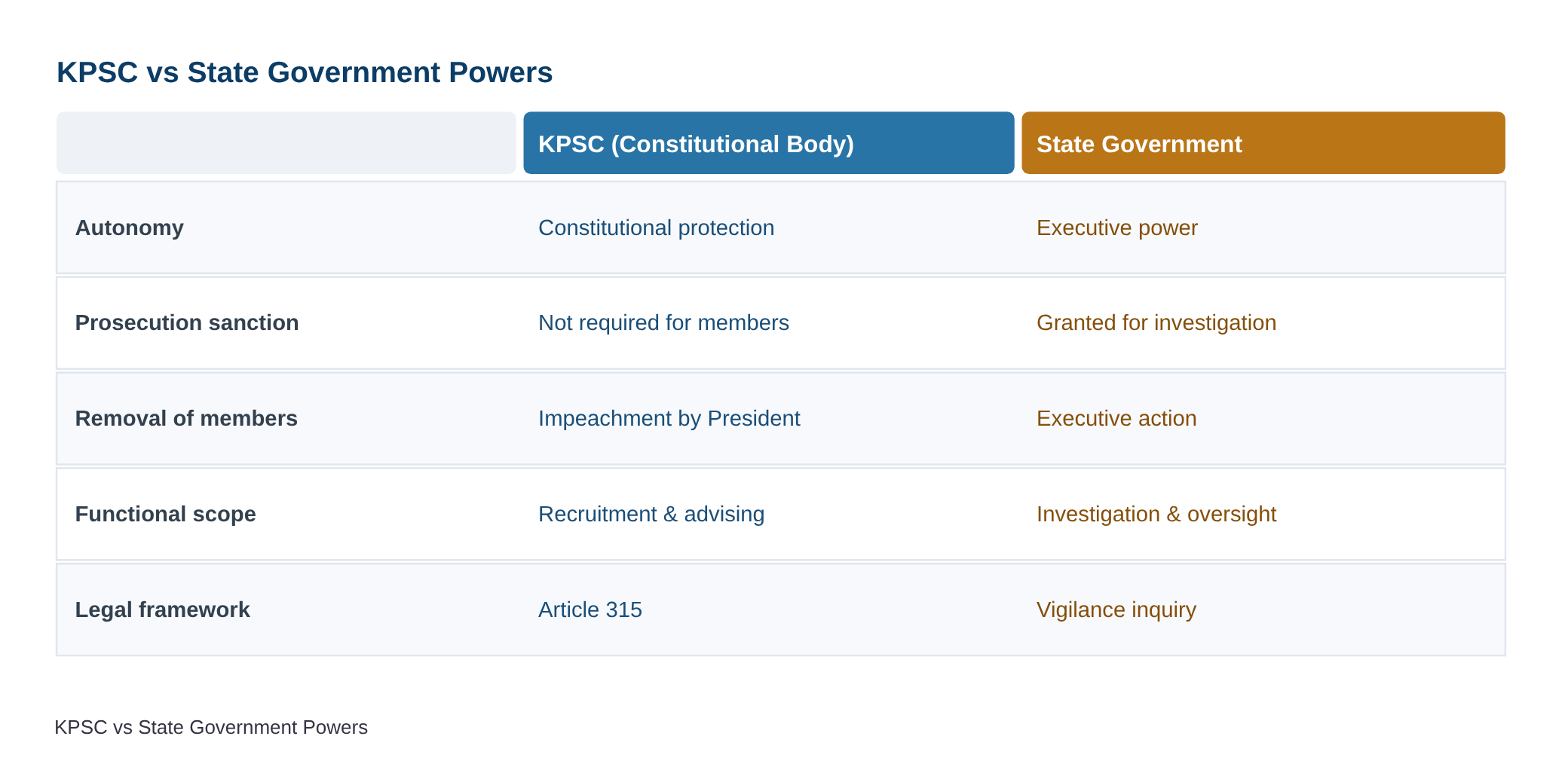
- The Kerala Public Services Commission (KPSC) is a constitutional body established under Article 315 of the Constitution of India to conduct examinations for recruitment to the state civil services and to advise the state government on matters relating to recruitment, promotions, and disciplinary actions.
- The KPSC functions under the provisions of the Constitution, and its members enjoy constitutional protection, including the requirement for impeachment by the President of India for removal from office.
- The case pertains to alleged irregularities in the evaluation process of answer sheets for the appointment of the Chief (Industry and Infrastructure Division) of the Kerala State Planning Board, where Economics questions were reportedly not assessed due to an error in the allocation of evaluators.
- The Crime Branch registered an FIR based on a Vigilance inquiry, which identified procedural lapses in the evaluation process. The State government granted prosecution sanction to investigate the alleged malpractices.
- The KPSC has contended that the State government lacks the authority to sanction prosecution against its members and staff, as they are protected by constitutional immunity and operate as an autonomous body.
- The case highlights the tension between institutional autonomy of constitutional bodies and the executive’s power to investigate alleged misconduct within such bodies.
What is the Kerala Public Services Commission (KPSC)?
- The Kerala Public Services Commission (KPSC) is a constitutional body constituted under Article 315 of the Constitution of India, responsible for conducting examinations for recruitment to the state civil services and advising the state government on recruitment, promotions, and disciplinary matters.
- The KPSC operates under the provisions of the Constitution.
- The members of the KPSC can only be removed from office by the President of India, following a process of impeachment for proven misbehaviour or incapacity, as outlined in Article 317 of the Constitution.
- The KPSC’s functions include conducting competitive examinations, interviews, and selection processes for various posts in the state government, ensuring meritocracy and fairness in recruitment.
- The Commission is mandated to ensure transparency and integrity in the selection process, including the evaluation of answer sheets, to prevent malpractices and maintain public trust in the civil services.
- The KPSC’s decisions are subject to judicial review, but the Commission itself is shielded from arbitrary interference by the executive or legislative branches, in line with constitutional principles of separation of powers.
Key Features
| Feature | Significance |
|---|---|
| Autonomy of the Kerala Public Services Commission (KPSC) | The KPSC is a constitutional body under Article 320 of the Constitution, tasked with conducting examinations for appointments to the state’s civil services. Its autonomy ensures impartiality and independence from executive interference in recruitment processes. |
| Prosecution Sanction Order | The order grants permission to investigate alleged irregularities in the appointment process. Such sanctions are critical in upholding accountability while ensuring that investigations do not unduly target constitutional bodies. |
| First Information Report (FIR) | The FIR marks the initiation of a legal process to investigate alleged malpractices in the evaluation of answer sheets for a specific recruitment. It serves as the formal record of the complaint and the basis for further inquiry. |
| On-Screen Marking Evaluation Process | A modern method of evaluating answer sheets where responses are marked electronically. Errors in this process, such as misallocation of evaluators, can lead to procedural lapses and potential injustices in recruitment outcomes. |
| Remedial Measures by KPSC | The KPSC’s claim of rectifying errors in the rank list and evaluation process highlights the importance of self-correction mechanisms within constitutional bodies to maintain public trust and procedural integrity. |
Why it Matters
Constitutional and Governance
- The case underscores the delicate balance between accountability and autonomy for constitutional bodies like the KPSC, which are empowered to function independently under the Constitution.
- It highlights the role of the judiciary in resolving disputes between constitutional bodies and the executive, ensuring that investigations do not infringe upon the functional autonomy guaranteed by the Constitution.
- The dispute involves the interpretation of Article 320, which vests the KPSC with the responsibility of conducting examinations and advising the government on recruitment matters, raising questions about the extent of executive oversight.
Administrative and Procedural
- The alleged procedural lapses in the evaluation process, such as the misallocation of evaluators, demonstrate the need for robust administrative safeguards in modern recruitment systems, particularly those reliant on technology.
- The case raises questions about the adequacy of existing grievance redressal mechanisms within constitutional bodies to address procedural errors promptly and transparently.
- It also highlights the challenges in maintaining the integrity of competitive examinations, where even minor errors can have significant implications for candidates and the credibility of the recruitment process.
Legal and Institutional
- The petition challenges the prosecution sanction order, which is a critical legal instrument in ensuring that investigations are conducted without bias or undue pressure, particularly against constitutional bodies.
- The case may set a precedent for how disputes between constitutional bodies and investigative agencies are resolved, particularly in matters involving recruitment irregularities.
- It also tests the limits of executive authority over autonomous bodies, particularly in matters of prosecution and investigation.
Challenges
1. Balancing Autonomy and Accountability
- The primary challenge is ensuring that constitutional bodies like the KPSC retain their independence while remaining accountable for their actions.
- The case raises questions about the extent to which the executive can intervene in the functioning of autonomous bodies without compromising their constitutional mandate.
- It also highlights the need for clear guidelines on the circumstances under which prosecution sanctions can be granted against members of constitutional bodies.
UPSC Link: Constitutional bodies – Article 320
2. Procedural Integrity in Modern Recruitment Systems
- The reliance on technology, such as on-screen marking, introduces new vulnerabilities, including procedural errors that can undermine the fairness of recruitment processes.
- Ensuring the accuracy and reliability of such systems requires robust oversight mechanisms and the capacity for rapid correction of errors.
- The case underscores the need for continuous training and monitoring of personnel involved in these processes to prevent lapses.
UPSC Link: E-governance and recruitment
3. Judicial Role in Constitutional Disputes
- The judiciary’s role in resolving disputes between constitutional bodies and the executive is critical, particularly in matters involving autonomy and accountability.
- The case may influence future judicial interpretations of the powers and limitations of constitutional bodies.
- It also highlights the need for judicial clarity on the procedural requirements for investigations involving constitutional bodies.
UPSC Link: Judicial review of constitutional bodies
4. Public Trust and Credibility of Recruitment Processes
- Allegations of irregularities, even if later rectified, can erode public trust in the fairness and transparency of recruitment processes.
- The case highlights the importance of transparent communication and swift corrective action to maintain the credibility of constitutional bodies.
- It also underscores the need for mechanisms to address grievances of candidates who may have been adversely affected by procedural errors.
UPSC Link: Public trust in governance
Challenges — UPSC Perspective
| Issue | Concern |
|---|---|
| Autonomy vs. Executive Oversight | The extent to which the executive can exercise oversight over autonomous constitutional bodies without infringing on their independence. |
| Procedural Errors in Technology-Driven Recruitment | The vulnerability of modern recruitment systems to procedural lapses, particularly in on-screen marking and evaluation processes. |
| Prosecution Sanctions Against Constitutional Bodies | The legal and procedural requirements for granting prosecution sanctions against members of constitutional bodies. |
| Judicial Intervention in Constitutional Disputes | The role of the judiciary in resolving disputes between constitutional bodies and the executive, ensuring fairness and adherence to constitutional provisions. |
| Public Trust in Recruitment Processes | The impact of allegations of irregularities on the credibility of recruitment processes and the need for transparent corrective measures. |
Way Forward
- Clarify the procedural safeguards required for modern recruitment systems, particularly those reliant on technology, to prevent errors such as misallocation of evaluators.
- Strengthen grievance redressal mechanisms within constitutional bodies to address procedural lapses promptly and transparently.
- Develop clear guidelines on the circumstances under which prosecution sanctions can be granted against members of constitutional bodies, balancing accountability and autonomy.
- Enhance training and monitoring of personnel involved in recruitment processes to ensure adherence to procedural standards.
- Promote transparency in communication regarding procedural errors and corrective actions to maintain public trust.
- Encourage the judiciary to provide clear interpretations of the powers and limitations of constitutional bodies in disputes with the executive.
- Establish independent oversight bodies to periodically review the functioning of constitutional bodies and address systemic issues.
- Ensure that candidates affected by procedural errors have access to mechanisms for redressal and compensation.
UPSC Value Addition
Keywords for Mains Answer-Writing
Constitutional autonomy of Public Service Commissions · Prosecution sanction under CrPC · Autonomous constitutional bodies in India · Judicial review of administrative actions · Federalism and State-Centre relations · Removal of members of constitutional bodies · Judicial scrutiny of malpractice in public examinations · Role of High Courts in constitutional disputes · Sanction for prosecution under Section 197 CrPC · Remedial measures in public recruitment processes
Constitutional & Policy Linkages
- Article 320 – Functions of Public Service Commissions
- Article 318 – Appointment and term of members of Public Service Commissions
- Article 319 – Prohibition as to the holding of offices by members of Public Service Commissions on ceasing to be such members
Concept Flow
Alleged irregularities in recruitment process for a constitutional post → Prosecution sanction granted by the State Government → FIR registered by Crime Branch for malpractices in evaluation → KPSC challenges sanction and FIR in High Court citing constitutional autonomy → Judicial scrutiny of the balance between autonomy and accountability → Potential implications for procedural integrity in modern recruitment systems → Impact on public trust and credibility of constitutional bodies
Prelims Practice Questions
Q1. Consider the following statements regarding the constitutional status of the Kerala Public Service Commission (KPSC):
1. The KPSC is an autonomous constitutional body under Article 315 of the Constitution of India.
2. Members of the KPSC can be removed only by the President of India as per Article 317.
3. The State government has the authority to grant prosecution sanction against KPSC members for actions taken in their official capacity.
How many of the above statements are correct?
- Only one
- Only two
- All three
- None
Answer: All three — Statement 1 and 2 are correct as KPSC is a constitutional body under Article 315 and its members can be removed only by the President under Article 317. Statement 3 is incorrect because the State government does not have the authority to grant prosecution sanction against KPSC members for actions taken in their official capacity under Section 197 of the Code of Criminal Procedure (CrPC).
Q2. Assertion (A): The Kerala Public Service Commission (KPSC) has approached the Kerala High Court challenging the prosecution sanction order and the registered case against its members and staff.
Reason (R): The KPSC contends that its members can only be removed by the President of India and that the State government lacks the authority to grant prosecution sanction for actions taken in their official capacity.
In the context of the above statements, which of the following is correct?
- Both A and R are true, and R is the correct explanation of A
- Both A and R are true, but R is not the correct explanation of A
- A is true, but R is false
- A is false, but R is true
Answer: Both A and R are true, but R is not the correct explanation of A — Both the Assertion (A) and Reason (R) are true. The KPSC has indeed approached the High Court challenging the prosecution sanction order, and the Reason (R) correctly explains the legal contention of the KPSC regarding the removal of its members and the authority of the State government to grant prosecution sanction.
Q3. Match the following constitutional provisions with their correct descriptions:
Column I (Provision)
A. Article 315
B. Article 317
C. Section 197 of the Code of Criminal Procedure (CrPC)
D. Article 239AA
Column II (Description)
1. Provides for the establishment of Public Service Commissions for the Union and the States
2. Deals with the removal and suspension of members of Public Service Commissions
3. Requires prior sanction for prosecution of public servants for acts done in the discharge of official duty
4. Grants special status to the National Capital Territory of Delhi
Select the correct match:
- A-1, B-2, C-3, D-4; A-2, B-1, C-3, D-4; A-1, B-3, C-2, D-4; A-4, B-2, C-1, D-3
- answer_string_list_indexes_are_0_based_but_answer_is_1_based_so_answer_0_for_first_option_etc.
Answer: A-1, B-2, C-3, D-4; A-2, B-1, C-3, D-4; A-1, B-3, C-2, D-4; A-4, B-2, C-1, D-3 — The correct match is: A-1 (Article 315 provides for the establishment of Public Service Commissions), B-2 (Article 317 deals with the removal and suspension of members of Public Service Commissions), C-3 (Section 197 CrPC requires prior sanction for prosecution of public servants for acts done in the discharge of official duty), and D-4 (Article 239AA grants special status to the National Capital Territory of Delhi).
Mains Practice Question
✍ The constitutional autonomy of Public Service Commissions in India is a cornerstone of the federal structure and the merit-based recruitment system. In this context, critically examine the legal and constitutional safeguards available to members of the Kerala Public Service Commission (KPSC) against arbitrary prosecution. Also, analyse the implications of judicial intervention in such disputes for the autonomy of constitutional bodies. (15 Marks)
Approach: MODEL-ANSWER SKELETON:
1. **Constitutional Basis of Autonomy**:
– Article 315: Establishes Public Service Commissions for the Union and States.
– Article 317: Provides for the removal and suspension of members only by the President of India, ensuring independence from State executive interference.
– Article 320: Mandates consultation with Public Service Commissions in matters of recruitment and disciplinary actions.
2. **Legal Safeguards Against Arbitrary Prosecution**:
– **Section 197 CrPC**: Requires prior sanction for prosecution of public servants for acts done in the discharge of official duty. This provision is crucial for protecting KPSC members from frivolous litigation while ensuring accountability.
– **Judicial Review**: High Courts and the Supreme Court can scrutinise the legality of prosecution sanction orders, ensuring adherence to constitutional principles.
– **Remedial Measures**: KPSC’s claim of taking corrective actions (e.g., rectifying errors in evaluation processes) highlights the need for procedural fairness.
3. **Judicial Intervention and Implications**:
– **Judicial Review of Administrative Actions**: Courts can intervene to quash unjust prosecution sanction orders, reinforcing the autonomy of constitutional bodies (e.g., *KPSC v. State of Kerala*, Kerala High Court, 2026).
– **Balance Between Autonomy and Accountability**: While judicial scrutiny ensures fairness, excessive interference may undermine the functional independence of constitutional bodies.
– **Federalism Concerns**: The dispute underscores the tension between State executive authority and the autonomy of constitutional bodies, necessitating clear delineation of powers.
4. **Broader Implications**:
– **Precedent for Other Commissions**: The outcome of this case may set a precedent for similar disputes involving other State Public Service Commissions.
– **Meritocracy vs. Political Interference**: Upholding KPSC’s autonomy is essential for maintaining a merit-based recruitment system free from political pressures.
5. **Conclusion**:
– The KPSC’s challenge reflects the broader constitutional principle of safeguarding the independence of autonomous bodies. Judicial intervention must strike a balance between accountability and autonomy to preserve the integrity of public institutions.
Source: The Hindu
Kerala PCS (Kerala PSC (KAS)) — State PCS Practice
Prelims: Which constitutional body has approached the Kerala High Court challenging a prosecution sanction order and a case registered against its members and staff?
- A. Kerala Public Service Commission
- B. Kerala State Human Rights Commission
- C. Kerala State Information Commission
- D. Kerala State Women’s Commission
Answer: A. Kerala Public Service Commission — The Kerala Public Service Commission (KPSC) filed a petition in the Kerala High Court against a prosecution sanction order and a registered case involving its members and staff.
Mains: Critically examine the legal and constitutional implications of the Kerala Public Service Commission’s decision to approach the High Court against a prosecution sanction order and a registered case involving its members and staff. Discuss the role of the KPSC in the context of Kerala’s administrative framework.
Generated by AanyaAi for educational purpose.
Related guides on our sites
- Current affairs for upsc 2026
- Best PSIR optional coaching for upsc
- Best PSIR optional teacher for upsc
- Best teacher of PSIR optional for upsc

- KPSC Challenges Prosecution Sanction in Kerala High Court: Key UPSC Polity Insight - September 23, 2026
- केरल में एंटीमाइक्रोबियल रेजिस्टेंस: सरकारी रिपोर्ट में चौंकाने वाले आँकड़े सामने - September 23, 2026
- Kerala’s AMR Crisis: Rising Drug Resistance Threatens Public Health in 2025 - September 23, 2026

No Comments