


23 Sep Supreme Court to Hear Plea on CEC, ECs Appointment Law 2023
✎ The appointment of the Chief Election Commissioner and Election Commissioners is governed by Article 324 of the Constitution, and the 2023 law shifts the process from a judicial-collegium system to a parliamentary committee…
Subject Relevance — Where This Topic Fits
- GS Paper II — Polity and Governance: Constitutional and Statutory Bodies | GS Paper II — Polity and Governance: Electoral Reforms and Judicial Review
- Prelims: Chief Election Commissioner (CEC), Election Commissioners (ECs), Article 324, Constitution (104th Amendment) Act 2019, Judicial Review, Constitutional Bench, Electoral Integrity, Collegium System, Separation of Powers
- Essay: Electoral Integrity and Democratic Governance, Judicial Role in Safeguarding Constitutional Institutions
Quick Revision: The appointment of the Chief Election Commissioner and Election Commissioners is governed by Article 324 of the Constitution, and the 2023 law shifts the process from a judicial-collegium system to a parliamentary committee, raising questions about the independence of the Election Commission of India.
Why is this in the news?
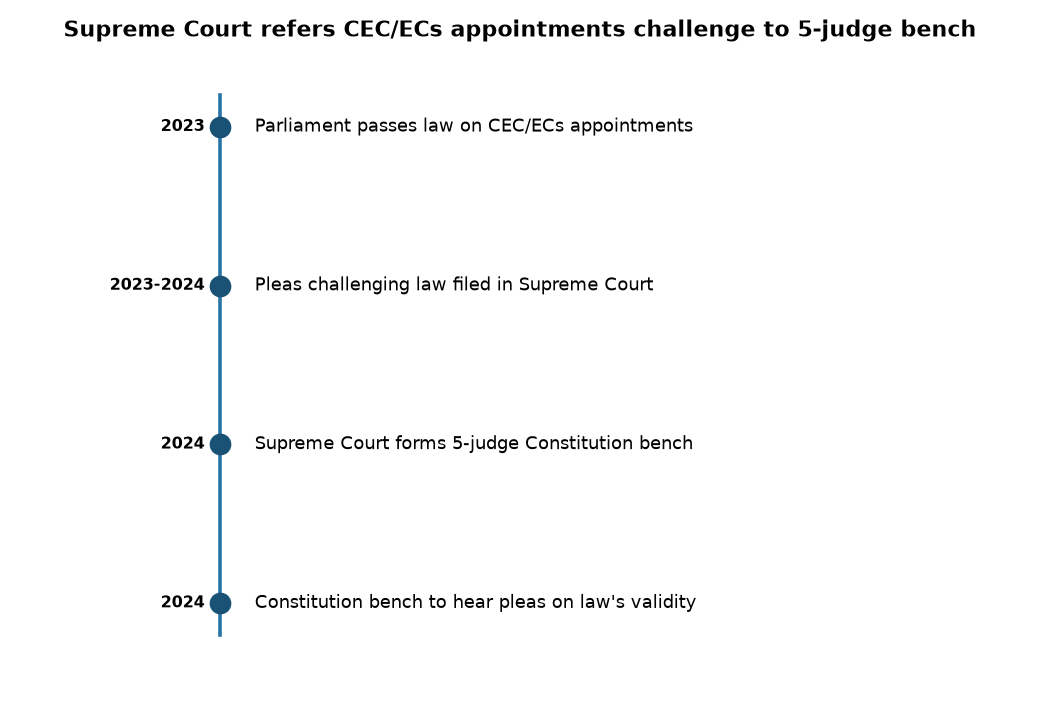
The Supreme Court of India has referred multiple petitions challenging the constitutional validity of the 2023 law governing the appointment of the Chief Election Commissioner (CEC) and Election Commissioners (ECs) to a five-judge Constitution bench. This decision underscores the significance of the issue in ensuring the independence and impartiality of the Election Commission of India (ECI), a critical institution for the conduct of free and fair elections in the country.
Background
- The Election Commission of India (ECI) is a constitutional body established under Article 324 of the Constitution, tasked with the superintendence, direction, and control of elections to Parliament, State Legislatures, and the offices of the President and Vice-President.
- In 2023, Parliament enacted a law to formalise the appointment process, shifting it to a committee comprising the Prime Minister, Leader of the Opposition (or the leader of the largest Opposition party in the Lok Sabha), and a Union Cabinet Minister nominated by the Prime Minister.
- The Association for Democratic Reforms (ADR) and other petitioners have challenged the 2023 law, arguing that it compromises the independence of the ECI by reducing the role of the judiciary and altering the balance of power in the appointment process.
- The Supreme Court’s decision to refer the matter to a larger bench reflects the constitutional gravity of the issue and the need for clarity on the balance between parliamentary sovereignty and judicial oversight in matters of institutional independence.
What is the Legal Framework for the Appointment of the Chief Election Commissioner and Election Commissioners?
- The Election Commission of India (ECI) is a constitutional body established under **Article 324** of the Constitution, responsible for the conduct of elections to Parliament, State Legislatures, and the offices of the President and Vice-President.
- The **appointment process** for the CEC and ECs has evolved over time. Initially, appointments were made by the President of India on the advice of the Council of Ministers. However, the Supreme Court in *T.N. Seshan v. Union of India* (2002) held that the ECI must function independently and impartially, leading to the adoption of a **collegium system** involving the Prime Minister, Leader of the Opposition, and the Chief Justice of India.
- In **2023**, Parliament enacted the **Chief Election Commissioner and Other Election Commissioners (Appointment, Conditions of Service and Term of Office) Act, 2023**, which formalised the appointment process through a committee comprising the Prime Minister, the Leader of the Opposition (or the leader of the largest Opposition party in the Lok Sabha), and a Union Cabinet Minister nominated by the Prime Minister.
- The **2023 Act** has been challenged on the grounds that it **reduces the role of the judiciary** in the appointment process, thereby compromising the independence of the ECI. Petitioners argue that the new process lacks transparency and may lead to political interference.
- The **Supreme Court’s reference to a five-judge Constitution bench** indicates that the matter involves substantial questions of law regarding the **balance of powers** between the executive, legislature, and judiciary in the appointment of constitutional functionaries.
- The **independence of the ECI** is crucial for maintaining the integrity of elections, as the Commission must remain free from political influence to ensure free and fair elections.
- The **judicial review** of the 2023 Act will examine whether the new appointment process aligns with the **basic structure of the Constitution**, particularly the principles of **separation of powers** and **institutional independence**.
Key Features
| Feature | Significance |
|---|---|
| Referral to 5-judge Constitution Bench | Ensures constitutional validity of the 2023 law is examined by a larger bench, preventing prolonged legal ambiguity in EC appointments. |
| Split Verdict by Two-Judge Bench | Highlights the complexity of the issue, necessitating a definitive ruling to resolve conflicting judicial interpretations. |
| Challenge to 2023 Law | Questions the procedural and substantive validity of the law governing the appointment of CEC and ECs, particularly its alignment with constitutional principles. |
| Role of Petitioners (ADR, Jaya Thakur, etc.) | Represents civil society and public interest concerns regarding transparency and independence in the appointment process of constitutional authorities. |
| Union Government’s Stance | Advocates for the referral to a larger bench to ensure legal clarity and prevent delays in the functioning of the Election Commission. |
Why it Matters
Constitutional and Governance
- The case underscores the importance of an independent Election Commission for free and fair elections, a cornerstone of India’s democratic framework.
- Examines the balance between executive prerogative and judicial oversight in the appointment of constitutional functionaries.
- Raises questions about the adequacy of the current appointment process in ensuring transparency and impartiality.
Judicial Process and Precedent
- Demonstrates the Supreme Court’s role in resolving disputes involving constitutional interpretation and statutory validity.
- Highlights the necessity of a larger bench for matters of significant constitutional importance to ensure uniformity in judicial reasoning.
- Illustrates the interplay between judicial review and legislative competence in governance-related matters.
Public Trust and Electoral Integrity
- The appointment process of the Election Commission directly impacts public confidence in electoral outcomes and democratic processes.
- A transparent and accountable appointment mechanism is essential to uphold the integrity of the world’s largest democracy.
- The case reflects broader concerns about the independence of constitutional bodies from political interference.
Challenges
1. Constitutional Validity of Appointment Process
- The 2023 law may alter the balance of power in the appointment of CEC and ECs, raising concerns about its compliance with constitutional principles.
- The lack of a collegium-like system for appointments could undermine the independence of the Election Commission.
- The absence of a transparent and participatory process may lead to perceptions of bias or political influence.
UPSC Link: Polity – Constitutional Bodies
2. Judicial vs Executive Role in Appointments
- The case tests the boundaries of judicial review over legislative and executive actions in the appointment of constitutional authorities.
- It questions whether the judiciary should defer to the legislature or assert its role in ensuring constitutional morality.
- The split verdict reflects the tension between judicial activism and judicial restraint in governance matters.
UPSC Link: Polity – Separation of Powers
3. Ensuring Independence of Constitutional Bodies
- The Election Commission’s independence is critical for conducting free and fair elections, a fundamental requirement of democracy.
- The appointment process must insulate the EC from political pressures to maintain its credibility and impartiality.
- The case highlights the need for a robust mechanism to prevent the politicisation of constitutional appointments.
UPSC Link: Polity – Election Commission
4. Delay in Legal Resolution and Governance Impact
- Prolonged legal disputes can create uncertainty in the functioning of the Election Commission, affecting electoral processes.
- Delays in resolving constitutional questions may lead to ad-hoc or interim arrangements, compromising institutional stability.
- The Supreme Court’s decision to refer the case to a larger bench aims to prevent further delays in the appointment process.
UPSC Link: Polity – Judicial Review
5. Public Interest and Transparency Concerns
- Civil society petitions reflect broader public concerns about the transparency and accountability of the appointment process.
- The lack of a participatory mechanism in appointments may erode public trust in the Election Commission’s impartiality.
- The case underscores the need for a consultative and inclusive process to enhance the legitimacy of constitutional appointments.
UPSC Link: Polity – Public Interest Litigation
Challenges — UPSC Perspective
| Issue | Concern |
|---|---|
| Independence of Election Commission | Risk of political interference in appointments undermining electoral integrity. |
| Constitutional Validity of 2023 Law | Potential conflict with constitutional principles governing the appointment of constitutional authorities. |
| Judicial vs Executive Role | Tension between judicial review and legislative/executive prerogative in governance matters. |
| Transparency in Appointments | Lack of a transparent and participatory process may lead to perceptions of bias or favouritism. |
| Delay in Legal Resolution | Prolonged disputes may create uncertainty in the functioning of the Election Commission. |
Way Forward
- The five-judge Constitution bench should expedite the hearing to resolve the constitutional questions without undue delay.
- Parliament may consider amending the 2023 law to incorporate a consultative or collegium-like process for appointments, ensuring transparency.
- The Election Commission should proactively engage with stakeholders to build public trust in its appointment process.
- Civil society organisations should continue to advocate for reforms that enhance the independence and accountability of constitutional bodies.
- Judicial precedents on the appointment of constitutional authorities should be reviewed to ensure consistency with democratic principles.
- The government should clarify the rationale behind the 2023 law to address concerns about its constitutional validity.
- Future appointments to the Election Commission should prioritise candidates with a proven record of impartiality and integrity.
- The Supreme Court should issue guidelines to streamline the appointment process, balancing judicial oversight with executive autonomy.
UPSC Value Addition
Keywords for Mains Answer-Writing
Constitution of India · Election Commission of India · Chief Election Commissioner · Article 324 · Constitution Bench · Judicial Review · Appointment Process · Separation of Powers · Independence of Constitutional Bodies · Electoral Reforms · Supreme Court of India · Collegium System · Executive-Judiciary Relations · Checks and Balances · Constitutional Morality
Constitutional & Policy Linkages
- Article 324 – Powers and functions of the Election Commission
- Article 324(2) – Appointment of CEC and ECs
- Basic Structure Doctrine – Independence of constitutional institutions
Concept Flow
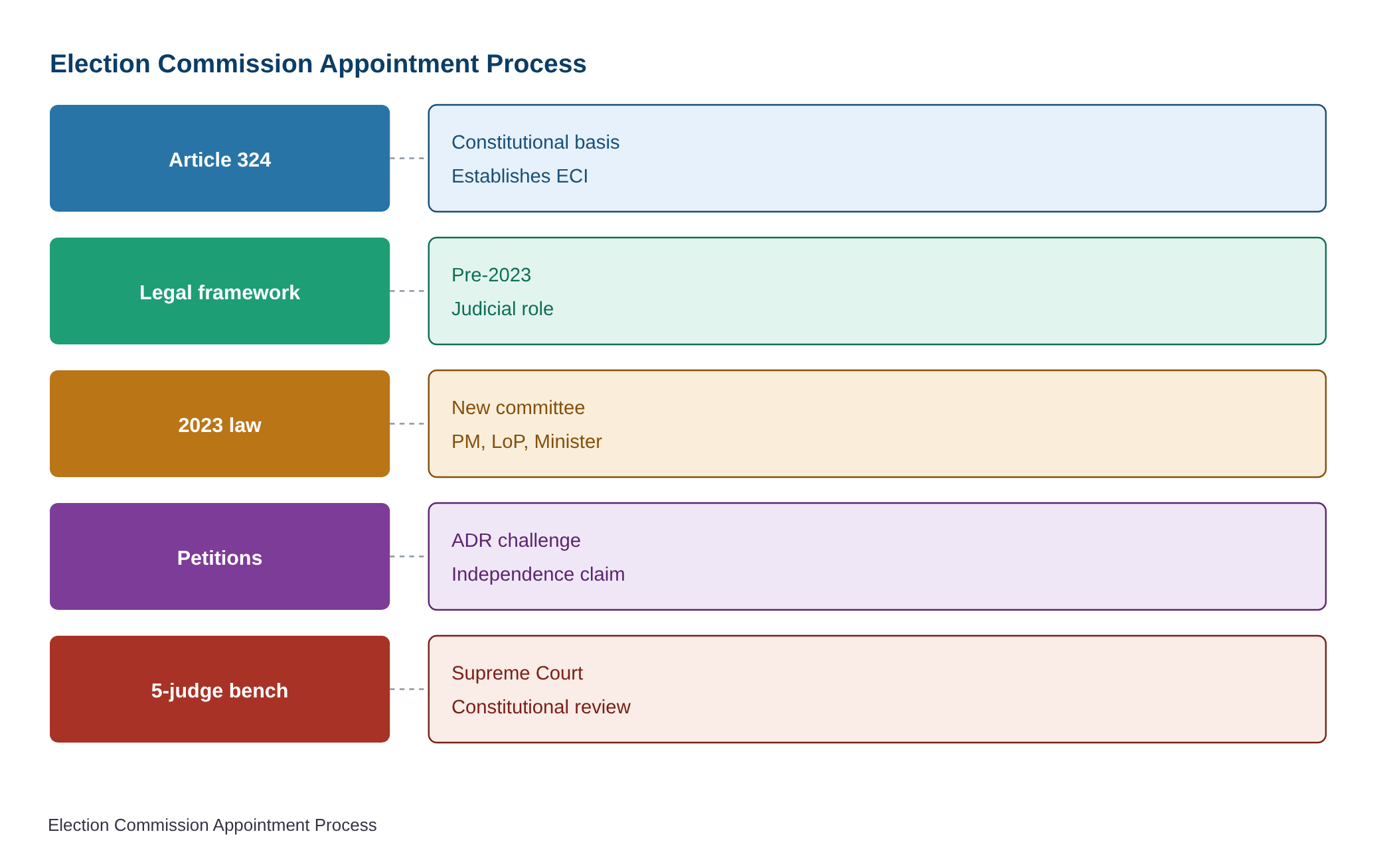
Constitutional provision for Election Commission (Article 324) → Legal framework for appointments → 2023 law altering appointment process → Petitions challenging its validity → Supreme Court referral to larger bench → Examination of constitutional compliance → Judicial ruling on independence and transparency → Impact on electoral integrity
Prelims Practice Questions
Q1. Consider the following statements regarding the appointment of the Chief Election Commissioner (CEC) and Election Commissioners (ECs) in India:
1. The Constitution of India, under Article 324, originally provided for a collegium-based appointment mechanism for the CEC and ECs.
2. The 2023 law governing the appointment of the CEC and ECs introduced a committee comprising the Prime Minister, Leader of Opposition in the Lok Sabha, and the Chief Justice of India.
3. The Supreme Court of India has the power to strike down laws that violate the basic structure of the Constitution.
How many of the above statements are correct?
- Only one
- Only two
- All three
- None
Answer: All three — Statement 1 is incorrect: Article 324 originally did not specify a collegium-based mechanism; it vested the power of appointment in the President. Statement 2 is correct: The 2023 law introduced a committee for appointments. Statement 3 is correct: The Supreme Court has the power of judicial review to strike down laws violating the basic structure of the Constitution.
Q2. Assertion (A): The Election Commission of India is a constitutional body under Article 324 of the Constitution.
Reason (R): The Constitution empowers the Election Commission to superintend, direct, and control the entire process of elections to Parliament and State Legislatures.
Options:
A. Both A and R are true, and R is the correct explanation of A.
B. Both A and R are true, but R is not the correct explanation of A.
C. A is true, but R is false.
D. A is false, but R is true.
Answer: ? — Assertion (A) is true: The Election Commission is a constitutional body under Article 324. Reason (R) is also true and correctly explains the role of the Election Commission as per Article 324(1).
Q3. Match the following provisions related to the Election Commission of India with their respective articles in the Constitution of India:
Column I
1. Article 324(1)
2. Article 324(2)
3. Article 324(5)
Column II
A. Power of the Election Commission to superintend, direct, and control elections
B. Composition of the Election Commission
C. Conditions of service and tenure of Election Commissioners
Options:
1-A, 2-B, 3-C
1-B, 2-A, 3-C
1-C, 2-B, 3-A
1-A, 2-C, 3-B
Answer: ? — Article 324(1) empowers the Election Commission to superintend, direct, and control elections (A). Article 324(2) deals with the composition of the Election Commission (B). Article 324(5) pertains to the conditions of service and tenure of Election Commissioners (C).
Mains Practice Question
✍ The appointment process of the Chief Election Commissioner (CEC) and Election Commissioners (ECs) has been a subject of judicial scrutiny in recent times. Critically examine the constitutional provisions governing their appointment and the implications of the Supreme Court’s decision to refer challenges to the 2023 law to a five-judge Constitution bench. Also, analyse the broader significance of an independent Election Commission in a democratic polity. (15 Marks)
Approach: MODEL-ANSWER SKELETON:
1. **Constitutional Framework (3 Marks)**
– Article 324(1): Vesting of power in the Election Commission to superintend, direct, and control elections.
– Article 324(2): Composition of the Election Commission (originally a single-member body; expanded to multi-member post-1993 amendments).
– Original ambiguity: No explicit provision for appointment process; vested in the President (executive).
2. **Evolution of Appointment Mechanism (4 Marks)**
– **Pre-2023**: Appointments made by the President on the aid and advice of the Council of Ministers (executive-led process).
– **2023 Law**: Introduced a committee comprising the Prime Minister, Leader of Opposition (or leader of the largest opposition party in Lok Sabha), and the Chief Justice of India for appointments.
– **Judicial Scrutiny**: Challenges to the 2023 law on grounds of violating the basic structure (independence of constitutional bodies, separation of powers).
3. **Supreme Court’s Role and Judicial Review (4 Marks)**
– Reference to a five-judge Constitution bench: Implications for judicial review of parliamentary laws.
– Doctrine of Basic Structure: Independence of the Election Commission as part of the basic structure (e.g., In re: Special Courts Bill, 1978; Second and Third Judges Cases).
– Judicial activism vs. judicial restraint: Balancing constitutional morality with parliamentary sovereignty.
4. **Significance of an Independent Election Commission (4 Marks)**
– **Democracy and Electoral Integrity**: Ensures free and fair elections, a cornerstone of democratic governance.
– **Checks on Executive**: Prevents executive overreach in electoral processes.
– **Public Trust**: Enhances credibility of electoral outcomes and legitimacy of elected representatives.
– **Comparative Perspective**: Contrast with appointment mechanisms in other democracies (e.g., US: bipartisan commission; UK: Speaker-led appointments).
5. **Balanced View (1 Mark)**
– Arguments for executive-led appointments (efficiency, accountability to elected representatives).
– Arguments for judicial/collegium-led appointments (independence, insulation from political interference).
Source: Hindustan Times
Generated by AanyaAi for educational purpose.
Related guides on our sites
- Best PSIR optional coaching for upsc
- Best Law optional coaching for upsc
- Best PSIR optional teacher for upsc
- Best teacher of PSIR optional for upsc

- Supreme Court to Hear Plea on CEC, ECs Appointment Law 2023 - September 23, 2026
- बेंगलुरु की रक्षा फर्म ने 100 घंटे की उड़ान परीक्षण पूरी की: देश का पहला AI-संचालित लड़ाकू विमान - September 23, 2026
- Bengaluru’s Kaal Bhairava Lite achieves 100-hour flight test milestone for UPSC exams - September 23, 2026

No Comments