


24 Sep Himachal HC Directs Fresh Report on Delhi-Shimla-Dharamshala Flights & Sanjauli Heliport
✎ The Himachal Pradesh High Court’s intervention in the Delhi-Shimla-Dharamshala air routes and Sanjauli Heliport case exemplifies judicial review under Article 226 of the Constitution to ensure accountability in public…
Subject Relevance — Where This Topic Fits
- GS Paper II — Governance, Constitution, Polity, Social Justice and International Relations | GS Paper III — Infrastructure, Transport, and Aviation
- Prelims: Air Connectivity Enhancement Scheme (ACES), Regional Connectivity Scheme (RCS)-UDAN, Heliports in India, Judicial Review of Government Policies, Public Interest Litigation (PIL), State High Courts’ Powers under Article 226 of the Constitution
- Essay: Judicial Activism and Governance: Balancing Development and Public Welfare, The Role of Courts in Ensuring Equitable Infrastructure Development
Quick Revision: The Himachal Pradesh High Court’s intervention in the Delhi-Shimla-Dharamshala air routes and Sanjauli Heliport case exemplifies judicial review under Article 226 of the Constitution to ensure accountability in public infrastructure projects and adherence to the Regional Connectivity Scheme (RCS)-UDAN.
Why is this in the news?
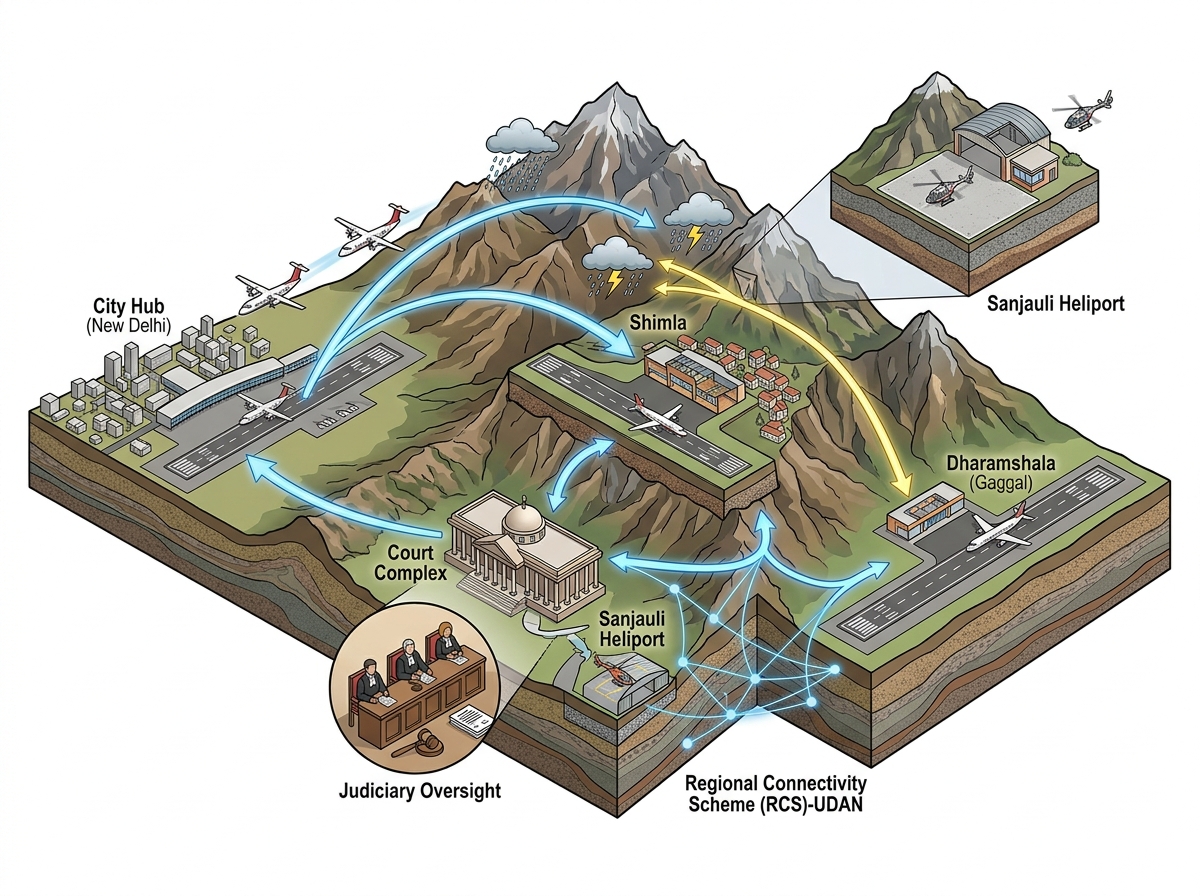
The Himachal Pradesh High Court has directed the Union and State governments, along with aviation operators, to submit fresh affidavits regarding the operationalisation of Delhi-Shimla-Dharamshala air routes and the utilisation of the Sanjauli Heliport. The Court’s intervention underscores the judiciary’s role in ensuring accountability in public infrastructure projects and addressing gaps in air connectivity, particularly in hilly regions.
Background
- Himachal Pradesh, a Himalayan state, faces unique challenges in air connectivity due to its rugged terrain and seasonal weather disruptions, including monsoon-induced flight suspensions.
- The Regional Connectivity Scheme (RCS)-UDAN, launched in 2016 by the Ministry of Civil Aviation, aims to enhance air connectivity to underserved and unserved airports, including those in hilly states like Himachal Pradesh.
- The Sanjauli Heliport, located near Shimla, is a critical infrastructure asset for emergency medical services, tourism, and connectivity in the region, but its utilisation has been suboptimal.
- Public Interest Litigations (PILs) have increasingly been used to address governance deficits in infrastructure projects, with courts acting as watchdogs to ensure timely implementation and public welfare.
- The Himachal Pradesh High Court’s suo motu cognisance and subsequent directives reflect the judiciary’s proactive stance in safeguarding public interest, particularly in infrastructure and disaster management.
- The case also highlights the intersection of judicial review with executive and legislative functions, particularly in matters of policy implementation and inter-governmental coordination.
Judicial Review of Air Connectivity and Heliport Infrastructure: Legal and Policy Framework
- The Himachal Pradesh High Court’s directive to the Union and State governments to submit fresh affidavits on Delhi-Shimla-Dharamshala air routes and the Sanjauli Heliport is rooted in the constitutional mandate under Article 226 of the Constitution, which empowers High Courts to issue writs for the enforcement of fundamental rights and other legal rights.
- The case involves multiple stakeholders, including the Ministry of Civil Aviation, the State Government of Himachal Pradesh, and aviation operators like Alliance Air, highlighting the need for inter-governmental coordination in infrastructure projects.
- The Regional Connectivity Scheme (RCS)-UDAN, a flagship initiative of the Government of India, seeks to improve air connectivity in remote and hilly regions by subsidising airfare and providing viability gap funding to airlines. The Court’s scrutiny ensures that the scheme’s objectives are met in letter and spirit.
- The Sanjauli Heliport, designed to accommodate twin-engine helicopters, is a critical asset for emergency medical services, disaster response, and tourism in Shimla. Its underutilisation raises questions about policy implementation, funding, and operational challenges.
- The Court’s focus on the resumption of suspended flights during the monsoon season underscores the need for robust contingency planning in air transport, particularly in regions prone to weather disruptions.
- Judicial oversight in such cases ensures that public funds are utilised efficiently and that infrastructure projects do not remain stalled due to bureaucratic inertia or lack of accountability.
- The case also highlights the role of PILs in addressing governance deficits, with courts acting as catalysts for reform in public infrastructure and service delivery.
- The Himachal Pradesh High Court’s directives to submit fresh affidavits reflect a broader trend of judicial activism in governance, where courts proactively intervene to ensure that executive and legislative actions align with constitutional and statutory mandates.
Key Features
| Feature | Significance |
|---|---|
| High Court directive on Delhi-Shimla-Dharamshala flights | Ensures compliance with judicial oversight on aviation infrastructure development and public transport accessibility in Himachal Pradesh. |
| Mandate for fresh affidavits from Centre and State | Strengthens transparency and accountability in the implementation of regional connectivity schemes. |
| Judicial scrutiny of Sanjauli Heliport utilisation | Examines the operational capacity and safety standards of the heliport for multi-engine helicopter operations. |
| Next hearing scheduled for 3 November 2026 | Provides a structured timeline for judicial review and corrective action in aviation infrastructure matters. |
| High Court notice on Thappal village’s dilapidated structures | Highlights judicial intervention in public safety and infrastructure maintenance under Article 21 of the Constitution. |
Why it Matters
Economic Significance
- Enhanced regional connectivity through air services can boost tourism, trade, and economic activity in Himachal Pradesh, particularly in Shimla and Dharamshala.
- Efficient heliport operations support emergency medical services, disaster response, and high-altitude tourism, contributing to socio-economic resilience.
- Judicial oversight ensures that infrastructure projects align with public welfare objectives rather than being delayed by bureaucratic inertia.
Strategic Significance
- Improved air connectivity in hilly terrains enhances national integration and accessibility to remote regions, aligning with the government’s UDAN (Ude Desh ka Aam Nagrik) scheme objectives.
- Heliports serve as critical nodes for rapid deployment of security forces and disaster management teams in geographically challenging areas.
Judicial Significance
- The High Court’s proactive stance underscores the role of the judiciary in ensuring the implementation of constitutional directives on governance and public welfare.
- Judicial intervention in infrastructure matters ensures that executive actions comply with legal and safety standards, protecting citizens’ rights.
Challenges
1. Seasonal Disruptions in Air Connectivity
- Monsoon-induced suspension of flights on the Delhi-Shimla-Dharamshala route disrupts travel plans and economic activities.
- Dependence on weather conditions necessitates robust contingency planning and alternative transport arrangements.
UPSC Link: GS-III: Infrastructure – Aviation
2. Infrastructure Maintenance and Safety
- Dilapidated structures along public pathways pose risks to pedestrian safety, particularly in rural areas like Thappal village.
- Inadequate maintenance of heliports and airstrips may compromise operational safety and emergency response capabilities.
UPSC Link: GS-II: Governance – Public Safety
3. Intergovernmental Coordination
- Delays in inter-ministerial and Centre-State coordination can stall infrastructure projects despite judicial directives.
- Divergent priorities between aviation authorities, state governments, and local bodies may hinder seamless implementation.
UPSC Link: GS-II: Federalism
4. Resource Allocation and Budgetary Constraints
- Limited financial resources may impede the timely upgradation of aviation and heliport infrastructure.
- Competing demands for public funds across sectors necessitate prioritisation based on socio-economic impact.
UPSC Link: GS-III: Budgeting and Fiscal Policy
5. Public Awareness and Stakeholder Engagement
- Insufficient awareness among local communities about infrastructure projects and safety protocols may lead to underutilisation or misuse.
- Lack of participatory governance in project planning can result in misalignment with local needs.
UPSC Link: GS-II: Citizen Participation
Challenges — UPSC Perspective
| Issue | Concern |
|---|---|
| Monsoon disruptions in air services | Frequent cancellations and delays affect tourism and economic activities. |
| Dilapidated public infrastructure | Jejopardises pedestrian safety and access to essential services. |
| Inter-ministerial delays in project approvals | Leads to prolonged judicial oversight and stalled progress. |
| Limited budgetary allocation for aviation infrastructure | Constraints timely upgradation and maintenance. |
| Low community engagement in project planning | Results in misalignment with local needs and underutilisation. |
Way Forward
- Conduct a comprehensive audit of aviation infrastructure, including heliports and airstrips, to identify maintenance gaps and safety concerns.
- Formulate a seasonal contingency plan for air connectivity, incorporating alternative transport modes during monsoon disruptions.
- Establish a multi-stakeholder task force comprising Centre, State, and local bodies to expedite project approvals and implementation.
- Allocate dedicated budgetary provisions for the upgradation and maintenance of aviation and heliport infrastructure.
- Launch public awareness campaigns to educate communities on infrastructure safety and utilisation protocols.
- Ensure participatory governance by involving local bodies and communities in the planning and monitoring of infrastructure projects.
- Strengthen inter-ministerial coordination mechanisms to streamline approvals and reduce delays in project execution.
UPSC Value Addition
Keywords for Mains Answer-Writing
Judicial activism in India · Public Interest Litigation (PIL) · Air connectivity infrastructure · Regional aviation policy · Heliport infrastructure development · High Court of Himachal Pradesh · Judicial review of executive actions · Infrastructure governance · Himachal Pradesh administration · Judicial directions for public welfare
Constitutional & Policy Linkages
- Article 21 (Right to Life and Personal Liberty) – Ensuring public safety and access to essential services.
Concept Flow
Judicial intervention in public interest litigation (PIL) -> High Court directives for fresh affidavits and reports -> Scrutiny of aviation and heliport infrastructure -> Identification of seasonal and structural challenges -> Judicial oversight ensures compliance with constitutional directives -> Implementation of corrective measures and policy reforms.
Prelims Practice Questions
Q1. Consider the following statements regarding the Public Interest Litigation (PIL) in India:
1. PIL can be filed only by affected parties and not by any citizen.
2. The Supreme Court of India first permitted PIL in the case of S.P. Gupta v. Union of India (1982).
3. PIL is explicitly mentioned in the Constitution of India under Article 32.
How many of the above statements are correct?
- Only one
- Only two
- All
- None
Answer: Only two — Statement 1 is incorrect: PIL can be filed by any citizen, not just affected parties. Statement 2 is correct: the landmark case S.P. Gupta v. Union of India (1982) established PIL. Statement 3 is incorrect: PIL is not explicitly mentioned in the Constitution; it is a judicial innovation.
Q2. Assertion (A): The High Court of Himachal Pradesh has the power to issue directions for the restoration of suspended air services under Article 226 of the Constitution.
Reason (R): Article 226 empowers High Courts to issue writs for the enforcement of any legal right and for any other purpose.
- Both A and R are true, and R is the correct explanation of A.
- Both A and R are true, but R is not the correct explanation of A.
- A is true, but R is false.
- A is false, but R is true.
Answer: Both A and R are true, and R is the correct explanation of A. — Both A and R are true. The High Court of Himachal Pradesh invoked Article 226 to seek a fresh report on air connectivity and heliport infrastructure. R correctly explains A as Article 226 provides the constitutional basis for such judicial directions.
Q3. Match the following pairs related to aviation infrastructure in India:
Column I (Institution/Authority)
A. Directorate General of Civil Aviation (DGCA)
B. Airports Authority of India (AAI)
C. Regional Connectivity Scheme (RCS)-UDAN
D. National Civil Aviation Policy (NCAP) 2016
Column II (Function/Role)
1. Implements the Regional Connectivity Scheme to enhance air connectivity in underserved regions
2. Regulates civil aviation activities including licensing, safety, and airworthiness standards
3. Owns and manages civil aviation infrastructure including airports and airspace
4. Provides the policy framework for the development of the civil aviation sector
Select the correct match:
- A-2, B-3, C-1, D-4
- A-3, B-2, C-4, D-1
- A-1, B-4, C-2, D-3
- A-4, B-1, C-3, D-2
Answer: A-2, B-3, C-1, D-4 — Correct matching: A (DGCA) regulates civil aviation activities (2); B (AAI) owns and manages aviation infrastructure (3); C (RCS-UDAN) implements the Regional Connectivity Scheme (1); D (NCAP 2016) provides the policy framework (4).
Mains Practice Question
✍ The High Court of Himachal Pradesh has recently directed the Union and State governments to submit fresh affidavits regarding the restoration of suspended air services and the optimal utilisation of the Sanjauli heliport. In this context, critically examine the role of the judiciary in ensuring infrastructure governance, particularly in the aviation sector. (15 Marks)
Approach: MODEL-ANSWER SKELETON:
1. Introduction: Define infrastructure governance and the judiciary’s role in public interest litigation (PIL).
2. Legal Framework: Cite Article 226 of the Constitution, which empowers High Courts to issue writs for enforcement of legal rights and other purposes. Reference the landmark case S.P. Gupta v. Union of India (1982) establishing PIL.
3. Judicial Activism in Infrastructure: Explain how the judiciary intervenes to ensure accountability in infrastructure projects, citing examples like the Delhi-Mumbai Industrial Corridor and airport privatisation cases.
4. Aviation Sector Context: Discuss the significance of air connectivity for regional development, citing the Regional Connectivity Scheme (RCS)-UDAN and its objectives.
5. Challenges: Highlight issues such as inter-governmental coordination, funding constraints, and environmental clearances that impede infrastructure development.
6. Balanced View: Present the counter-argument that judicial intervention may lead to executive overreach or delays in project execution.
7. Conclusion: Emphasise the judiciary’s role as a guardian of constitutional rights and a catalyst for equitable infrastructure development, while advocating for a collaborative approach between the judiciary and executive.
Source: amarujala.com
Himachal Pradesh PCS (HPPSC (HAS)) — State PCS Practice
Prelims: Recently, the Himachal Pradesh High Court directed authorities to submit a fresh report on which of the following infrastructure projects related to air connectivity in the state?
- A. Expansion of Shimla Airport to international standards
- B. Direct flights between Delhi, Shimla, and Dharamshala
- C. Establishment of a new helipad in Manali
- D. Construction of a metro rail link from Chandigarh to Shimla
Answer: B. Direct flights between Delhi, Shimla, and Dharamshala — The High Court sought a fresh report on direct flights between Delhi, Shimla, and Dharamshala, along with the operational status of the Sanjauli Helipad.
Mains: Critically analyze the significance of improved air connectivity (direct flights and helipads) for the socio-economic development of Himachal Pradesh. Suggest measures to address challenges in expanding such infrastructure in the state.
Generated by AanyaAi for educational purpose.
Related guides on our sites
- Best PSIR optional coaching in delhi for UPSC
- Best PSIR optional coaching for upsc
- Best economics optional coaching for upsc
- Best PSIR optional teacher for upsc

- उत्तराखंड फिल्म नीति: 5 साल में 1759 करोड़ निवेश, राज्य बना फिल्म निर्माण केंद्र - September 24, 2026
- Uttarakhand Film Policy: ₹1759 Crore Investment in 5 Years for UPSC Exams - September 24, 2026
- हिमाचल उच्च न्यायालय ने दिल्ली-शिमला-धर्मशाला विमान सेवाओं और हेलीपोर्ट पर ताजा रिपोर्ट मांगी - September 24, 2026

No Comments