


25 Sep Kerala Consumer Case Backlog Surges: 26,668 Pending Cases Explained for UPSC
✎ The Consumer Protection Act, 2019 mandates the establishment of a three-tier consumer dispute redressal system with strict timelines for disposal, but Kerala’s backlog highlights failures in appointment processes, infrastructure…
Subject Relevance — Where This Topic Fits
- GS Paper II — Governance, Transparency and Accountability | GS Paper III — Consumer Protection and Legal Framework
- Prelims: Consumer Protection Act, 2019, Consumer Disputes Redressal Commissions, Pendency of cases, Amicus Curiae, Judicial Infrastructure, Suo Motu cognisance
- Essay: Judicial Reforms and Access to Justice, Role of Institutions in Ensuring Consumer Rights
Quick Revision: The Consumer Protection Act, 2019 mandates the establishment of a three-tier consumer dispute redressal system with strict timelines for disposal, but Kerala’s backlog highlights failures in appointment processes, infrastructure, and gender representation, necessitating urgent institutional reforms.
Why is this in the news?
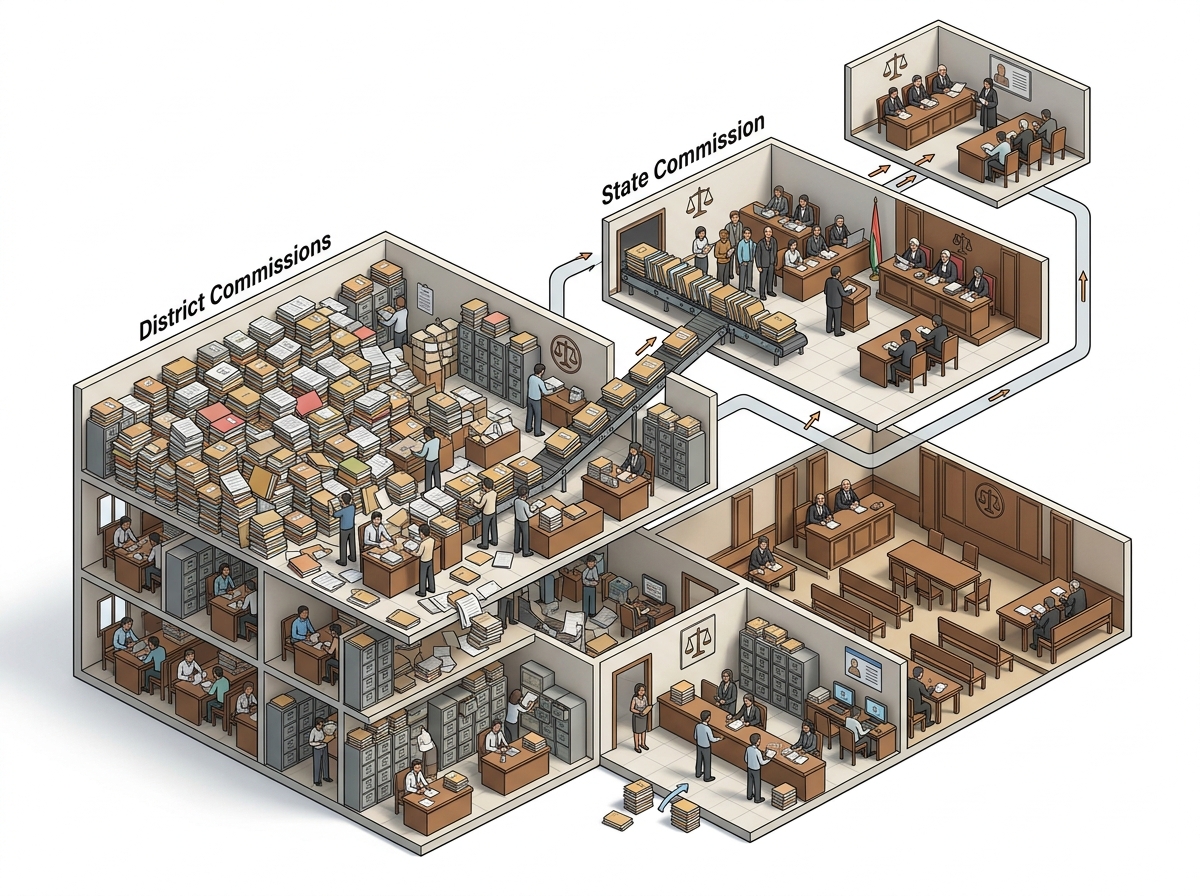
The Supreme Court’s suo motu intervention in a case concerning vacancies and inadequate infrastructure in consumer commissions across states has brought to light the severe pendency crisis in Kerala’s consumer dispute redressal system. The submission of a status report by the amicus curiae reveals a 76% surge in backlog in Kerala’s district commissions since December 2023, underscoring systemic inefficiencies in the implementation of the Consumer Protection Act, 2019. This development is critical for aspirants to understand the operational challenges in India’s judicial infrastructure and the policy gaps in consumer governance.
Background
- The Consumer Protection Act, 2019, replaced the earlier Act of 1986, introducing a three-tier structure for consumer dispute redressal: District Commissions, State Commissions, and the National Commission.
- Kerala’s consumer commissions are part of the decentralised judicial system designed to provide affordable and expeditious justice to consumers, with pecuniary jurisdiction thresholds of up to ₹1 crore for District Commissions, ₹1 crore–₹10 crore for State Commissions, and above ₹10 crore for the National Commission.
- The Act mandates the establishment of Consumer Disputes Redressal Commissions at the district, state, and national levels, with provisions for timely disposal of cases, appointment of qualified members, and infrastructure development.
- The Supreme Court’s suo motu cognisance of the issue highlights the judiciary’s proactive role in addressing systemic governance failures, particularly in ensuring the functional efficiency of quasi-judicial bodies.
- Comparative data indicates that Kerala’s pendency is disproportionately high, with its backlog nearly twice that of Karnataka and six times that of Tamil Nadu, reflecting regional disparities in judicial capacity and administrative preparedness.
What are Consumer Disputes Redressal Commissions?
- Consumer Disputes Redressal Commissions are quasi-judicial bodies established under the Consumer Protection Act, 2019, to adjudicate disputes between consumers and service providers or manufacturers.
- The three-tier structure includes: District Commissions (for claims up to ₹1 crore), State Commissions (for claims between ₹1 crore and ₹10 crore), and the National Commission (for claims above ₹10 crore).
- These commissions function as an alternative dispute resolution mechanism, offering a faster and more accessible route to justice compared to civil courts, with prescribed timelines for disposal (e.g., 90 days for District Commissions and 150 days for State Commissions).
- The commissions are empowered to order compensation, replacement of goods, removal of defects, or discontinuation of unfair trade practices, with provisions for appeal to higher forums.
- Infrastructure requirements include dedicated courtrooms, digital recording facilities, and video-conferencing capabilities to enhance accessibility, particularly for remote litigants.
- The pendency crisis in Kerala underscores the challenges in meeting the Act’s objectives, including timely appointments, adequate infrastructure, and efficient case management.
- The role of the amicus curiae in the Supreme Court’s suo motu case exemplifies the judiciary’s oversight in ensuring compliance with statutory mandates and constitutional principles of access to justice.
Key Features
| Feature | Significance |
|---|---|
| Rising case backlog in Kerala’s district consumer commissions | Indicates systemic inefficiencies in consumer dispute redressal, leading to delayed justice and erosion of consumer trust in the judicial process. |
| Sharp increase in pendency (76% rise since December 2023) | Demonstrates a failure to match the pace of case filing with disposal mechanisms, exacerbating the backlog crisis. |
| Oldest pending case dating to 1995 | Highlights chronic delays in resolution, undermining the efficacy of consumer protection mechanisms and violating the right to timely justice under Article 21. |
| Vacancies in State Consumer Commission (2 of 4 posts unfilled) | Directly impacts the commission’s capacity to adjudicate disputes, contributing to backlog and inefficiency. |
| Absence of women members in Kerala State Consumer Commission | Violates Rule 3(3) of the Consumer Protection (Qualification for Appointment) Rules, 2020, raising concerns about gender representation and inclusivity in dispute resolution. |
| Lack of video-conferencing facilities in district commissions | Impedes access to justice, particularly for remote or marginalised complainants, and reduces procedural efficiency. |
Why it Matters
Judicial and Legal
- Consumer commissions are quasi-judicial bodies established under the Consumer Protection Act, 2019, to provide speedy and inexpensive redressal of consumer disputes.
- The backlog undermines the core objective of the Act, which is to ensure timely resolution of consumer grievances to protect consumer rights under Article 39A (equal justice and free legal aid).
- Chronic delays in consumer dispute resolution may erode public confidence in the judicial system and encourage extra-judicial remedies, such as private settlements or social media campaigns.
Economic
- Consumer disputes often involve financial losses, defective products, or deficient services, and prolonged pendency can exacerbate economic hardships for complainants.
- Businesses face uncertainty due to unresolved disputes, potentially deterring investment and innovation in consumer-facing sectors.
- The inefficiency of consumer commissions may lead to increased litigation costs, further straining both complainants and businesses.
Administrative
- The surge in backlog reflects administrative and infrastructural deficiencies in the functioning of consumer commissions, including staffing shortages and technological gaps.
- The failure to utilise video-conferencing despite its potential to expedite proceedings highlights a lack of adaptive governance in dispute resolution mechanisms.
- The presence of vacancies in key positions indicates a breakdown in the recruitment and appointment processes under the Consumer Protection (Qualification for Appointment) Rules, 2020.
Social
- Prolonged delays disproportionately affect marginalised and low-income consumers, who may lack the resources to pursue prolonged legal battles.
- The absence of women in the State Consumer Commission raises concerns about gender bias in institutional representation and the need for inclusive governance in dispute resolution.
Challenges
1. Chronic Case Backlog and Pendency
- The backlog of 26,668 cases in Kerala’s consumer commissions is nearly twice that of Karnataka and six times that of Tamil Nadu, indicating a systemic issue.
- The district commissions disposed of only 3,931 cases against 6,016 new filings in the first seven months of 2026, highlighting a widening gap between case filing and disposal.
- Chronic delays violate the principle of ‘justice delayed is justice denied,’ undermining the constitutional guarantee of speedy trial under Article 21.
UPSC Link: Consumer Protection Act, 2019; Article 21 (Right to Life and Personal Liberty)
2. Institutional Vacancies and Staffing Shortages
- Two of the four sanctioned posts in the Kerala State Consumer Commission remain unfilled, directly impacting the commission’s adjudicatory capacity.
- The backlog in district commissions has surged despite the absence of adequate staffing, indicating a failure to address human resource gaps.
- Vacancies in key positions violate the Consumer Protection (Qualification for Appointment) Rules, 2020, which mandate timely filling of posts to ensure efficient functioning.
UPSC Link: Consumer Protection (Qualification for Appointment) Rules, 2020
3. Gender Representation Deficits in Consumer Commissions
- Kerala is among three States with no women members or presidents in its State Consumer Commission, violating Rule 3(3) of the 2020 Rules.
- The lack of gender diversity in dispute resolution bodies may lead to biased outcomes and erode public trust in the fairness of the system.
- Inclusive governance in judicial and quasi-judicial bodies is essential to ensure equitable access to justice and representation.
UPSC Link: Rule 3(3) of Consumer Protection (Qualification for Appointment) Rules, 2020; Article 14 (Right to Equality)
4. Technological and Infrastructural Gaps
- The absence or underutilisation of video-conferencing facilities in district consumer commissions impedes access to justice, particularly for remote complainants.
- Technological lag in dispute resolution mechanisms reduces procedural efficiency and exacerbates delays in case disposal.
- The lack of adaptive governance in adopting digital tools reflects a broader failure to modernise institutional infrastructure.
UPSC Link: Consumer Protection Act, 2019; Digital India initiatives
5. Long-Standing Pending Cases and Judicial Delay
- The oldest pending case in Kerala dates back to 1995, highlighting the failure of the system to resolve disputes within a reasonable timeframe.
- Such delays violate the right to timely justice under Article 21 and undermine the efficacy of consumer protection mechanisms.
- The persistence of decade-old cases reflects a systemic inability to prioritise and expedite dispute resolution.
UPSC Link: Article 21 (Right to Life and Personal Liberty); Consumer Protection Act, 2019
Challenges — UPSC Perspective
| Issue | Concern |
|---|---|
| Rising backlog in district commissions | Systemic inefficiency leading to delayed justice and erosion of consumer trust. |
| Unfilled vacancies in State Commission | Reduced adjudicatory capacity and violation of appointment rules. |
| Absence of women members in State Commission | Violation of gender representation norms and potential bias in dispute resolution. |
| Lack of video-conferencing facilities | Impeded access to justice and reduced procedural efficiency. |
| Chronic delays in oldest pending cases | Violation of the right to timely justice and undermining of consumer protection mechanisms. |
| Failure to match case filing with disposal | Exacerbation of backlog and widening gap between demand and supply of justice. |
Way Forward
- Constitute a high-powered committee under the Consumer Protection Act, 2019, to audit the functioning of Kerala’s consumer commissions and identify bottlenecks in case disposal.
- Fill all sanctioned vacancies in the State and district consumer commissions within a stipulated timeframe to enhance adjudicatory capacity.
- Implement mandatory video-conferencing facilities in all district consumer commissions to expedite proceedings and improve access to justice, particularly for remote complainants.
- Introduce time-bound resolution targets for consumer disputes, with periodic reviews to ensure adherence to the Consumer Protection Act’s objectives.
- Promote gender diversity in consumer commissions by adhering to Rule 3(3) of the Consumer Protection (Qualification for Appointment) Rules, 2020, and conducting sensitisation programmes.
- Leverage technology for case management, including AI-assisted prioritisation of cases and digital filing systems to streamline processes.
- Conduct awareness campaigns to educate consumers about their rights and the dispute resolution mechanisms available under the Consumer Protection Act, 2019.
- Strengthen the role of the State Legal Services Authority in providing free legal aid to marginalised consumers to ensure equitable access to justice.
UPSC Value Addition
Keywords for Mains Answer-Writing
Consumer Protection Act 2019 · Consumer Disputes Redressal Commissions · Judicial Pendency · Consumer Justice Report 2026 · Amicus Curiae · Suo Motu Jurisdiction · Judicial Infrastructure · Women’s Representation in Judiciary · Virtual Court Facilities · Judicial Vacancies · Consumer Case Backlog · Judicial Efficiency · Rule 3(3) of Consumer Protection Rules 2020 · Supreme Court Monitoring · State vs District Consumer Commissions
Constitutional & Policy Linkages
- Article 21 (Right to Life and Personal Liberty) – Ensures timely justice as part of the right to life.
- Article 39A (Equal Justice and Free Legal Aid) – Mandates equal opportunity for justice and provision of free legal aid to the poor.
- Article 14 (Right to Equality) – Ensures non-discrimination and equal protection under law, including gender representation in institutions.
Concept Flow
Inadequate staffing and infrastructure in consumer commissions → Rising case backlog and pendency → Chronic delays in dispute resolution → Violation of Article 21 (right to timely justice) and Article 39A (equal justice) → Erosion of public trust in consumer protection mechanisms → Systemic inefficiency and failure to achieve objectives of the Consumer Protection Act, 2019 → Failure to adhere to Rule 3(3) of the Consumer Protection (Qualification for Appointment) Rules, 2020 → Absence of gender diversity in commissions → Potential bias in dispute resolution → Violation of Article 14 (right to equality) → Need for inclusive governance and institutional reforms → Lack of technological adoption (e.g., video-conferencing) → Reduced procedural efficiency → Impeded access to justice for remote complainants → Exacerbation of backlog and delays → Need for modernisation of dispute resolution infrastructure → Chronic delays in oldest pending cases → Violation of the principle of ‘justice delayed is justice denied’ → Undermining of consumer protection mechanisms → Need for time-bound resolution targets and systemic reforms
Prelims Practice Questions
Q1. Consider the following statements regarding the Consumer Protection Act, 2019:
1. The Act mandates the establishment of a four-tier structure of consumer dispute redressal commissions.
2. District Consumer Disputes Redressal Commissions have jurisdiction over claims up to ₹1 crore.
3. The State Consumer Disputes Redressal Commission can entertain appeals against orders of the District Commission.
4. The National Consumer Disputes Redressal Commission has original jurisdiction over disputes involving claims exceeding ₹10 crore.
How many of the above statements are correct?
- Only one
- Only two
- Only three
- All four
Answer: All four — Statements 1, 3, and 4 are correct. Statement 2 is incorrect as the District Commission has jurisdiction over claims up to ₹1 crore, not ₹1 crore as a ceiling but up to that value.
Q2. Assertion (A): The Consumer Protection Act, 2019, empowers the Supreme Court to take suo motu cognizance of systemic issues in consumer dispute redressal mechanisms across States.
Reason (R): The Act explicitly provides for the appointment of an amicus curiae to assist the Supreme Court in monitoring the functioning of consumer commissions.
In the context of the above two statements, which one of the following is correct?
- Both A and R are true, and R is the correct explanation of A
- Both A and R are true, but R is NOT the correct explanation of A
- A is true, but R is false
- A is false, but R is true
Answer: A is true, but R is false — The Supreme Court can take suo motu cognizance under Article 142 of the Constitution, but the Act does not explicitly provide for the appointment of an amicus curiae; however, the Supreme Court has used this mechanism in practice.
Q3. Match the following consumer dispute redressal commissions with their respective jurisdictions:
Column I (Commission) Column II (Jurisdiction)
A. District Consumer Disputes Redressal Commission 1. Claims exceeding ₹10 crore
B. State Consumer Disputes Redressal Commission 2. Claims up to ₹1 crore
C. National Consumer Disputes Redressal Commission 3. Claims exceeding ₹1 crore but not exceeding ₹10 crore
Select the correct match:
- A-2, B-3, C-1
- A-1, B-2, C-3
- A-3, B-1, C-2
- A-2, B-1, C-3
Answer: A-2, B-3, C-1 — District Commission (A) handles claims up to ₹1 crore (2); State Commission (B) handles claims exceeding ₹1 crore but not exceeding ₹10 crore (3); National Commission (C) handles claims exceeding ₹10 crore (1).
Mains Practice Question
✍ The pendency of consumer cases before the District Consumer Disputes Redressal Commissions in Keralam has surged by nearly 76% since December 2023, reflecting systemic challenges in the consumer justice delivery mechanism. Critically examine the structural, institutional, and procedural factors contributing to such judicial pendency. Also, suggest measures to enhance the efficiency and accessibility of consumer dispute redressal in India. (15 Marks)
Approach: MODEL-ANSWER SKELETON:
1. **Structural Factors:**
– Four-tier structure under Consumer Protection Act, 2019 (District, State, National, and Central Consumer Protection Authority).
– Overlapping jurisdictions and lack of clear demarcation of powers.
– Limited number of consumer commissions relative to the volume of cases.
2. **Institutional Factors:**
– Vacancies in posts of President and Members (Rule 3(3) of Consumer Protection Rules, 2020 mandates representation and qualifications).
– Inadequate infrastructure, including lack of video-conferencing facilities in district commissions.
– Absence of dedicated judicial and administrative staff.
3. **Procedural Factors:**
– Lengthy and cumbersome adjudication processes.
– Delayed filing of appeals and lack of expeditious disposal mechanisms.
– Absence of alternative dispute resolution (ADR) mechanisms like mediation in consumer disputes.
4. **Data and Comparative Analysis:**
– Reference to Consumer Justice Report 2026 highlighting Keralam’s pendency as nearly twice that of Karnataka and six times that of Tamil Nadu.
– Oldest pending case in Keralam dates back to 1995, indicating systemic inertia.
5. **Measures to Enhance Efficiency:**
– Filling vacancies promptly and ensuring gender representation (Rule 3(3)).
– Strengthening infrastructure with digital tools (e.g., e-filing, video-conferencing).
– Promoting ADR mechanisms like mediation and conciliation.
– Increasing the number of consumer commissions and benches.
– Capacity building for members and staff.
– Regular monitoring by the Supreme Court and High Courts under suo motu jurisdiction.
6. **Constitutional and Legal Framework:**
– Reference to Article 32 and 226 for judicial oversight.
– Role of the Consumer Protection Act, 2019, in providing a robust framework.
Balance of views: Acknowledge the challenges posed by the sheer volume of cases while critiquing the lack of proactive measures by the executive and judiciary to address systemic bottlenecks.
Source: The Hindu
Generated by AanyaAi for educational purpose.
Related guides on our sites
- Best PSIR optional coaching for upsc
- Best PSIR optional teacher for upsc
- Best teacher of PSIR optional for upsc
- Best PSIR optional coaching in delhi for UPSC

- Exercise Tarang Shakti 2026: India’s Mega Multi-Nation Air Power Showcase - September 27, 2026
- रबी अभियान 2026: राष्ट्रीय सम्मेलन में केंद्र-राज्य तालमेल पर होगा जोर - September 27, 2026
- Himachal CM Sukhu: All Doctor Vacancies to be Filled by March - September 27, 2026

No Comments