


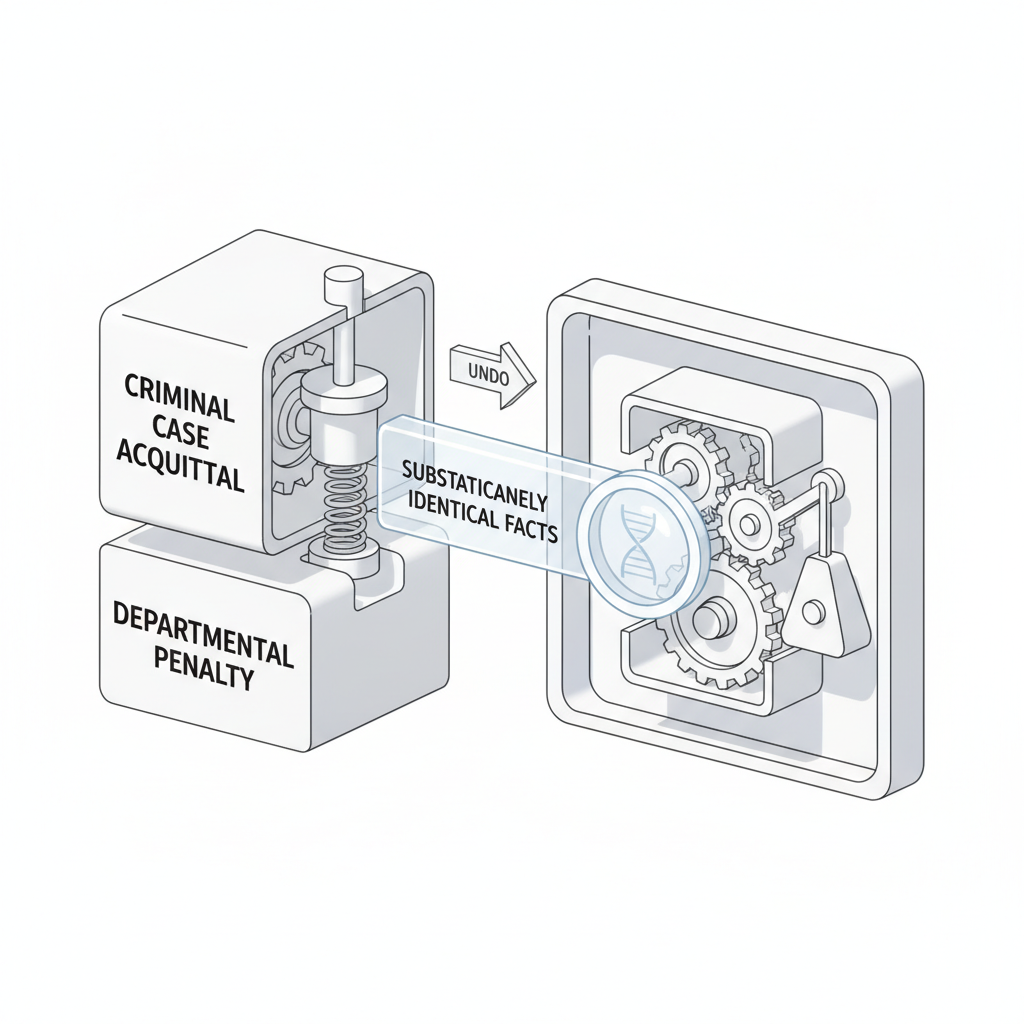
26 Sep Karnataka HC: Criminal Acquittal Only Undoes Dept Penalty If Facts Match
✎ An acquittal in a criminal case can invalidate a departmental penalty only when both proceedings are based on substantially identical facts, evidence, and witnesses; otherwise, the penalty may stand independently.
Subject Relevance — Where This Topic Fits
- GS Paper II — Polity: Constitutional Provisions, Judicial Review, and Administrative Law | GS Paper IV — Ethics, Integrity and Aptitude: Probity in Governance
- Prelims: departmental enquiry, compulsory retirement, acquittal in criminal case, judicial review of administrative actions, Article 311 of the Constitution, principles of natural justice, doctrine of res judicata
- Essay: Administrative Justice vs. Judicial Justice: The Imperative of Coherence in Governance
Quick Revision: An acquittal in a criminal case can invalidate a departmental penalty only when both proceedings are based on substantially identical facts, evidence, and witnesses; otherwise, the penalty may stand independently.
Why is this in the news?
The Karnataka High Court, in a recent judgment, clarified the legal principle governing the impact of a criminal acquittal on departmental penalties imposed on public servants. The ruling underscores that an acquittal in a criminal proceeding can invalidate a departmental penalty only when both proceedings are founded on substantially identical facts, evidence, and witnesses. This decision is significant for civil service governance, as it reinforces the need for consistency between criminal and administrative adjudication processes, thereby safeguarding the rights of public servants against arbitrary or disproportionate penalties.
Background
- Public servants in India are governed by a dual framework of accountability: criminal law (e.g., the Indian Penal Code, 1860) and departmental disciplinary proceedings under service rules.
- Departmental penalties range from minor disciplinary actions to severe measures such as compulsory retirement or dismissal, which can significantly impact the career and livelihood of an officer.
- Criminal acquittals are often perceived as absolving an individual of wrongdoing, but administrative authorities have historically treated them as non-binding, leading to parallel departmental proceedings.
- The Constitution of India, under Article 311, provides safeguards to civil servants against arbitrary dismissal or reduction in rank, requiring adherence to principles of natural justice and disciplinary procedures.
- Judicial precedents, including those from the Supreme Court, have evolved principles to reconcile criminal acquittals with departmental penalties, emphasizing the need for factual alignment between the two proceedings.
- The Karnataka High Court’s judgment aligns with the broader judicial trend of ensuring coherence between criminal and administrative adjudication to prevent miscarriage of justice.
What is the Doctrine of Substantially Identical Facts?
- The doctrine refers to the legal principle that an acquittal in a criminal case can invalidate a departmental penalty only when both proceedings are based on substantially identical facts, evidence, witnesses, and circumstances.
- This principle ensures that a public servant is not subjected to double jeopardy—being penalised twice for the same alleged misconduct—thereby upholding the principles of natural justice and fairness.
- The doctrine does not imply automatic setting aside of departmental penalties upon criminal acquittal; rather, it requires a case-specific analysis to determine whether the underlying facts and charges are identical or substantially similar.
- The Karnataka High Court’s ruling clarifies that the mere phraseology of an acquittal—such as ‘benefit of doubt’ or ‘failure to prove guilt beyond reasonable doubt’—is not determinative. The substance of the acquittal, including the reasoning and evidence, must be considered.
- The court emphasised that the impact of an acquittal on a departmental penalty depends on whether the charge, substratum of allegations, evidence, witnesses, and documents in both proceedings are the same or substantially the same.
- This doctrine is rooted in the broader legal principle of *res judicata*, which prevents the re-litigation of issues already decided by a competent court, albeit in a different forum.
- The doctrine also aligns with the constitutional mandate under Article 311, which requires that disciplinary actions against civil servants be fair, reasonable, and based on valid evidence.
- The ruling reinforces the judiciary’s role in reviewing administrative actions to ensure they are not arbitrary, oppressive, or disproportionate to the alleged misconduct.
Key Features
| Feature | Significance |
|---|---|
| Judicial principle on departmental penalties | Establishes that criminal acquittal can invalidate departmental penalties only when both proceedings are based on substantially identical facts, evidence, and witnesses. |
| Substantive alignment of facts | Mere acquittal in a criminal case does not automatically annul departmental actions; alignment of facts, evidence, and witnesses is critical. |
| Merits over semantics of acquittal | The substance of the acquittal (e.g., failure to prove guilt beyond reasonable doubt) prevails over procedural phrasing (e.g., ‘benefit of doubt’). |
| Judicial scrutiny of witness testimony | Courts examine consistency of witness testimony across criminal and departmental proceedings to determine alignment. |
| Proportionality of penalties | Extreme penalties like compulsory retirement must be justified by substantial evidence; lack thereof renders them unjust and oppressive. |
Why it Matters
Administrative Law
- Reinforces the principle that departmental inquiries must be grounded in independent evidence, not merely on the outcome of criminal proceedings.
- Clarifies the boundaries of judicial review over administrative actions, ensuring they are not arbitrary or based on flawed premises.
- Emphasises the need for consistency in evidence across multiple forums to sustain disciplinary actions.
Constitutional Governance
- Upholds the rule of law by ensuring that administrative penalties are not imposed on flimsy or duplicative grounds.
- Highlights the judiciary’s role in safeguarding public servants from unjust disciplinary actions when criminal proceedings fail to establish guilt.
Public Service Ethics
- Reaffirms the importance of due process in disciplinary proceedings, preventing misuse of power in administrative actions.
- Ensures that penalties are proportionate to the evidence and not based on technicalities or procedural oversights.
Challenges
1. Ensuring Consistency Across Forums
- Departmental inquiries often rely on the same set of facts as criminal cases, leading to potential conflicts if outcomes differ.
- Witness testimony may vary in quality or reliability across forums, complicating the alignment of evidence.
- Administrative bodies may struggle to reconcile findings from criminal courts, especially when acquittals are based on technicalities.
UPSC Link: GS-II: Statutory, regulatory and various quasi-judicial bodies
2. Proportionality in Penalties
- Determining the appropriate penalty for misconduct remains a challenge, particularly when evidence is circumstantial or weak.
- Extreme penalties like compulsory retirement must be justified by clear and substantial evidence to avoid legal challenges.
- Administrative bodies may err on the side of harshness due to perceived public pressure or institutional bias.
UPSC Link: GS-IV: Ethics and Integrity in Governance
3. Judicial Review of Administrative Actions
- Courts must balance deference to administrative decisions with the need to prevent injustice, especially in cases of acquittal.
- The standard of proof in departmental inquiries (preponderance of evidence) differs from criminal trials (beyond reasonable doubt), creating potential conflicts.
- Judicial scrutiny may be perceived as encroaching on administrative autonomy, leading to tensions between the judiciary and executive.
UPSC Link: GS-II: Judiciary and its role
Challenges — UPSC Perspective
| Issue | Concern |
|---|---|
| Divergent outcomes in criminal and departmental proceedings | Risk of injustice if departmental penalties are imposed despite acquittal in criminal cases. |
| Variability in witness testimony | Inconsistencies in witness accounts across forums may undermine the credibility of disciplinary actions. |
| Proportionality of penalties | Ensuring penalties are fair and justified, particularly for extreme measures like compulsory retirement. |
| Judicial deference vs. judicial activism | Balancing the need for judicial review with respect for administrative discretion. |
| Administrative efficiency vs. due process | Ensuring timely disciplinary actions without compromising fairness or evidence standards. |
Way Forward
- Departmental inquiries should be conducted independently, with their own evidence base, even when aligned with criminal proceedings.
- Administrative bodies must ensure that penalties imposed are proportionate to the evidence and aligned with judicial principles.
- Witness testimony in departmental inquiries should be rigorously examined to ensure consistency with criminal trial records.
- Judicial training programs should emphasise the distinction between criminal and departmental standards of proof.
- Public service codes should be reviewed to ensure clarity on the evidentiary standards required for disciplinary actions.
- Whistleblower protection mechanisms should be strengthened to prevent misuse of departmental inquiries for ulterior motives.
- Transparency in disciplinary proceedings should be enhanced to build public trust in administrative actions.
UPSC Value Addition
Keywords for Mains Answer-Writing
Departmental inquiry · Criminal trial · Acquittal · Constitutional governance · Procedural fairness · Natural justice · Article 311(2) of the Constitution · Public servant discipline · Judicial review of administrative actions · Substantial identity of facts · Procedural estoppel · Compulsory retirement · Departmental penalty · Due process · Rule of law in governance
Constitutional & Policy Linkages
- Article 311: Safeguards for public servants against arbitrary dismissal or reduction in rank.
Concept Flow
Criminal proceedings initiated against a public servant for alleged misconduct. → Acquittal in criminal court due to failure to prove guilt beyond reasonable doubt. → Departmental inquiry initiated based on the same allegations. → Departmental penalty imposed, including compulsory retirement. → Public servant challenges the penalty, citing the criminal acquittal. → High Court examines alignment of facts, evidence, and witnesses across both proceedings. → Court rules that identical facts and evidence invalidate the departmental penalty. → Penalty set aside as unjust and oppressive, reinforcing the principle of proportionality.
Prelims Practice Questions
Q1. Consider the following statements regarding the impact of a criminal acquittal on departmental penalties for public servants in India:
1. A criminal acquittal automatically nullifies any departmental penalty imposed on a public servant.
2. The Karnataka High Court held that departmental penalties can be set aside only if the criminal case and departmental inquiry are based on substantially identical facts.
3. The mere phraseology used in the criminal acquittal order, such as ‘benefit of doubt’, is determinative of the validity of a departmental penalty.
How many of the above statements are correct?
- Only one
- Only two
- All three
- None
Answer: Only two — Statement 1 is incorrect because a criminal acquittal does not automatically nullify a departmental penalty; Statement 2 is correct as per the Karnataka High Court’s ruling; Statement 3 is incorrect because the court held that the semantics of the acquittal order are not determinative—only the substance matters.
Q2. Assertion (A): The doctrine of ‘substantial identity of facts’ is a key principle in determining whether a criminal acquittal should invalidate a departmental penalty.
Reason (R): The Karnataka High Court ruled that departmental penalties can only be set aside if the criminal proceedings and departmental inquiry are based on substantially identical facts, evidence, and witnesses.
Options:
A. Both A and R are true, and R is the correct explanation of A
B. Both A and R are true, but R is not the correct explanation of A
C. A is true, but R is false
D. A is false, but R is true
Answer: ? — Both the Assertion and Reason are true, and the Reason correctly explains the Assertion as per the Karnataka High Court’s judgment in the case of K. Eshwar.
Q3. Match the following provisions of the Constitution of India with their correct descriptions:
Column I (Provision) | Column II (Description)
— | —
1. Article 311(2)(a) | A. Safeguards against arbitrary dismissal or removal of civil servants
2. Article 311(2)(b) | B. Protection against dismissal without inquiry in certain cases
3. Article 311(2)(c) | C. Excludes the application of Article 311(2) for certain categories of employees
Options:
A. 1-A, 2-B, 3-C
B. 1-B, 2-A, 3-C
C. 1-C, 2-B, 3-A
D. 1-A, 2-C, 3-B
- A
- B
- C
- D
Answer: A — Article 311(2)(a) provides safeguards against arbitrary dismissal or removal of civil servants; Article 311(2)(b) protects against dismissal without inquiry in certain cases; Article 311(2)(c) excludes the application of Article 311(2) for certain categories of employees.
Mains Practice Question
✍ The principle that a criminal acquittal can invalidate a departmental penalty only when both proceedings are based on substantially identical facts is a critical safeguard for procedural fairness in governance. Critically examine the legal and constitutional foundations of this principle, with particular reference to Article 311(2) of the Constitution of India and recent judicial precedents. Also, analyse the implications of this principle for the balance between administrative discipline and the rule of law in public service. (15 Marks)
Approach: MODEL-ANSWER SKELETON:
1. **Introduction (2 marks)**
– Briefly define departmental inquiries and criminal trials for public servants.
– State the constitutional context: Article 311(2) of the Constitution, which protects civil servants from arbitrary dismissal/removal.
– Mention the Karnataka High Court’s judgment in *K. Eshwar v. State of Karnataka* (2026) as a contemporary anchor.
2. **Legal Foundations of the Principle (4 marks)**
– **Article 311(2)**: Explain the three exceptions where Article 311(2) does not apply (misconduct established in a criminal trial, conviction, or where the President/ Governor is satisfied that it is not reasonably practicable to hold an inquiry).
– **Procedural fairness and natural justice**: Link to the principles of audi alteram partem and nemo judex in causa sua.
– **Judicial precedents**: Cite key cases such as *Union of India v. Tulsiram Patel* (1985), *Sham Lal v. State of Haryana* (2018), and *K. Eshwar* to illustrate the evolution of this principle.
3. **Substantial Identity of Facts: Core of the Principle (4 marks)**
– Define ‘substantially identical facts’ as interpreted by the Karnataka High Court: same charge, evidence, witnesses, and circumstances.
– Contrast with cases where facts differ (e.g., *State of Maharashtra v. Chandrabhan* (2016)), where acquittal did not invalidate departmental action.
– Discuss the rationale: ensuring consistency in outcomes and preventing double jeopardy in spirit.
4. **Balance Between Administrative Discipline and Rule of Law (3 marks)**
– **Administrative discipline**: The need for accountability in public service to maintain efficiency and public trust.
– **Rule of law**: Emphasise the protection of individual rights and the principle that no one should be punished twice for the same act.
– **Constitutional morality**: Link to the balance between Articles 14 (equality) and 311(2) as interpreted in *Tulsiram Patel*.
5. **Implications and Challenges (2 marks)**
– **For public servants**: Clarity in the nexus between criminal and departmental proceedings reduces uncertainty.
– **For governance**: Ensures that departmental actions are not arbitrary and are grounded in evidence.
– **Challenges**: Potential delays in disciplinary proceedings if criminal cases drag on; the need for coordination between courts and administrative bodies.
Source: The Hindu
Karnataka PCS (KPSC) — State PCS Practice
Prelims: According to the Karnataka High Court’s ruling on acquittal in criminal cases and departmental penalties, under what condition can an acquittal undo a departmental penalty?
- If both the criminal case and departmental penalty are based on substantially identical facts
- If the departmental penalty was imposed without following due process
- If the criminal case was dismissed on technical grounds
- If the accused was granted bail in the criminal case
Answer: If both the criminal case and departmental penalty are based on substantially identical facts — The Karnataka High Court held that an acquittal in a criminal case can nullify a departmental penalty only when both proceedings rely on the same set of facts.
Mains: Critically examine the Karnataka High Court’s judgment on the relationship between criminal acquittal and departmental penalties. How does this ruling impact the disciplinary proceedings in Karnataka state services? Provide your analysis with relevant examples.
Generated by AanyaAi for educational purpose.
Related guides on our sites
- Current affairs for upsc 2026
- Best PSIR optional coaching for upsc
- Best PSIR optional teacher for upsc
- Best teacher of PSIR optional for upsc

- Exercise Tarang Shakti 2026: India’s Mega Multi-Nation Air Power Showcase - September 27, 2026
- रबी अभियान 2026: राष्ट्रीय सम्मेलन में केंद्र-राज्य तालमेल पर होगा जोर - September 27, 2026
- Himachal CM Sukhu: All Doctor Vacancies to be Filled by March - September 27, 2026

No Comments