


26 Sep Amaravati as Andhra’s sole capital: High Court dismisses three-capitals petitions
✎ The designation of a State capital is a legislative function subject to judicial review, and Parliament’s amendment to the Andhra Pradesh Reorganisation Act, 2014, designating Amaravati as the sole capital, renders challenges to…
Subject Relevance — Where This Topic Fits
- GS Paper II — Functions and Responsibilities of the Union and the States, Issues and Challenges Pertaining to the Federal Structure, Devolution of Powers and Finances up to Local Levels and Challenges Therein | GS Paper III — Development, Bio diversity, Environment, Security and Disaster Management (Land Acquisition and Rehabilitation) | GS Paper II — Separation of Powers between various organs, Dispute Redressal Mechanisms and Institutions
- Prelims: Amaravati, Andhra Pradesh Reorganisation Act 2014, Three Capitals Policy, Land Pooling Scheme (LPS), Article 3 of the Constitution, Doctrine of Pith and Substance, Doctrine of Colourable Legislation, Special Leave Petition (SLP), High Court Jurisdiction under Article 226, Concurrent List Entry 18 (Land), Seventh Schedule
- Essay: Federalism in India: Balancing Unity and Diversity, Judicial Review and Constitutional Governance: The Role of the Higher Judiciary in Policy Disputes
Quick Revision: The designation of a State capital is a legislative function subject to judicial review, and Parliament’s amendment to the Andhra Pradesh Reorganisation Act, 2014, designating Amaravati as the sole capital, renders challenges to the three-capitals policy infructuous under the doctrine of legislative competence and judicial finality.
Why is this in the news?
The Andhra Pradesh High Court declared over 120 writ petitions challenging the State’s three-capitals policy as infructuous following Parliament’s amendment to the Andhra Pradesh Reorganisation Act, 2014, designating Amaravati as the sole capital. This legal development underscores the interplay between legislative competence, judicial review, and the federal structure in resolving inter-regional developmental disputes. The case also highlights the procedural and substantive dimensions of land acquisition and capital city designation under India’s constitutional framework.
Background
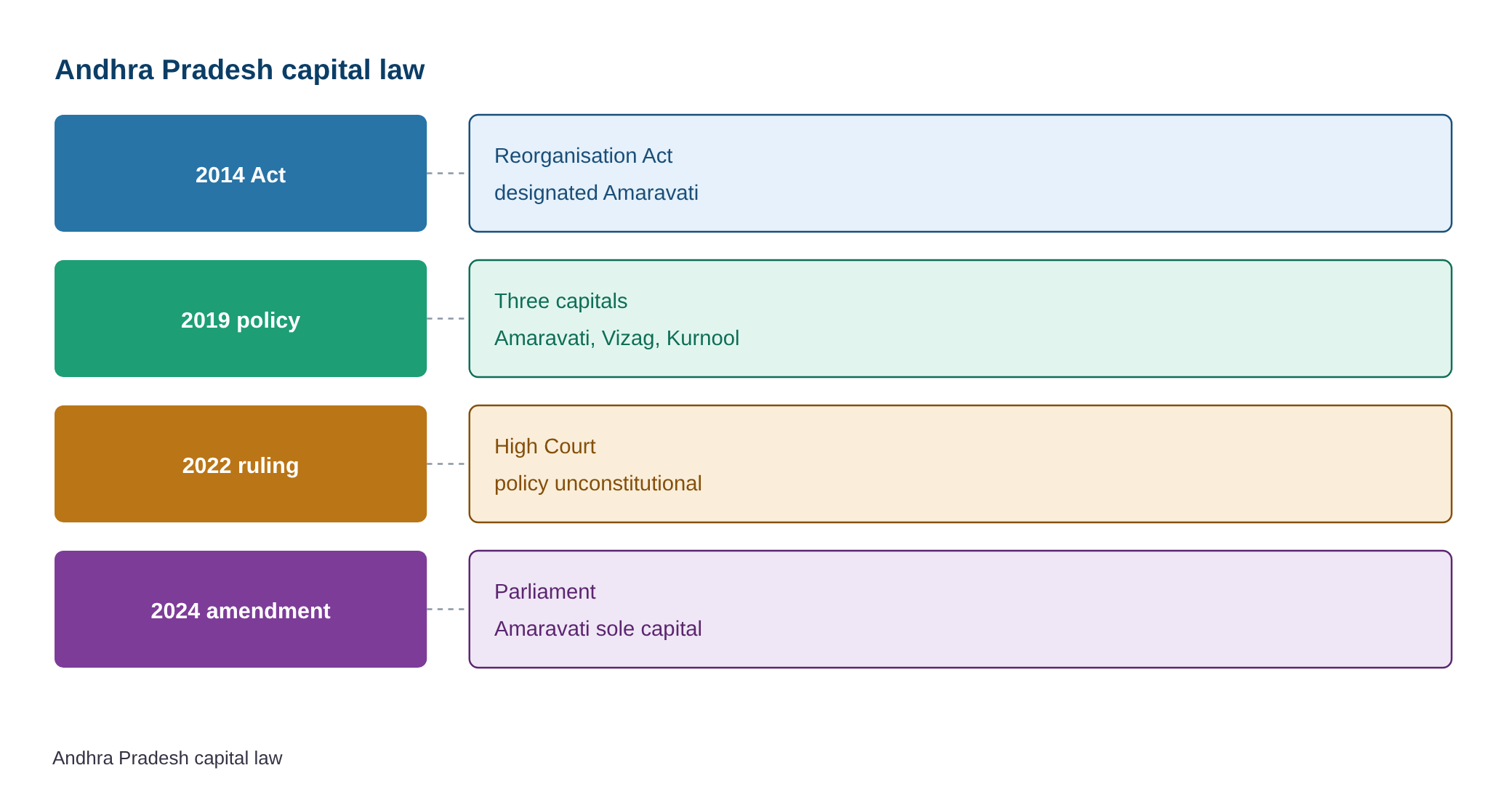
- The bifurcation of Andhra Pradesh in 2014, pursuant to the Andhra Pradesh Reorganisation Act, left the issue of the capital unresolved, with Hyderabad serving as a temporary capital for both Telangana and Andhra Pradesh until 2024.
- In December 2019, the YSR Congress Party (YSRCP) government proposed a three-capitals policy, designating Amaravati as the legislative capital, Visakhapatnam as the executive capital, and Kurnool as the judicial capital, triggering widespread protests, particularly from farmers who had contributed land under the Land Pooling Scheme (LPS) for Amaravati’s development.
- The Land Pooling Scheme (LPS) was introduced to aggregate land parcels from farmers for the development of Amaravati, with promises of developed plots in return, leading to significant land acquisition and rehabilitation challenges.
- In March 2022, a three-judge bench of the Andhra Pradesh High Court ruled that the State lacked legislative competence to shift the capital out of Amaravati, as the 2014 Act had implicitly designated Amaravati as the capital, rendering the three-capitals policy unconstitutional.
- The YSRCP government filed Special Leave Petitions (SLPs) in the Supreme Court against the High Court’s 2022 judgment, while simultaneously pursuing legislative amendments to formalise Amaravati as the sole capital.
- Parliament amended the Andhra Pradesh Reorganisation Act, 2014, to designate Amaravati as the sole capital of Andhra Pradesh, thereby resolving the legal ambiguity.
What is the Legal and Constitutional Framework Governing Capital City Designation in India?
- The Andhra Pradesh Reorganisation Act, 2014, which bifurcated the State, did not explicitly designate a capital but implied Amaravati as the capital through the creation of the Capital Region Development Authority, a contention later upheld by the High Court in 2022.
- The doctrine of **pith and substance** applies to determine the true nature of a legislative enactment; in this case, the High Court held that the State’s attempt to decentralise the capital violated the constitutional scheme embedded in the 2014 Act.
- The **doctrine of colourable legislation** prevents a legislature from indirectly achieving what it cannot do directly; here, the State’s three-capitals policy was deemed an attempt to circumvent the implicit capital designation in the 2014 Act.
- The **Land Pooling Scheme (LPS)** is a statutory mechanism under the Andhra Pradesh Capital Region Development Authority Act, 2014, for land aggregation and development, but its implementation must align with constitutional safeguards for landowners, as highlighted in the protests by farmers.
- The **judicial review** of legislative actions by the High Court under Article 226 and the Supreme Court under Article 136 ensures that State actions comply with constitutional provisions, particularly in matters affecting federal balance and land rights.
- The **doctrine of necessity** and **proportionality** may also be invoked in such disputes to balance developmental goals with constitutional rights, though their application depends on the facts of each case.
Key Features
| Feature | Significance |
|---|---|
| Andhra Pradesh Reorganisation (Amendment) Bill, 2026 | Legally enshrines Amaravati as the sole capital of Andhra Pradesh by amending the AP Reorganisation Act, 2014, thereby resolving the ambiguity over the state’s capital status. |
| High Court’s infructuous ruling on petitions | Declares over 120 writ petitions challenging the three-capitals plan as infructuous due to the legislative validation of Amaravati as the capital, rendering further adjudication unnecessary on the core issue. |
| Supreme Court’s pending appeals (November 29, 2026) | Likely hearing of appeals against the High Court’s 2022 Amaravati judgment, which had upheld Amaravati as the sole capital, ensuring judicial oversight of the legislative decision. |
| Land Pooling Scheme (LPS) beneficiaries | Addresses the concerns of farmers who contributed land under LPS for Amaravati’s development, with demands for time-bound allotment of developed plots to ensure equitable compensation. |
| Infrastructure development timeline (3 years) | State government’s commitment to complete Amaravati’s infrastructure projects within three years, as stated in its affidavit to the Supreme Court, ensuring timely execution of the capital’s development. |
Why it Matters
Constitutional and Legal
- The amendment to the AP Reorganisation Act, 2014, reinforces the principle of legislative supremacy in determining state capitals, subject to constitutional validity.
- The High Court’s ruling underscores the doctrine of judicial review, where legislative actions are examined for constitutional compliance, even as the core issue is resolved by law.
- The Supreme Court’s impending hearing highlights the hierarchy of judicial forums in resolving disputes of national importance, ensuring uniformity in constitutional interpretation.
Economic
- Amaravati’s designation as the sole capital is expected to accelerate infrastructure development, attracting investments and fostering economic growth in the region.
- Completion of infrastructure projects within three years, as committed by the state government, is critical to realizing Amaravati’s potential as a growth engine.
- The resolution of the capital dispute may restore investor confidence in Andhra Pradesh, which had been impacted by prolonged uncertainty over the state’s administrative setup.
Administrative and Governance
- The three-capitals proposal, while aimed at decentralization, faced procedural and legal challenges, demonstrating the complexities of balancing regional equity with administrative efficiency.
- The state government’s affidavit in the Supreme Court reflects a commitment to transparent governance, with a clear timeline for infrastructure development to address public concerns.
- The High Court’s intervention ensures that administrative decisions are subject to judicial scrutiny, reinforcing the rule of law in governance.
Social and Equity
- The Land Pooling Scheme (LPS) beneficiaries’ demands highlight the need for equitable compensation and timely allotment of developed plots, ensuring that farmers are not left in limbo.
- The resolution of the capital dispute may alleviate socio-economic tensions in the region, particularly among farmers who had contributed land under the LPS.
Challenges
1. Land Acquisition and Compensation Disputes
- Delays in the allotment of developed plots to LPS beneficiaries may lead to legal disputes and social unrest, undermining the state’s credibility.
- Ensuring fair compensation for landowners, including those who had contributed land under the LPS, remains a critical challenge to maintain public trust.
UPSC Link: Land Reforms and Compensation
2. Infrastructure Development Timelines
- Meeting the three-year deadline for completing Amaravati’s infrastructure projects is a significant logistical challenge, given the scale of development required.
- Delays in infrastructure development could erode investor confidence and delay the realization of Amaravati’s potential as a capital city.
UPSC Link: Urban Development and Infrastructure
3. Judicial Review and Legislative Supremacy
- Balancing judicial review with legislative supremacy remains a constitutional challenge, particularly when legislative actions are challenged in higher courts.
- The Supreme Court’s impending hearing may set a precedent for future disputes involving state capitals, requiring careful judicial reasoning.
UPSC Link: Judicial Review and Separation of Powers
4. Regional Equity and Decentralization
- The three-capitals proposal, while aimed at decentralization, faced opposition due to concerns over regional equity and administrative efficiency.
- Ensuring that decentralization does not compromise governance efficiency remains a challenge for the state government.
UPSC Link: Federalism and Regional Balance
5. Public Trust and Governance Credibility
- Prolonged disputes over the capital have eroded public trust in the state government’s ability to make and implement decisions.
- Rebuilding public trust through transparent governance and timely execution of commitments is essential for the state’s long-term stability.
UPSC Link: Good Governance and Transparency
Challenges — UPSC Perspective
| Issue | Concern |
|---|---|
| Land Pooling Scheme (LPS) beneficiaries | Delays in allotment of developed plots and fair compensation may lead to legal disputes and social unrest. |
| Infrastructure development timelines | Meeting the three-year deadline for Amaravati’s infrastructure projects is a significant logistical challenge. |
| Judicial review vs. legislative supremacy | Balancing judicial scrutiny with legislative decisions remains a constitutional challenge. |
| Regional equity and decentralization | Ensuring decentralization does not compromise governance efficiency is a key challenge. |
| Public trust and governance credibility | Prolonged disputes have eroded public trust, requiring transparent and timely governance. |
Government Initiatives — Must-Memorise for Prelims
- Land Pooling Scheme (LPS) for Amaravati
- AP Capital Region Development Authority Repeal Act, 2020
- AP Decentralisation and Inclusive Development of All Regions Act, 2020
Way Forward
- Ensure time-bound allotment of developed plots to LPS beneficiaries to address their concerns and prevent legal disputes.
- Accelerate infrastructure development in Amaravati to meet the three-year deadline and restore investor confidence.
- Maintain transparent communication with stakeholders, including farmers, investors, and the public, to rebuild trust in governance.
- Monitor the implementation of the AP Reorganisation (Amendment) Bill, 2026, to ensure compliance with legal and constitutional provisions.
- Prepare for the Supreme Court’s hearing on November 29, 2026, by consolidating all relevant documents and legal arguments.
- Address regional equity concerns by ensuring balanced development across Amaravati, Visakhapatnam, and Kurnool, if applicable.
- Strengthen inter-departmental coordination to streamline infrastructure development and avoid bureaucratic delays.
- Conduct periodic reviews of the state’s governance mechanisms to ensure accountability and efficiency in decision-making.
UPSC Value Addition
Keywords for Mains Answer-Writing
Andhra Pradesh Reorganisation Act, 2014 · Amaravati as sole capital · Three Capitals Policy · Land Pooling Scheme (LPS) · AP Capital Region Development Authority Repeal Act, 2020 · AP Decentralisation and Inclusive Development of All Regions Act, 2020 · Andhra Pradesh High Court · Supreme Court of India · Parliamentary sovereignty · Federalism in India · Judicial review of legislative competence · Special Leave Petitions (SLP) · Constitutional amendment process · Infrastructure development in Amaravati
Constitutional & Policy Linkages
- Article 3 of the Constitution of India (Formation of new States and alteration of areas, boundaries or names of existing States)
- Article 246 (Distribution of Legislative Powers between Parliament and State Legislatures)
- Article 254 (Inconsistency between laws made by Parliament and laws made by the Legislatures of States)
Concept Flow
AP Reorganisation Act, 2014 → Designation of Amaravati as the capital of Andhra Pradesh. → Proposal for three capitals (2019) → Widespread protests, particularly from LPS beneficiaries. → High Court judgment (March 2022) → Upholds Amaravati as the sole capital, citing lack of legislative competence to reverse the 2014 decision. → State government challenges High Court judgment in the Supreme Court (SLPs filed in 2020) → Pending hearing on November 29, 2026. → AP Reorganisation (Amendment) Bill, 2026 → Parliament enshrines Amaravati as the sole capital by law. → High Court rules petitions infructuous → Supreme Court’s impending hearing to address appeals against the 2022 judgment. → State government commits to completing infrastructure projects in Amaravati within three years → Ensures timely execution and investor confidence.
Prelims Practice Questions
Q1. Consider the following statements regarding the Andhra Pradesh Reorganisation Act, 2014:
1. The Act originally envisaged Amaravati as the sole capital of Andhra Pradesh.
2. The Act was amended in 2026 to explicitly designate Amaravati as the sole capital.
3. The Act empowered the State Legislature to establish multiple capitals through subsequent legislation.
4. The Act is silent on the issue of land acquisition for capital development.
How many of the above statements are correct?
- Only one
- Only two
- Only three
- All four
Answer: Only three — Statement 1 is correct as the Act originally provided for Amaravati as the capital. Statement 2 is correct as the 2026 amendment explicitly designated Amaravati as the sole capital. Statement 3 is incorrect because the Act does not empower the State Legislature to establish multiple capitals; it was the 2020 Acts that attempted to do so, later struck down. Statement 4 is incorrect as the Act includes provisions for land acquisition and development.
Q2. Assertion (A): The Andhra Pradesh High Court held that the State Legislature lacked the competence to reverse the capital decision taken under the Andhra Pradesh Reorganisation Act, 2014.
Reason (R): The High Court ruled that the capital issue was settled by Parliament and could not be altered by State legislation.
In the context of the above statements, which of the following is correct?
- Both A and R are true, and R is the correct explanation of A.
- Both A and R are true, but R is not the correct explanation of A.
- A is true but R is false.
- A is false but R is true.
Answer: Both A and R are true, but R is not the correct explanation of A. — The High Court’s judgment in 2022 explicitly held that the State Legislature lacked the competence to reverse the capital decision taken under the Andhra Pradesh Reorganisation Act, 2014, as it was a matter settled by Parliament. Thus, both the assertion and reason are true, and the reason correctly explains the assertion.
Q3. Match the following pairs related to the Andhra Pradesh capital issue:
Column I (Legislative/Executive Action) | Column II (Outcome/Consequence)
1. AP Capital Region Development Authority Repeal Act, 2020 | A. Designated Amaravati as the sole capital
2. Andhra Pradesh Reorganisation (Amendment) Bill, 2026 | B. Attempted to establish three capitals
3. Supreme Court’s likely hearing on November 29, 2026 | C. Petitions against three capitals declared infructuous
4. Land Pooling Scheme (LPS) | D. Infrastructure development in Amaravati
Choose the correct match:
- 1-B, 2-A, 3-C, 4-D
- 1-A, 2-B, 3-C, 4-D
- 1-C, 2-A, 3-B, 4-D
- 1-B, 2-C, 3-A, 4-D
Answer: 1-B, 2-A, 3-C, 4-D — The AP Capital Region Development Authority Repeal Act, 2020 (1) attempted to establish three capitals (B). The Andhra Pradesh Reorganisation (Amendment) Bill, 2026 (2) designated Amaravati as the sole capital (A). The Supreme Court’s likely hearing (3) will examine appeals against the High Court’s judgment, rendering petitions infructuous (C). The Land Pooling Scheme (4) is linked to infrastructure development in Amaravati (D).
Mains Practice Question
✍ The Parliament’s amendment to the Andhra Pradesh Reorganisation Act, 2014, designating Amaravati as the sole capital of Andhra Pradesh, has rendered the three-capitals policy legally infructuous. Critically examine the constitutional and federal implications of this legislative intervention, with reference to the doctrine of legislative competence and the balance of powers between the Union and the States. Also, analyse the judicial response to such interventions in recent years. (15 Marks)
Approach: MODEL-ANSWER SKELETON:
1. **Legislative Competence**: Explain the constitutional basis of Parliament’s power under Article 3 of the Constitution to reorganise states and amend the Andhra Pradesh Reorganisation Act, 2014. Contrast this with the State Legislature’s competence under the State List (List II) and the Concurrent List (List III).
2. **Federalism and Balance of Powers**: Discuss the federal principle enshrined in the Constitution, highlighting the tension between Union and State powers. Reference the Sarkaria Commission (1988) and Punchhi Commission (2010) recommendations on Centre-State relations, particularly regarding legislative interventions in State matters.
3. **Judicial Response**: Analyse the Andhra Pradesh High Court’s judgment in 2022 (three-judge Bench) and the Supreme Court’s likely hearing on November 29, 2026. Reference the doctrine of ‘pith and substance’ and the principle that legislative competence is determined by the ‘dominant intention’ of the statute. Cite relevant Supreme Court judgments such as State of West Bengal v. Union of India (1963) and State of Bihar v. Union of India (2017).
4. **Recent Trends**: Examine recent judicial trends where the Supreme Court has upheld or struck down legislative interventions by Parliament in State matters, such as the abrogation of Article 370 (2019) and the Citizenship (Amendment) Act, 2019. Discuss the implications for federalism and the rule of law.
5. **Constitutional Amendments and Governance**: Explain the process of constitutional amendment under Article 368, including the requirement of a special majority and, where necessary, ratification by State Legislatures. Discuss the role of the President in such amendments and the principle of basic structure doctrine (Kesavananda Bharati, 1973).
6. **Conclusion**: Summarise the balance between legislative sovereignty and federalism, and the need for constitutional morality and democratic consensus in such interventions. Highlight the importance of judicial review in safeguarding federal principles.
Source: The Hindu
Andhra Pradesh PCS (APPSC) — State PCS Practice
Prelims: As per the recent Andhra Pradesh High Court ruling on the three-capitals issue, which city has been legally declared as the sole capital of Andhra Pradesh?
- Amaravati
- Visakhapatnam
- Kurnool
- Hyderabad
Answer: Amaravati — The Andhra Pradesh High Court ruled that Amaravati is the sole capital of Andhra Pradesh by law, making petitions for three capitals infructuous.
Mains: Critically analyze the legal and constitutional implications of the Andhra Pradesh High Court’s verdict on the three-capitals issue, with specific reference to the Andhra Pradesh Decentralisation and Inclusive Development of All Regions Act, 2020.
Generated by AanyaAi for educational purpose.
Related guides on our sites
- Best PSIR optional coaching for upsc
- Best PSIR optional teacher for upsc
- Best teacher of PSIR optional for upsc
- Best PSIR optional coaching in delhi for UPSC

- PM Modi Praises Youth-Led Nasha Mukt Yuva Abhiyan Momentum - September 27, 2026
- राजनाथ सिंह का बड़ा बयान: भारत किसी की ज़मीन कब्ज़ा नहीं करेगा, लेकिन सुरक्षा पर होगा कठोर - September 27, 2026
- Exercise Tarang Shakti 2026: India’s Mega Multi-Nation Air Power Showcase - September 27, 2026

No Comments