


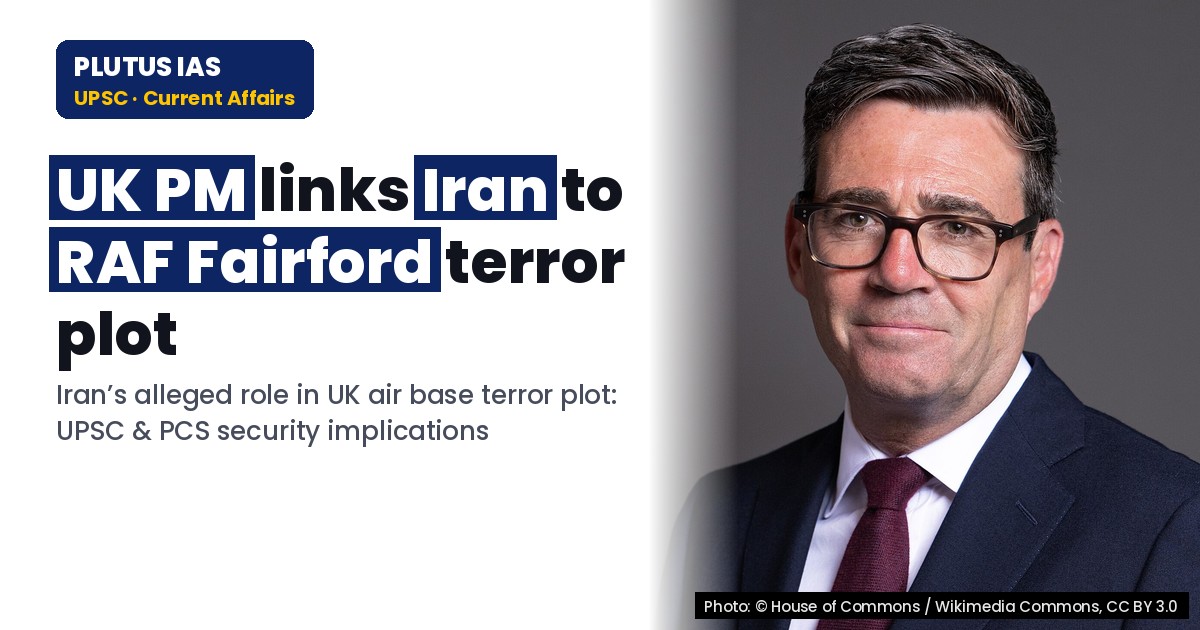
30 Sep Iran’s Alleged Role in UK Air Base Terror Plot: UPSC & PCS Analysis
✎ State-sponsored terrorism involves a state’s direct or indirect support for terrorist acts, while counter-terrorism frameworks—domestic and international—combine legal, intelligence, and diplomatic tools to prevent and respond to…
Subject Relevance — Where This Topic Fits
- GS Paper II — International Relations — Threats to Internal Security through External State and Non-State Actors | GS Paper III — Internal Security — Challenges Related to Terrorism and Counter-Terrorism Measures
- Prelims: State-sponsored terrorism, Counter-Terrorism and Security (CTS) architecture, RAF Fairford, Islamic Revolutionary Guard Corps (IRGC), COBRA, Bail conditions in terror cases, Extradition treaties, UN Security Council Resolution 1373
- Essay: The Role of State Actors in International Terrorism: A Threat to Global Stability, Balancing National Security and Civil Liberties in Counter-Terrorism Frameworks
Quick Revision: State-sponsored terrorism involves a state’s direct or indirect support for terrorist acts, while counter-terrorism frameworks—domestic and international—combine legal, intelligence, and diplomatic tools to prevent and respond to such threats, as demonstrated in the UK’s investigation into the RAF Fairford incident.
Why is this in the news?
The incident, involving arrests of five British nationals and subsequent investigations, underscores the challenges in attributing state involvement in terror acts while navigating legal and diplomatic constraints.
Background
- The Royal Air Force (RAF) Fairford in Gloucestershire, England, is a key strategic air base historically used for deploying US military assets, including B-52 bombers, for operations such as the Gulf War and more recently for airstrikes against targets in the Middle East.
- The Islamic Revolutionary Guard Corps (IRGC), a branch of Iran’s Armed Forces, has been designated as a terrorist organisation by several countries, including the United States, for its alleged involvement in regional destabilisation and support for proxy groups.
- The UK’s Counter-Terrorism Policing (CTP) operates under the National Counter Terrorism Security Office (NaCTSO) and is responsible for investigating terror-related incidents, coordinating with intelligence agencies, and ensuring public safety.
- The UK’s counter-terrorism legal framework includes the Terrorism Act 2000, the Anti-Terrorism, Crime and Security Act 2001, and the Counter-Terrorism and Security Act 2015, which empower authorities to detain suspects, impose bail conditions, and conduct investigations under strict legal safeguards.
- The UK’s Cabinet Office Briefing Room A (COBRA) is a crisis management committee that coordinates government responses to emergencies, including terror attacks, through inter-agency collaboration.
- The incident follows veiled threats issued by the IRGC in July 2026 against the British monarchy, reflecting heightened tensions between Iran and Western nations over regional influence and security policies.
What is State-Sponsored Terrorism and How Does Counter-Terrorism Address It?
- State-sponsored terrorism refers to the deliberate use or support of violence by a state, or its proxies, against another state or its citizens to achieve political, ideological, or strategic objectives. This can include providing funding, training, weapons, or safe havens to non-state actors engaged in terrorist activities.
- Counter-terrorism measures encompass a range of legal, intelligence, military, and diplomatic strategies designed to prevent, deter, and respond to terrorist threats. These include surveillance, intelligence-sharing, legislative reforms, and international cooperation under frameworks like the UN Global Counter-Terrorism Strategy.
- The UK’s counter-terrorism response to the incident involves multiple agencies: Counter-Terrorism Policing (CTP) for investigation, MI5 for domestic intelligence, GCHQ for signals intelligence, and the Foreign, Commonwealth & Development Office (FCDO) for diplomatic engagement with Iran and allied nations.
- Bail conditions in terror cases are stringent and often include electronic monitoring, travel restrictions, reporting to police stations, and prohibitions on accessing certain locations or communication devices. These measures aim to mitigate risks while upholding the presumption of innocence until proven guilty.
- The COBRA mechanism ensures a coordinated government-wide response to crises, integrating inputs from security agencies, local authorities, and international partners to manage the incident’s fallout and prevent further threats.
- International legal frameworks, such as UN Security Council Resolution 1373 (2001), mandate member states to criminalise terrorist financing, deny safe haven to terrorists, and cooperate in extradition and intelligence-sharing to combat state-sponsored terrorism.
- Diplomatic channels remain critical in addressing allegations of state involvement in terrorism, as accusations must be substantiated with credible evidence to avoid escalating tensions or triggering retaliatory measures.
Key Features
| Feature | Significance |
|---|---|
| Alleged Iranian involvement in UK terror incident | Raises questions about state-sponsored terrorism, cross-border security threats, and the role of foreign actors in domestic terrorism cases. |
| RAF Fairford as a strategic military base | Highlights the base’s significance as a host to US Air Force operations, including airstrikes against Iran, making it a potential target for retaliatory or deterrent actions. |
| Counter-terrorism investigation and bail conditions | Demonstrates the balance between national security imperatives and legal due process, particularly in cases involving suspected foreign state actors. |
| COBRA emergency meeting | Illustrates the UK’s crisis management protocol for high-risk security incidents, involving multi-agency coordination and intelligence sharing. |
| Diplomatic denial by Iran | Underscores the geopolitical sensitivity of such allegations and the challenges in attributing state involvement in terror incidents without conclusive evidence. |
Why it Matters
Geopolitical and Diplomatic Implications
- The allegation of Iranian involvement in a terror incident near a NATO-linked military base could escalate tensions between the UK, US, and Iran, potentially affecting regional stability in West Asia.
- Such allegations, if unproven, risk exacerbating diplomatic friction and undermining trust in international counter-terrorism cooperation.
- The incident may influence UK-Iran bilateral relations, particularly in areas like trade, consular access, and regional security partnerships.
- The UK’s response, including the convening of COBRA, signals a high-priority engagement with the issue, reflecting its strategic interests in counter-terrorism and alliance commitments.
Counter-Terrorism and National Security
- The incident highlights vulnerabilities in the security of military installations, even in allied nations, and the need for robust counter-terrorism measures.
- The investigation’s complexity underscores the challenges in attributing state sponsorship in terror acts, requiring advanced forensic, cyber, and intelligence capabilities.
- The use of bail conditions for suspects in a high-profile terror case reflects the legal system’s attempt to balance security with civil liberties, a recurring debate in counter-terrorism policy.
- The recovery of petrol and lack of explosives in the stopped vehicles may indicate either a failed attack or a staged scenario, raising questions about the attackers’ intent and capabilities.
Strategic Military and Alliance Dynamics
- RAF Fairford’s role as a forward operating base for US military operations, including airstrikes, makes it a potential target for asymmetric warfare or retaliation by state or non-state actors.
- The incident may prompt a reassessment of security protocols for allied military bases, particularly those hosting multinational forces or participating in regional conflict zones.
- The allegation of Iranian involvement could influence NATO’s stance on Iran, particularly in the context of broader transatlantic security cooperation against state-sponsored threats.
Legal and Procedural Challenges
- The granting of bail to suspects in a terror case, despite strict conditions, highlights the legal principle of presumption of innocence until proven guilty, even in high-stakes security scenarios.
- The investigation’s reliance on intelligence and forensic evidence underscores the need for transparent yet classified information sharing in counter-terrorism operations.
- The case may set a precedent for how future terror incidents involving alleged state actors are handled, particularly in terms of evidence admissibility and diplomatic immunity considerations.
Challenges
1. Attribution of State Involvement in Terror Incidents
- Proving state sponsorship in terror acts is inherently difficult due to the use of proxies, deniable operations, and sophisticated cover mechanisms.
- The lack of conclusive evidence in this case risks politicising the investigation, with potential reputational damage to either the UK or Iran.
- International law lacks a clear framework for attributing state responsibility in terror incidents, leading to ambiguity in responses and counter-measures.
- Over-reliance on intelligence without corroborating evidence may undermine the credibility of counter-terrorism operations in the eyes of the public or allies.
UPSC Link: GS3: Internal Security Challenges
2. Balancing Security and Civil Liberties in Counter-Terrorism
- Strict bail conditions for terror suspects raise ethical and legal questions about the presumption of innocence and the right to fair trial.
- The use of surveillance and intelligence-gathering in such cases must comply with domestic laws and human rights standards, particularly in democratic nations.
- Public perception of security measures can influence policy decisions, creating a tension between perceived safety and actual civil liberties.
- The incident may reignite debates on the effectiveness of preventive detention laws and the role of judicial oversight in high-risk cases.
UPSC Link: GS2: Fundamental Rights and DPSP
3. Securing Military Installations Against Asymmetric Threats
- Military bases, even those in allied nations, are vulnerable to asymmetric warfare tactics, including drone attacks, cyber intrusions, or insider threats.
- The incident highlights the need for integrated security systems that combine physical, cyber, and human intelligence to mitigate evolving threats.
- Cooperation between host nations and allied forces is critical for sharing best practices in base security, particularly in conflict-prone regions.
- The UK’s response may prompt a review of security protocols for RAF bases hosting multinational forces, including joint exercises and intelligence-sharing mechanisms.
UPSC Link: GS3: Security Challenges in Border Areas
4. Geopolitical Fallout and Regional Stability
- Allegations of state involvement in terror acts can escalate into diplomatic crises, affecting regional alliances and economic partnerships.
- The incident may strain UK-US-Iran relations, particularly if further evidence emerges or if retaliatory measures are taken by any party.
- Regional stability in West Asia could be affected if the allegation is perceived as a pretext for military or economic actions against Iran.
- The UK’s diplomatic response must navigate the complexities of maintaining alliances while avoiding escalation in a volatile geopolitical landscape.
UPSC Link: GS2: India’s Neighbourhood Policy
5. Investigative Transparency and Public Trust
- The complexity of the investigation and the reliance on classified intelligence may limit public disclosure, raising concerns about transparency.
- Media reporting, such as the claim of a suspect contacting authorities pre-incident, must be balanced with the need to avoid prejudicing the investigation or trial.
- Public trust in counter-terrorism agencies depends on their ability to demonstrate competence, impartiality, and adherence to the rule of law.
- The case may set a benchmark for how future terror incidents are communicated to the public, particularly in cases involving alleged foreign state actors.
UPSC Link: GS4: Ethics in Governance
Challenges — UPSC Perspective
| Issue | Concern |
|---|---|
| Proving state involvement in terror acts | Lack of conclusive evidence may lead to politicisation of the investigation or diplomatic fallout. |
| Balancing security measures with civil liberties | Strict bail conditions and surveillance raise ethical and legal questions about due process. |
| Securing military installations against asymmetric threats | Vulnerabilities in base security may expose allied forces to retaliatory or deterrent actions. |
| Managing geopolitical fallout from allegations | Potential escalation in tensions between UK, US, and Iran could affect regional stability. |
| Ensuring investigative transparency without compromising security | Classified intelligence and media reporting may limit public disclosure and trust. |
| Coordinating multi-agency responses in high-risk cases | Effective collaboration between counter-terrorism, intelligence, and legal agencies is critical but challenging. |
Way Forward
- Conduct a comprehensive review of security protocols for RAF Fairford and other allied military bases, focusing on asymmetric threat mitigation and intelligence-sharing mechanisms.
- Enhance international cooperation with NATO allies and regional partners to strengthen counter-terrorism frameworks and evidence-sharing protocols.
- Strengthen forensic and cyber capabilities to improve the attribution of state involvement in terror incidents, reducing reliance on circumstantial evidence.
- Clarify legal frameworks for handling terror suspects in cases involving alleged state actors, balancing security imperatives with civil liberties and due process.
- Develop a transparent communication strategy for high-profile investigations to maintain public trust while safeguarding sensitive intelligence.
- Assess the diplomatic and strategic implications of the allegation, including potential measures to de-escalate tensions with Iran and mitigate regional instability.
- Review bail conditions and preventive detention laws to ensure they align with constitutional principles and human rights standards.
- Promote inter-agency training and simulation exercises to improve coordination between counter-terrorism, military, and legal authorities in crisis scenarios.
UPSC Value Addition
Keywords for Mains Answer-Writing
State-sponsored terrorism · counter-terrorism cooperation · international law on state responsibility · United Nations Security Council Resolution 1373 · extradition and mutual legal assistance treaties · terrorism financing under FATF · sovereign immunity and diplomatic relations · counter-terrorism architecture in India · UN Charter Chapter VII · state actors in terrorism · RAF Fairford · UK-US military cooperation · Islamic Revolutionary Guard Corps (IRGC) · counter-terrorism policing · bail conditions in terrorism cases
Concept Flow
Incident near RAF Fairford (strategic military base) → Allegation of Iranian involvement (state-sponsored terrorism) → Counter-terrorism investigation and arrests → Bail granted under strict conditions → Diplomatic denial by Iran → Geopolitical tensions and media scrutiny → Review of security protocols and international cooperation → Potential policy reforms in counter-terrorism and due process
Prelims Practice Questions
Q1. Consider the following statements regarding counter-terrorism measures under international law:
1. United Nations Security Council Resolution 1373 mandates all member states to criminalise the financing of terrorism.
2. The Financial Action Task Force (FATF) is an intergovernmental body that sets standards for combating money laundering and terrorist financing.
3. Extradition treaties are not applicable in cases involving state-sponsored terrorism.
4. The principle of sovereign immunity prevents any legal action against a state for acts of terrorism committed by its nationals.
How many of the above statements are correct?
- Only one
- Only two
- Only three
- All
Answer: Only three — Statements 1 and 2 are correct. UNSCR 1373 (2001) requires states to criminalise terrorism financing, and FATF sets global standards for combating terrorist financing. Statement 3 is incorrect as extradition treaties can apply even in state-sponsored terrorism cases. Statement 4 is incorrect as sovereign immunity does not shield states from accountability for acts of terrorism under international law.
Q2. Assertion (A): The United Kingdom’s counter-terrorism police operate under the authority of the Home Office.
Reason (R): The Home Office is the central government department responsible for internal security, immigration, and counter-terrorism policy in the UK.
Options:
A. Both A and R are true, and R is the correct explanation of A.
B. Both A and R are true, but R is not the correct explanation of A.
C. A is true, but R is false.
D. A is false, but R is true.
Answer: ? — Both A and R are true. The UK’s counter-terrorism policing is indeed overseen by the Home Office, which is the central department for internal security. However, R is not the correct explanation of A because the operational independence of counter-terrorism police is maintained within the broader framework of Home Office policy.
Q3. Match the following international legal instruments with their primary objectives:
Column I
1. United Nations Security Council Resolution 1373
2. Financial Action Task Force (FATF) Recommendations
3. International Convention for the Suppression of the Financing of Terrorism, 1999
4. UN Charter Chapter VII
Column II
A. Criminalises terrorism financing and requires states to freeze assets
B. Sets global standards for combating money laundering and terrorist financing
C. Provides the legal framework for the use of force in international relations
D. Establishes obligations for states to prevent and suppress terrorism financing
Options:
1-B, 2-D, 3-A, 4-C
1-D, 2-B, 3-A, 4-C
1-A, 2-C, 3-D, 4-B
1-C, 2-A, 3-B, 4-D
Answer: ? — The correct match is: 1-D (UNSCR 1373 establishes obligations for states to prevent and suppress terrorism financing), 2-B (FATF Recommendations set global standards for combating money laundering and terrorist financing), 3-A (The 1999 Convention criminalises terrorism financing and requires asset freezing), and 4-C (UN Charter Chapter VII provides the legal framework for the use of force in international relations).
Mains Practice Question
✍ The assertion that state actors may be implicated in acts of terrorism raises complex questions of attribution, accountability, and international law. Critically examine the legal and institutional frameworks available to counter such threats, with particular reference to the doctrine of state responsibility and the role of counter-terrorism policing in contemporary international relations. (15 Marks)
Approach: MODEL-ANSWER SKELETON:
1. **Doctrine of State Responsibility (3 marks)**
– Define state responsibility under customary international law (ILC Articles on State Responsibility, 2001).
– Distinguish between direct state involvement and indirect support (e.g., harbouring terrorists, providing logistical aid).
– Cite relevant ICJ judgments (e.g., *Nicaragua v. United States*, 1986) to illustrate attribution standards.
2. **International Legal Frameworks (4 marks)**
– UN Charter Chapter VII: Powers of the Security Council to address threats to peace (e.g., sanctions regimes under UNSCR 1373).
– International Convention for the Suppression of the Financing of Terrorism, 1999: Obligations to criminalise and prosecute terrorism financing.
– FATF Recommendations: Role in monitoring compliance and imposing counter-measures for non-compliance.
– Extradition and Mutual Legal Assistance Treaties: Mechanisms for cooperation in prosecuting state-linked terrorism.
3. **Counter-Terrorism Policing and Institutional Responses (4 marks)**
– Role of counter-terrorism units (e.g., UK’s Counter-Terrorism Policing Network) in investigating state-linked threats.
– Coordination mechanisms: Interpol, Europol, and bilateral agreements.
– Challenges: Sovereign immunity, diplomatic constraints, and evidentiary hurdles in proving state involvement.
– Case study: UK’s response to the RAF Fairford incident (e.g., COBRA meetings, bail conditions, and international cooperation).
4. **Critique and Gaps (3 marks)**
– Limitations of the doctrine of state responsibility in attributing covert state actions.
– Political constraints in invoking international legal mechanisms (e.g., veto powers in the UN Security Council).
– Need for stronger multilateral frameworks to address state-sponsored terrorism.
5. **Conclusion (1 mark)**
– Summarise the balance between sovereignty and accountability, and the evolving nature of counter-terrorism responses.
Source: orissapost.com
Generated by AanyaAi for educational purpose.
Related guides on our sites
- Current affairs for upsc 2026
- UPSC EPFO syllabus
- Best PSIR optional coaching for upsc
- Best PSIR optional teacher for upsc

- हरियाणा सरकार ने गुरुग्राम में 24 मीटर चौड़ी सड़कों के लिए 1,158 एकड़ निजी भूमि अधिग्रहण करेगी - October 3, 2026
- Wildlife Corridors: Key to Survival for UPSC & State PCS Aspirants - October 3, 2026
- अमित शाह भोपाल में गौपालक सम्मेलन को संबोधित करेंगे, न्याय संहिता प्रदर्शनी का उद्घाटन - October 3, 2026

No Comments