



01 Oct Supreme Court’s E-Challan Recovery Measures: Key UPSC Polity Insights
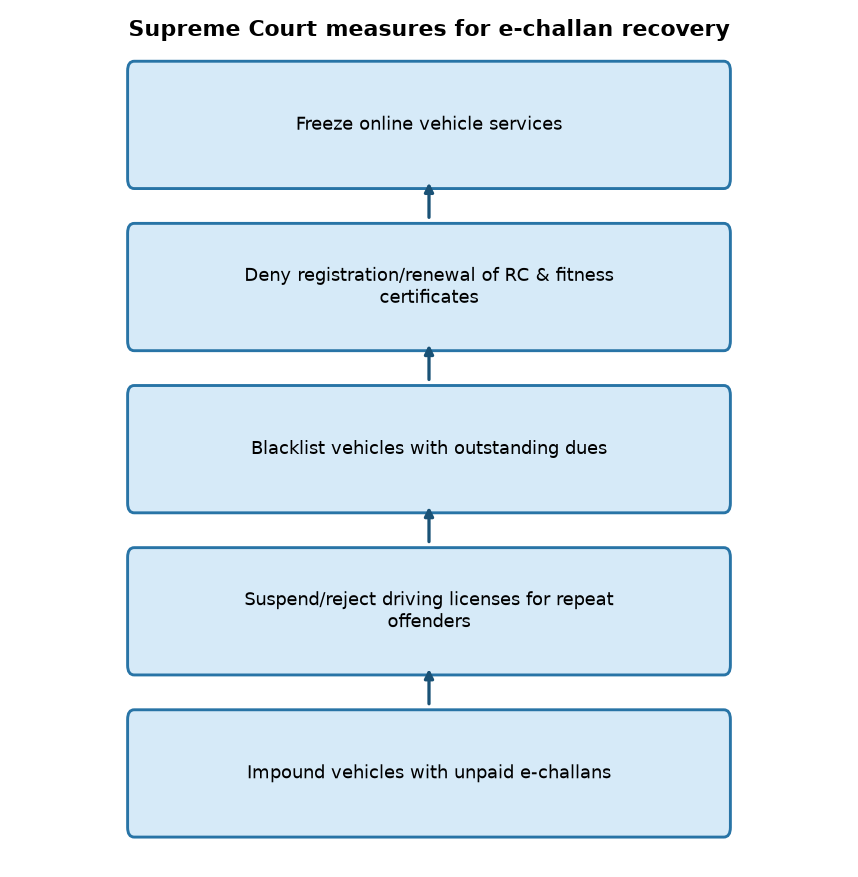
✎ The Supreme Court’s directions for recovery of traffic e-challan dues include denial of vehicle services, fitness certificates, driving licence renewals, and PUC certificates, alongside potential vehicle impoundment, all aimed at…
Subject Relevance — Where This Topic Fits
- GS Paper II — Governance, Transparency and Accountability | GS Paper III — Infrastructure, Road Safety and Transport Policy
- Prelims: e-challan, Motor Vehicles Act 1988, Parivahan portal, Pollution Under Control (PUC) certificate, fitness certificate, driving licence suspension, vehicle blacklisting, Central Motor Vehicles Rules 1989
- Essay: Enforcement of Road Safety Regulations: Balancing Accountability and Accessibility in Public Policy, The Role of Judicial Intervention in Strengthening Administrative Compliance
Quick Revision: The Supreme Court’s directions for recovery of traffic e-challan dues include denial of vehicle services, fitness certificates, driving licence renewals, and PUC certificates, alongside potential vehicle impoundment, all aimed at enforcing compliance with the Motor Vehicles Act, 1988.
Why is this in the news?
The Supreme Court of India, while hearing a long-pending writ petition concerning the implementation of road safety provisions under the Motor Vehicles Act, 1988 and Central Motor Vehicles Rules, 1989, issued detailed directions for the effective recovery of unpaid traffic e-challan dues. The Court clarified that its oral suggestion to link e-challan dues with electricity bills was not part of the formal order, which instead recorded measures such as freezing of vehicle-related services, denial of registration renewals, and suspension of driving licences for non-payment of fines. The order underscores the judiciary’s role in ensuring compliance with statutory provisions for road safety and electronic enforcement mechanisms.
Background
- The Motor Vehicles Act, 1988, and the Central Motor Vehicles Rules, 1989, mandate electronic enforcement of traffic violations through e-challans to enhance transparency and accountability in road safety enforcement.
- The Supreme Court has been monitoring the implementation of these provisions through a writ petition for nearly 14 years, reflecting persistent challenges in enforcement and recovery of traffic fines.
- The Court noted that mere issuance of e-challans without effective recovery mechanisms undermines the deterrent effect of traffic penalties and fails to promote road safety.
- The Parivahan portal, operated by the Ministry of Road Transport and Highways, serves as a centralised platform for vehicle registration, fitness certificates, and driving licence services, making it a critical tool for enforcement.
- Pollution Under Control (PUC) certificates are mandatory for vehicle registration and renewal, providing a potential lever for enforcement of traffic dues alongside environmental compliance.
What are the judicial directions for recovery of traffic e-challan dues?
- The Supreme Court directed that no vehicle-related service—including registration renewal, issuance of duplicate registration certificates, or address updates—shall be provided until pending e-challan dues are cleared.
- Fitness certificates for vehicles shall be denied until all outstanding traffic fines are paid, ensuring compliance with roadworthiness and safety standards.
- Driving licences shall not be renewed if multiple traffic violations are pending, and existing licences may be suspended in such cases to enforce accountability.
- The Court ordered the blacklisting of vehicles with outstanding e-challans on the Parivahan portal, which would obstruct their sale or transfer of ownership, thereby incentivising compliance.
- Pollution Under Control (PUC) certificates shall not be issued to vehicles with unpaid e-challans, linking environmental compliance with traffic enforcement.
- Random checks of vehicles shall be conducted, and if an e-challan remains unpaid, the vehicle may be impounded as a last resort to enforce recovery.
- The directions emphasise the need for ground-level implementation by authorities, recognising the practical challenges in enforcing traffic penalties across diverse jurisdictions.
- The Court clarified that its oral suggestion to link e-challan dues with electricity bills was not part of the formal order, which solely records recovery measures under existing statutory frameworks.
Key Features
| Feature | Significance |
|---|---|
| Freezing online vehicle-related services | Prevents access to digital services (e.g., insurance, permits) until dues are cleared, ensuring compliance with traffic regulations. |
| Withholding registration certificate renewal | Blocks renewal of RCs for vehicles with pending e-challans, reinforcing accountability for traffic violations. |
| Denial of fitness certificates (PUC) | Prohibits issuance of Pollution Under Control certificates until fines are paid, linking environmental compliance with traffic enforcement. |
| Blacklisting vehicles on Parivahan portal | Restricts sale, transfer, or ownership changes for vehicles with outstanding challans, enhancing deterrence. |
| Impounding vehicles for unpaid e-challans | Directs authorities to seize vehicles in cases of repeated or unpaid violations, strengthening enforcement mechanisms. |
Why it Matters
Legal and Institutional
- The Supreme Court’s directions operationalise the Motor Vehicles Act, 1988, and Central Motor Vehicles Rules, 1989, by mandating strict recovery mechanisms for unpaid traffic fines.
- The order underscores the judiciary’s role in ensuring executive compliance with statutory provisions, particularly in long-pending public interest litigation (PIL) matters.
- The court’s emphasis on ‘ground realities’ highlights the need for pragmatic implementation of traffic enforcement policies, balancing deterrence with administrative feasibility.
Economic
- Pending e-challan dues amount to approximately ₹49,194.05 crore, with only ₹26,175.05 crore recovered, indicating a significant revenue leakage in traffic enforcement systems.
- Effective recovery mechanisms can augment state revenues while promoting road safety, aligning economic incentives with regulatory compliance.
- The order’s measures (e.g., impounding vehicles) may deter repeat violations but could also impose short-term economic burdens on vehicle owners.
Road Safety and Governance
- The directions aim to address the systemic issue of low compliance with traffic fines, which undermines the deterrent effect of e-challans.
- By linking enforcement to vehicle-related services (e.g., registration, PUC), the court seeks to create a multi-layered compliance framework.
- The order reflects a shift from punitive measures (issuing challans) to enforcement-oriented solutions (recovery and compliance checks).
Challenges
1. Enforcement Gaps
- Despite technological advancements (e-challans), recovery mechanisms remain weak, leading to low compliance rates.
- States and UTs face administrative and logistical challenges in implementing measures like vehicle impounding and blacklisting.
- Coordination between traffic authorities, transport departments, and digital platforms (e.g., Parivahan portal) is often fragmented.
UPSC Link: GS-II: Governance, Challenges in Implementation
2. Revenue vs. Compliance Trade-off
- Aggressive enforcement (e.g., impounding) may deter violations but could disproportionately burden low-income vehicle owners.
- Balancing revenue generation with social equity remains a persistent challenge in traffic fine recovery systems.
- The economic impact of fines on marginalised communities requires careful policy calibration.
UPSC Link: GS-III: Economic and Social Development
3. Technological and Data Integration
- Effective implementation of measures like blacklisting and online service freezing depends on robust digital infrastructure and data-sharing mechanisms.
- Gaps in inter-state data sharing (e.g., for vehicles registered in one state but violating in another) hinder enforcement.
- Ensuring real-time updates on Parivahan portals and traffic databases is critical but often lacking.
UPSC Link: GS-III: Science and Technology
4. Public Perception and Compliance Culture
- Low public trust in traffic enforcement systems (e.g., perceived arbitrariness in fine issuance) reduces voluntary compliance.
- Cultural attitudes toward traffic rules, particularly in urban areas, contribute to high violation rates.
- Educational campaigns and community engagement are essential but often underutilised.
UPSC Link: GS-II: Citizen Charter, Transparency
5. Legal and Procedural Delays
- Protracted litigation (e.g., 14-year-old PIL) highlights systemic delays in resolving enforcement-related disputes.
- Lack of expeditious grievance redressal mechanisms for vehicle owners contesting e-challans exacerbates compliance issues.
- Judicial overreach in policy implementation (e.g., oral suggestions not reflected in orders) can create confusion.
UPSC Link: GS-II: Judiciary, Governance
Challenges — UPSC Perspective
| Issue | Concern |
|---|---|
| Fragmented inter-state data sharing | Hinders enforcement for vehicles violating rules across state borders. |
| Weak digital infrastructure | Delays in updating Parivahan portals and traffic databases reduce enforcement efficacy. |
| Low public awareness of fine recovery mechanisms | Leads to non-compliance due to lack of understanding of consequences. |
| High administrative costs of enforcement | States may lack resources to implement measures like vehicle impounding at scale. |
| Risk of disproportionate penalties | Aggressive enforcement may unfairly target low-income vehicle owners. |
| Lack of grievance redressal for contested challans | Delays in resolving disputes discourage voluntary compliance. |
Way Forward
- States and UTs should establish dedicated task forces to implement the Supreme Court’s directions, with clear timelines for compliance.
- Strengthen inter-state data-sharing mechanisms (e.g., through the Parivahan portal) to enable seamless enforcement across jurisdictions.
- Launch public awareness campaigns to educate vehicle owners on the consequences of unpaid e-challans and recovery processes.
- Develop grievance redressal portals for contesting e-challans, with expedited dispute resolution mechanisms.
- Invest in digital infrastructure to ensure real-time updates on vehicle statuses (e.g., registration, PUC) and fine payments.
- Conduct periodic audits of traffic enforcement systems to identify systemic gaps in recovery and compliance.
- Promote community-based initiatives (e.g., neighbourhood watch groups) to report traffic violations and improve compliance culture.
- Explore pilot projects for alternative recovery mechanisms (e.g., linking fines to insurance premiums) while ensuring equity.
UPSC Value Addition
Keywords for Mains Answer-Writing
Supreme Court of India · Motor Vehicles Act, 1988 · Central Motor Vehicles Rules, 1989 · electronic enforcement mechanisms · e-challan systems · recovery of traffic fines · road safety regulations · Parivahan portal · Pollution Under Control (PUC) certificate · driving licence suspension · vehicle fitness certificate · registration certificate renewal · administrative adjudication · fiscal federalism in enforcement · judicial activism in governance
Constitutional & Policy Linkages
- Article 226: Writ jurisdiction of High Courts for enforcement of statutory rights (e.g., traffic fine recovery).
- Article 14: Equality before law and equal protection of laws (ensuring fair and non-arbitrary enforcement).
- Article 300A: Right to property (protecting vehicle ownership while enforcing compliance).
Concept Flow
Issue of e-challans under Motor Vehicles Act → Low recovery rates due to weak enforcement → Supreme Court’s PIL on road safety → Directions for strict recovery mechanisms → Freezing of services, impounding, blacklisting → Enhanced compliance but challenges in implementation → Need for systemic reforms in governance and technology.
Prelims Practice Questions
Q1. Consider the following statements regarding the Motor Vehicles Act, 1988:
1. The Act mandates the use of electronic enforcement mechanisms for traffic violations.
2. The Act empowers authorities to suspend driving licences for non-payment of e-challans.
3. The Act prohibits the issuance of Pollution Under Control (PUC) certificates to vehicles with pending e-challans.
4. The Act requires the linking of e-challan dues with electricity bills for recovery.
How many of the above statements are correct?
- Only one
- Only two
- Only three
- All
Answer: Only three — Statements 1, 2, and 3 are correct as per the Motor Vehicles Act, 1988 and the Supreme Court’s directives. Statement 4 is incorrect because the Supreme Court’s oral suggestion regarding linking e-challan dues with electricity bills was not part of the final order.
Q2. Assertion (A): The Supreme Court of India has directed authorities to impound vehicles for non-payment of e-challans.
Reason (R): The Motor Vehicles Act, 1988 empowers the judiciary to impose such penalties for traffic violations.
Options:
A. Both A and R are true, and R is the correct explanation of A.
B. Both A and R are true, but R is not the correct explanation of A.
C. A is true, but R is false.
D. A is false, but R is true.
Answer: ? — Both the Assertion (A) and Reason (R) are true. The Supreme Court’s order directs impoundment of vehicles for non-payment of e-challans, and the Motor Vehicles Act, 1988 provides the legal framework for such enforcement actions.
Q3. Match the following recovery measures directed by the Supreme Court with their corresponding legal provisions under the Motor Vehicles Act, 1988:
Column I (Recovery Measures)
A. Suspension of driving licence
B. Denial of fitness certificate
C. Blacklisting of vehicles on Parivahan portal
D. Impoundment of vehicles
Column II (Relevant Sections)
1. Section 111 (Power to suspend or revoke driving licence)
2. Section 56 (Fitness certificate)
3. Section 110 (Power to impound vehicles)
4. Section 47 (Registration of motor vehicles)
Options:
A. A-1, B-2, C-4, D-3
B. A-2, B-1, C-3, D-4
C. A-3, B-4, C-1, D-2
D. A-4, B-3, C-2, D-1
Answer: ? — The correct matching is: A (Suspension of driving licence) – 1 (Section 111), B (Denial of fitness certificate) – 2 (Section 56), C (Blacklisting of vehicles on Parivahan portal) – 4 (Section 47), D (Impoundment of vehicles) – 3 (Section 110).
Mains Practice Question
✍ The Supreme Court of India has recently issued detailed directives to enhance the recovery of pending traffic e-challan dues under the Motor Vehicles Act, 1988. Critically examine the constitutional and statutory basis of these directives, and analyse their implications for federalism, administrative efficiency, and judicial activism in India. (15 Marks)
Approach: MODEL-ANSWER SKELETON:
1. **Constitutional and Statutory Basis** (5 Marks):
– Article 226 (High Court writ jurisdiction) and Article 32 (Supreme Court writ jurisdiction) for judicial intervention.
– Sections 110, 111, 56, and 47 of the Motor Vehicles Act, 1988 empower authorities to enforce traffic regulations and suspend licences/fitness certificates.
– Central Motor Vehicles Rules, 1989 provide procedural framework for electronic enforcement (e-challans).
2. **Federalism Implications** (4 Marks):
– Enforcement of traffic regulations is a state subject (Entry 35, List II, Seventh Schedule), but the Supreme Court’s directives ensure uniformity in recovery mechanisms across states.
– Tension between centralised judicial directives and state-level implementation (e.g., Parivahan portal is a centralised platform).
– Role of Union Government in facilitating inter-state coordination via the Ministry of Road Transport and Highways.
3. **Administrative Efficiency** (3 Marks):
– Electronic enforcement (e-challans) reduces manual errors and enhances transparency.
– Measures like blacklisting vehicles on the Parivahan portal and impoundment ensure deterrence and compliance.
– Challenges: Digital divide, lack of infrastructure in rural areas, and delayed judicial processes.
4. **Judicial Activism vs. Separation of Powers** (3 Marks):
– Supreme Court’s proactive stance in monitoring road safety litigation (14-year-old case).
– Balance between judicial oversight and executive/administrative autonomy.
– Precedents: Vishaka Guidelines (1997) and Prakash Singh case (2006) on judicial activism in governance.
5. **Conclusion** (1 Mark):
– The directives strike a balance between enforcement and citizen rights, but require state-level capacity-building and periodic reviews.
Source: orissapost.com
Generated by AanyaAi for educational purpose.
Related guides on our sites
- Best PSIR optional coaching for upsc
- Best PSIR optional teacher for upsc
- Best teacher of PSIR optional for upsc
- Best PSIR optional coaching in delhi for UPSC

- Supreme Court’s E-Challan Recovery Measures: Key UPSC Polity Insights - October 1, 2026
- AI गवर्नेंस पर सहमति का इंतजार न करें: भारत के लिए सीख - October 1, 2026
- Rajasthan Panchayat Polls: Sarpanches Must Resign as Administrator Before Nomination - October 1, 2026

No Comments