


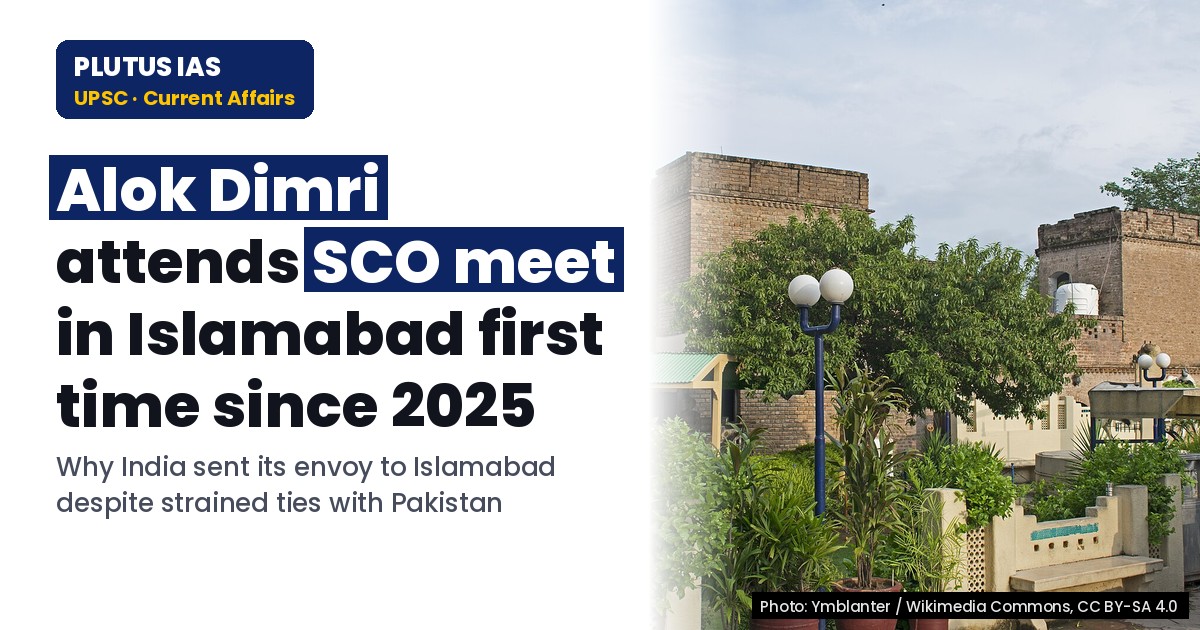
02 Oct India’s SCO Visit to Pakistan: 5 Key Takeaways for UPSC Aspirants
✎ The SCO provides India with a critical multilateral platform to engage with Pakistan and China, ensuring situational awareness and mitigating the absence of bilateral dialogue in a complex geopolitical environment.
Subject Relevance — Where This Topic Fits
- GS Paper II — International Relations — India’s Foreign Policy, Multilateral Institutions, Regional Organisations
- Prelims: Shanghai Cooperation Organisation (SCO), Operation Sindoor, SAARC, G20, BRICS, Kashmir, Pakistan-occupied Kashmir (PoK)
- Essay: Multilateralism in a multipolar world: Opportunities and constraints for India
Quick Revision: The SCO provides India with a critical multilateral platform to engage with Pakistan and China, ensuring situational awareness and mitigating the absence of bilateral dialogue in a complex geopolitical environment.
Why is this in the news?
The attendance of a senior Indian official at the Shanghai Cooperation Organisation (SCO) National Coordinators’ Meeting in Islamabad represents India’s first high-level official engagement with Pakistan in the aftermath of Operation Sindoor, underscoring the strategic necessity of multilateral diplomacy despite strained bilateral relations. The visit occurs against the backdrop of Pakistan’s assumption of the SCO presidency and amid evolving geopolitical dynamics, including the Russia-Ukraine conflict, US-Iran tensions, and the unpredictable foreign policy trajectory of the United States.
Background
- The Shanghai Cooperation Organisation (SCO) is a permanent intergovernmental regional organisation established in 2001, comprising eight member states including India and Pakistan, which joined in 2017.
- The SCO operates through mechanisms such as the Council of National Coordinators, which meets annually to coordinate policy and prepare for summits.
- India-Pakistan bilateral relations have remained strained since the revocation of Article 370 in August 2019 and subsequent developments, including Operation Sindoor.
- The SCO provides a platform for India to engage with Pakistan and China in a multilateral setting, mitigating the absence of bilateral dialogue.
What is the Shanghai Cooperation Organisation (SCO)?
- The SCO is a Eurasian political, economic, and security alliance established to promote regional stability, counter-terrorism, and economic cooperation.
- Its permanent bodies include the Secretariat in Beijing and the Regional Anti-Terrorist Structure (RATS) in Tashkent.
- The organisation operates on the principles of non-interference, mutual respect, and consensus-based decision-making.
- Key areas of focus include counter-terrorism, regional security, trade facilitation, and cultural exchanges.
- The SCO has expanded its membership to include India and Pakistan, alongside China, Russia, Kazakhstan, Kyrgyzstan, Tajikistan, and Uzbekistan.
- The organisation conducts annual summits and ministerial meetings, with the presidency rotating among member states.
- The SCO’s observer states and dialogue partners include Afghanistan, Belarus, Iran, Mongolia, and Turkey.
- India’s participation in the SCO is driven by strategic interests in Central Asia, energy security, and counter-terrorism cooperation.
Key Features
| Feature | Significance |
|---|---|
| Participation in SCO National Coordinators’ Meeting | Fulfils India’s obligation as an SCO member state; maintains multilateral engagement despite bilateral tensions. |
| Attendance by Senior Indian Official (Alok Dimri) | Signals India’s commitment to multilateral diplomacy; leverages institutional platforms to monitor regional developments. |
| First Official Visit Since Operation Sindoor | Demonstrates strategic pragmatism; avoids isolation while maintaining calibrated engagement. |
| Observation of SCO Materials and Narratives | India will scrutinise documents, maps, and statements for territorial assertions or provocative content. |
| Potential PM Modi Visit to Pakistan | Opportunity to reset diplomatic engagement; subject to favourable conditions and strategic assessment. |
Why it Matters
Strategic Diplomacy
- Multilateral forums like SCO provide India with a structured platform to engage adversarial states without conceding on core interests.
- Attendance ensures situational awareness of Pakistan’s regional posture, particularly under evolving US-China dynamics.
- Prevents strategic overreach by adversaries by maintaining a presence in key regional institutions.
Counter-Terrorism and Regional Stability
- SCO’s Regional Anti-Terrorist Structure (RATS) offers a framework for India to address cross-border terrorism concerns indirectly.
- Engagement allows India to monitor Pakistan’s compliance with SCO counter-terrorism commitments, if any.
- Reduces the risk of unilateral escalation by maintaining diplomatic channels.
Global Power Dynamics
- US policy shifts under unpredictable leadership may embolden Pakistan; SCO engagement mitigates risks of miscalculation.
- Russia’s preoccupation with Ukraine and China’s strategic alignment with Pakistan necessitate calibrated Indian diplomacy.
- SCO serves as a balancing mechanism against unilateral alignments in South Asia.
Challenges
1. Bilateral Tensions and Diplomatic Constraints
- Frozen bilateral ties limit the scope of direct negotiations; multilateral forums become the sole viable engagement channel.
- Risk of Pakistan leveraging SCO platforms to legitimise its narratives on Kashmir or terrorism.
- Need to balance participation without normalising contentious bilateral issues.
UPSC Link: GS II: India’s Foreign Policy
2. Monitoring Territorial Assertions
- SCO documents or materials may include disputed territorial claims (e.g., PoK, Aksai Chin).
- Requires real-time tracking and diplomatic rebuttals to prevent normalisation of such claims.
- India must coordinate with SCO secretariat to ensure adherence to agreed norms.
UPSC Link: GS II: India-Pakistan Relations
3. Leadership-Level Engagement Risks
- Any high-profile visit (e.g., PM Modi to Pakistan) could be misconstrued domestically or internationally.
- Requires careful timing and preconditions to avoid undermining India’s strategic posture.
- Domestic political narratives may complicate decision-making.
UPSC Link: GS II: International Treaties/Organisations
4. US Policy Unpredictability
- US support for Pakistan under certain administrations may embolden Rawalpindi’s regional actions.
- India must navigate SCO engagements while accounting for external geopolitical pressures.
- Limited bilateral channels necessitate multilateral monitoring.
UPSC Link: GS II: US-India Relations
Challenges — UPSC Perspective
| Issue | Concern |
|---|---|
| PoK and Aksai Chin in SCO Narratives | Risk of normalisation of disputed territories in official documents. |
| Pakistan’s SCO Presidency | Potential for Islamabad to shape agendas or narratives unfavourable to India. |
| US-China-Pakistan Alignment | Strategic pressure on India to align or counterbalance in SCO forums. |
| Domestic Political Fallout | Perception of engagement with Pakistan as weakness or concession. |
| Limited Bilateral Channels | Over-reliance on multilateral platforms may dilute direct diplomatic leverage. |
Way Forward
- Monitor SCO-related materials (maps, documents) for territorial assertions and issue timely diplomatic rebuttals.
- Leverage SCO’s counter-terrorism mechanisms (RATS) to address cross-border terrorism concerns indirectly.
- Assess the feasibility of high-level visits (e.g., PM Modi to Pakistan) based on strategic conditions.
- Strengthen coordination with like-minded SCO members (Russia, Central Asian states) to counterbalance Pakistan-China alignment.
- Enhance situational awareness through intelligence-sharing with SCO partners on regional security threats.
- Prepare contingency plans for escalation risks arising from SCO engagements or external geopolitical shifts.
- Engage with SCO secretariat to ensure adherence to agreed norms on territorial integrity.
- Conduct post-meeting debriefs to evaluate Pakistan’s SCO-related activities and India’s strategic responses.
UPSC Value Addition
Keywords for Mains Answer-Writing
Shanghai Cooperation Organisation (SCO) · multilateral diplomacy · India-Pakistan bilateral relations · strategic autonomy in foreign policy · SCO institutional mechanisms · Kashmir issue in international forums · SCO National Coordinators’ Meeting · diplomatic engagement without normalisation · territorial integrity in multilateral documents · SCO summit diplomacy · India’s foreign policy pragmatism · SCO as a platform for regional engagement
Constitutional & Policy Linkages
- [‘Article 51 (Promotion of International Peace)’, ‘Directive Principle guiding India’s foreign policy engagements.’]
Concept Flow
Bilateral tensions → Frozen diplomatic channels → Need for multilateral engagement → SCO as viable platform → Attendance to monitor developments → Observation of narratives/documents → Strategic assessment → Future engagement decisions.
Prelims Practice Questions
Q1. Consider the following statements regarding the Shanghai Cooperation Organisation (SCO):
1. The SCO is a permanent intergovernmental international organisation established in 2001.
2. The SCO Secretariat is headquartered in Beijing, China.
3. The SCO has observer states including Iran, Mongolia, and Afghanistan.
4. The SCO’s decision-making body is the Council of Heads of State.
How many of the above statements are correct?
- Only one
- Only two
- Only three
- All
Answer: All — Statements 1, 2, and 4 are correct. Statement 3 is incorrect as Afghanistan is no longer an observer state (its status was suspended in 2022).
Q2. Assertion (A): India’s participation in the SCO National Coordinators’ Meeting in Islamabad in October 2026 is a deviation from its policy of not engaging bilaterally with Pakistan.
Reason (R): The SCO framework mandates that all member states must participate in its meetings, irrespective of the state of bilateral relations.
In the context of the above two statements, which one of the following is correct?
- Both A and R are true, and R is the correct explanation of A
- Both A and R are true, but R is not the correct explanation of A
- A is true, but R is false
- A is false, but R is true
Answer: A is true, but R is false — A is true as India’s participation does not imply a shift in its bilateral stance. R is also true as SCO membership requires participation in its institutional mechanisms, but R does not explain A.
Q3. Match the following SCO bodies with their respective locations:
Column I (SCO Body) Column II (Location)
A. SCO Secretariat 1. Tashkent
B. Regional Anti-Terrorist Structure 2. Beijing
C. SCO Business Council 3. Moscow
D. SCO Interbank Consortium 4. Shanghai
Select the correct match:
- A-2, B-3, C-4, D-1
- A-2, B-1, C-4, D-3
- A-4, B-3, C-2, D-1
- A-3, B-2, C-1, D-4
Answer: A-2, B-1, C-4, D-3 — The SCO Secretariat is in Beijing (A-2), the Regional Anti-Terrorist Structure is in Tashkent (B-1), the SCO Business Council is in Shanghai (C-4), and the SCO Interbank Consortium is in Moscow (D-3).
Mains Practice Question
✍ The participation of an Indian official delegation in the SCO National Coordinators’ Meeting in Islamabad in October 2026 underscores India’s strategic use of multilateral platforms to safeguard its interests amid strained bilateral relations with Pakistan. Critically examine the institutional mechanisms of the SCO that enable such diplomatic engagement. Also, analyse how India balances its policy of non-normalisation with Pakistan while leveraging multilateral forums for strategic objectives. (15 Marks)
Approach: MODEL-ANSWER SKELETON:
1. **Institutional Mechanisms of SCO Enabling Engagement** (6 points, 100 words):
– **Mandate of SCO Membership**: SCO Charter (2002) obligates member states to participate in its institutional mechanisms, including the Council of National Coordinators, regardless of bilateral tensions (Art. 3, SCO Charter).
– **Rotational Chairmanship**: Pakistan’s assumption of the SCO presidency (post-Bishkek Summit, 2026) triggered the Islamabad meeting, demonstrating the SCO’s procedural neutrality (SCO Rules of Procedure, 2004).
– **Multilateral Diplomacy as a Tool**: SCO’s emphasis on ‘Shanghai Spirit’ (mutual trust, mutual benefit, equality, consultation, respect for diversity, and pursuit of common development) provides a neutral platform for engagement (SCO Declaration on Long-Term Good-Neighbourliness, Friendship and Cooperation, 2007).
– **Technical and Functional Engagement**: SCO meetings focus on non-contentious issues (counter-terrorism, economic cooperation, cultural exchanges), allowing India to engage without endorsing Pakistan’s bilateral narratives (SCO Action Plan for 2025-2030).
– **Observer and Dialogue Partner Mechanism**: SCO’s engagement with observer states (e.g., Iran) and dialogue partners (e.g., Saudi Arabia) further dilutes bilateral tensions by embedding interactions in a larger regional framework.
– **Documentation and Procedural Safeguards**: SCO’s emphasis on consensus-based decision-making (SCO Rules of Procedure, Art. 12) ensures that no single member can unilaterally alter outcomes, providing India with procedural safeguards.
2. **India’s Strategic Balancing Act** (6 points, 100 words):
– **Policy of Non-Normalisation**: India’s refusal to engage bilaterally with Pakistan (e.g., boycott of SAARC summits post-Uri attacks, 2016) is rooted in its stance on cross-border terrorism and territorial integrity (MHA Annual Report, 2025).
– **Leveraging Multilateral Platforms**: India’s participation in SCO meetings is framed as a ‘calculated pragmatic move’ to maintain situational awareness (MEA Statement, October 2026), avoiding any endorsement of Pakistan’s bilateral claims.
– **Monitoring Territorial Integrity**: India’s vigilance over SCO documents (e.g., maps, banners) aligns with its constitutional commitment to protect territorial integrity (Art. 1, Constitution of India) and international legal principles (UN Charter, Art. 2(4)).
– **Strategic Autonomy**: India’s engagement in SCO is part of its broader ‘multi-alignment’ strategy, balancing relations with the US, Russia, China, and regional actors without aligning exclusively with any bloc (MEA Annual Report, 2025).
– **Precedent of Engagement**: India’s participation in the SCO Heads of Government Meeting (2024) and BRICS Summit (2026) demonstrates its willingness to engage in multilateral forums while maintaining a firm stance on bilateral issues.
– **Consequences of Non-Engagement**: India’s refusal to engage bilaterally with Pakistan risks marginalising its interests in regional forums (e.g., exclusion from SAARC initiatives), necessitating calibrated multilateral participation.
3. **Critical Evaluation and Way Forward** (3 points, 50 words):
– **Limits of Multilateral Engagement**: While SCO provides a neutral platform, it lacks enforcement mechanisms to address bilateral disputes, limiting its effectiveness in resolving India-Pakistan tensions.
– **Risk of Normalisation by Stealth**: Prolonged engagement in multilateral forums may inadvertently legitimise Pakistan’s narratives, requiring India to maintain strict procedural and documentary vigilance.
– **Future Prospects**: India’s approach reflects a mature foreign policy prioritising strategic interests over symbolic gestures, but its success hinges on balancing multilateral engagement with firm bilateral stances.
Source: The Indian Express
Generated by AanyaAi for educational purpose.
Related guides on our sites
- Current affairs for upsc 2026
- Best PSIR optional coaching for upsc
- Best PSIR optional teacher for upsc
- Best teacher of PSIR optional for upsc


No Comments