


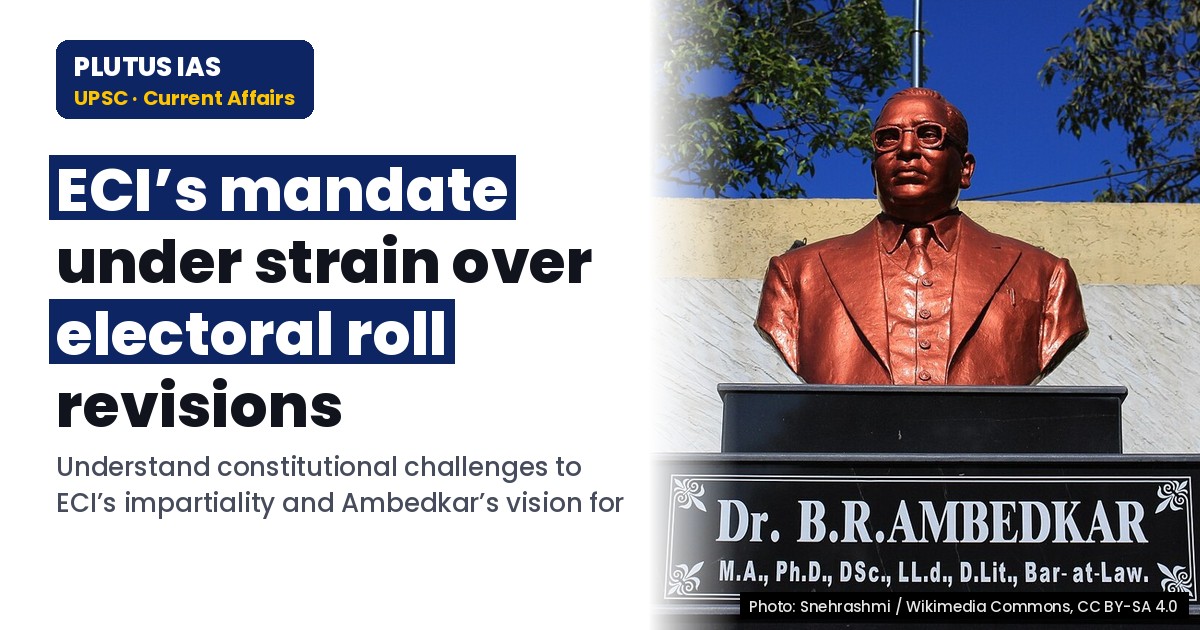
05 Oct ECI’s constitutional mandate under strain: UPSC & State PCS analysis
✎ The Election Commission of India, constituted under **Article 324**, is a **constitutional body** mandated to ensure the **integrity and fairness of elections** in India, with its independence designed to insulate it from…
Subject Relevance — Where This Topic Fits
- GS Paper II — Polity and Governance: Constitutional and Statutory Bodies | GS Paper II — Polity and Governance: Electoral Reforms and Challenges
- Prelims: Election Commission of India (ECI), Article 324, Model Code of Conduct, Electoral Rolls, Voter Deletion, Special Intensive Revision (SIR), Constitutional Provisions, Electoral Integrity, Independence of Constitutional Bodies
- Essay: The Erosion of Institutional Autonomy: A Case Study of the Election Commission of India, Democracy and Electoral Integrity: Balancing Efficiency with Accountability
Quick Revision: The Election Commission of India, constituted under **Article 324**, is a **constitutional body** mandated to ensure the **integrity and fairness of elections** in India, with its independence designed to insulate it from executive interference.
Why is this in the news?
The Election Commission of India (ECI) has recently faced significant public scrutiny over allegations of procedural impropriety in the conduct of the Special Intensive Revision (SIR) of electoral rolls, raising concerns about legality, impartiality, and adherence to constitutional norms. This scrutiny has reignited debates on the ECI’s institutional autonomy, its historical evolution, and the adequacy of existing safeguards to preserve electoral integrity in India.
Background
- The Election Commission of India (ECI) is a constitutional body established under **Article 324** of the Constitution of India, entrusted with the superintendence, direction, and control of the preparation of electoral rolls and the conduct of elections to Parliament, State Legislatures, the offices of the President and Vice-President, as per Article 324(1).
- The ECI’s structure and functions were deliberated extensively during the **Constituent Assembly Debates (1946–1950)**, where the framers of the Constitution sought to insulate the institution from executive interference to ensure electoral fairness. Dr. B.R. Ambedkar, Chairman of the Drafting Committee, emphasized the necessity of a **centralized, independent election machinery** to prevent partisan manipulation, citing past instances of provincial-level electoral malpractices.
- The **Special Intensive Revision (SIR)** of electoral rolls is a statutory process conducted periodically under the **Representation of the People Act, 1950**, and the **Electoral Rolls Rules, 1960**, aimed at updating and purifying electoral rolls by verifying voter details, removing duplicates, and including new eligible voters. The process is governed by **Section 21** of the Act and **Rule 21** of the Rules.
- Concerns have emerged regarding the **transparency and procedural compliance** in the recent SIR exercises, particularly allegations of **arbitrary deletion of voters** without due process, inadequate public notice mechanisms, and insufficient grievance redressal avenues for affected citizens.
- The **Model Code of Conduct (MCC)**, a set of norms issued by the ECI to regulate political parties and candidates during elections, has also been cited in critiques of the ECI’s recent actions, with questions raised about its **uniform application** and **impartial enforcement** in the context of voter verification processes.
- The **Supreme Court of India** has, in past judgments such as **Common Cause v. Union of India (2013)** and **Anoop Baranwal v. Union of India (2023)**, underscored the ECI’s obligation to act as a **neutral arbiter** and to uphold the **purity of electoral rolls** while ensuring **procedural fairness** in all its actions.
What is the Election Commission of India (ECI)?
- The **Election Commission of India (ECI)** is a **permanent constitutional body** established under **Article 324** of the Constitution, with the primary mandate to conduct free, fair, and credible elections at all levels of governance in India.
- The ECI consists of a **Chief Election Commissioner (CEC)** and **Election Commissioners (ECs)**, whose appointment is made by the **President of India** under **Article 324(2)**. The **tenure, salary, and service conditions** of the CEC and ECs are determined by Parliament via legislation, as per **Article 324(5)**.
- The ECI’s functions, as outlined in **Article 324(1)**, include the **superintendence, direction, and control** of the preparation of electoral rolls and the conduct of elections to the **Lok Sabha, Rajya Sabha, State Legislative Assemblies, and offices of the President and Vice-President**. It also has the power to **recognize political parties** and **allot symbols** under the **Representation of the People Act, 1951**.
- The ECI operates under the **Constitution of India** and is **not subordinate to the executive branch**, ensuring its independence from political interference. This autonomy is a cornerstone of India’s democratic framework and was a deliberate design choice during the framing of the Constitution to prevent electoral manipulation.
- The **Model Code of Conduct (MCC)**, formulated by the ECI, is an **extra-constitutional but binding set of guidelines** that regulates the conduct of political parties and candidates during elections. It aims to ensure a **level playing field** and prevent misuse of official machinery or resources.
- The ECI’s role extends beyond elections to include **electoral reforms**, such as the introduction of **Voter Verifiable Paper Audit Trail (VVPAT)** machines, **Electronic Voting Machines (EVMs)**, and **electronic electoral rolls** to enhance transparency and reduce electoral fraud.
- The ECI is also empowered to **issue directions to the Government of India and State Governments** to ensure the **integrity of the electoral process**, including the deployment of central forces and the suspension of officials found violating electoral norms.
- The **institutional independence** of the ECI is further reinforced by the provision for the removal of the Chief Election Commissioner in the same manner and on the same grounds as a Judge of the Supreme Court, as per **Article 324(5)**.
Key Features
| Feature | Significance |
|---|---|
| Constitutional Mandate of ECI (Article 324) | Ensures independence of the Election Commission of India from executive control, guaranteeing impartial electoral administration and preserving democratic integrity. |
| Special Intensive Revision (SIR) of Electoral Rolls | A statutory process to update electoral rolls with rigorous verification, aimed at maintaining accuracy and inclusivity in voter registration. |
| Centralised Election Machinery | Establishes a single, unified ECI at the Centre to prevent partisan interference from State-level authorities, as envisaged in the Constituent Assembly debates. |
| Procedural Rigour in Voter Deletion | Mandates strict adherence to legal provisions (e.g., Representation of the People Act, 1951) to prevent arbitrary exclusion of voters on extraneous grounds. |
Why it Matters
Democratic Governance
- The ECI’s impartiality is foundational to free and fair elections, a cornerstone of India’s parliamentary democracy.
- Any erosion of public trust in the ECI undermines the legitimacy of electoral outcomes and the stability of democratic institutions.
- Historical precedents (e.g., post-Emergency reforms) demonstrate the necessity of insulating electoral bodies from executive influence.
Electoral Integrity
- Accurate electoral rolls are critical to prevent disenfranchisement or inclusion of ineligible voters, which could distort electoral representation.
- The SIR process, if compromised, risks systematic exclusion or inclusion of voters, potentially skewing electoral outcomes.
- Global best practices (e.g., voter ID verification, biometric authentication) highlight the need for transparent and technology-driven processes.
Constitutional Framework
- The ECI’s autonomy is constitutionally safeguarded (Article 324) to prevent misuse of electoral machinery by political entities.
- The rejection of decentralised election machinery in the Constituent Assembly underscores the dangers of State-level partisan control.
- Judicial precedents (e.g., *T.N. Seshan v. Union of India*) reinforce the ECI’s powers to enforce electoral laws rigorously.
Challenges
1. Erosion of Institutional Autonomy
- Perceived or actual partisan conduct by the ECI in electoral processes (e.g., SIR operations) risks undermining its constitutional mandate.
- Lack of transparent mechanisms for appointment and removal of Election Commissioners may compromise independence.
- Delays or irregularities in electoral processes (e.g., voter list revisions) can erode public confidence in the ECI’s impartiality.
UPSC Link: GS-II: Constitutional Bodies
2. Procedural Non-Compliance
- Arbitrary or illegal deletions from electoral rolls (e.g., without proper notice or verification) violate the Representation of the People Act, 1951.
- Failure to adhere to timelines for SIR operations may disenfranchise eligible voters or include ineligible ones.
- Inadequate grievance redressal mechanisms for voters affected by erroneous deletions or inclusions.
UPSC Link: GS-II: Electoral Reforms
3. Public Perception and Trust
- Widespread criticism of the ECI’s actions can lead to a crisis of legitimacy, affecting voter turnout and electoral participation.
- Media scrutiny and social media amplification of perceived irregularities may distort public understanding of electoral processes.
- International observers may question the fairness of India’s elections if the ECI’s impartiality is doubted.
UPSC Link: GS-II: Electoral Reforms
4. Legal and Institutional Safeguards
- The absence of a fixed tenure or security of tenure for Election Commissioners may expose them to executive pressure.
- Limited judicial oversight over the ECI’s administrative decisions (e.g., model code of conduct violations) creates accountability gaps.
- Inadequate resources or technological capabilities to conduct large-scale electoral operations efficiently.
UPSC Link: GS-II: Constitutional Bodies
Challenges — UPSC Perspective
| Issue | Concern |
|---|---|
| Arbitrary deletions in electoral rolls | Risk of systematic disenfranchisement of voters, violating the Representation of the People Act, 1951. |
| Lack of transparency in SIR operations | Undermines public trust and may lead to allegations of partisan conduct. |
| Delays in electoral processes | Can disenfranchise eligible voters or create logistical challenges during elections. |
| Perceived erosion of ECI autonomy | Threatens the constitutional mandate of an impartial electoral body. |
| Inadequate grievance redressal | Leaves voters without recourse against erroneous deletions or inclusions. |
| Limited judicial oversight | Creates accountability gaps in the ECI’s administrative decisions. |
Way Forward
- Strengthen the independence of the ECI by adopting a transparent, merit-based appointment process for Election Commissioners, possibly through a collegium system.
- Enhance procedural rigour in the Special Intensive Revision (SIR) of electoral rolls by mandating biometric verification and public audits of deletions/inclusions.
- Establish a statutory grievance redressal mechanism for voters to challenge erroneous entries or deletions in electoral rolls within a fixed timeline.
- Introduce fixed tenures and security of service for Election Commissioners to insulate them from executive or political pressure.
- Expand the scope of judicial review over the ECI’s administrative decisions to ensure accountability while respecting its constitutional autonomy.
- Leverage technology (e.g., blockchain, AI-driven verification) to improve the accuracy and transparency of electoral rolls and reduce human error.
- Conduct periodic third-party audits of the ECI’s electoral processes to identify systemic weaknesses and build public trust.
- Amend the Representation of the People Act, 1951, to prescribe stricter penalties for officials responsible for procedural violations in electoral roll revisions.
UPSC Value Addition
Keywords for Mains Answer-Writing
Election Commission of India · Constitutional mandate · Electoral rolls · Special Intensive Revision · Constitutional propriety · Constituent Assembly debates · Dr. B.R. Ambedkar · Electoral integrity · Procedural correctness · Accountability mechanisms · Electoral reforms · Constitutional bodies · Impartiality of ECI · Deletion of voters · Executive control vs autonomy · Electoral laws · Constitutional provisions · Electoral governance · Public trust in institutions · Judicial oversight of ECI
Constitutional & Policy Linkages
- Article 324: Superintendence, direction and control of elections vested in the ECI.
- Article 325: No person to be ineligible for inclusion in electoral rolls on grounds of religion, race, caste, or sex.
- Article 326: Elections to the House of the People and State Legislative Assemblies to be on the basis of adult suffrage.
Concept Flow
Constitutional provision (Article 324) → Establishes ECI as an autonomous body → Ensures independence from executive control → Mandates impartial electoral administration. → Constituent Assembly debates → Rejection of decentralised election machinery → Centralisation of ECI to prevent State-level partisan interference → Emphasis on integrity of electoral rolls. → Special Intensive Revision (SIR) of electoral rolls → Statutory process for updating voter lists → Requires strict adherence to legal provisions → Risk of procedural violations undermining integrity. → Perceived or actual partisan conduct by ECI → Erosion of public trust → Undermines legitimacy of electoral outcomes → Threatens democratic stability. → Lack of transparency in SIR operations → Allegations of arbitrary deletions/inclusions → Disenfranchisement of eligible voters → Violations of the Representation of the People Act, 1951. → Judicial and institutional safeguards → Need for fixed tenures, grievance redressal, and judicial oversight → Ensures accountability while preserving ECI autonomy.
Prelims Practice Questions
Q1. Consider the following statements regarding the Election Commission of India (ECI):
1. The ECI is a constitutional body established under Article 324 of the Constitution of India.
2. The ECI is responsible for the preparation of electoral rolls and the conduct of elections to the Parliament, State legislatures, and the offices of the President and Vice-President of India.
3. The ECI functions under the direct administrative control of the Prime Minister’s Office to ensure efficiency.
4. The Chief Election Commissioner (CEC) and Election Commissioners are appointed by the President of India on the advice of the Council of Ministers.
How many of the above statements are correct?
- Only one
- Only two
- Only three
- All
Answer: Only three — Statements 1 and 2 are correct as per Article 324 of the Constitution. Statement 3 is incorrect because the ECI is designed to be independent of the executive. Statement 4 is incorrect as the CEC and Election Commissioners are appointed by the President on the recommendation of the Prime Minister, but the process is not purely advisory by the Council of Ministers alone.
Q2. Assertion (A): The Election Commission of India (ECI) is empowered to supervise, direct, and control the entire process of elections to the Parliament and State Legislatures.
Reason (R): The ECI derives its powers from Article 324 of the Constitution of India, which explicitly vests it with such authority.
- Both A and R are true, and R is the correct explanation of A
- Both A and R are true, but R is not the correct explanation of A
- A is true, but R is false
- A is false, but R is true
Answer: Both A and R are true, and R is the correct explanation of A — Both Assertion (A) and Reason (R) are true. Article 324(1) of the Constitution explicitly vests the ECI with the power to supervise, direct, and control the preparation of electoral rolls and the conduct of elections to Parliament and State Legislatures. The Reason (R) correctly explains the Assertion (A).
Q3. Match the following provisions related to the Election Commission of India with their corresponding constitutional articles:
Column I (Provision) | Column II (Article)
———————|——————-
A. Superintendence, direction and control of elections | 1. Article 324(2)
B. Appointment of Chief Election Commissioner and Election Commissioners | 2. Article 324(1)
C. Conditions of service and tenure of Election Commissioners | 3. Article 324(5)
D. Power of President to remove Chief Election Commissioner | 4. Article 324(4)
- A-2, B-1, C-3, D-4; A-1, B-2, C-4, D-3; A-2, B-4, C-1, D-3; A-4, B-3, C-2, D-1
- answer_string_list_indexed_0based_0:0
- explain_list_indexed_0based_0: [“A-2: Article 324(1) vests the ECI with superintendence, direction, and control of elections.”, “B-1: Article 324(2) provides for the appointment of the CEC and other Election Commissioners.”, “C-3: Article 324(5) deals with the conditions of service and tenure of Election Commissioners.”, “D-4: Article 324(4) empowers the President to remove the CEC on the recommendation of Parliament.”]
- format
Answer: A-2, B-1, C-3, D-4; A-1, B-2, C-4, D-3; A-2, B-4, C-1, D-3; A-4, B-3, C-2, D-1 —
Mains Practice Question
✍ The constitutional mandate of the Election Commission of India (ECI) has been questioned in recent times due to perceived lapses in procedural correctness and impartiality. Critically examine the institutional safeguards designed to ensure the autonomy and accountability of the ECI, and analyse whether these safeguards have been adequate in maintaining public trust in the electoral process. (15 Marks)
Approach: MODEL-ANSWER SKELETON:
1. **Constitutional Framework and Institutional Safeguards (4 Marks)**
– Article 324 of the Constitution: Role, composition, and powers of the ECI.
– Independence from executive control: Dr. B.R. Ambedkar’s vision in the Constituent Assembly debates.
– Appointment process: Role of the President, Council of Ministers, and collegium system (if any).
– Tenure and removal: Provisions under Article 324(5) and (4) to ensure security of tenure.
– Financial autonomy: Separation from the Consolidated Fund of India.
2. **Procedural Correctness and Recent Controversies (4 Marks)**
– Special Intensive Revision (SIR) of electoral rolls: Legal provisions under the Representation of the People Act, 1950, and the Conduct of Elections Rules, 1961.
– Cases of large-scale deletion of voters: Constitutional propriety and adherence to due process.
– Role of the ECI in ensuring transparency: Public notice, grievance redressal, and verification mechanisms.
– Recent instances of perceived partisanship: Neutral framing of issues without attributing motives.
3. **Accountability Mechanisms and Public Trust (4 Marks)**
– Judicial oversight: Landmark judgments (e.g., *Union of India v. Association for Democratic Reforms*, 2002; *PUCL v. Union of India*, 2013) on ECI’s powers and limitations.
– Parliamentary accountability: Role of the Standing Committee on Personnel, Public Grievances, Law and Justice.
– Transparency and citizen engagement: Use of technology (e.g., ECI’s cVIGIL app) and voter education initiatives.
– Public perception and trust: Surveys, reports, and editorials highlighting concerns.
4. **Way Forward and Recommendations (3 Marks)**
– Strengthening institutional autonomy: Collegium-based appointment system for CEC and ECs.
– Legal reforms: Amendments to the Representation of the People Act to clarify procedures for electoral roll revisions.
– Technological interventions: Use of AI and blockchain for voter verification and grievance redressal.
– Citizen awareness campaigns: Role of civil society and media in fostering electoral literacy.
– Role of the judiciary: Expanding judicial review to ensure constitutional propriety in ECI’s actions.
Source: The Hindu
Generated by AanyaAi for educational purpose.
Related guides on our sites
- Best PSIR optional coaching for upsc
- Best PSIR optional teacher for upsc
- Best teacher of PSIR optional for upsc
- Best PSIR optional coaching in delhi for UPSC

- केरल उच्च न्यायालय ने 14 साल पुराने सैनिक लापता मामले में सीबीआई जांच का दिया आदेश - October 5, 2026
- ECI’s constitutional mandate under strain: UPSC & State PCS analysis - October 5, 2026
- तीन-भाषा नीति: छात्रों को तीसरी भाषा चुनने की आजादी क्यों जरूरी? - October 5, 2026

No Comments