


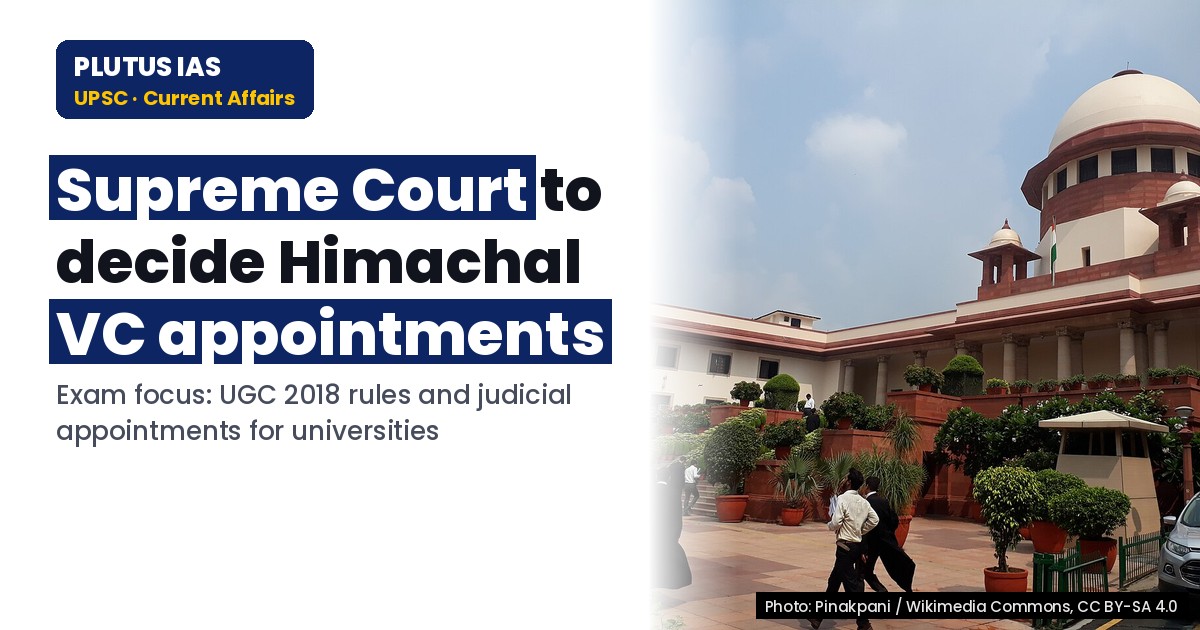
05 Oct Himachal High Court VC Appointment Row: SC to Decide Future of Agriculture Universities
✎ The appointment of Vice-Chancellors in state agricultural universities must comply with the UGC Regulations, 2018, which mandate a transparent search-cum-selection committee process, and any state amendment to this procedure is…
Subject Relevance — Where This Topic Fits
- GS Paper II — Constitutional and Statutory Bodies (Judiciary) | GS Paper III — Issues Relating to Agricultural Research and Education
- Prelims: Vice-Chancellor appointment process, UGC Regulations 2018, State Agricultural Universities, Judicial review of executive actions, Search-cum-selection committee, Himachal Pradesh High Court, Supreme Court of India
- Essay: Judicial activism in governance: Balancing autonomy and accountability in higher education
Quick Revision: The appointment of Vice-Chancellors in state agricultural universities must comply with the UGC Regulations, 2018, which mandate a transparent search-cum-selection committee process, and any state amendment to this procedure is subject to judicial review.
Why is this in the news?
The matter concerning the appointment of Vice-Chancellors (VCs) at Himachal Pradesh Agricultural University, Palampur, and Dr. Yashwant Singh Parmar University of Horticulture and Forestry, Nauni, has reached the Supreme Court after the state government challenged a Himachal Pradesh High Court order. The High Court had quashed the state’s revised appointment procedure and directed adherence to the University Grants Commission (UGC) Regulations, 2018, thereby initiating a fresh selection process. The Supreme Court’s intervention now determines the fate of this process, raising critical questions about the autonomy of state agricultural universities and the role of judicial oversight in executive appointments.
Background
- The controversy stems from amendments made by the Himachal Pradesh government to the appointment procedure for VCs in state agricultural universities, which were challenged in the High Court.
- The High Court, in its order dated 27 August 2026, set aside the state’s revised provisions and directed that VC appointments must comply with the UGC Regulations, 2018.
- The UGC Regulations, 2018, mandate a structured search-cum-selection committee process, including the participation of a nominee from the UGC, to ensure transparency and meritocracy in appointments.
- Following the High Court’s directive, the state government initiated a fresh selection process in conformity with the UGC norms, but simultaneously filed a Special Leave Petition (SLP) in the Supreme Court against the High Court’s order.
- The duality—pursuing a fresh selection process while challenging the High Court’s ruling—has created legal uncertainty, suspending the appointment of VCs in both universities.
- The case highlights the tension between state autonomy in higher education governance and the need for adherence to central regulatory frameworks to maintain academic standards.
What are the legal and institutional dimensions of Vice-Chancellor appointments in State Agricultural Universities?
- Vice-Chancellors (VCs) of state agricultural universities are appointed through a statutory process governed by the respective state Acts and UGC Regulations, 2018.
- The UGC Regulations, 2018, prescribe a search-cum-selection committee comprising external experts, university representatives, and a nominee from the UGC to ensure objectivity and transparency.
- State governments may amend appointment procedures, but such amendments must not contravene the UGC Regulations or the constitutional principles of fairness and non-arbitrariness.
- Judicial review plays a pivotal role in ensuring that executive actions in university governance comply with statutory and regulatory frameworks, particularly when state amendments are perceived as undermining institutional autonomy.
- The Himachal Pradesh High Court’s order underscores the primacy of UGC norms in VC appointments, reflecting the broader principle that central regulatory frameworks are binding on state institutions in matters of higher education.
- The Supreme Court’s intervention is crucial as it will clarify whether state governments can override UGC norms through legislative amendments or whether such amendments are ultra vires the constitutional scheme.
- The case also raises questions about the balance between state control over higher education institutions and the need for academic autonomy, a recurring theme in India’s higher education governance.
- The appointment process involves multiple stages: advertisement of vacancies, constitution of the search committee, shortlisting of candidates, interviews, and final recommendation to the Chancellor (Governor) for appointment.
Key Features
| Feature | Significance |
|---|---|
| Appointment of Vice-Chancellors (VCs) in state agricultural universities | Determines academic leadership, institutional autonomy, and governance quality in higher agricultural education. |
| UGC Regulations, 2018 for VC appointments | Establish standardised, transparent, and merit-based selection criteria for university leadership. |
| Judicial intervention by Himachal Pradesh High Court (27 August 2026) | Reinforced adherence to UGC norms, nullified state-specific amendments, and mandated compliance with central guidelines. |
| State government’s appeal to the Supreme Court | Introduces legal uncertainty, halts ongoing selection processes, and may delay institutional leadership transitions. |
| Dual-track process (High Court order vs. Supreme Court appeal) | Creates institutional ambiguity, affecting administrative continuity and academic planning in the universities. |
Why it Matters
Governance of Higher Education
- Ensures alignment of state-level university appointments with national regulatory frameworks (UGC 2018 norms) to maintain academic standards and autonomy.
- Highlights the tension between state legislative powers and central regulatory oversight in higher education administration.
- Demonstrates the role of the judiciary in enforcing constitutional and statutory compliance in university governance.
Institutional Autonomy vs. State Control
- Examines the constitutional principle of university autonomy under Article 26(1) of the Constitution (freedom of religious and educational institutions) and its extension to state-run universities.
- Illustrates the conflict between state policy discretion and central regulatory supremacy in higher education management.
- Raises questions about the balance between democratic accountability (state government) and academic independence (universities).
Judicial Review of Administrative Actions
- Demonstrates the judiciary’s role in reviewing executive decisions impacting public institutions, ensuring adherence to law and procedure.
- Highlights the interplay between writ jurisdiction (Article 226 of the Constitution) and appellate jurisdiction (Article 136) in governance disputes.
- Showcases the Supreme Court’s function as the final arbiter in disputes involving state actions and central regulations.
Impact on Agricultural Education Ecosystem
- Delays in VC appointments may disrupt academic leadership, strategic planning, and research priorities in state agricultural universities.
- Affects faculty morale, student admissions, and external collaborations due to prolonged leadership vacuum.
- Undermines the credibility of selection processes, potentially eroding public trust in institutional governance.
Challenges
1. Legal and Procedural Uncertainty
- Simultaneous existence of High Court-mandated and Supreme Court-challenged selection processes creates administrative confusion.
- Risk of prolonged litigation delaying critical institutional appointments and disrupting academic calendars.
- Potential erosion of transparency if state-specific amendments bypass UGC norms, leading to allegations of favouritism.
UPSC Link: GS-II: Judiciary and Judicial Review
2. Conflict Between State and Central Regulatory Frameworks
- State government’s amendments to VC appointment rules may conflict with UGC’s 2018 regulations, raising questions of federalism.
- Lack of clear demarcation of powers between state legislatures and central regulatory bodies in higher education governance.
- Possibility of inconsistent application of norms across states, affecting national educational standards.
UPSC Link: GS-II: Centre-State Relations
3. Institutional Leadership Vacuum
- Prolonged absence of VCs may lead to administrative paralysis, affecting strategic decision-making and policy implementation.
- Risk of interim arrangements (e.g., pro-vice-chancellors) lacking the mandate to drive long-term institutional goals.
- Potential decline in research output, faculty recruitment, and student placements due to leadership instability.
UPSC Link: GS-II: Public Administration
4. Public Trust and Governance Credibility
- Repeated legal challenges to selection processes may erode public confidence in the fairness and integrity of university governance.
- Media scrutiny and political narratives could amplify perceptions of institutional dysfunction, affecting stakeholder morale.
- Risk of politicisation of university appointments, undermining meritocratic principles in higher education leadership.
UPSC Link: GS-II: Role of Civil Services in Governance
5. Operational Disruptions in Academic Institutions
- Delays in VC appointments may postpone critical academic initiatives, such as curriculum reforms, faculty development, and infrastructure projects.
- Uncertainty in leadership may deter external collaborations, funding opportunities, and national/international rankings.
- Faculty and student bodies may face governance gaps, affecting institutional culture and academic performance.
UPSC Link: GS-II: Issues Relating to Development and Management of Social Sector/Services
Challenges — UPSC Perspective
| Issue | Concern |
|---|---|
| Dual-track selection process | Administrative paralysis due to conflicting legal orders from High Court and Supreme Court. |
| State vs. UGC regulatory conflict | Potential undermining of national higher education standards by state-specific amendments. |
| Leadership vacuum in universities | Risk of stagnation in academic and research activities due to prolonged VC vacancies. |
| Erosion of public trust | Perception of governance failures may deter stakeholder engagement and institutional credibility. |
| Operational delays in academic programmes | Postponement of strategic initiatives, faculty recruitments, and infrastructure development. |
| Judicial overreach vs. executive discretion | Debate on the appropriate balance between judicial review and administrative autonomy in university governance. |
Way Forward
- The Supreme Court should expedite the hearing to resolve the legal ambiguity and provide clarity on the validity of the High Court’s order.
- The state government should align its selection process with UGC norms (2018) to ensure compliance and avoid further litigation.
- A transparent and time-bound selection process should be adopted, with clear criteria for Search Committees and stakeholder representation.
- Institutional mechanisms (e.g., interim leadership frameworks) should be established to mitigate disruptions during leadership transitions.
- Capacity-building initiatives for Search Committees should be undertaken to ensure adherence to meritocratic and inclusive selection practices.
- Public disclosure of selection criteria, committee compositions, and evaluation processes should be mandated to enhance transparency.
- A national-level review of state-level university governance frameworks may be considered to harmonise practices across states.
- Academic calendars and institutional plans should be revised to accommodate potential delays while maintaining continuity in core activities.
UPSC Value Addition
Keywords for Mains Answer-Writing
University Grants Commission (UGC) Regulations 2018 · Appointment of Vice-Chancellors in State Agricultural Universities · Judicial review of executive appointments in higher education · Search-cum-Selection Committee for VC appointments · Article 226 of the Constitution of India · Judicial intervention in administrative processes · State Public Service Commissions and higher education governance · Supreme Court’s role in resolving inter-institutional conflicts · Governance of agricultural universities under state and central regulatory frameworks · Judicial activism in higher education administration
Constitutional & Policy Linkages
- Article 226 – High Court’s writ jurisdiction for enforcement of legal rights (demonstrated in the Himachal Pradesh High Court order).
- Article 136 – Supreme Court’s special leave jurisdiction (invoked by the state government in this case).
Concept Flow
State government amends VC appointment rules under university acts → UGC 2018 norms mandate standardised selection process → High Court strikes down state amendments, directs compliance with UGC norms (27 August 2026) → State government appeals to Supreme Court → Dual-track selection process creates administrative uncertainty → Supreme Court’s decision will determine the fate of ongoing and future VC appointments → Institutional leadership vacuum impacts academic and research activities → Public trust in governance erodes, raising questions about autonomy vs. state control.
Prelims Practice Questions
Q1. Consider the following statements regarding the appointment of Vice-Chancellors in Indian universities:
1. The UGC Regulations, 2018 mandate that the Search-cum-Selection Committee for VC appointments must include a nominee from the UGC.
2. The Supreme Court, under Article 136 of the Constitution, can entertain appeals against decisions of the High Court in matters related to university administration.
3. The Governor of a state acts as the Chancellor of state universities and is solely responsible for the appointment of Vice-Chancellors.
How many of the above statements are correct?
- Only one
- Only two
- All
- None
Answer: Only two — Statement 1 is correct as per UGC Regulations, 2018. Statement 2 is correct as the Supreme Court can grant special leave to appeal under Article 136. Statement 3 is incorrect as the Chancellor (often the Governor) does not act unilaterally; the process involves a Search-cum-Selection Committee and may require judicial or statutory compliance.
Q2. Assertion (A): The High Court, under Article 226 of the Constitution, can issue writs to ensure compliance with UGC Regulations in the appointment of Vice-Chancellors.
Reason (R): Article 226 empowers the High Court to issue directions, orders, or writs for the enforcement of fundamental rights and other legal rights.
- Both A and R are true, and R is the correct explanation of A
- Both A and R are true, but R is not the correct explanation of A
- A is true, but R is false
- A is false, but R is true
Answer: Both A and R are true, and R is the correct explanation of A — Both the Assertion and Reason are correct. Article 226 of the Constitution empowers the High Court to issue writs for enforcement of legal rights, including ensuring compliance with statutory regulations like the UGC Regulations, 2018. The Reason correctly explains the Assertion.
Q3. Match the following pairs related to the governance of agricultural universities in India:
Column I (Regulatory Framework)
A. UGC Regulations, 2018
B. State Agricultural University Acts
C. The Constitution of India (Articles 226 & 227)
D. University Grants Commission Act, 1956
Column II (Role)
1. Provides legal basis for judicial review of administrative actions
2. Governs the establishment and functioning of agricultural universities
3. Regulates the appointment of Vice-Chancellors and academic standards
4. Empowers the UGC to coordinate and determine standards in higher education
- A-3, B-2, C-1, D-4
- A-1, B-2, C-3, D-4
- A-4, B-3, C-2, D-1
- A-2, B-1, C-4, D-3
Answer: A-3, B-2, C-1, D-4 — A-3: UGC Regulations, 2018 regulate VC appointments and academic standards. B-2: State Agricultural University Acts govern the establishment and functioning of these universities. C-1: Articles 226 & 227 of the Constitution provide the legal basis for judicial review. D-4: The UGC Act, 1956 empowers the UGC to coordinate and determine standards in higher education.
Mains Practice Question
✍ The appointment of Vice-Chancellors in state agricultural universities has become a subject of judicial scrutiny, as evidenced by recent developments in Himachal Pradesh. Examine the constitutional and statutory framework governing such appointments, highlighting the role of the judiciary in ensuring adherence to regulatory norms. Also, discuss the implications of judicial intervention on the autonomy of state universities. (15 Marks)
Approach: MODEL-ANSWER SKELETON:
1. **Constitutional and Statutory Framework**:
– Article 226 of the Constitution empowers High Courts to issue writs for enforcement of legal rights, including compliance with UGC Regulations, 2018.
– UGC Regulations, 2018 prescribe the composition of the Search-cum-Selection Committee for VC appointments, including a nominee from the UGC.
– State Agricultural University Acts govern the establishment and functioning of these universities, including the role of the Chancellor (often the Governor) and the state government.
2. **Judicial Role and Recent Developments**:
– The Himachal Pradesh High Court, in its order dated 27 August 2026, directed the state government to follow UGC Regulations, 2018 for VC appointments, thereby overriding state-specific provisions.
– The state government’s appeal to the Supreme Court highlights the tension between state autonomy and central regulatory oversight.
– Article 136 of the Constitution allows the Supreme Court to entertain appeals against High Court decisions, reinforcing its role as the final arbiter in such disputes.
3. **Implications for University Autonomy**:
– Judicial intervention ensures adherence to statutory norms but may be perceived as encroaching upon the autonomy of state universities.
– The balance between central regulatory frameworks (UGC) and state legislative powers (State Agricultural University Acts) remains a contentious issue.
– The outcome of the Supreme Court’s decision will set a precedent for future appointments, potentially clarifying the extent of judicial oversight in university governance.
4. **Conclusion**:
– The judiciary acts as a check on executive excesses, ensuring transparency and fairness in VC appointments.
– However, excessive judicial intervention may undermine the principle of federalism and the autonomy of state institutions.
Source: amarujala.com
Himachal Pradesh PCS (HPPSC (HAS)) — State PCS Practice
Prelims: Recently, the appointment of the Vice-Chancellor of which Himachal Pradesh agricultural or horticultural university has been challenged in the Supreme Court, raising concerns over the new selection process?
- Dr. Yashwant Singh Parmar University of Horticulture and Forestry, Solan
- Chaudhary Sarwan Kumar Himachal Pradesh Krishi Vishvavidyalaya, Palampur
- Himachal Pradesh Agricultural University, Palampur
- Himachal Pradesh University of Agriculture and Technology, Hamirpur
Answer: Chaudhary Sarwan Kumar Himachal Pradesh Krishi Vishvavidyalaya, Palampur — The matter pertains to the appointment of the Vice-Chancellor of Chaudhary Sarwan Kumar Himachal Pradesh Krishi Vishvavidyalaya (CSK HPKV), Palampur, which has been challenged in the Supreme Court over procedural irregularities in the selection process.
Mains: Critically analyze the implications of the Supreme Court intervention in the appointment process of the Vice-Chancellor of a Himachal Pradesh agricultural or horticultural university. Discuss the challenges in the new selection procedure and suggest measures to ensure transparency and meritocracy in such high-level academic appointments.
Generated by AanyaAi for educational purpose.
Related guides on our sites
- Current affairs for upsc 2026
- UPSC EPFO syllabus
- Best PSIR optional coaching for upsc
- Best PSIR optional teacher for upsc


No Comments