


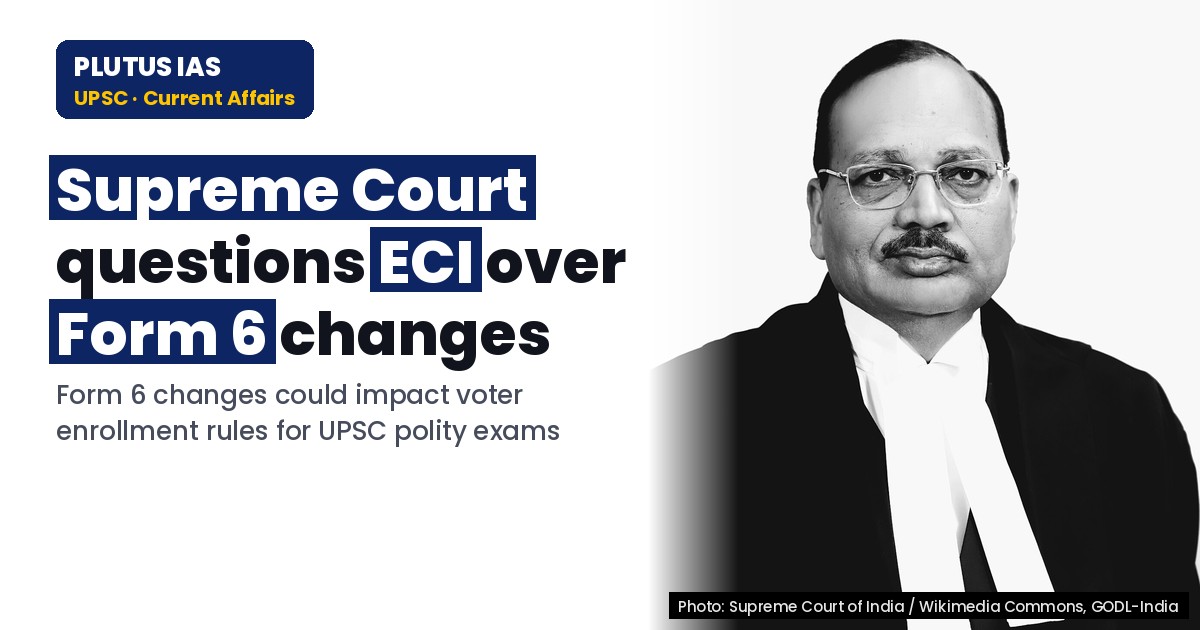
06 Oct Supreme Court Questions ECI on Unapproved Form 6 Changes: Polity Explained
✎ Form 6, prescribed under the Registration of Electors Rules, 1960, is the statutory form for voter enrolment; any modification requires a formal amendment to the Rules, and the Supreme Court’s scrutiny ensures adherence to…
Subject Relevance — Where This Topic Fits
- GS Paper II — Constitutional and Statutory Bodies | GS Paper II — Electoral Reforms and Governance | GS Paper III — Role of Constitutional and Statutory Bodies in Governance
- Prelims: Form 6, Registration of Electors Rules, 1960, Special Intensive Revision (SIR), Electoral Rolls, Election Commission of India (ECI), Chief Election Commissioner (CEC), Constitutional provisions under Article 324, Judicial Review of Administrative Actions
- Essay: Electoral integrity and democratic governance, Role of constitutional institutions in maintaining public trust
Quick Revision: Form 6, prescribed under the Registration of Electors Rules, 1960, is the statutory form for voter enrolment; any modification requires a formal amendment to the Rules, and the Supreme Court’s scrutiny ensures adherence to constitutional and statutory safeguards in electoral processes.
Why is this in the news?
The Supreme Court of India, in a suo motu observation during the hearing of a petition, has raised concerns regarding the modification of Form 6, the official application form used for the enrolment of new voters in India. The Court has explicitly stated that it did not approve any ‘modified’ version of Form 6 and has directed the Election Commission of India (ECI) to produce records to ascertain the origin and justification of the changes. This development underscores the constitutional and statutory framework governing electoral processes and the importance of adherence to prescribed procedures in matters of electoral roll revision.
Background
- The Registration of Electors Rules, 1960, framed under the Representation of the People Act, 1950, prescribe the forms and procedures for the preparation and revision of electoral rolls in India.
- Form 6 is the prescribed application form for the inclusion of names in the electoral rolls, including for new voters and those seeking correction of entries.
- The Election Commission of India (ECI), a constitutional body under Article 324 of the Constitution, is responsible for the superintendence, direction, and control of the preparation of electoral rolls and the conduct of elections.
- The Special Intensive Revision (SIR) is a periodic process conducted by the ECI to ensure the accuracy and completeness of electoral rolls, typically before general elections.
- The ECI, in its statement dated September 26, 2026, clarified that Form 6 would revert to the original version as per the Registration of Electors Rules, 1960, for non-SIR periods, while the declaration attached to Form 6 for SIR had been upheld by the Supreme Court.
- The matter has been referred to a three-judge bench comprising the Chief Justice of India, Surya Kant, and Justices Joymalya Bagchi and V Mohana.
What is Form 6 and its Legal Framework?
- Form 6 is the official application form prescribed under the Registration of Electors Rules, 1960, for the enrolment of new voters in the electoral rolls of India.
- The form is used for both general enrolment and corrections, including changes in address, name, age, or other particulars.
- The Registration of Electors Rules, 1960, are framed under the Representation of the People Act, 1950, which provides the legal framework for the preparation and revision of electoral rolls.
- Any modification to Form 6 requires a formal amendment to the Registration of Electors Rules, 1960, as the form is statutorily prescribed and cannot be altered unilaterally by administrative action.
- The Election Commission of India (ECI), as the constitutional authority under Article 324, is responsible for ensuring the integrity and accuracy of electoral rolls, including the use of prescribed forms.
- The Special Intensive Revision (SIR) is a periodic exercise conducted by the ECI to update and verify electoral rolls, typically before general elections, to ensure completeness and accuracy.
- The principle of natural justice and procedural fairness requires that any changes to forms or procedures affecting citizens’ rights must be transparent, legally valid, and subject to due process.
Key Features
| Feature | Significance |
|---|---|
| Form 6 under Registration of Electors Rules, 1960 | Primary document for new voter enrollment; governed by statutory rules, not administrative modifications. |
| Special Intensive Revision (SIR) of electoral rolls | Periodic revision to update electoral rolls with rigorous verification; critical for electoral integrity. |
| Online ECINet portal for Form 6 submission | Digital interface for voter registration; ensures accessibility but raises concerns over unauthorized changes. |
| Declaration requiring SIR roll verification | New condition added to Form 6 to confirm applicant’s presence in previous SIR rolls; aims to prevent duplicate enrollments. |
| Supreme Court’s scrutiny of ECI records | Judicial oversight to determine legality of procedural changes; upholds constitutional safeguards in electoral processes. |
Why it Matters
Electoral Integrity
- Ensures accuracy and fairness in voter enrollment by adhering to statutory forms and procedures.
- Prevents manipulation through unauthorized modifications to official documents like Form 6.
- Maintains public trust in electoral rolls, a cornerstone of democratic governance.
Rule of Law
- Highlights the supremacy of statutory rules (Registration of Electors Rules, 1960) over administrative discretion.
- Demonstrates judicial review of executive actions in electoral administration.
- Reinforces the principle that constitutional bodies must operate within legal frameworks.
Institutional Accountability
- Examines the role of the Election Commission of India (ECI) in maintaining transparency and procedural fidelity.
- Raises questions about intra-institutional dissent and decision-making processes.
- Emphasizes the need for inter-institutional checks and balances in governance.
Challenges
1. Procedural Legality of Form Modifications
- Uncertainty over who authorized changes to Form 6 and whether such changes complied with the Registration of Electors Rules, 1960.
- Risk of administrative overreach undermining statutory safeguards in electoral processes.
- Potential for legal challenges if procedural irregularities are confirmed.
UPSC Link: GS-II: Constitutional Bodies (ECI)
2. Transparency in Electoral Roll Revisions
- Lack of clarity on how new conditions in Form 6 (e.g., SIR roll verification) were introduced and communicated.
- Concerns about exclusion of eligible voters due to procedural hurdles or misinterpretation of rules.
- Need for standardized protocols to ensure fairness in Special Intensive Revision (SIR) exercises.
UPSC Link: GS-II: Electoral Reforms
3. Judicial-Executive Interface in Governance
- Tension between judicial oversight and executive autonomy in electoral administration.
- Requirement for clear demarcation of powers between the Supreme Court and the ECI in electoral matters.
- Need for mechanisms to resolve disputes without undermining institutional credibility.
UPSC Link: GS-II: Separation of Powers
Challenges — UPSC Perspective
| Issue | Concern |
|---|---|
| Unauthorized modification of Form 6 | Violation of statutory provisions governing voter enrollment. |
| Lack of inter-institutional consensus | Dissent among Election Commissioners raises governance concerns. |
| Exclusion of eligible voters | Potential denial of voting rights due to procedural ambiguities. |
| Judicial scrutiny of administrative actions | Risk of judicial overreach or erosion of executive autonomy. |
| Public perception of electoral fairness | Erosion of trust in electoral processes due to procedural irregularities. |
Way Forward
- The ECI must submit complete records of Form 6 modifications to the Supreme Court for judicial review.
- Parliament or the Government should clarify the procedure for amending the Registration of Electors Rules, 1960, to prevent future ambiguities.
- The ECI should establish a transparent protocol for introducing changes to official forms, including stakeholder consultations.
- Judicial precedents on electoral reforms should be consolidated to guide future administrative actions.
- Independent audits of electoral roll revisions (e.g., SIR) should be institutionalized to ensure fairness and accuracy.
- Public awareness campaigns should be launched to educate voters about procedural requirements in Form 6 submission.
- Mechanisms for grievance redressal should be strengthened to address voter concerns promptly.
UPSC Value Addition
Keywords for Mains Answer-Writing
Form 6 · Registration of Electors Rules, 1960 · Electoral Rolls Special Intensive Revision (SIR) · Election Commission of India (ECI) · Supreme Court of India · Constitutional provisions for electoral rolls · Electoral reforms · Constitutional authority of the ECI · Judicial review of electoral processes · Electoral transparency · Electoral roll modifications · Constitutional bench of the Supreme Court · Electoral roll declaration requirements · Constitutional governance of elections
Constitutional & Policy Linkages
- Article 324: Superintendence, direction and control of elections vested in the ECI.
- Article 325: No person to be ineligible for inclusion in electoral rolls on grounds of religion, race, caste, or sex.
- Article 326: Elections to the House of the People and to the Legislative Assemblies of States to be on the basis of adult suffrage.
Concept Flow
Introduction of new condition in Form 6 requiring SIR roll verification → Procedural ambiguity over statutory compliance → Dissent among Election Commissioners → Public disclosure of irregularities → Petition before Supreme Court → Judicial scrutiny of ECI records → Potential reversion to original Form 6 → Reinforcement of rule of law in electoral governance.
Prelims Practice Questions
Q1. Consider the following statements regarding Form 6 used for voter enrolment in India:
1. Form 6 is prescribed under the Registration of Electors Rules, 1960.
2. Only the Election Commission of India (ECI) can modify Form 6 without amending the Registration of Electors Rules, 1960.
3. The Supreme Court of India has the authority to approve modifications to Form 6.
4. Form 6 is used exclusively for the Special Intensive Revision (SIR) of electoral rolls.
How many of the above statements are correct?
- Only one
- Only two
- Only three
- All
Answer: Only two — Statement 1 is correct as Form 6 is indeed prescribed under the Registration of Electors Rules, 1960. Statement 2 is incorrect because only the Government, through an amendment to the rules, can modify Form 6. Statement 3 is incorrect as the Supreme Court has clarified it did not approve any modified Form 6. Statement 4 is incorrect as Form 6 is used for new voter enrolment generally, not exclusively for SIR.
Q2. Assertion (A): The Election Commission of India (ECI) can unilaterally modify Form 6 without parliamentary approval.
Reason (R): The Registration of Electors Rules, 1960, empowers the ECI to make such modifications as it deems necessary for electoral roll management.
Options:
A. Both A and R are true, and R is the correct explanation of A.
B. Both A and R are true, but R is NOT the correct explanation of A.
C. A is true, but R is false.
D. A is false, but R is true.
Answer: ? — Assertion (A) is false because the ECI cannot unilaterally modify Form 6; such changes require an amendment to the Registration of Electors Rules, 1960, which is a parliamentary process. Reason (R) is also false as the ECI does not have the authority to modify Form 6 unilaterally under the rules.
Q3. Match the following electoral processes with their corresponding legal provisions:
Column I (Process)
A. Preparation and revision of electoral rolls
B. Modification of Form 6
C. Conduct of elections
D. Appointment of Election Commissioners
Column II (Legal Provision)
1. Article 324 of the Constitution of India
2. Registration of Electors Rules, 1960
3. Representation of the People Act, 1951
4. Election Commission (Conditions of Service of Election Commissioners and Transaction of Business) Act, 1991
Options:
A. A-2, B-3, C-1, D-4
B. A-3, B-2, C-1, D-4
C. A-1, B-2, C-3, D-4
D. A-2, B-1, C-3, D-4
Answer: ? — A. Preparation and revision of electoral rolls — Registration of Electors Rules, 1960 (2). B. Modification of Form 6 — requires amendment to Registration of Electors Rules, 1960 (2). C. Conduct of elections — Article 324 of the Constitution (1). D. Appointment of Election Commissioners — Election Commission (Conditions of Service of Election Commissioners and Transaction of Business) Act, 1991 (4).
Mains Practice Question
✍ The Supreme Court of India has recently observed that it did not approve any modified version of Form 6, used for voter enrolment, and has sought records from the Election Commission of India (ECI) to ascertain the authority and process behind such modifications. Critically examine the constitutional and legal framework governing the preparation and revision of electoral rolls in India, with particular reference to the role of the ECI and the limitations imposed by the Registration of Electors Rules, 1960. (15 Marks)
Approach: MODEL-ANSWER SKELETON:
1. **Constitutional Framework**:
– Article 324 of the Constitution vests the superintendence, direction, and control of elections in the ECI.
– The ECI’s powers are derived from the Constitution and the Representation of the People Act, 1951.
2. **Legal Framework for Electoral Rolls**:
– The Registration of Electors Rules, 1960, prescribe the forms (including Form 6) and procedures for electoral roll preparation and revision.
– Form 6 is the application form for inclusion of names in the electoral rolls.
3. **Authority for Modifications**:
– The ECI cannot unilaterally modify Form 6; such changes require an amendment to the Registration of Electors Rules, 1960, which is a parliamentary process under Article 324(5).
– The Supreme Court’s observation underscores the principle that no constitutional authority can act beyond its legal mandate.
4. **Judicial Review and Accountability**:
– The Supreme Court’s directive to examine ECI records reflects the judiciary’s role in ensuring constitutional governance and transparency in electoral processes.
– Recent judicial precedents (e.g., *Anoop Baranwal v. Union of India*, 2023) highlight the judiciary’s oversight role in electoral reforms.
5. **Contemporary Issues**:
– The controversy over Form 6 modifications raises questions about procedural legitimacy and the need for parliamentary oversight in electoral reforms.
– The ECI’s statement on reverting to the original Form 6 aligns with the legal requirement but underscores the need for clarity in rule-making processes.
6. **Conclusion**:
– The incident highlights the importance of adherence to constitutional and legal frameworks in electoral administration.
– It also underscores the need for transparency and inter-institutional coordination in electoral reforms.
Source: The Indian Express
Generated by AanyaAi for educational purpose.
Related guides on our sites
- Best PSIR optional coaching for upsc
- Best PSIR optional teacher for upsc
- Best teacher of PSIR optional for upsc
- Best PSIR optional coaching in delhi for UPSC

- Supreme Court Questions ECI on Unapproved Form 6 Changes: Polity Explained - October 6, 2026
- यूपीआई लेन-देन पर एमडीआर पर जीएसटी न लगाने की मांग: सी. रंगराजन - October 6, 2026
- RBI Extends Directions for Baghat Urban Co-op Bank: Key for UPSC - October 6, 2026

No Comments