


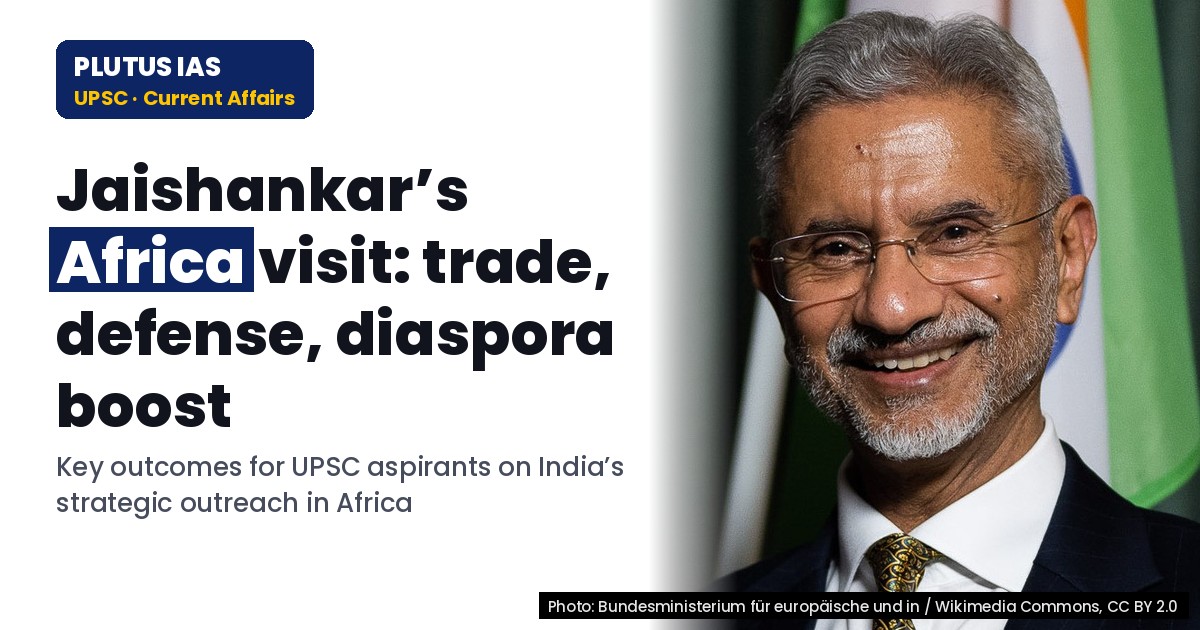
06 Oct EAM’s Africa Visit: Key Outcomes for UPSC & State PCS
✎ India’s diplomatic engagement with Ghana, Côte d’Ivoire, and Ethiopia in October 2026 is a strategic move to reinforce economic, developmental, and maritime partnerships in West Africa and the Horn of Africa, aligning with…
Subject Relevance — Where This Topic Fits
- GS Paper II — International Relations: Bilateral, Regional and Global Groupings and Agreements involving India and/or affecting India’s interests | GS Paper II — International Relations: Effect of Policies and Politics of Developed and Developing Countries on India’s interests | GS Paper II — International Relations: India-Africa Relations
- Prelims: African Union, Indian Ocean Rim Association (IORA), Blue Economy, Indian Technical and Economic Cooperation (ITEC), Pan-African e-Network Project, Visa on Arrival for African Countries, India-Africa Forum Summit (IAFS), G20 Common Framework for Debt Treatment
- Essay: India’s Role in Global South: Bridging Development and Diplomacy, The Geopolitics of the Indian Ocean: Cooperation, Competition and Connectivity
Quick Revision: India’s diplomatic engagement with Ghana, Côte d’Ivoire, and Ethiopia in October 2026 is a strategic move to reinforce economic, developmental, and maritime partnerships in West Africa and the Horn of Africa, aligning with India’s broader Africa policy and global commitments.
Why is this in the news?
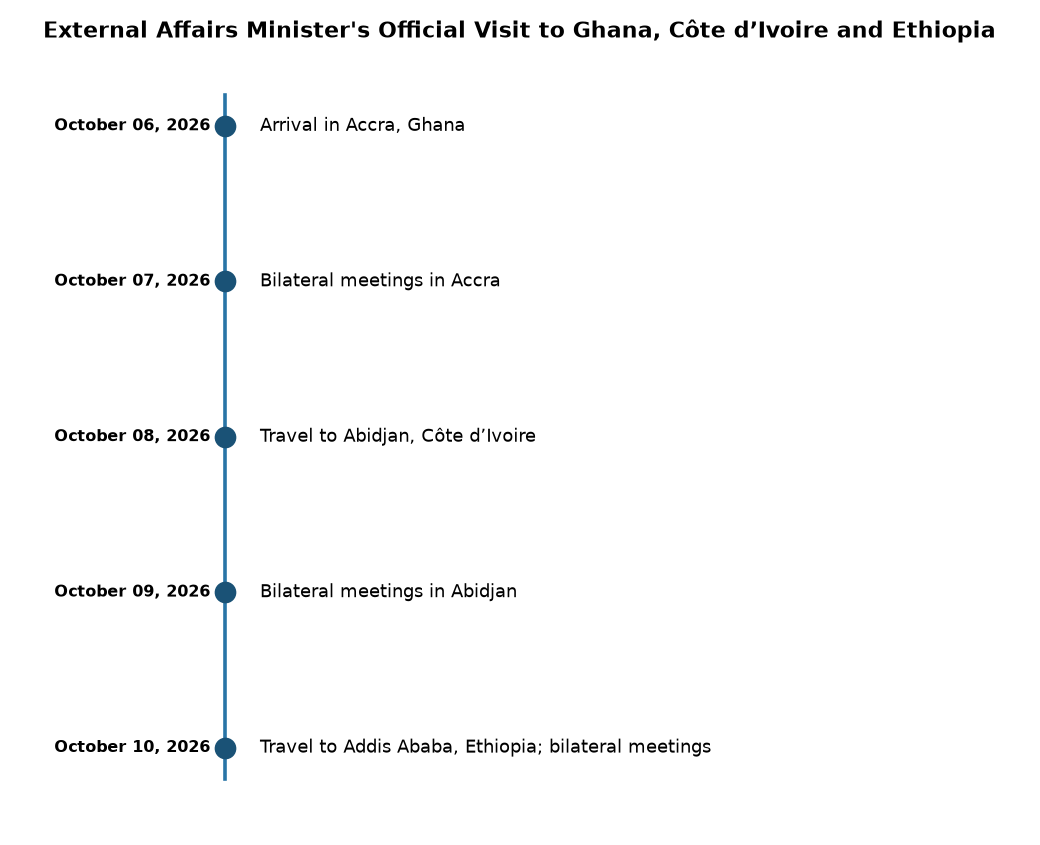
The official visit of India’s External Affairs Minister to Ghana, Côte d’Ivoire, and Ethiopia from October 6–10, 2026, underscores India’s sustained diplomatic engagement with Africa, particularly West Africa and the Horn of Africa, amid evolving global geopolitical dynamics. This visit follows India’s long-standing commitment to strengthening partnerships with African nations through mechanisms such as the India-Africa Forum Summit (IAFS) and the Forum for India-Pacific Islands Cooperation (FIPIC). The timing coincides with India’s ongoing presidency of the G20 and its emphasis on South-South cooperation, making this visit strategically significant for both India and the host nations.
Background
- India’s engagement with Africa has historically been rooted in the principles of mutual respect, sovereignty, and shared developmental aspirations, as articulated in the 2015 India-Africa Forum Summit (IAFS) III held in New Delhi.
- The African Union (AU) has been a key partner for India, with India being one of the first countries to establish a dedicated mission to the AU in Addis Ababa, Ethiopia, in 2011.
- West Africa and the Horn of Africa are critical regions for India due to their strategic location, rich natural resources, and growing economic potential, particularly in sectors such as agriculture, mining, and energy.
- The Indian Ocean Rim Association (IORA), of which India is a founding member, plays a pivotal role in fostering economic and maritime cooperation between India and African littoral states.
- India’s development partnership with Africa includes initiatives such as the Pan-African e-Network Project, the e-VidyaBharati and e-ArogyaBharati (e-VBAB) initiative, and capacity-building programs under the Indian Technical and Economic Cooperation (ITEC) scheme.
What is the significance of India’s engagement with Ghana, Côte d’Ivoire, and Ethiopia?
- Ghana, Côte d’Ivoire, and Ethiopia are pivotal states in West Africa and the Horn of Africa, each serving as economic and political anchors in their respective sub-regions. Ghana is a key player in West African economic integration, while Côte d’Ivoire is a major agricultural and industrial hub. Ethiopia, as the headquarters of the African Union, holds strategic importance in continental diplomacy.
- India’s engagement with these nations aligns with its broader Africa policy, which emphasizes sustainable development, capacity building, and mutually beneficial partnerships rather than transactional relations.
- The visit is expected to focus on deepening economic ties, particularly in sectors such as agriculture, pharmaceuticals, renewable energy, and digital infrastructure, where India has comparative advantages.
- India’s development assistance to these countries includes lines of credit (LoCs) for infrastructure projects, grants for capacity-building programs, and technical cooperation through institutions like the Indian Institute of Technology (IITs) and the Indian Institute of Management (IIMs).
- The visit also provides an opportunity to strengthen India’s maritime security cooperation with these nations, given their strategic locations along key shipping routes in the Gulf of Guinea and the Red Sea.
- India’s engagement with Ethiopia is particularly significant due to its role as the seat of the African Union, where India has consistently supported AU-led initiatives for continental integration and peacekeeping.
- The visit is likely to reaffirm India’s commitment to the G20 Common Framework for Debt Treatment, which aims to provide sustainable debt relief to vulnerable countries, including several in Africa.
- Cultural and people-to-people ties, including the Indian diaspora in these countries, are also expected to feature prominently in the discussions, given the historical and contemporary linkages.
Key Features
| Feature | Significance |
|---|---|
| Bilateral Agreements on Trade and Investment | Enhances economic cooperation, facilitates market access, and strengthens supply chain resilience between India and West African nations. |
| Cultural and Educational Exchanges | Promotes people-to-people ties through scholarships, academic collaborations, and cultural festivals, fostering long-term soft power. |
| Defence and Maritime Security Dialogues | Strengthens regional security architecture, particularly in the Gulf of Guinea and the Horn of Africa, aligning with India’s SAGAR initiative. |
| Renewable Energy and Technology Partnerships | Accelerates joint ventures in solar, wind, and green hydrogen, supporting Africa’s energy transition and India’s climate commitments. |
| Humanitarian Assistance and Disaster Relief (HADR) Cooperation | Facilitates joint exercises and resource-sharing for disaster response, addressing climate-induced vulnerabilities in the region. |
Why it Matters
Economic and Strategic
- Deepens trade relations with West Africa, a region rich in critical minerals and agricultural commodities, diversifying India’s import sources beyond traditional partners.
- Strengthens India’s footprint in Africa, complementing existing engagements in East and Southern Africa under the India-Africa Forum Summit framework.
- Bolsters supply chain security for India’s pharmaceuticals, automotive, and IT sectors by securing raw material and market access in West Africa.
- Enhances maritime security cooperation in the Gulf of Guinea, a critical sea lane for global trade, aligning with India’s Security and Growth for All in the Region (SAGAR) doctrine.
Diplomatic and Geopolitical
- Reinforces India’s role as a non-aligned, development-oriented partner in Africa, counterbalancing other external powers’ influence without entering bloc politics.
- Highlights India’s commitment to multilateralism, particularly within the African Union and ECOWAS frameworks, fostering consensus on global governance issues.
- Demonstrates India’s proactive engagement in the Indian Ocean Region (IOR) and Africa, addressing China’s expanding influence through economic and security partnerships.
- Strengthens India’s voice in international forums on issues like climate change, debt sustainability, and technology transfer, where African nations often seek India’s leadership.
Socio-Cultural and Soft Power
- Expands scholarships and academic exchanges under the Indian Technical and Economic Cooperation (ITEC) programme, building long-term human capital ties.
- Promotes Indian cultural diplomacy through yoga, Ayurveda, and film festivals, enhancing India’s global image beyond economic metrics.
- Facilitates diaspora engagement, particularly with Indian communities in East and West Africa, leveraging their role as bridges for economic and social cooperation.
Climate and Sustainability
- Advances joint projects in renewable energy, including solar parks and green hydrogen, aligning with India’s International Solar Alliance (ISA) initiatives.
- Supports Africa’s Just Energy Transition Partnership (JETP) goals, ensuring equitable access to clean energy technologies.
- Addresses climate-induced migration and food security challenges through technology transfer and capacity-building programmes.
Challenges
1. Geopolitical Fragmentation in West Africa
- Proliferation of regional blocs (ECOWAS, ECCAS, AU) complicates consensus-building on trade, security, and governance issues.
- Instability in the Sahel region (e.g., Burkina Faso, Niger) may disrupt supply chains and investment flows, requiring adaptive diplomatic strategies.
- Competition with other major powers (China, EU, Turkey) for influence in critical sectors like minerals and infrastructure.
UPSC Link: GS II: Regional groupings and agreements
2. Economic Constraints and Debt Sustainability
- High debt-to-GDP ratios in many West African nations limit fiscal space for infrastructure and industrial projects, necessitating innovative financing models.
- Over-reliance on commodity exports (e.g., cocoa, oil) makes economies vulnerable to price volatility, requiring diversification efforts.
- Trade imbalances with India, where imports (e.g., oil, minerals) far exceed exports, may lead to protectionist pressures.
UPSC Link: GS III: Indian Economy and issues relating to planning, mobilization of resources
3. Infrastructure and Logistics Bottlenecks
- Poor port infrastructure in West Africa increases trade costs and delays, undermining the competitiveness of Indian exports.
- Limited road and rail connectivity within and between West African nations hampers intra-regional trade and integration.
- Inadequate power supply and unreliable electricity grids deter industrial investments, particularly in manufacturing.
UPSC Link: GS II: Bilateral groupings and agreements involving India and/or affecting India’s interests
4. Security and Maritime Threats
- Piracy and armed robbery in the Gulf of Guinea remain persistent threats to maritime trade, requiring coordinated naval patrols and capacity-building.
- Terrorism and insurgency in the Sahel (e.g., ISIS-GS, Al-Qaeda affiliates) pose risks to Indian investments and personnel in the region.
- Cybersecurity threats and data localisation requirements in some African nations may complicate digital trade and IT services exports.
UPSC Link: GS III: Security challenges and their management in border areas
5. Regulatory and Bureaucratic Hurdles
- Complex and opaque regulatory frameworks in many West African nations discourage Indian businesses, particularly SMEs, from entering the market.
- Corruption and weak contract enforcement systems increase transaction costs and legal risks for Indian investors.
- Non-tariff barriers (e.g., technical standards, sanitary and phytosanitary measures) often act as de facto trade restrictions.
UPSC Link: GS II: Government policies and interventions for development in various sectors
Challenges — UPSC Perspective
| Issue | Concern |
|---|---|
| Regional Instability | Disruptions in supply chains and investment due to coups, terrorism, or civil unrest in Sahel and Gulf of Guinea. |
| Debt Sustainability | High public debt levels constrain fiscal space for infrastructure and social sector spending. |
| Trade Imbalances | Persistent deficits in India-West Africa trade, with limited export diversification. |
| Infrastructure Deficits | Poor port, road, and power infrastructure increases trade costs and reduces competitiveness. |
| Regulatory Complexity | Opaque business environments and corruption deter Indian private sector participation. |
| Climate Vulnerabilities | Extreme weather events and desertification threaten food security and economic stability. |
Way Forward
- Conclude bilateral trade agreements with Ghana, Côte d’Ivoire, and Ethiopia to reduce tariff and non-tariff barriers, focusing on sectors like pharmaceuticals, IT services, and agro-processing.
- Establish a dedicated India-West Africa Trade and Investment Facilitation Centre to provide end-to-end support to Indian businesses, including legal and regulatory guidance.
- Expand the Indian Technical and Economic Cooperation (ITEC) programme to include more scholarships in renewable energy, maritime security, and digital governance for African professionals.
- Launch a joint India-Africa Green Hydrogen Mission to accelerate technology transfer and pilot projects in West Africa, leveraging India’s ISA and PLI schemes.
- Strengthen maritime security cooperation by operationalising the India-Africa Defence Ministers’ Dialogue and conducting joint HADR exercises in the Gulf of Guinea.
- Develop a credit guarantee mechanism for Indian SMEs investing in West Africa, mitigating risks associated with political instability and regulatory uncertainty.
- Promote cultural diplomacy through the establishment of Indian cultural centres in Accra, Abidjan, and Addis Ababa, offering language training and yoga/Ayurveda certification programmes.
- Enhance digital connectivity by supporting the Africa-India e-Network project to improve telemedicine, e-education, and fintech linkages.
UPSC Value Addition
Keywords for Mains Answer-Writing
Indian Foreign Policy · Ministry of External Affairs · Soft Power Diplomacy · Historical and Cultural Ties · India-Africa Strategic Partnership · Blue Economy · Maritime Security · Development Partnership Administration · UN Security Council Reform · Pan-Africanism · Non-Aligned Movement · South-South Cooperation · Indian Diaspora
Concept Flow
India’s proactive foreign policy under ‘Act East’ and ‘SAGAR’ doctrines → Identification of West Africa as a strategic priority for trade, security, and development → Official visit by EAM to Ghana, Côte d’Ivoire, and Ethiopia → Bilateral negotiations on trade, investment, and security → Signing of MoUs in renewable energy, maritime security, and cultural exchanges → Implementation of projects under India’s development partnership framework → Enhanced economic integration and soft power projection → Long-term strategic alignment with Africa’s growth trajectory.
Prelims Practice Questions
Q1. Consider the following statements regarding India’s engagement with African nations:
1. India’s Development Partnership Administration (DPA-I) focuses on capacity-building and infrastructure projects in Africa.
2. The India-Africa Forum Summit (IAFS) is a biennial event initiated in 2008 to strengthen India-Africa relations.
3. The Pan-African e-Network Project, launched in 2009, aims to provide tele-education and tele-medicine services across Africa.
How many of the above statements are correct?
- Only one
- Only two
- All
- None
Answer: All — Statements 1 and 3 are correct. Statement 2 is incorrect as the IAFS was initiated in 2008 but is not a biennial event; subsequent summits were held in 2011, 2015, and 2019.
Q2. Assertion (A): The Indian Ocean Rim Association (IORA) is a key platform for promoting maritime security and blue economy initiatives in the Indian Ocean region.
Reason (R): India has been a founding member of IORA since its inception in 1997 and has actively promoted initiatives such as the ‘Security and Growth for All in the Region’ (SAGAR) doctrine.
- Both A and R are true, and R is the correct explanation of A.
- Both A and R are true, but R is not the correct explanation of A.
- A is true, but R is false.
- A is false, but R is true.
Answer: Both A and R are true, and R is the correct explanation of A. — Both the assertion and reason are true, and the reason correctly explains the assertion. IORA is indeed a key platform for maritime security and blue economy, and India has been a founding member since 1997, promoting the SAGAR doctrine.
Q3. Match the following Indian diplomatic initiatives with their respective African regions or countries:
Column I (Initiative) | Column II (Region/Country)
— | —
A. Pan-African e-Network Project | 1. East Africa
B. India-Nigeria Joint Commission Meeting | 2. West Africa
C. India-Mozambique Line of Credit for Port Development | 3. Southern Africa
D. India-Ethiopia Bilateral Cooperation in Agriculture | 4. Pan-African
Select the correct match:
- A-4, B-2, C-3, D-1
- A-2, B-4, C-1, D-3
- A-1, B-3, C-2, D-4
- A-3, B-1, C-4, D-2
Answer: A-4, B-2, C-3, D-1 — A matches with 4 (Pan-African initiative), B with 2 (West Africa, Nigeria), C with 3 (Southern Africa, Mozambique), and D with 1 (East Africa, Ethiopia).
Mains Practice Question
✍ India’s External Affairs Minister’s recent visit to Ghana, Côte d’Ivoire, and Ethiopia underscores the strategic importance of Africa in India’s foreign policy. Critically examine the evolving dynamics of India-Africa relations, highlighting the role of historical ties, developmental partnerships, and geopolitical considerations. Also, assess the challenges and opportunities for India in deepening engagement with the continent. (15 Marks)
Approach: Define India-Africa relations and contextualise the visit within broader Indian foreign policy objectives. Highlight the historical and cultural bonds, including the shared colonial experience, Pan-Africanism, and the Non-Aligned Movement. Mention the role of the Indian diaspora in Africa. Discuss key initiatives such as the Development Partnership Administration (DPA-I), Lines of Credit, capacity-building programs, and the Pan-African e-Network Project. Cite specific examples from Ghana, Côte d’Ivoire, and Ethiopia. Analyse the geopolitical significance of Africa for India, including maritime security (SAGAR doctrine), access to critical minerals, and countering China’s influence in the Indian Ocean region. Outline challenges such as political instability in some African nations, competition with other global powers, and the need for sustainable and inclusive development partnerships. Discuss opportunities in sectors like agriculture, renewable energy, digital infrastructure, and healthcare. Highlight the potential of the African Continental Free Trade Area (AfCFTA) for Indian businesses. Conclude with a balanced assessment of India’s strategic approach to Africa, emphasising the need for long-term engagement, mutual benefit, and alignment with African priorities.
Source: Ministry of External Affairs
Generated by AanyaAi for educational purpose.
Related guides on our sites
- Current affairs for upsc 2026
- Best PSIR optional coaching for upsc
- Best PSIR optional teacher for upsc
- Best teacher of PSIR optional for upsc

- क्या शांतिपूर्ण असहमति भारत में कमजोर हो रही है? जानिए संवैधानिक अधिकार - October 7, 2026
- Lok Sabha Speaker on Strengthening Democracy Through Dialogue and Inclusion - October 6, 2026
- बेंगलुरु में पांच पुलिस आयुक्तालयों के गठन को कैबिनेट की मंजूरी, पूर्व अधिकारियों ने व्यक्त की चिंता - October 6, 2026

No Comments