


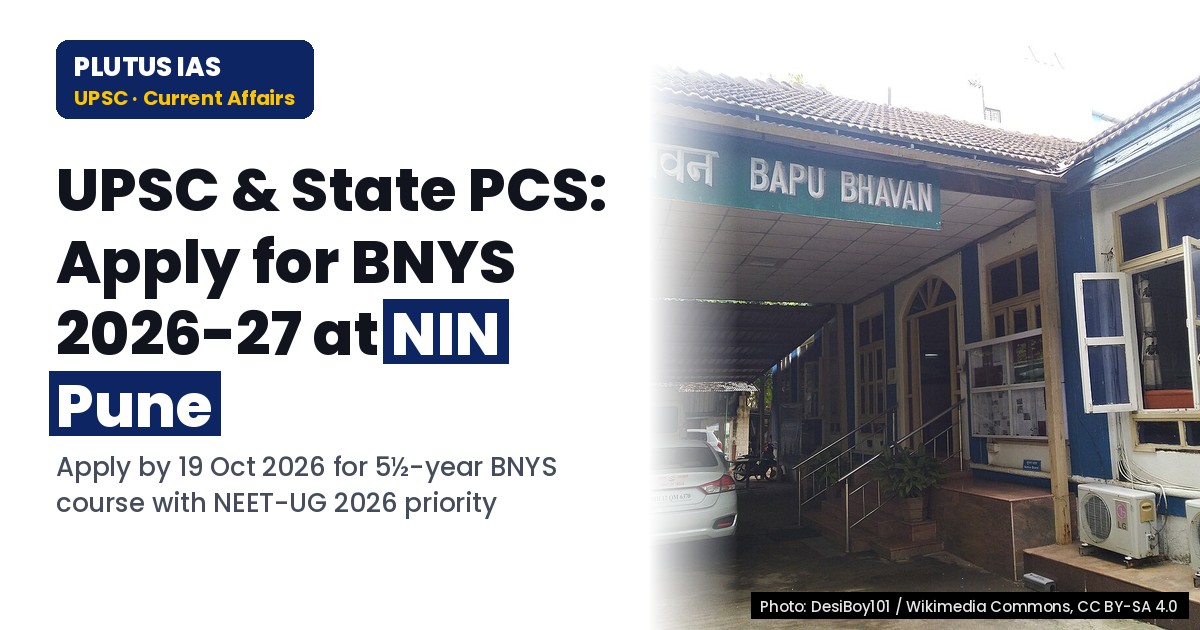
07 Oct UPSC & State PCS: Apply for BNYS 2026-27 at NIN Pune
✎ The BNYS is a 5½-year residential professional degree programme in naturopathy and yoga, affiliated with a central university, offering integrated academic and clinical training with a mandatory rotatory internship.
Subject Relevance — Where This Topic Fits
- GS Paper II — Governance, Administration and Challenges | GS Paper III — Science and Technology in Health Systems
- Prelims: BNYS, Ayush, Naturopathy, Yoga, National Institute of Naturopathy (NIN), NEET-UG, AYUSH Ministry, Lal Bahadur Shastri National Sanskrit University, Integrated Medicine, Complementary and Alternative Medicine (CAM), Residential Professional Course, Rotatory Internship, Clinical Training in Naturopathy, Institutional Education Standards, Autonomous Body under Ministry of AYUSH
- Essay: The Role of Traditional Knowledge Systems in Modern Healthcare, Integrating Indigenous Health Practices with Evidence-Based Medicine
Quick Revision: The BNYS is a 5½-year residential professional degree programme in naturopathy and yoga, affiliated with a central university, offering integrated academic and clinical training with a mandatory rotatory internship.
Why is this in the news?
The National Institute of Naturopathy (NIN), Pune, an autonomous body under the Ministry of AYUSH, has invited online applications for the Bachelor of Naturopathy and Yogic Sciences (BNYS) programme for the academic year 2026-27. This initiative underscores the institutionalisation of naturopathy education in India, aligning with the government’s broader efforts to promote integrative healthcare systems through structured academic and clinical training. The announcement is significant for aspirants seeking careers in naturopathy and yoga, as it provides a pathway to a professional degree recognised under the AYUSH framework.
Background
- The Ministry of AYUSH, Government of India, was established in 2014 to promote the growth and development of Ayurveda, Yoga and Naturopathy, Unani, Siddha, and Homoeopathy (AYUSH) systems of medicine.
- Naturopathy and Yoga have been practised in India for centuries, with roots in traditional health systems and Gandhian principles of holistic living.
- The National Institute of Naturopathy (NIN), Pune, operates under the aegis of the AYUSH Ministry and is mandated to promote education, research, and clinical practice in naturopathy.
- The BNYS programme is a 5½-year full-time residential professional course, integrating academic instruction, clinical training, and a mandatory rotatory internship.
- Lal Bahadur Shastri National Sanskrit University, New Delhi, serves as the affiliating university for the BNYS programme offered by NIN, marking a milestone in institutionalising naturopathy education within the higher education framework of India.
What is the Bachelor of Naturopathy and Yogic Sciences (BNYS) programme?
- The BNYS is a 5½-year full-time residential professional degree programme that combines academic instruction in naturopathy and yoga with clinical training and a mandatory rotatory internship (CRRI).
- The curriculum is structured to provide integrated academic education in natural therapeutic modalities, including hydrotherapy, mud therapy, massage, yoga therapy, and dietary management, alongside foundational medical sciences.
- The programme includes 4½ years of academic and clinical training, followed by a one-year compulsory rotatory internship in naturopathy hospitals and wellness centres to gain practical exposure.
- The BNYS programme is affiliated with Lal Bahadur Shastri National Sanskrit University, New Delhi, a central university, ensuring academic rigour and recognition within the higher education system.
- The National Institute of Naturopathy (NIN), Pune, operates the BNYS programme at its flagship campus, Nisargagram, Yevale Wadi, Pune, which is equipped with a 250-bed naturopathy hospital, academic facilities, research laboratories, hostels, and modern infrastructure for yoga and naturopathy treatments.
- The programme aims to produce qualified naturopaths capable of integrating traditional knowledge with contemporary health practices, thereby contributing to the development of integrative healthcare systems in India.
- Admission to the BNYS programme is based on merit, with preference given to candidates who have appeared for NEET-UG 2026. In case of vacant seats, admissions are conducted based on merit in the qualifying examination (10+2) in Physics, Chemistry, and Biology.
- The BNYS degree is recognised under the AYUSH framework, enabling graduates to pursue careers in naturopathy clinics, wellness centres, research institutions, and academic roles in naturopathy education.
Key Features
| Feature | Significance |
|---|---|
| Autonomous Institution under AYUSH Ministry | Ensures standardized governance and policy alignment for natural medicine and yoga education in India. |
| 5½-Year Full-Time Residential Professional Course (BNYS) | Provides integrated academic, clinical, and research training with mandatory internship for holistic competency development. |
| Affiliation with Lal Bahadur Shastri National Sanskrit University | Enhances academic credibility and institutional recognition for the course. |
| 100 Seats for Academic Year 2026-27 | Limited intake ensures quality control and personalized training in a specialized domain. |
| NEET-UGC 2026 Preference for Admission | Aligns with national-level medical entrance standards, ensuring merit-based selection. |
| Nisargagram Campus Infrastructure (25 acres) | Provides integrated facilities including a 250-bed hospital, hostels, and research labs for immersive learning. |
Why it Matters
Healthcare System Integration
- Promotes evidence-based integration of Naturopathy and Yoga into mainstream healthcare through structured education.
- Supports the National Health Policy 2017’s emphasis on preventive and promotive healthcare.
- Contributes to the AYUSH sector’s goal of achieving a 26% share in the national health workforce by 2024.
Human Resource Development
- Addresses the critical shortage of qualified naturopaths and yoga therapists in India.
- Develops a cadre of professionals trained in indigenous health systems aligned with global wellness trends.
- Enhances research capacity in complementary and alternative medicine (CAM) through institutional training.
Cultural and Historical Continuity
- Revives and institutionalizes Mahatma Gandhi’s vision of natural healing and self-sufficiency in healthcare.
- Preserves traditional knowledge systems while adapting them to modern scientific paradigms.
- Strengthens India’s soft power in global wellness and alternative medicine discourse.
Educational Innovation
- Introduces a unique residential model combining academic rigor with clinical exposure.
- Sets a benchmark for interdisciplinary education in integrative medicine.
- Encourages innovation in curriculum design, blending ancient practices with contemporary research.
Challenges
1. Limited Awareness and Perception
- Public skepticism towards naturopathy and yoga as standalone medical disciplines.
- Need for extensive outreach to demystify the BNYS course and career prospects.
- Challenge of aligning traditional knowledge with modern medical validation.
UPSC Link: GS2: Health and Education
2. Regulatory and Accreditation Hurdles
- Ensuring consistent quality across institutions offering similar courses.
- Harmonizing BNYS standards with global complementary medicine frameworks.
- Addressing inter-state variability in recognition and licensing of naturopaths.
UPSC Link: GS2: Health Governance
3. Infrastructure and Resource Constraints
- Scaling up clinical training facilities to accommodate growing student intake.
- Ensuring equitable access to advanced research infrastructure for all enrolled students.
- Balancing residential requirements with logistical challenges in a metropolitan setting.
UPSC Link: GS3: Infrastructure and Human Resource
4. Curriculum Relevance and Adaptability
- Updating syllabi to incorporate emerging research in naturopathy and yoga sciences.
- Integrating digital health and telemedicine components for future-ready professionals.
- Addressing the tension between traditional practices and evidence-based medicine.
UPSC Link: GS2: Education System
5. Career Prospects and Industry Integration
- Creating structured pathways for BNYS graduates in government and private healthcare sectors.
- Encouraging collaboration with mainstream medical institutions for interdisciplinary practice.
- Developing entrepreneurship opportunities in wellness tourism and corporate wellness programs.
UPSC Link: GS3: Employment and Skill Development
Challenges — UPSC Perspective
| Issue | Concern |
|---|---|
| Public Perception | Skepticism towards naturopathy as a standalone medical system. |
| Regulatory Gaps | Variability in recognition and licensing across states. |
| Infrastructure Scaling | Limited clinical training facilities for growing student intake. |
| Curriculum Modernization | Balancing traditional knowledge with contemporary scientific validation. |
| Career Pathways | Lack of structured integration into mainstream healthcare employment. |
| Research Funding | Limited resources for advanced research in integrative medicine. |
Way Forward
- Expand outreach programs to enhance awareness about BNYS career opportunities among students and parents.
- Strengthen industry-academia partnerships to create internship and employment avenues for graduates.
- Develop a national framework for standardized accreditation of naturopathy and yoga institutions.
- Integrate digital learning modules to modernize curriculum and improve accessibility.
- Establish a dedicated research fund to support evidence-based studies in naturopathy and yoga.
- Collaborate with state governments to harmonize licensing and recognition policies.
- Introduce mentorship programs pairing students with experienced practitioners for hands-on learning.
- Promote BNYS graduates’ participation in global wellness and integrative medicine conferences.
UPSC Value Addition
Keywords for Mains Answer-Writing
National Institute of Naturopathy (NIN), Pune · Bachelor of Naturopathy and Yogic Sciences (BNYS) · AYUSH Ministry · Integrated Medicine · Naturopathy and Yoga education · Autonomous institutions under AYUSH · Lal Bahadur Shastri National Sanskrit University · NEET-UG 2026 · Medical education standards · Complementary and Alternative Medicine (CAM) · Naturopathy hospitals · Residential professional courses · Clinical training in naturopathy · Yogic sciences curriculum · Government of India’s initiatives in naturopathy
Concept Flow
AYUSH Ministry’s autonomy → Standardized governance for natural medicine education. → Institutional affiliation (LBS National Sanskrit University) → Academic credibility and recognition. → BNYS course design → Integrated 5½-year residential program with clinical training. → NEET-UGC alignment → Merit-based admission ensuring quality intake. → Nisargagram campus infrastructure → Immersive learning environment with hospital and research facilities. → Graduate employment → Integration into healthcare workforce and wellness industry. → Policy feedback loop → Continuous curriculum updates based on research and industry needs.
Prelims Practice Questions
Q1. Consider the following statements regarding the Bachelor of Naturopathy and Yogic Sciences (BNYS) course offered by the National Institute of Naturopathy (NIN), Pune:
1. The BNYS course is a 5½-year full-time residential professional programme.
2. The course includes 4½ years of academic and clinical training followed by a mandatory one-year rotatory internship.
3. Admission to the BNYS course is based solely on the marks obtained in the Class 12 examination in Physics, Chemistry, and Biology.
4. The NIN is affiliated with the Lal Bahadur Shastri National Sanskrit University, New Delhi.
How many of the above statements are correct?
- Only one
- Only two
- Only three
- All four
Answer: Only three — Statements 1, 2, and 4 are correct. Statement 3 is incorrect because admission to the BNYS course prioritises candidates who have appeared for NEET-UG 2026, and if seats remain vacant, admission is based on merit in Physics, Chemistry, and Biology in Class 12.
Q2. Assertion (A): The National Institute of Naturopathy (NIN), Pune, operates under the administrative control of the Ministry of AYUSH, Government of India.
Reason (R): The NIN is an autonomous institution dedicated to promoting education, research, and healthcare in naturopathy and yoga.
In the context of the above two statements, which of the following is correct?
- Both A and R are true, and R is the correct explanation of A
- Both A and R are true, but R is NOT the correct explanation of A
- A is true, but R is false
- A is false, but R is true
Answer: Both A and R are true, but R is NOT the correct explanation of A — Both the Assertion (A) and Reason (R) are true. The NIN is indeed an autonomous institution under the Ministry of AYUSH, and its primary objective is to promote education, research, and healthcare in naturopathy and yoga. The Reason (R) correctly explains the Assertion (A).
Q3. Match the following institutions with their respective affiliations or administrative control:
Column I
1. National Institute of Naturopathy (NIN), Pune
2. All India Institute of Ayurveda (AIIA), New Delhi
3. National Institute of Unani Medicine (NIUM), Bengaluru
4. National Institute of Homoeopathy (NIH), Kolkata
Column II
A. Ministry of AYUSH, Government of India
B. Lal Bahadur Shastri National Sanskrit University, New Delhi
C. University Grants Commission (UGC)
D. Central Council of Homoeopathy
Select the correct match:
- 1-B, 2-A, 3-A, 4-D
- 1-A, 2-B, 3-C, 4-D
- 1-B, 2-A, 3-D, 4-C
- 1-A, 2-C, 3-A, 4-B
Answer: 1-B, 2-A, 3-A, 4-D — The correct matches are: 1-B (NIN is affiliated with Lal Bahadur Shastri National Sanskrit University), 2-A (AIIA is under the Ministry of AYUSH), 3-A (NIUM is under the Ministry of AYUSH), and 4-D (NIH is under the Central Council of Homoeopathy).
Mains Practice Question
✍ Critically examine the significance of the Bachelor of Naturopathy and Yogic Sciences (BNYS) programme in the context of India’s healthcare system and the promotion of integrative medicine. Also, analyse the role of autonomous institutions under the Ministry of AYUSH in advancing education and research in complementary and alternative medicine. (15 Marks)
Approach: MODEL-ANSWER SKELETON:
1. **Introduction to BNYS and NIN**: Define BNYS as a 5½-year residential professional programme integrating naturopathy and yogic sciences, with 4½ years of academic/clinical training and a mandatory one-year internship. Highlight NIN, Pune, as an autonomous institution under the Ministry of AYUSH, promoting education, research, and healthcare in naturopathy and yoga.
2. **Significance of BNYS in Healthcare**:
– **Holistic Healthcare**: Discuss how BNYS aligns with the global shift towards integrative medicine, combining conventional and traditional systems to address chronic diseases and lifestyle disorders.
– **Preventive and Promotive Health**: Emphasise the role of naturopathy and yoga in preventive healthcare, reducing the burden on tertiary care systems.
– **Evidence-Based Practice**: Highlight the importance of institutionalising education and research in naturopathy to ensure evidence-based practice and standardisation.
3. **Role of Autonomous Institutions under AYUSH**:
– **Policy and Governance**: Explain the mandate of autonomous institutions like NIN in implementing the National AYUSH Mission and other government initiatives to promote traditional medicine.
– **Education and Standardisation**: Discuss how these institutions set academic standards, curricula, and accreditation frameworks for courses like BNYS, ensuring quality and uniformity.
– **Research and Innovation**: Highlight their contribution to research in naturopathy, yoga, and integrative medicine, including clinical trials, documentation of traditional knowledge, and development of standard treatment protocols.
4. **Challenges and Way Forward**:
– **Acceptance and Integration**: Address challenges in integrating naturopathy and yoga into mainstream healthcare, including scepticism from the allopathic community and lack of regulatory recognition in some contexts.
– **Infrastructure and Resources**: Discuss the need for adequate infrastructure, faculty, and funding to scale up education and research in these fields.
– **Public Awareness**: Emphasise the importance of public awareness campaigns to promote the acceptance and utilisation of naturopathy and yoga in healthcare.
5. **Conclusion**: Summarise the transformative potential of BNYS and autonomous institutions like NIN in shaping a more inclusive, preventive, and holistic healthcare system in India. Conclude with the need for continued policy support, research, and collaboration between traditional and modern medical systems.
Source: PIB (Press Information Bureau)
Maharashtra PCS (MPSC) — State PCS Practice
Prelims: Which of the following institutions in Maharashtra has invited applications for the Bachelor of Naturopathy and Yogic Sciences (BNYS) undergraduate course for the academic year 2026-27?
- A. National Institute of Naturopathy, Pune
- B. Government Ayurved College, Mumbai
- C. Maharashtra University of Health Sciences, Nashik
- D. National Institute of Yoga, Nagpur
Answer: A. National Institute of Naturopathy, Pune — The National Institute of Naturopathy (NIN), Pune, under the Ministry of AYUSH, Government of India, has invited applications for the BNYS undergraduate course for 2026-27.
Mains: Examine the significance of the National Institute of Naturopathy (NIN), Pune, in promoting naturopathy and yogic sciences in Maharashtra. Discuss its role in integrating traditional Indian healthcare systems with modern medical practices, and suggest measures to enhance its outreach and effectiveness in the state.
Generated by AanyaAi for educational purpose.
Related guides on our sites
- How to prepare for GS paper 1 for UPSC CSE mains exam
- Best Neet coaching
- Best neet coaching
- Best UPSC coaching for IFOS exam

- UPSC & State PCS: Apply for BNYS 2026-27 at NIN Pune - October 7, 2026
- कर्नाटक उच्च न्यायालय ने बाल हिरासत मामलों में ‘पेरेंटिंग टाइम’ शब्द अपनाने का आदेश दिया - October 7, 2026
- RBI Rate Hike: How Home Loan EMIs Burden Middle-Class Buyers - October 7, 2026

No Comments