


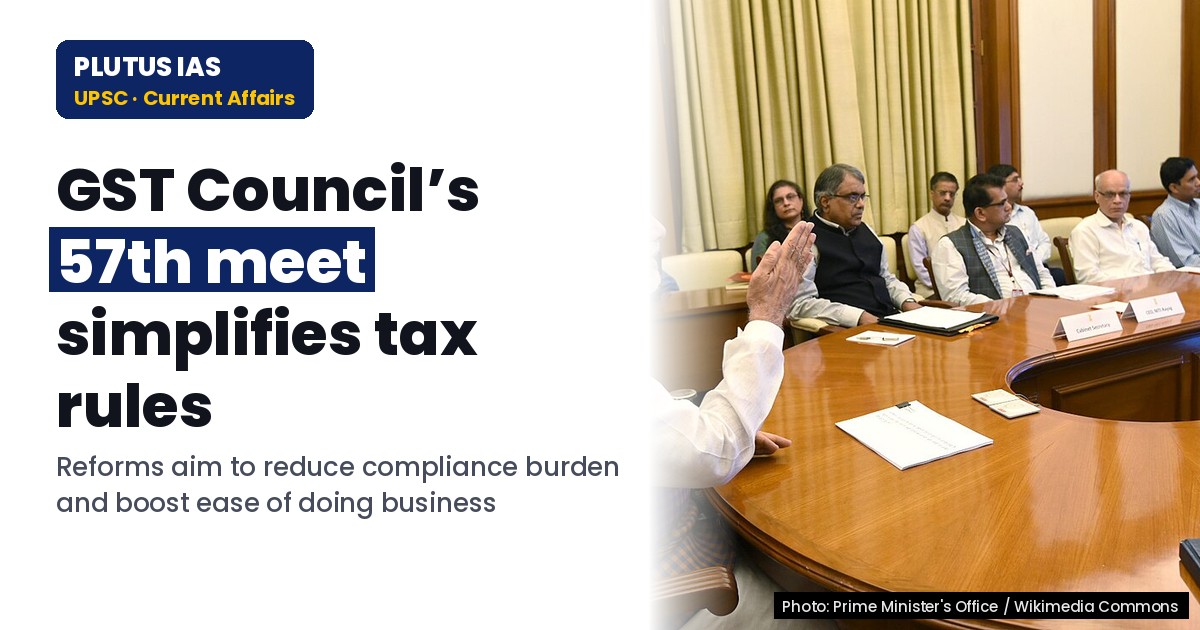
10 Oct GST Council’s 57th Meet: Major Reforms to Simplify Taxation System
✎ The 57th GST Council meeting marks a transition from an enforcement-centric to a trust-based compliance model, with key reforms including automation of registrations, faceless assessment, annual rate reviews, and restrictions on…
Subject Relevance — Where This Topic Fits
- GS Paper III — Indian Economy and issues relating to Planning, Mobilisation of Resources, Growth, Development and Employment | GS Paper III — Government Budgeting and Fiscal Policy
- Prelims: GST Council, GST reforms, Input Tax Credit (ITC), faceless assessment, GST registration automation, GST return filing simplification, GST refunds, GST officer powers, GST rate slabs, GST compliance burden
- Essay: The evolution of India’s indirect tax system: From complexity to simplicity, Trust in governance: Redefining the taxpayer-state relationship in India
Quick Revision: The 57th GST Council meeting marks a transition from an enforcement-centric to a trust-based compliance model, with key reforms including automation of registrations, faceless assessment, annual rate reviews, and restrictions on GST officer powers to reduce harassment and enhance ease of doing business.
Why is this in the news?
The 57th meeting of the GST Council introduced a series of procedural and administrative reforms aimed at reducing compliance burdens, enhancing trust in taxpayers, and automating key processes within the Goods and Services Tax (GST) regime. These measures mark a paradigm shift from a historically enforcement-centric approach to a trust-based compliance model, addressing longstanding grievances related to input tax credit (ITC) denial, excessive discretionary powers of tax officers, and procedural redundancies. The reforms are significant as they occur in the tenth year of GST implementation, a juncture where the system’s efficacy and public trust are critical for sustained revenue buoyancy and economic integration.
Background
- The Goods and Services Tax (GST) was introduced in India on 1 July 2017, subsuming multiple indirect taxes into a unified, destination-based tax system, with the objective of creating a seamless national market.
- The GST Council, a constitutional body under Article 279A of the Constitution, comprises the Union Finance Minister and state Finance Ministers, and is responsible for making recommendations on GST-related matters, including tax rates, exemptions, and procedural reforms.
- Over the initial years, the GST regime faced criticism for its complexity, attributed to multiple tax slabs, frequent rate changes, and procedural hurdles such as delayed input tax credit (ITC) claims, excessive documentation, and discretionary powers vested in tax officers.
- Gross GST collections have stabilised in recent years, with collections averaging around ₹1.6–1.8 lakh crore per month in FY 2024–25 and FY 2025–26, indicating a maturing tax base and reduced volatility in revenue performance.
- The Council’s 56th meeting in August 2026 had already addressed rate-related issues and reduced the number of GST slabs from five to four, simplifying the tax structure and reducing compliance complexity.
- The shift towards automation and faceless assessment in direct taxes (e.g., Income Tax) has served as a model for indirect tax reforms, demonstrating the potential of technology-driven governance to enhance efficiency and reduce human discretion.
What is the Goods and Services Tax (GST) Council?
- The GST Council is a constitutional body established under Article 279A of the Constitution of India, tasked with making recommendations on issues related to the implementation and administration of the Goods and Services Tax (GST).
- It is chaired by the Union Finance Minister and includes the Union Minister of State in charge of Revenue or Finance, and the Finance Ministers of all states and Union Territories with legislatures.
- The Council operates on the principle of cooperative federalism, ensuring that both the Centre and states have a voice in GST policy formulation, thereby balancing fiscal autonomy and national uniformity.
- Key functions of the Council include determining tax rates, exemptions, thresholds, and procedural rules; resolving disputes between Centre and states; and recommending measures to improve compliance and reduce tax evasion.
- Decisions in the Council are taken by a three-fourths majority of the weighted votes of the members present and voting, with the Centre having one-third of the total votes and states collectively holding two-thirds.
- The Council has historically played a pivotal role in addressing structural issues in GST, such as the rationalisation of tax slabs, expansion of the tax base, and simplification of return filing mechanisms.
- Recent reforms in the 57th meeting reflect a broader shift towards institutionalising trust-based compliance, reducing procedural friction, and leveraging technology to enhance transparency and efficiency in tax administration.
Key Features
| Feature | Significance |
|---|---|
| Automated GST registrations | Eliminates manual intervention, reducing delays and errors in the onboarding process for taxpayers. |
| Reduced return filing frequency for small businesses | Lowers compliance burden, enabling micro and small enterprises to focus on operations rather than paperwork. |
| Computer-based refund verification | Replaces manual scrutiny, expediting legitimate refunds and reducing working capital bottlenecks for businesses. |
| Limitation of GST officer powers | Curbs arbitrary enforcement, shifting from a punitive to a facilitative compliance model. |
| Faceless assessment system for Central GST | Introduces anonymity in tax assessments to minimise discretion and enhance transparency. |
| Annual rate review cycle | Provides predictability in tax rates, reducing uncertainty for businesses and investors. |
Why it Matters
Economic Governance
- Demonstrates a shift from enforcement-driven taxation to trust-based compliance, aligning with global best practices in tax administration.
- Reduces transaction costs for businesses by simplifying compliance, thereby enhancing ease of doing business in India.
- Facilitates better cash flow management for enterprises by expediting input tax credit (ITC) refunds and reducing working capital constraints.
Institutional Reforms
- Strengthens the institutional credibility of the GST Council by addressing long-standing grievances of taxpayers through structural changes.
- Promotes technological integration in tax administration, reducing human discretion and enhancing efficiency in compliance processes.
- Sets a precedent for periodic review and reform of tax policies, ensuring adaptability to economic conditions.
Business Ecosystem
- Alleviates operational challenges for small and medium enterprises (SMEs) by reducing compliance complexity and frequency of filings.
- Encourages formalisation of the economy by making GST compliance less burdensome, thereby integrating more businesses into the tax net.
- Improves investor confidence by providing a more predictable and transparent tax regime.
Challenges
1. Implementation of Computer-Based Refund Verification
- Requires robust IT infrastructure to handle large-scale refund processing without delays or errors.
- Demands capacity-building for tax officers to adapt to automated systems and address system-generated discrepancies.
- Necessitates safeguards to prevent misuse of automated processes, such as fraudulent refund claims.
UPSC Link: GS3: Tax Administration Reforms
2. Balancing Trust and Enforcement
- Maintaining deterrence against tax evasion while fostering a culture of voluntary compliance remains a delicate balance.
- Ensuring that reduced officer powers do not lead to underreporting or non-compliance in high-risk sectors.
- Monitoring the effectiveness of faceless assessment in preventing collusion and ensuring fairness.
UPSC Link: GS3: Tax Evasion and Compliance
3. Harmonisation of State and Central GST Systems
- Ensuring seamless integration between state and central GST portals to avoid compliance fragmentation.
- Addressing disparities in IT capabilities across states to prevent bottlenecks in refund processing or registration.
- Standardising procedures for inter-state transactions to reduce disputes and litigation.
UPSC Link: GS2: Centre-State Relations
Challenges — UPSC Perspective
| Issue | Concern |
|---|---|
| IT Infrastructure Gaps | Risk of system failures or delays in automated processes, particularly for refunds and registrations. |
| Capacity Building for Officers | Inadequate training may lead to inefficiencies or errors in faceless assessment and refund verification. |
| State-Central Coordination | Lack of synchronisation between state and central GST systems could create compliance hurdles. |
| Tax Evasion Risks | Reduced human oversight may embolden non-compliant taxpayers in sectors prone to evasion. |
| Predictability vs. Flexibility | Annual rate reviews may limit the Council’s ability to respond to economic shocks or sector-specific needs. |
Way Forward
- Establish a dedicated task force to oversee the phased rollout of computer-based refund verification by April 1, ensuring robust testing and stakeholder feedback.
- Conduct nationwide capacity-building programmes for GST officers to familiarise them with faceless assessment and automated compliance tools.
- Develop a real-time dashboard to monitor refund processing times and identify bottlenecks in the IT infrastructure.
- Introduce a graded system for GST officer powers, allowing higher discretion only for high-risk taxpayers or sectors.
- Formulate a standard operating procedure (SOP) for inter-state GST transactions to harmonise compliance across states.
- Publish an annual report on the performance of GST reforms, including metrics on compliance rates, refund turnaround times, and taxpayer satisfaction.
- Explore the integration of GST data with other government databases (e.g., MCA, Income Tax) to enable cross-verification and reduce fraud.
UPSC Value Addition
Keywords for Mains Answer-Writing
Goods and Services Tax (GST) · GST Council · GST reforms · input tax credit (ITC) · faceless assessment · GST compliance simplification · GST administration trust-based model · GST rate review mechanism · GST refund process automation · GST arrest powers reduction · Constitutional provisions under Article 279A · GST Council’s role in tax policy · taxpayer trust and compliance · GST litigation reduction · GST Council’s 57th meeting outcomes · automation in tax administration · GST rate slabs rationalisation · GST return filing simplification · GST input tax credit denial issues · GST Council’s committee for ITC solutions
Constitutional & Policy Linkages
- [“Article 279A: GST Council’s Constitutional Mandate”]
- [‘Article 246A: Concurrent Power to Levy GST’]
Concept Flow
GST Rollout (2017) → Initial Complexity and High Compliance Burden → Taxpayer Grievances and Revenue Stability → GST Council’s 57th Meeting (2026) → Structural Reforms (Automation, Reduced Filings, Faceless Assessment) → Enhanced Ease of Doing Business → Improved Cash Flow and Formalisation → Sustainable Revenue Growth
Prelims Practice Questions
Q1. Consider the following statements regarding the Goods and Services Tax (GST) Council in India:
1. The GST Council is a constitutional body established under Article 279A of the Constitution.
2. The Council consists of the Union Finance Minister as Chairperson and the Finance Ministers of all States and Union Territories with Legislatures as members.
3. The decisions of the GST Council are binding on both the Central and State Governments.
4. The GST Council can recommend the rates of tax, exemptions, and thresholds for levy of GST.
How many of the above statements are correct?
- Only one
- Only two
- Only three
- All
Answer: All — Statements 1, 2, and 4 are correct. Statement 3 is incorrect as the decisions of the GST Council are recommendatory in nature and not binding.
Q2. Assertion (A): The GST Council, in its 57th meeting, decided to reduce the arrest powers of GST officers to curb harassment of taxpayers.
Reason (R): The decision aligns with the broader objective of shifting towards a trust-based tax administration model under GST reforms.
Options:
A. Both A and R are true, and R is the correct explanation of A.
B. Both A and R are true, but R is NOT the correct explanation of A.
C. A is true, but R is false.
D. A is false, but R is true.
Answer: ? — Both A and R are true, and R correctly explains A as the reduction in arrest powers is part of the trust-based compliance model adopted by the GST Council.
Q3. Match the following provisions related to GST with their respective objectives:
Column I (Provision) | Column II (Objective)
———————|———————-
A. Faceless assessment system | 1. Reduction of human discretion in tax administration
B. Input Tax Credit (ITC) denial until supplier files return | 2. Addressing working capital issues for businesses
C. Annual rate review mechanism | 3. Reducing uncertainty in tax policy
D. Reduction in arrest powers of GST officers | 4. Curbing harassment of taxpayers
Options:
A. A-1, B-2, C-3, D-4
B. A-2, B-1, C-4, D-3
C. A-1, B-4, C-3, D-2
D. A-3, B-2, C-1, D-4
Answer: ? — Correct matching: A-1 (Faceless assessment reduces human discretion), B-2 (ITC denial until supplier files return addresses working capital issues), C-3 (Annual rate review reduces uncertainty), D-4 (Reduction in arrest powers aims to curb harassment).
Mains Practice Question
✍ The Goods and Services Tax (GST) regime in India has undergone significant reforms aimed at simplifying compliance and fostering a trust-based tax administration. Critically examine the key reforms introduced by the GST Council in its 57th meeting, with specific reference to their implications for taxpayer compliance, administrative efficiency, and revenue stability. (15 Marks)
Approach: MODEL-ANSWER SKELETON:
1. **Introduction (2 marks)**
– Brief context: GST as a constitutional tax regime under Article 279A, its objectives of uniformity, simplicity, and revenue buoyancy.
– Recent reforms as a shift from a compliance-heavy, enforcement-driven model to a trust-based, automated system.
2. **Key Reforms and Their Implications (8 marks)**
– **Trust-based Compliance Model**:
– Reduction in arrest powers of GST officers (Article 279A(10) and GST Act provisions).
– Tightening rules around inspection, searches, and seizures to curb harassment.
– Faceless assessment system for Central GST (aligned with Income Tax faceless assessment).
– **Simplification of Compliance Processes**:
– Automation of GST registrations and return filing (reducing human discretion).
– Reduction in return filing frequency for small businesses.
– Computer-based verification of refunds to expedite processing.
– **Input Tax Credit (ITC) Reforms**:
– Committee tasked to solve the issue of ITC denial until suppliers file returns (addressing working capital constraints).
– **Rate Review Mechanism**:
– Annual rate review and implementation only at the start of financial years to reduce policy uncertainty.
– **Rationalisation of GST Slabs**:
– Reduction in the number of GST slabs to simplify the tax structure.
3. **Administrative Efficiency and Revenue Stability (3 marks)**
– Data showing stable GST collections over the past two years, indicating reduced revenue anxiety.
– Long-term taxpayer familiarity with GST processes reducing compliance burdens.
– Potential for higher voluntary compliance due to reduced harassment and simplified processes.
4. **Critical Analysis and Challenges (2 marks)**
– **Implementation Challenges**:
– Ensuring seamless integration of automation across states and Union Territories.
– Addressing concerns of small businesses regarding return filing frequency and ITC reforms.
– **Balance Between Trust and Enforcement**:
– Need for robust mechanisms to detect and penalise non-compliance without reverting to a punitive model.
– Role of technology in ensuring transparency and accountability in tax administration.
5. **Conclusion (2 marks)**
– Reforms mark a paradigm shift towards a taxpayer-friendly GST regime.
– Long-term success depends on effective implementation, stakeholder engagement, and continuous monitoring of outcomes.
Source: The Hindu
Generated by AanyaAi for educational purpose.
Related guides on our sites
- Best economics optional coaching for upsc
- Best economics optional teacher for upsc
- Best economics services coaching
- How to prepare for GS paper 1 for UPSC CSE mains exam

- सीएक्यूएम ने दिल्ली में धूल प्रदूषण नियंत्रण के लिए उठाए कदम, एमसीडी को मिले निर्देश - October 22, 2026
- India-Australia AUSTRAHIND 2026 Exercise: Key Highlights for UPSC & State PCS - October 22, 2026
- एससीओ बैठक में भारत का आतंकवाद विरोध: क्षेत्रीय सहयोग पर जोर - October 22, 2026

No Comments