


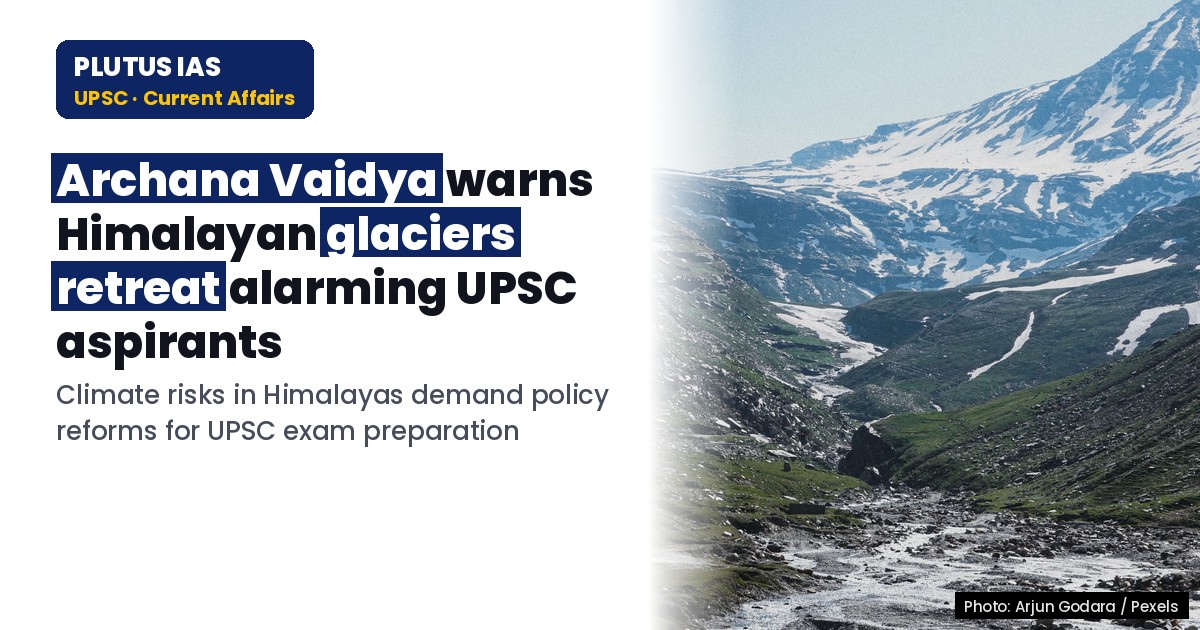
13 Oct Himalayan Warming Threatens UPSC: Climate Risks & Policy Reforms Needed
✎ Permafrost thaw and glacial retreat in the Himalayas are amplifying disaster risks by destabilising slopes, increasing landslides, and threatening water security, necessitating climate-resilient development policies.
Subject Relevance — Where This Topic Fits
- GS Paper I — Geography (Physical Geography of India, Climate Change and Associated Disasters) | GS Paper III — Environment and Disaster Management (Climate Change Mitigation, Sustainable Development, Disaster Risk Reduction)
- Prelims: Himalayan glacier retreat, Permafrost thaw, Supraglacial lakes, Moulins, Subglacial and englacial drainage, Hindu Kush Himalaya (HKH), Disaster risk amplification, Climate change vulnerability of mountain ecosystems, Geological cementing role of permafrost, IPCC AR6 findings on high-mountain warming
- Essay: Climate change as a multiplier of existing vulnerabilities in fragile ecosystems, Balancing development imperatives with ecological sustainability in the Himalayas
Quick Revision: Permafrost thaw and glacial retreat in the Himalayas are amplifying disaster risks by destabilising slopes, increasing landslides, and threatening water security, necessitating climate-resilient development policies.
Why is this in the news?
Recent scientific assessments and catastrophic events in the Himalayan region highlight the accelerating impacts of climate change on glacial and permafrost systems, which are destabilising mountain slopes and amplifying disaster risks. These developments necessitate a re-evaluation of developmental approaches in the Indian Himalayan Region (IHR) to ensure climate resilience and hazard mitigation.
Background
- The Himalayas, extending over 3,500 km across eight countries, are often referred to as the ‘Third Pole’ due to their vast freshwater reserves stored in glaciers and snow.
- The International Centre for Integrated Mountain Development (ICIMOD) reported in March 2026 that ice-loss rates in the Hindu Kush Himalaya (HKH) have doubled since 2000, with significant implications for water security and ecosystem stability.
- Glacial retreat and permafrost thaw are altering the mechanical stability of mountain slopes, increasing the frequency and intensity of landslides, rockfalls, and debris flows.
- The Himalayas are home to over 50 million people and support critical biodiversity hotspots, making their ecological stability essential for regional livelihoods and downstream water security.
- Historically, developmental activities in the IHR have prioritised economic growth over environmental sustainability, often overlooking geological and climatic risks.
What is the geological and climatic context of the Himalayan instability?
- The Himalayas are a young, tectonically active mountain range formed by the collision of the Indian and Eurasian plates, characterised by steep slopes, deep valleys, and fragile geological structures.
- Glaciers in the Himalayas act as natural reservoirs, storing water in the form of ice and releasing it gradually through meltwater, which is critical for river systems like the Ganga, Brahmaputra, and Indus.
- Permafrost, a layer of soil or rock that remains frozen for at least two consecutive years, acts as a ‘geological cement’ by binding rock fragments and stabilising steep slopes in high-altitude regions.
- Rising temperatures are causing permafrost to thaw, reducing its binding capacity and increasing the likelihood of rock avalanches, landslides, and debris flows, particularly during extreme weather events.
- Glacial retreat is driven by shifts in the balance between winter snow accumulation and summer melt, with meltwater pooling in supraglacial lakes and carving moulins—vertical shafts that transport water to the glacier bed.
- Subglacial and englacial drainage systems generate mechanical stresses that fracture glaciers, accelerating their movement and increasing the risk of glacial lake outburst floods (GLOFs).
- The western Himalayas are warming faster than the central and eastern stretches, with night-time minimum and winter temperatures rising most rapidly, exacerbating seasonal instability.
- The Hindu Kush Himalaya (HKH) region is a global biodiversity hotspot and a critical water tower for South Asia, supporting the livelihoods of millions and the ecological integrity of downstream ecosystems.
Key Features
| Feature | Significance |
|---|---|
| Glacier Retreat | Accelerated melting due to rising temperatures reduces freshwater storage, alters river regimes, and increases glacial lake outburst flood (GLOF) risks. |
| Permafrost Thaw | Loss of permafrost as geological ‘cement’ destabilises mountain slopes, triggering rock avalanches, landslides, and debris flows. |
| Supraglacial Lakes & Moulins | Surface meltwater pools and vertical shafts accelerate glacier sliding by lubricating the ice-bedrock interface, enhancing fracture propagation. |
| Non-Uniform Warming | Western Himalaya exhibits faster warming than central/eastern stretches, with night-time minima and winter temperatures rising disproportionately. |
| Disaster Frequency Increase | Climate-induced hazards such as floods, landslides, and GLOFs have become more frequent and severe, disrupting livelihoods and infrastructure. |
Why it Matters
Environmental Security
- Glacier and permafrost degradation threatens biodiversity hotspots in the Himalayas, including endemic flora and fauna adapted to cold climates.
- Altered hydrological cycles disrupt downstream ecosystems, particularly in the Ganga-Brahmaputra-Meghna basin, affecting wetlands, floodplains, and deltaic regions.
- Increased sediment load from landslides and debris flows accelerates siltation in reservoirs, reducing hydroelectric generation capacity and water storage efficiency.
Human Security & Livelihoods
- Agricultural productivity in Himalayan valleys and foothills is jeopardised by erratic precipitation, reduced snowmelt, and soil degradation from landslides.
- Tourism-dependent economies face heightened risks from climate-induced hazards, including road closures, infrastructure damage, and loss of life.
- Indigenous communities, particularly in the Hindu Kush Himalaya, face displacement due to glacier lake outbursts and loss of traditional agricultural practices.
Strategic & Geopolitical
- Transboundary water security is compromised as glacier-fed rivers (e.g., Indus, Ganga, Brahmaputra) become more unpredictable, straining diplomatic relations.
- Military logistics and border infrastructure in high-altitude regions are increasingly vulnerable to landslides, avalanches, and road disruptions.
- Climate-induced migration from Himalayan regions may exacerbate socio-economic pressures in downstream states and neighbouring countries.
Economic Implications
- Infrastructure projects (roads, hydropower dams, tunnels) face escalating costs due to climate-proofing requirements and higher maintenance due to increased hazard exposure.
- Insurance premiums for development projects in the IHR are rising due to elevated risk profiles, impacting investment viability.
- Loss of ecosystem services (water purification, flood regulation, carbon sequestration) imposes long-term economic burdens on regional and national economies.
Challenges
1. Climate-Proofing Infrastructure
- Existing infrastructure in the IHR was designed under historical climate assumptions and requires retrofitting to withstand increased frequency of extreme events.
- High-altitude construction faces technical challenges due to permafrost thaw, unstable slopes, and limited access to materials and labour.
- Cost-benefit analyses for climate adaptation must incorporate long-term risk reduction rather than short-term economic gains.
UPSC Link: GS3: Disaster Management
2. Data Gaps & Monitoring
- Limited long-term, high-resolution climate and glacier data for the IHR hinders accurate risk assessment and policy formulation.
- Real-time monitoring systems for glacier lakes, permafrost, and landslides are underdeveloped, delaying early warning dissemination.
- Cross-border data sharing and collaborative research between Himalayan countries remain insufficient for comprehensive risk management.
UPSC Link: GS3: Science & Technology
3. Policy Coordination
- Development policies for the IHR are often sectoral (e.g., hydropower, tourism, agriculture) and lack integration with climate adaptation frameworks.
- State and central government policies frequently conflict, particularly in land-use planning, forest conservation, and infrastructure approvals.
- Local governance structures are ill-equipped to address climate-induced risks, with limited technical and financial capacity for adaptation.
UPSC Link: GS2: Federalism
4. Economic Viability of Adaptation
- High upfront costs of climate-proofing infrastructure deter private investment, necessitating public-private partnerships and innovative financing mechanisms.
- Subsidies and incentives for climate-resilient agriculture or tourism may distort markets without ensuring equitable benefits across communities.
- Loss and Damage mechanisms (e.g., international compensation) are politically contentious and lack clear implementation pathways.
UPSC Link: GS3: Economic Development
5. Legal & Institutional Frameworks
- Existing environmental laws (e.g., EIA Notification 2006) are inadequate for addressing climate-induced risks in dynamic mountain ecosystems.
- Institutional mandates for disaster risk reduction (NDMA, SDMAs) are often siloed, with limited integration of climate science into planning.
- Enforcement of environmental safeguards is weak due to capacity constraints, corruption, and political interference.
UPSC Link: GS2: Governance
Challenges — UPSC Perspective
| Issue | Concern |
|---|---|
| Glacial Lake Outburst Floods (GLOFs) | Sudden release of water from glacial lakes can cause catastrophic downstream flooding, destroying infrastructure and habitats. |
| Permafrost Degradation | Thawing permafrost destabilises slopes, leading to landslides and rockfalls that threaten settlements and transportation corridors. |
| Erratic Monsoon Patterns | Changing precipitation regimes disrupt traditional agricultural cycles and increase the frequency of flash floods. |
| Biodiversity Loss | Temperature-sensitive species face habitat loss, while invasive species proliferate, altering ecosystem dynamics. |
| Water Scarcity | Reduced glacier melt and altered precipitation patterns threaten water security for millions dependent on Himalayan rivers. |
Way Forward
- Integrate climate risk assessments into all infrastructure projects in the IHR, including retrofitting of existing assets, with mandatory multi-hazard vulnerability mapping.
- Strengthen transboundary collaboration under frameworks like the Indus Waters Treaty and regional bodies (ICIMOD) for data sharing, joint monitoring, and adaptation planning.
- Establish a dedicated Himalayan Climate Adaptation Fund to finance localised, community-driven resilience projects, including ecosystem-based solutions.
- Enhance real-time monitoring networks for glaciers, permafrost, and landslides, leveraging remote sensing, AI, and citizen science for early warning systems.
- Revise environmental impact assessment norms to incorporate climate change projections, with stricter enforcement and third-party audits.
- Promote climate-resilient agriculture through crop diversification, water-efficient irrigation, and insurance schemes tailored to Himalayan conditions.
- Develop standardised protocols for disaster risk reduction in high-altitude regions, including evacuation planning, infrastructure design codes, and post-disaster recovery frameworks.
UPSC Value Addition
Keywords for Mains Answer-Writing
Indian Himalayan Region (IHR) · climate-induced disasters · glacial retreat · permafrost thaw · Hindu Kush Himalaya (HKH) · disaster risk reduction · climate-resilient infrastructure · mountain ecosystem stability · water security · sustainable development · IPCC findings on Himalayan warming · ICIMOD reports · geological hazards in Himalayas · Himalayan geo-tectonics · adaptation strategies for mountain regions
Constitutional & Policy Linkages
- Article 21 (Right to Life) – Protection from climate-induced hazards as part of fundamental rights.
- Article 48A (Directive Principles) – Duty of the State to protect and improve the environment.
- Article 51A(g) (Fundamental Duties) – Duty of citizens to protect the natural environment.
Concept Flow
Rising global temperatures → Accelerated warming in the Himalayas (0.3°C/decade) → Increased glacier melt and permafrost thaw → Destabilisation of slopes and glacier dynamics → Formation of supraglacial lakes and moulins → Enhanced glacier sliding and fracture propagation → Increased frequency of landslides, avalanches, and GLOFs → Disruption of river regimes and ecosystems → Threats to water security, livelihoods, and infrastructure → Heightened disaster risks and socio-economic vulnerabilities.
Prelims Practice Questions
Q1. Consider the following statements regarding the Indian Himalayan Region (IHR):
1. The warming rate in the IHR is nearly twice the global average.
2. Permafrost acts as geological cement in the Himalayas by filling fractures and joints with solid ice.
3. The Hindu Kush Himalaya (HKH) region has experienced a doubling of ice-loss rates since 2000.
4. Night-time minimum temperatures in the western Himalaya are rising at a slower rate than day-time temperatures.
How many of the above statements are correct?
- Only one
- Only two
- Only three
- All
Answer: Only three — Statements 1, 2, and 3 are correct. Statement 4 is incorrect as night-time minimum and winter temperatures in the western Himalaya are rising at the most extreme rates, not slower.
Q2. Assertion (A): The retreat of glaciers in the Himalayas increases the risk of glacial lake outburst floods (GLOFs).
Reason (R): Glacier retreat leads to the formation of supraglacial lakes that may breach and release large volumes of water suddenly.
Options:
A. Both A and R are true, and R is the correct explanation of A.
B. Both A and R are true, but R is not the correct explanation of A.
C. A is true, but R is false.
D. A is false, but R is true.
Answer: ? — Both A and R are true, and R correctly explains A. Glacier retreat contributes to supraglacial lake formation, which can lead to GLOFs.
Q3. Match the following pairs related to geological and climatic processes in the Himalayas:
Column I (Process) | Column II (Impact)
———————————————|———————————————
1. Permafrost thaw | A. Increased rock avalanches and landslides
2. Glacier retreat | B. Formation of supraglacial lakes
3. Subglacial water channels | C. Lubrication of glacier beds
4. Englacial water channels | D. Mechanical fracturing of glacier ice
Options:
A. 1-A, 2-B, 3-C, 4-D
B. 1-B, 2-A, 3-D, 4-C
C. 1-C, 2-D, 3-A, 4-B
D. 1-D, 2-C, 3-B, 4-A
Answer: ? — Correct matches: 1-A (Permafrost thaw leads to rock avalanches), 2-B (Glacier retreat forms supraglacial lakes), 3-C (Subglacial water channels lubricate glacier beds), 4-D (Englacial water channels cause mechanical fracturing).
Mains Practice Question
✍ The Himalayas, often described as the ‘Third Pole’, are undergoing rapid climatic and geological transformations that threaten ecological stability and human security. Critically analyse the implications of glacial retreat and permafrost thaw in the Indian Himalayan Region (IHR) for disaster risk reduction and sustainable development. Also, outline the institutional and policy measures required to mitigate these risks. (15 Marks)
Approach: MODEL-ANSWER SKELETON:
1. **Introduction (2 Marks)**
– Briefly define the Indian Himalayan Region (IHR) and its ecological significance.
– State the primary climatic and geological changes: glacial retreat, permafrost thaw, and their drivers (IPCC and ICIMOD findings).
– Highlight the existential crisis posed by these changes (e.g., Nepal floods of August 2026 as a case study).
2. **Implications for Disaster Risk Reduction (5 Marks)**
– **Glacial Retreat**: Explain mechanisms (supraglacial lakes, moulins, subglacial/englacial water channels) and their role in increasing GLOFs, landslides, and debris flows.
– **Permafrost Thaw**: Describe how it destabilises mountain slopes, leading to rock avalanches and infrastructure collapse.
– **Cascading Risks**: Discuss threats to water security, livelihoods, and ecosystems (e.g., hydrological disruptions, loss of biodiversity).
– **Geological Hazards**: Link to increased seismic activity (e.g., USGS recorded event during Nepal floods) and geo-tectonic instability.
3. **Sustainable Development Challenges (4 Marks)**
– **Infrastructure Vulnerability**: Critique current development models in the IHR (e.g., hydropower projects, road networks) in light of geological instability.
– **Water Security**: Analyse the impact on seasonal water availability and long-term sustainability of Himalayan rivers.
– **Livelihoods and Migration**: Discuss the socio-economic consequences for mountain communities dependent on agriculture, tourism, and traditional practices.
4. **Institutional and Policy Measures (4 Marks)**
– **National Frameworks**: Reference the National Disaster Management Authority (NDMA) guidelines, National Mission for Sustaining the Himalayan Ecosystem (NMSHE), and the National Action Plan on Climate Change (NAPCC).
– **International Collaborations**: Highlight the role of ICIMOD, IPCC, and WMO in monitoring and knowledge dissemination.
– **Local Governance**: Emphasise the need for community-based disaster risk reduction (CBDRR) and participatory planning.
– **Technological Interventions**: Discuss early warning systems, remote sensing, and glacial lake monitoring (e.g., ISRO’s satellite data).
– **Legal and Regulatory Gaps**: Identify the absence of a dedicated Himalayan-specific disaster management framework and the need for stricter environmental impact assessments (EIAs).
5. **Conclusion (2 Marks)**
– Summarise the urgency of rethinking development paradigms in the IHR.
– Stress the integration of climate resilience, geological stability, and sustainable livelihoods in policy and practice.
– Conclude with a balanced view: while challenges are immense, proactive measures can mitigate risks and ensure long-term ecological and human security.
Source: The Hindu
Generated by AanyaAi for educational purpose.
Related guides on our sites
- Current affairs for upsc 2026
- How to prepare for GS paper 1 for UPSC CSE mains exam
- Best UPSC coaching for IFOS exam
- Best geography optional coaching

- आरबीआई द्वारा 91, 182 और 364 दिनीय ट्रेजरी बिलों की नीलामी: प्रमुख तथ्य - November 7, 2026
- Shram Samvad: Capacity Building on Labour Codes in Ujjain - November 7, 2026
- पटना में ठोस अपशिष्ट प्रबंधन: नगर निगम की नई योजना - November 7, 2026

No Comments