


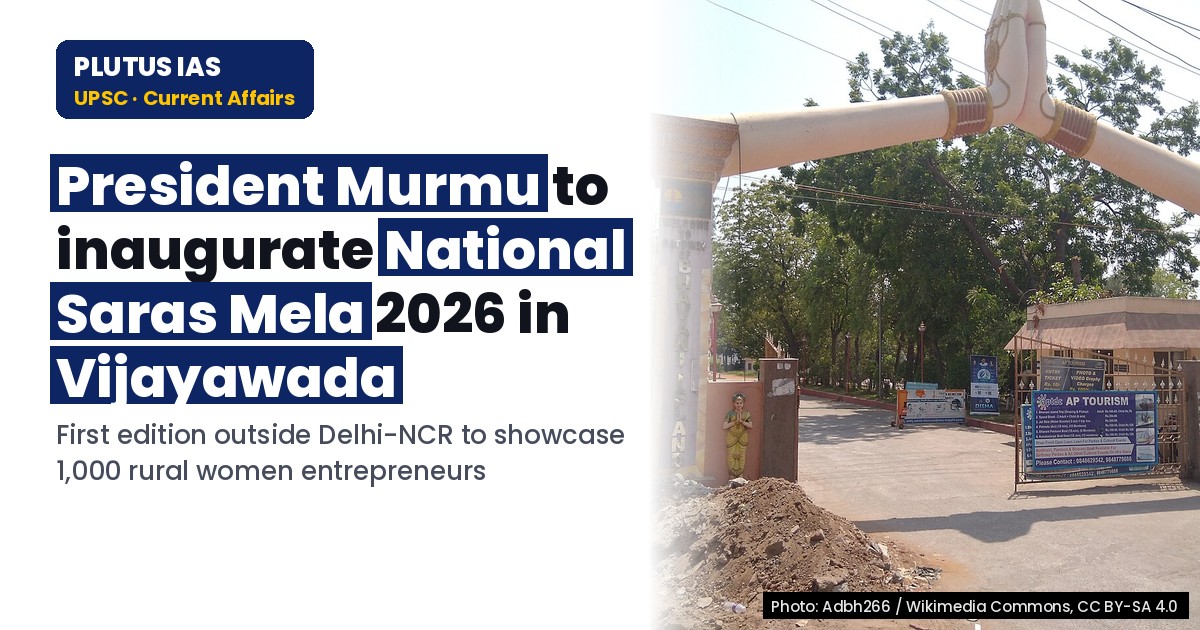
15 Oct National Saras Mela 2026: First Edition Outside Delhi-NCR in Vijayawada on Oct 15
✎ The National Saras Livelihood Fair 2026 is a decentralised platform under DAY-NRLM to scale rural women’s entrepreneurship, integrating SHG networks, e-commerce, and skill demonstrations to achieve the ‘Lakhpati Didi’ target of 6…
Subject Relevance — Where This Topic Fits
- GS Paper II — Government Policies and Interventions for Development in various sectors and issues arising out of their design and implementation | GS Paper III — Issues relating to Development and Management of Social Sector/Services relating to Health, Education, Human Resources | GS Paper III — Food Processing and Related Industries; Scope and Significance, Supply Chain Management
- Prelims: DAY-NRLM, SERP (Andhra Pradesh State Rural Livelihoods Mission), Lakhpati Didi initiative, Deendayal Antyodaya Yojana-National Rural Livelihoods Mission, Vocal for Local, Self-Help Groups (SHGs), E-commerce integration for rural artisans
- Essay: Role of decentralisation in inclusive growth, Women-led development as a pathway to national prosperity
Quick Revision: The National Saras Livelihood Fair 2026 is a decentralised platform under DAY-NRLM to scale rural women’s entrepreneurship, integrating SHG networks, e-commerce, and skill demonstrations to achieve the ‘Lakhpati Didi’ target of 6 crore beneficiaries.
Why is this in the news?
The National Saras Livelihood Fair 2026, being organised for the first time outside Delhi-NCR in Vijayawada, Andhra Pradesh, on 15 October 2026, marks a significant institutional step towards decentralising flagship rural livelihood programmes. The event, inaugurated by the President of India, underscores the convergence of constitutional directives on gender equality (Article 15(3)), Directive Principles of State Policy (Article 38, 41, 43, 46), and the Union Government’s ‘Vocal for Local’ and ‘Atmanirbhar Bharat’ initiatives. It also exemplifies the operationalisation of DAY-NRLM’s goal to create 6 crore ‘Lakhpati Didis’ by leveraging SHG networks, e-commerce platforms, and skill demonstrations across 34 states and UTs.
Background
- The Deendayal Antyodaya Yojana-National Rural Livelihoods Mission (DAY-NRLM), launched in 2011, is a centrally sponsored scheme under the Ministry of Rural Development aimed at reducing poverty by enabling rural poor households to access gainful self-employment and skilled wage employment opportunities.
- Andhra Pradesh’s State Rural Livelihoods Mission (SERP), operational since 2000, has been a pioneer in SHG-based livelihood interventions, particularly in the dairy, handloom, and food processing sectors.
- The ‘Lakhpati Didi’ initiative, announced in 2023, is a sub-mission under DAY-NRLM targeting the creation of 6 crore women entrepreneurs with annual incomes exceeding ₹1 lakh through skill upgradation, market linkages, and financial inclusion.
- ‘Vocal for Local’ and ‘Atmanirbhar Bharat’ are policy frameworks emphasising domestic production, local value addition, and global competitiveness, with a strong focus on grassroots entrepreneurship.
- Prior to 2026, the National Saras Livelihood Fair had been an annual event exclusively held in Delhi-NCR, serving as a national platform for SHG products but limited in geographical outreach.
What is the National Saras Livelihood Fair 2026?
- The National Saras Livelihood Fair is a flagship event organised under DAY-NRLM to showcase the products and enterprises of rural women entrepreneurs affiliated with SHGs across India.
- Scheduled for 15 October 2026 in Vijayawada, Andhra Pradesh, it is the first edition to be held outside Delhi-NCR, aligning with the Union Government’s decentralisation agenda for rural livelihood programmes.
- The fair will feature over 650 stalls displaying traditional handicrafts, handlooms, organic produce, and food items from 34 states and UTs, curated by approximately 1,000 ‘Lakhpati Didis’—women entrepreneurs earning ₹1 lakh or more annually.
- A thematic India Food Court will showcase live culinary demonstrations by 200+ women chefs from 28 states, preparing region-specific cuisines using indigenous spices, thereby promoting culinary tourism and gastronomic heritage.
- The event will include knowledge pavilions on packaging, branding, and e-commerce integration, with expert sessions conducted by Amazon, Flipkart, NABARD, and industry associations to enhance market access for rural artisans.
- Live demonstrations of traditional crafts such as pottery, embroidery, and weaving will be conducted, alongside convergence pavilions highlighting synergies between DAY-NRLM, SERP, and other livelihood schemes.
- The ‘Lakhpati Didi Compendium’ and ‘Saras Shakti Application’—digital tools designed to track SHG enterprises, market linkages, and skill training—will be launched during the inauguration by the President of India.
- The fair embodies the constitutional principle of gender equality (Article 15(3)) and the Directive Principles of State Policy (Articles 38, 41, 43, 46) by institutionalising women-led economic empowerment through decentralised governance.
Key Features
| Feature | Significance |
|---|---|
| Hosting outside Delhi-NCR (Vijayawada, Krishna River banks) | Demonstrates decentralisation of national events, aligning with the vision of inclusive growth and grassroots empowerment beyond metropolitan hubs. |
| 1,000+ ‘Lakhpati Didi’ women entrepreneurs from 34 states/UTs | Showcases pan-India rural economic participation, highlighting the success of DAY-NRLM and state-level initiatives like AP-SERP in fostering women-led enterprises. |
| 650+ stalls with handloom, handicraft, organic products | Provides a platform for traditional livelihoods, promoting ‘Vocal for Local’ and integrating informal rural economies with formal markets. |
| India Food Court with 200+ women chefs | Preserves culinary heritage while creating market linkages for women in the food-processing sector, a key component of rural agro-based livelihoods. |
| ‘Saras Shakti’ app and ‘Lakhpati Didi Compendium’ launch | Leverages digital tools to document and scale successful models of rural entrepreneurship, ensuring knowledge dissemination and policy replication. |
| Live demonstrations (pottery, embroidery, packaging) | Bridges skill gaps by providing hands-on training in value addition, branding, and e-commerce, critical for transitioning from subsistence to market-oriented production. |
Why it Matters
Economic Empowerment
- Accelerates the realisation of the ‘Lakhpati Didi’ target (6 crore women) by creating market access, training, and financial linkages for rural women entrepreneurs.
- Enhances rural non-farm income through integration with e-commerce platforms (Amazon, Flipkart) and formal supply chains.
- Strengthens the ‘Vocal for Local’ initiative by promoting indigenous products and reducing dependency on imports in niche sectors like handloom and handicraft.
Social Inclusion
- Amplifies the voices of marginalised women from tribal, SC/ST, and minority communities by providing a national platform for their products and stories.
- Fosters inter-state cultural exchange through culinary, textile, and craft showcases, reinforcing national integration.
- Encourages inter-generational knowledge transfer by featuring live demonstrations of traditional skills alongside modern entrepreneurship training.
Policy Implementation
- Serves as a high-visibility outcome of the Deendayal Antyodaya Yojana-National Rural Livelihoods Mission (DAY-NRLM), demonstrating its impact on women-led economic transformation.
- Aligns with the National Mission for Sustainable Agriculture (NMSA) by promoting organic and agro-based products, contributing to climate-resilient livelihoods.
- Demonstrates the Centre-State convergence model, with AP-SERP (State Rural Livelihoods Mission) collaborating with DAY-NRLM to scale best practices.
Institutional Synergy
- Bridges the gap between rural producers and urban consumers through curated stalls and digital platforms, reducing transaction costs.
- Facilitates partnerships between women SHGs, cooperatives, and private enterprises (e.g., NABARD, e-commerce firms) for sustainable value chains.
- Provides a feedback loop for policymakers to assess the efficacy of livelihood schemes and design targeted interventions.
Challenges
1. Market Access and Competition
- Rural women face barriers in scaling production due to limited access to formal markets, branding, and pricing power against mass-produced goods.
- E-commerce platforms, while beneficial, often impose high commission fees, reducing net earnings for small producers.
- Lack of standardised quality control and certification hampers entry into premium retail chains and export markets.
UPSC Link: GS-III: Rural Development & MSMEs
2. Skill Gaps and Technology Adoption
- Limited exposure to modern entrepreneurship tools (e.g., digital marketing, supply chain management) constrains growth beyond localised markets.
- Traditional artisans often lack training in product diversification, packaging, and compliance with safety/quality standards (e.g., FSSAI for food products).
- Digital divide persists, with many women entrepreneurs lacking access to smartphones or internet connectivity for e-commerce participation.
UPSC Link: GS-II: Skill Development & Entrepreneurship
3. Financial Inclusion and Credit Constraints
- Despite schemes like PMMY (Pradhan Mantri Mudra Yojana), women-led enterprises struggle to secure collateral-free loans for scaling operations.
- High interest rates and complex documentation deter uptake of formal credit, pushing entrepreneurs towards informal lenders.
- Limited awareness of government schemes (e.g., Stand-Up India, Stand-Up Mitra) among rural women limits access to institutional finance.
UPSC Link: GS-III: Financial Inclusion & Banking
4. Logistics and Infrastructure Bottlenecks
- Poor last-mile connectivity in rural areas increases transportation costs, reducing profitability for small-scale producers.
- Lack of cold storage and processing facilities in hinterlands leads to post-harvest losses, particularly for perishable agro-products.
- Inadequate storage infrastructure at event venues can compromise product quality during multi-day exhibitions.
UPSC Link: GS-III: Infrastructure & Logistics
5. Sustainability and Scalability
- Many women-led enterprises operate in isolation, lacking networks to share best practices or aggregate demand for bulk orders.
- Over-reliance on seasonal products (e.g., festivals, weddings) creates income volatility, necessitating diversification strategies.
- Climate change impacts (e.g., erratic rainfall, soil degradation) threaten raw material availability for traditional crafts and agro-based livelihoods.
UPSC Link: GS-III: Sustainable Development & Climate Change
Challenges — UPSC Perspective
| Issue | Concern |
|---|---|
| Limited access to formal markets | Dependence on middlemen reduces profit margins and market reach for rural women. |
| Digital literacy gaps | Low smartphone penetration and internet access hinder adoption of e-commerce and digital payment systems. |
| High collateral requirements for loans | Women entrepreneurs often lack assets for securing bank credit, limiting business expansion. |
| Post-harvest losses | Inadequate storage and processing facilities lead to spoilage of perishable goods like organic produce. |
| Standardisation and certification hurdles | Lack of FSSAI, GI tags, or ISO certifications restricts entry into premium retail chains. |
| Seasonal income volatility | Dependence on festivals or local demand creates cash-flow challenges for sustained operations. |
Government Initiatives — Must-Memorise for Prelims
- Deendayal Antyodaya Yojana-National Rural Livelihoods Mission (DAY-NRLM)
- State Rural Livelihoods Mission (SRLM) – Andhra Pradesh SERP
- Stand-Up India Scheme
- Pradhan Mantri Mudra Yojana (PMMY)
- National Mission for Sustainable Agriculture (NMSA)
Way Forward
- Strengthen last-mile connectivity and cold chain infrastructure in rural areas to reduce post-harvest losses and improve market access.
- Expand digital literacy programmes (e.g., Common Service Centres, PMGDISHA) to enhance e-commerce participation among women entrepreneurs.
- Simplify loan application processes under PMMY and Stand-Up India, with dedicated helplines for women-led enterprises.
- Promote aggregation models (e.g., FPOs, cooperatives) to enable bulk procurement, branding, and collective bargaining for rural women.
- Institutionalise knowledge-sharing platforms (e.g., ‘Saras Shakti’ app) to document and replicate successful case studies across states.
- Integrate climate-resilient practices (e.g., organic farming, water-efficient crafts) into livelihood schemes to mitigate environmental risks.
- Encourage corporate social responsibility (CSR) partnerships with e-commerce firms and retail chains for sustained market linkages.
- Conduct periodic impact assessments of DAY-NRLM and SRLMs to identify gaps and tailor interventions for marginalised groups.
UPSC Value Addition
Keywords for Mains Answer-Writing
Deendayal Antyodaya Yojana-National Rural Livelihood Mission (DAY-NRLM) · Lakhpati Didi initiative · Women empowerment through SHGs · Vocal for Local and Atmanirbhar Bharat · SERP Andhra Pradesh · National Saras Livelihood Fair 2026 · President of India’s role in public events · Rural entrepreneurship and skill demonstration · E-commerce integration for rural artisans · Convergence pavilion in national fairs · Grassroots economic empowerment · Ministry of Rural Development initiatives · Self-help groups (SHGs) and livelihood promotion · Decentralisation of national events · Indigenous handicrafts and organic products
Concept Flow
National Rural Livelihoods Mission (DAY-NRLM) empowers women through Self-Help Groups (SHGs) and federations. → State-level missions (e.g., AP-SERP) implement DAY-NRLM with contextualised strategies for local livelihoods. → Women entrepreneurs gain skills in traditional crafts, agro-processing, and digital marketing through training programmes. → DAY-NRLM and SRLMs facilitate market linkages via national events (e.g., Saras Melas) and e-commerce platforms. → Income diversification and scaling of operations improve financial independence and social status of rural women. → Policy feedback loop informs scheme modifications, ensuring alignment with ground realities and aspirational targets (e.g., ‘Lakhpati Didi’).
Prelims Practice Questions
Q1. Consider the following statements about the Deendayal Antyodaya Yojana-National Rural Livelihood Mission (DAY-NRLM):
1. It is a centrally sponsored scheme aimed at promoting self-employment and poverty reduction through formation and strengthening of self-help groups (SHGs).
2. The scheme is implemented by the Ministry of Rural Development, Government of India.
3. One of its key objectives is to promote rural women entrepreneurship by providing them with skill training and access to markets.
4. The scheme exclusively targets urban women entrepreneurs.
How many of the above statements are correct?
- Only one
- Only two
- Only three
- All four
Answer: Only three — Statements 1, 2, and 3 are correct as DAY-NRLM is a centrally sponsored scheme under the Ministry of Rural Development, aimed at rural poverty reduction and women empowerment through SHGs. Statement 4 is incorrect as the scheme targets rural women, not urban entrepreneurs.
Q2. Assertion (A): The National Saras Livelihood Fair 2026 is being organised outside Delhi-NCR for the first time, with the President of India inaugurating the event.
Reason (R): The initiative aligns with the government’s vision of decentralising national events to promote grassroots economic empowerment and women entrepreneurship in different regions of the country.
In the context of the above two statements, which one of the following is correct?
- Both A and R are true, and R is the correct explanation of A
- Both A and R are true, but R is not the correct explanation of A
- A is true, but R is false
- A is false, but R is true
Answer: Both A and R are true, and R is the correct explanation of A — Both Assertion (A) and Reason (R) are true. The National Saras Livelihood Fair 2026 is indeed being organised outside Delhi-NCR for the first time, and the President of India is inaugurating it. The Reason (R) correctly explains the rationale behind decentralising such national events to promote grassroots empowerment.
Q3. Match the following initiatives with their respective ministries/departments:
Column I (Initiative) | Column II (Ministry/Department)
———————|—————————
1. Deendayal Antyodaya Yojana-National Rural Livelihood Mission (DAY-NRLM) | A. Ministry of Women and Child Development
2. SERP (Society for Elimination of Rural Poverty) | B. Ministry of Rural Development
3. Stand-Up India Scheme | C. Ministry of Micro, Small and Medium Enterprises
4. National Rural Livelihood Mission (NRLM) | D. Ministry of Rural Development
Choose the correct match:
- 1-B, 2-D, 3-C, 4-B; 1-A, 2-B, 3-C, 4-D; 1-B, 2-A, 3-C, 4-D; 1-D, 2-B, 3-A, 4-C
- answer_explain_match_pairs_listed_here
- answer_explain_match_pairs_listed_here
Answer: 1-B, 2-D, 3-C, 4-B; 1-A, 2-B, 3-C, 4-D; 1-B, 2-A, 3-C, 4-D; 1-D, 2-B, 3-A, 4-C — 1-B: DAY-NRLM is implemented by the Ministry of Rural Development. 2-D: SERP is an initiative of the Government of Andhra Pradesh, but it collaborates closely with the Ministry of Rural Development for DAY-NRLM. 3-C: Stand-Up India Scheme is under the Ministry of Micro, Small and Medium Enterprises. 4-B: NRLM is also under the Ministry of Rural Development.
Mains Practice Question
✍ The National Saras Livelihood Fair 2026 represents a significant step towards decentralising national events and promoting grassroots economic empowerment. In this context, critically examine the role of self-help groups (SHGs) in achieving the objectives of the Deendayal Antyodaya Yojana-National Rural Livelihood Mission (DAY-NRLM). Also, discuss how such initiatives contribute to the broader goals of ‘Vocal for Local’ and ‘Atmanirbhar Bharat’. (15 Marks)
Approach: MODEL-ANSWER SKELETON:
1. Introduction (2 marks):
– Briefly define SHGs and DAY-NRLM, citing the Ministry of Rural Development as the nodal agency.
– Mention the National Saras Livelihood Fair 2026 as a contemporary example of decentralisation and grassroots empowerment.
2. Role of SHGs in DAY-NRLM (5 marks):
– Formation and strengthening of SHGs as the core strategy for poverty alleviation and women empowerment.
– Financial inclusion through SHG-Bank Linkage Programme and access to credit.
– Skill development, capacity building, and market linkages for rural artisans and entrepreneurs.
– Cite the ‘Lakhpati Didi’ initiative as a specific outcome of SHG-led economic empowerment.
– Reference the collaboration with state-level agencies like SERP in Andhra Pradesh.
3. Contribution to ‘Vocal for Local’ and ‘Atmanirbhar Bharat’ (5 marks):
– Promotion of indigenous handicrafts, organic products, and traditional skills, aligning with ‘Vocal for Local’.
– Reduction of dependency on external markets and fostering local value chains.
– Integration of e-commerce platforms (e.g., Amazon, Flipkart) and training in packaging, branding, and digital marketing.
– Decentralisation of national events to showcase regional diversity and talent, as seen in the National Saras Livelihood Fair.
4. Challenges and Way Forward (3 marks):
– Address issues such as limited access to technology, market competition, and sustainability of SHGs.
– Suggest measures like continued government support, public-private partnerships, and policy interventions to strengthen SHGs.
– Conclude with the significance of such initiatives in achieving inclusive and sustainable development.
Source: PIB (Press Information Bureau)
Andhra Pradesh PCS (APPSC) — State PCS Practice
Prelims: Which of the following initiatives, launched by Union Minister Shri Shivraj Singh Chouhan, was organized for the first time outside Delhi-NCR in Vijayawada, Andhra Pradesh?
- A. National Saras Fair
- B. National Handloom Expo
- C. National Tribal Crafts Mela
- D. National Rural Livelihoods Fair
Answer: A. National Saras Fair — The ‘National Saras Fair’ was organized for the first time outside Delhi-NCR in Vijayawada, Andhra Pradesh, on 15th October, inaugurated by President Smt. Droupadi Murmu.
Mains: Discuss the significance of organizing the ‘National Saras Fair’ in Vijayawada, Andhra Pradesh, highlighting its potential socio-economic impact on the region and the state’s cultural heritage.
Generated by AanyaAi for educational purpose.

- India-Australia AUSTRAHIND 2026 Exercise: Key Highlights for UPSC & State PCS - October 22, 2026
- एससीओ बैठक में भारत का आतंकवाद विरोध: क्षेत्रीय सहयोग पर जोर - October 22, 2026
- SEC Directs Strict SC Order Compliance for Andhra ULB Polls - October 22, 2026

No Comments