


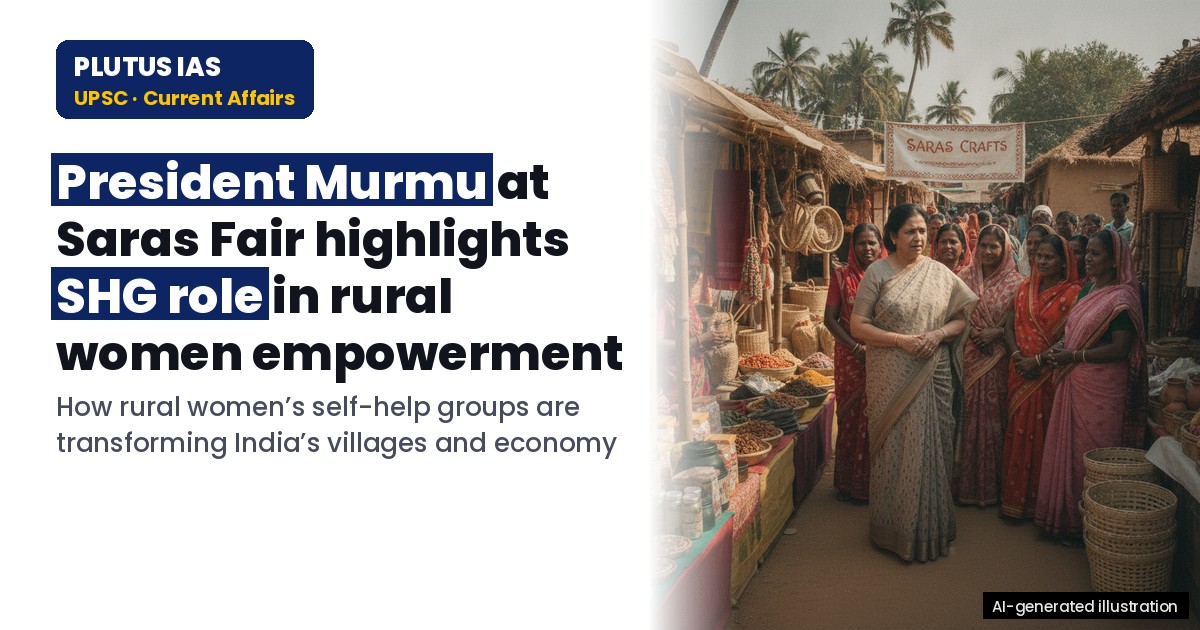
16 Oct UPSC Focus: President at National Saras Fair on Rural Women Empowerment
✎ Self Help Groups (SHGs) under DAY-NRLM are transforming rural women from beneficiaries to wealth creators, with the National Saras Mela serving as a critical platform for market access, skill enhancement, and inclusive…
Subject Relevance — Where This Topic Fits
- GS Paper II — Governance, Social Justice and Welfare | GS Paper III — Agriculture, Rural Development and Women Empowerment
- Prelims: Self Help Groups (SHGs), Deendayal Antyodaya Yojana-National Rural Livelihoods Mission (DAY-NRLM), Lakhpati Didi initiative, Saras Mela, Rural Entrepreneurship, Women’s Economic Participation
- Essay: Women-led development as a catalyst for inclusive growth, Role of grassroots institutions in achieving Sustainable Development Goals
Quick Revision: Self Help Groups (SHGs) under DAY-NRLM are transforming rural women from beneficiaries to wealth creators, with the National Saras Mela serving as a critical platform for market access, skill enhancement, and inclusive development.
Why is this in the news?
The President of India, Smt. Droupadi Murmu, attended the National Saras Mela 2026 in Vijayawada, Andhra Pradesh, highlighting the pivotal role of Self Help Groups (SHGs) and rural women in fostering inclusive economic growth. The event underscored the transformation of rural women from beneficiaries to wealth creators, aligning with the government’s vision of ‘Lakhpati Didi’ and the broader objective of ‘Viksit Bharat 2047’. The participation of approximately 1,500 SHG entrepreneurs and more than 650 stalls reflects the expanding scope of rural entrepreneurship and market linkages.
Background
- Self Help Groups (SHGs) are informal associations of 10–20 individuals, predominantly women, formed to promote savings, credit, and collective economic activities at the grassroots level.
- The Deendayal Antyodaya Yojana-National Rural Livelihoods Mission (DAY-NRLM), launched in 2011, aims to reduce poverty by enabling rural poor households to access gainful self-employment and skilled wage employment opportunities.
- The ‘Lakhpati Didi’ initiative, launched to promote women-led entrepreneurship, targets the creation of 2 crore ‘Lakhpati Didis’ by 2025, focusing on skill development, access to credit, and market linkages.
- The Saras Mela, an annual event organised by the Ministry of Rural Development, serves as a platform for SHG members to showcase and sell their products, fostering direct market access and economic independence.
- Rural women constitute approximately 30% of the agricultural workforce in India, yet their participation in decision-making and income generation remains constrained by socio-economic barriers.
- The 2026 edition of the National Saras Mela witnessed participation from 34 states and Union Territories, with approximately 1,500 SHG entrepreneurs and ‘Lakhpati Didis’ displaying products across more than 650 stalls.
What is the National Saras Mela?
- The National Saras Mela is an annual flagship event organised by the Ministry of Rural Development, Government of India, in collaboration with state governments to promote rural entrepreneurship and women-led economic empowerment.
- The event serves as a marketplace where SHG members, particularly women, display and sell their handmade products, including handicrafts, textiles, processed foods, and agro-based items, directly to consumers.
- Beyond commerce, the Saras Mela acts as a convergence platform for various government schemes, including skill development, financial inclusion, and digital literacy initiatives, aimed at enhancing the socio-economic status of rural women.
- The Mela facilitates networking opportunities, knowledge exchange, and capacity-building sessions for SHG members, enabling them to scale their enterprises and adopt innovative practices.
- The event aligns with the broader objectives of the DAY-NRLM, which seeks to mobilise rural poor households into SHGs and federate them into larger institutions for collective bargaining and market access.
- The Saras Mela also promotes sustainable and climate-resilient livelihoods by encouraging participation in eco-friendly and renewable energy-based enterprises, such as solar-powered products and organic farming.
- The 2026 edition, held in Vijayawada, Andhra Pradesh, from 15 to 31 October, featured over 650 stalls with products from 1,500 SHG entrepreneurs across 34 states and Union Territories.
- The event underscores the government’s commitment to achieving the ‘Viksit Bharat 2047’ vision by ensuring equitable distribution of development benefits to every village and household.
Key Features
| Feature | Significance |
|---|---|
| National Saras Mela | A national platform showcasing rural women entrepreneurs and their products, facilitating direct market linkages and fostering collective enterprise. |
| Lakhpati Didi Initiative | A government programme aimed at enhancing income-generating capabilities of rural women through skill development, financial inclusion, and entrepreneurship. |
| Self-Help Groups (SHGs) | Collective economic units enabling rural women to access credit, technology, and markets, thereby enhancing their financial and social agency. |
| Rural Haats (Village Markets) | Traditional markets evolving into modern platforms for rural women to sell products, integrating local economies with broader value chains. |
| Skill Development in Renewable Energy & Digital Services | Expansion of traditional livelihoods into modern sectors, diversifying income sources and enhancing economic resilience of rural women. |
Why it Matters
Economic Empowerment
- SHGs and Saras Mela serve as catalysts for rural economic growth by enhancing women’s participation in production, trade, and value addition.
- The expansion of SHGs to over 90 lakh groups with 10 crore women members underscores the scale of grassroots economic mobilisation.
- Direct market access through Saras Mela reduces intermediation costs, increasing the share of income retained by rural women entrepreneurs.
- Shift from subsistence to enterprise-based livelihoods strengthens local economies and reduces rural-urban migration pressures.
Social Inclusion
- Participation in SHGs and Saras Mela fosters social capital, reducing isolation and enhancing collective bargaining power among rural women.
- Increased decision-making roles in households and communities reflect evolving gender norms and inclusive development.
- Community-based enterprises like SHGs promote cooperative models, reinforcing social cohesion and shared prosperity.
- Recognition of women as ‘wealth creators’ challenges traditional perceptions, promoting intergenerational empowerment.
Policy Integration
- Alignment with national development goals such as ‘Viksit Bharat 2047’ and ‘Sabka Saath, Sabka Vikas’ through grassroots economic inclusion.
- Integration of modern sectors (renewable energy, digital services) into rural livelihoods reflects adaptive policy frameworks.
- Convergence of central and state initiatives (e.g., Deendayal Antyodaya Yojana – National Rural Livelihoods Mission) ensures multi-level governance support.
Institutional Innovation
- Saras Mela functions as a hybrid model combining traditional markets with e-commerce and digital payment systems, enhancing reach and efficiency.
- SHGs act as micro-institutions for financial intermediation, skill dissemination, and collective action, bridging gaps in formal banking and governance.
- Role of SHGs in climate-resilient enterprises (e.g., solar products, organic farming) aligns with sustainable development objectives.
Challenges
1. Limited Asset Ownership and Income Control
- Despite progress, a significant proportion of rural women lack formal ownership of productive assets (land, equipment), constraining long-term economic security.
- Income disparity persists due to unequal access to high-value markets and bargaining power in value chains.
UPSC Link: GS-II: Women and Development
2. Access to Formal Credit and Financial Services
- While SHGs provide micro-credit, many women remain excluded from formal banking systems due to documentation gaps and lack of collateral.
- High interest rates on informal loans continue to erode profitability for rural women entrepreneurs.
UPSC Link: GS-III: Financial Inclusion
3. Skill Gaps in Modern Sectors
- Transition to digital services and renewable energy requires advanced technical skills, which many rural women lack due to limited training infrastructure.
- Digital literacy remains a barrier to leveraging e-commerce platforms and online marketplaces.
UPSC Link: GS-III: Skill Development
4. Infrastructure and Market Linkages
- Poor rural connectivity (roads, digital infrastructure) limits participation in Saras Mela and other market platforms.
- Lack of cold storage, processing units, and transport facilities reduces shelf life and value addition potential of agricultural products.
UPSC Link: GS-III: Rural Infrastructure
5. Social and Cultural Barriers
- Deep-rooted gender norms in some regions restrict women’s mobility and participation in economic activities outside the household.
- Unequal division of domestic labour limits time available for entrepreneurship and skill development.
UPSC Link: GS-I: Social Empowerment
6. Climate Vulnerability and Sustainability
- Dependence on climate-sensitive sectors (agriculture, handicrafts) exposes rural women to risks from extreme weather events.
- Limited access to climate-smart technologies and financial instruments for adaptation and mitigation.
UPSC Link: GS-III: Environment and Climate Change
Challenges — UPSC Perspective
| Issue | Concern |
|---|---|
| Asset Ownership | Formal ownership of land and equipment remains low, reducing economic security and bargaining power. |
| Financial Inclusion | Exclusion from formal credit systems and reliance on informal loans perpetuates debt cycles. |
| Skill Mismatch | Gaps in digital and technical skills hinder transition to high-value sectors like renewable energy. |
| Market Access | Poor infrastructure and intermediation costs limit reach to urban and global markets. |
| Social Norms | Traditional gender roles restrict mobility, time allocation, and decision-making autonomy. |
| Climate Resilience | Vulnerability to climate change threatens livelihoods in agriculture and allied sectors. |
Government Initiatives — Must-Memorise for Prelims
- Deendayal Antyodaya Yojana – National Rural Livelihoods Mission (DAY-NRLM)
- Lakhpati Didi Initiative
- Stand-Up India Scheme
- Pradhan Mantri Kisan Samman Nidhi (PM-KISAN) – for ancillary income diversification
Way Forward
- Strengthen legal frameworks to enhance women’s asset ownership, including joint land titles and collateral-free credit access.
- Expand digital and technical skilling programmes tailored to rural women, with partnerships between government, NGOs, and private sector.
- Invest in rural infrastructure (roads, cold chains, digital connectivity) to improve market access and reduce transaction costs.
- Promote climate-resilient enterprises among SHGs, with subsidies for solar products, organic farming, and water-efficient technologies.
- Enhance convergence between DAY-NRLM, Mahatma Gandhi National Rural Employment Guarantee Scheme (MGNREGS), and agricultural schemes for holistic livelihood support.
- Establish mentorship programmes pairing rural women entrepreneurs with successful SHG leaders and industry experts.
- Encourage public-private partnerships to integrate Saras Mela with e-commerce platforms for wider market reach.
- Implement gender-sensitive monitoring and evaluation systems to track asset ownership, income growth, and decision-making power.
UPSC Value Addition
Keywords for Mains Answer-Writing
National Saras Fair · Deendayal Antyodaya Yojana-National Rural Livelihoods Mission (DAY-NRLM) · Self-Help Groups (SHGs) · Lakhpati Didi Initiative · Women Empowerment · Rural Entrepreneurship · Inclusive Development · Gender Budgeting · Community-Based Organisations (CBOs) · Sustainable Livelihoods · Skill Development for Rural Women · Grassroots Economic Transformation
Constitutional & Policy Linkages
- Article 15(3) – Empowerment of women through affirmative measures
- Article 21 – Right to livelihood and dignity
- Article 46 – Promotion of educational and economic interests of weaker sections
Concept Flow
Rural women face structural barriers in access to credit, markets, and skills -> Formation of SHGs provides collective bargaining and credit access -> SHGs evolve into micro-enterprises with support from DAY-NRLM and Lakhpati Didi Initiative -> Saras Mela acts as a market linkage platform for SHG products -> Direct market access increases income and decision-making power -> Reinvestment in skills and assets enhances long-term economic security -> Collective success fosters social capital and challenges gender norms -> Scalable model aligns with national goals of inclusive and sustainable development.
Prelims Practice Questions
Q1. Consider the following statements regarding the National Saras Fair:
1. It is organised by the Ministry of Rural Development in collaboration with state governments.
2. The fair aims to showcase products exclusively from urban industries.
3. The event provides a platform for rural women entrepreneurs to connect directly with consumers.
4. The first edition of the National Saras Fair was held in 2020.
How many of the above statements are correct?
- Only one
- Only two
- Only three
- All
Answer: Only three — Statements 1 and 3 are correct. Statement 2 is incorrect as the fair showcases products from rural women entrepreneurs, not urban industries. Statement 4 is incorrect as the first edition was not held in 2020; the event is a recent initiative.
Q2. Assertion (A): The Deendayal Antyodaya Yojana-National Rural Livelihoods Mission (DAY-NRLM) primarily focuses on providing financial assistance to urban entrepreneurs.
Reason (R): The mission aims to reduce rural-urban migration by creating sustainable livelihood opportunities in rural areas.
Options:
A. Both A and R are true, and R is the correct explanation of A
B. Both A and R are true, but R is not the correct explanation of A
C. A is true, but R is false
D. A is false, but R is true
Answer: ? — Assertion (A) is false because DAY-NRLM focuses on rural livelihoods, not urban entrepreneurs. Reason (R) is true as the mission aims to create sustainable livelihoods in rural areas to reduce migration.
Q3. Match the following initiatives with their respective objectives:
Column I
1. Lakhpati Didi Initiative
2. DAY-NRLM
3. National Saras Fair
4. Gender Budgeting
Column II
A. Empowering rural women to become entrepreneurs and earn a sustainable income
B. Providing a platform for rural women to showcase and sell their products
C. Enhancing women’s participation in economic activities through budgetary allocations
D. Creating sustainable livelihood opportunities for rural poor through community institutions
Options:
1. 1-A, 2-D, 3-B, 4-C
2. 1-B, 2-A, 3-D, 4-C
3. 1-C, 2-D, 3-A, 4-B
4. 1-D, 2-A, 3-B, 4-C
Answer: ? — 1-A: Lakhpati Didi Initiative aims to empower rural women entrepreneurs. 2-D: DAY-NRLM focuses on creating sustainable livelihoods for the rural poor. 3-B: National Saras Fair provides a platform for rural women to showcase products. 4-C: Gender Budgeting aims to enhance women’s participation in economic activities through budgetary allocations.
Mains Practice Question
✍ The National Saras Fair exemplifies the convergence of grassroots entrepreneurship and inclusive development in India. In this context, critically examine the role of Self-Help Groups (SHGs) and the DAY-NRLM in fostering rural women’s empowerment and economic transformation. Also, analyse the challenges that persist in achieving equitable participation of rural women in economic decision-making. (15 Marks)
Approach: MODEL-ANSWER SKELETON:
1. **Introduction (2 Marks)**: Define SHGs and DAY-NRLM, and their constitutional/statutory basis (e.g., Article 21 for right to livelihood, Article 15(3) for gender equality, and the National Rural Livelihoods Mission under the Ministry of Rural Development).
2. **Role of SHGs and DAY-NRLM (6 Marks)**:
– **Economic Empowerment**: Explain how SHGs provide access to credit, skill development, and market linkages (e.g., through the ‘Lakhpati Didi’ initiative). Cite data from the President’s address (e.g., 10 crore women in 90 lakh SHGs).
– **Social Empowerment**: Discuss how SHGs foster collective bargaining, reduce gender disparities, and enhance women’s decision-making power (e.g., in household and community matters). Reference the ‘Saras Fair’ as a platform for visibility and market access.
– **Institutional Framework**: Outline the structure of DAY-NRLM (e.g., Community Resource Persons, Federations, and the role of the Ministry of Rural Development).
3. **Challenges in Equitable Participation (5 Marks)**:
– **Structural Barriers**: Discuss socio-cultural norms, lack of access to resources, and limited digital literacy among rural women.
– **Institutional Gaps**: Highlight issues like inadequate training, weak market linkages, and bureaucratic hurdles in accessing government schemes.
– **Data and Monitoring**: Emphasise the need for gender-disaggregated data and participatory monitoring mechanisms to track progress.
4. **Way Forward (2 Marks)**: Suggest measures such as expanding digital inclusion, strengthening public-private partnerships, and integrating climate-resilient livelihoods (as highlighted by the President). Conclude with the importance of policy coherence between central and state governments.
Source: PIB (Press Information Bureau)
Andhra Pradesh PCS (APPSC) — State PCS Practice
Prelims: Which of the following statements is correct regarding the President of India’s visit to Andhra Pradesh for the ‘National Saras Fair’ in Vijayawada?
- The President inaugurated the ‘National Saras Fair’ in Vijayawada, Andhra Pradesh, highlighting the state’s cultural and economic contributions.
- The President participated in the ‘National Saras Fair’ in Vijayawada as a chief guest but did not inaugurate it.
- The ‘National Saras Fair’ in Vijayawada was organized by the Andhra Pradesh government to promote local handicrafts and handlooms.
- The President’s visit to Vijayawada was primarily focused on reviewing the implementation of the Andhra Pradesh Reorganisation Act.
Answer: The President inaugurated the ‘National Saras Fair’ in Vijayawada, Andhra Pradesh, highlighting the state’s cultural and economic contributions. — The President of India inaugurated the ‘National Saras Fair’ in Vijayawada, Andhra Pradesh, emphasizing the state’s cultural and economic significance during the event.
Mains: Discuss the significance of the ‘National Saras Fair’ in promoting Andhra Pradesh’s cultural heritage and economic development, with a focus on the role of such events in post-reorganisation state initiatives.
Generated by AanyaAi for educational purpose.
Related guides on our sites
- Current affairs for upsc 2026
- How to prepare for GS paper 1 for UPSC CSE mains exam
- Best UPSC coaching for IFOS exam
- Best mentorship programme for upsc

- India-Australia AUSTRAHIND 2026 Exercise: Key Highlights for UPSC & State PCS - October 22, 2026
- एससीओ बैठक में भारत का आतंकवाद विरोध: क्षेत्रीय सहयोग पर जोर - October 22, 2026
- SEC Directs Strict SC Order Compliance for Andhra ULB Polls - October 22, 2026

No Comments