


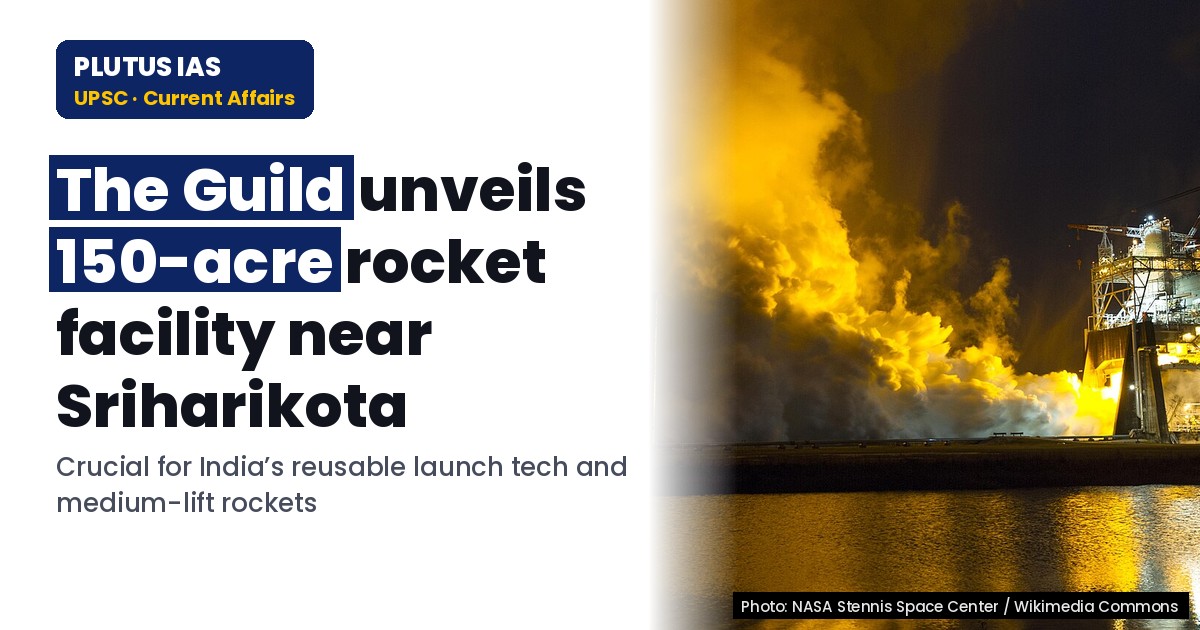
16 Oct The Guild’s 150-acre rocket facility: Key for India’s reusable launch tech
✎ The Guild’s 150-acre The Anchorage facility near Sriharikota is India’s first private sector-owned integrated testing infrastructure for fully reusable medium-lift launch vehicles, featuring in-house developed semi-cryogenic…
Subject Relevance — Where This Topic Fits
- GS Paper III — Science and Technology: Developments and their Applications and Effects in Everyday Life | GS Paper III — Indian Economy and Issues Relating to Planning, Mobilisation of Resources, Growth, Development and Employment | GS Paper III — Infrastructure: Energy, Ports, Roads, Airports, Railways etc.
- Prelims: IN-SPACe, Satish Dhawan Space Centre (SDSC-SHAR), Reusable Launch Vehicle (RLV), Semi-cryogenic engines, Private sector in space sector, ISRO, Space Policy 2023, Technology Transfer, Fully Reusable Launch Vehicle, Medium-lift launch vehicle
- Essay: The role of private sector in national technological self-reliance, Public-private partnerships in high-technology sectors: Opportunities and challenges
Quick Revision: The Guild’s 150-acre The Anchorage facility near Sriharikota is India’s first private sector-owned integrated testing infrastructure for fully reusable medium-lift launch vehicles, featuring in-house developed semi-cryogenic engines (Pegasus and Stallion) and a novel Full-Flow Segregated Cooling Cycle (FSCC) for upper-stage reusability.
Why is this in the news?
The unveiling of The Guild’s 150-acre rocket testing facility, The Anchorage, near Sriharikota marks a significant milestone in India’s space sector reforms, as it represents the first private sector-owned integrated testing infrastructure for reusable launch vehicles in the country. This development underscores the growing role of private enterprises in India’s space economy and aligns with the government’s strategic push for indigenous technological capabilities in space transportation.
Background
- The Indian space programme, historically led by ISRO, has witnessed a paradigm shift with the introduction of the Space Policy 2023, which explicitly encourages private sector participation in end-to-end space activities, including launch vehicle development, satellite manufacturing, and space-based services.
- The establishment of IN-SPACe (Indian National Space Promotion and Authorisation Centre) in 2020 as a single-window nodal agency has streamlined regulatory approvals and facilitated technology transfer from ISRO to private entities, fostering innovation and commercialisation.
- Sriharikota, home to the Satish Dhawan Space Centre (SDSC-SHAR), is India’s primary spaceport and has been the launch site for all of ISRO’s orbital missions since 1971. Its proximity to the Bay of Bengal provides an optimal safety corridor for launch trajectories.
- The global space economy is projected to reach USD 1 trillion by 2040, with reusable launch vehicles expected to dominate the market due to their cost-efficiency and sustainability. India’s participation in this sector is critical for maintaining strategic autonomy and reducing dependence on foreign launch services.
- The Government of India’s ‘Make in India’ initiative and the Production-Linked Incentive (PLI) scheme for the space sector aim to enhance domestic manufacturing capabilities and reduce import dependency in critical aerospace components.
- The Guild’s facility is part of a broader trend where private companies such as Skyroot Aerospace, Agnikul Cosmos, and Bellatrix Aerospace are developing indigenous launch vehicles, engines, and satellite systems, thereby contributing to India’s space sector’s self-reliance.
What is The Guild’s Reusable Launch Vehicle Testing Facility?
- The Anchorage is a 150-acre integrated rocket development and testing facility established by The Guild (Ethereal Exploration Guild), a Bengaluru-based private space technology company, near Sriharikota in Tirupati district, Andhra Pradesh.
- The facility is designed to support the development, testing, and qualification of Razor Crest Mk 1 (RCM1), The Guild’s fully reusable medium-lift launch vehicle.
- The RCM1 is engineered for the recovery and reuse of both its booster and upper stages, a technological feat that reduces launch costs and enhances sustainability in space transportation.
- The propulsion architecture of RCM1 comprises two semi-cryogenic rocket engines: the Pegasus (80 kN upper-stage engine) and the Stallion (1.2 MN booster engine), both developed entirely in-house by The Guild.
- The Pegasus engine incorporates a Full-Flow Segregated Cooling Cycle (FSCC) and a dual-thrust-chamber architecture, representing a novel feed cycle specifically designed for upper-stage reusability, a first in rocketry history.
- The facility is structured to enable progressive testing, from individual engine components to integrated propulsion systems and complete rocket stages, generating critical test data to inform design iterations and hardware qualification.
- The Guild’s approach emphasizes an integrated industrial ecosystem where manufacturing, qualification, refurbishment, and operational logistics are engineered to work in tandem throughout the vehicle’s lifecycle, ensuring long-term reusability.
Key Features
| Feature | Significance |
|---|---|
| 150-acre facility (The Anchorage) | Provides integrated ground infrastructure for end-to-end development, testing, and qualification of reusable launch vehicles, enabling repeated operational cycles. |
| Razor Crest Mk 1 (RCM1) | A fully reusable medium-lift launch vehicle designed for recovery and reuse of both booster and upper stages, reducing per-launch costs. |
| Pegasus engine (80 kN) | Upper-stage engine incorporating Full-Flow Segregated Cooling Cycle (FSCC) and dual-thrust-chamber architecture, specifically engineered for reusability. |
| Stallion engine (1.2 MN) | Gas-generator booster engine intended for lift-off and atmospheric ascent, designed for high-thrust reusable operations. |
| In-house propulsion technology | Entire propulsion architecture developed domestically, representing a first in rocket engine feed cycles for upper-stage reusability. |
Why it Matters
Economic
- Reduces launch costs through full reusability, enhancing commercial viability of medium-lift payloads and positioning India as a cost-competitive space launch provider.
- Stimulates private investment in space technology, fostering a domestic space industrial ecosystem and job creation in engineering and manufacturing sectors.
- Encourages foreign and domestic satellite operators to utilise Indian launch services, potentially increasing foreign exchange earnings.
Strategic
- Strengthens India’s self-reliance in critical space technologies, reducing dependence on foreign launch services for medium-lift missions.
- Supports India’s strategic space capabilities by enabling rapid deployment of satellites for communication, remote sensing, and navigation.
- Enhances India’s position in the global space economy, particularly in the emerging market for reusable launch services.
Technological
- Advances indigenous propulsion systems, including semi-cryogenic engines, aligning with India’s long-term space technology roadmap.
- Demonstrates mastery of reusable launch vehicle technologies, a key enabler for future human spaceflight and interplanetary missions.
- Establishes a testing infrastructure capable of supporting iterative design and qualification cycles, reducing time-to-market for new launch vehicles.
Institutional
- Complements ISRO’s existing facilities at SDSC-SHAR by providing additional capacity for private sector-led space activities.
- Encourages public-private partnerships in space technology, leveraging ISRO’s expertise while fostering private innovation.
- Sets a precedent for regulatory frameworks governing private space launches, testing, and operations in India.
Challenges
1. Technological Maturity
- Achieving full reusability requires overcoming challenges in thermal protection, engine refurbishment, and structural integrity over multiple flights.
- Integration of semi-cryogenic propulsion systems demands rigorous testing to ensure reliability and safety under varied operational conditions.
UPSC Link: GS3: Science & Tech
2. Regulatory and Safety Compliance
- Ensuring compliance with national and international space safety standards for reusable launch vehicles, including debris mitigation and collision avoidance.
- Establishing clear liability frameworks for private space activities, particularly in cases of launch failures or third-party damages.
UPSC Link: GS2: Governance
3. Infrastructure and Logistics
- Managing large-scale testing operations without disrupting nearby civilian infrastructure, given the proximity to SDSC-SHAR.
- Ensuring uninterrupted supply chains for high-precision components, including semi-cryogenic fuels and advanced materials.
UPSC Link: GS3: Infrastructure
4. Market Viability
- Demonstrating cost advantages over established global players to attract commercial satellite operators and government contracts.
- Navigating competition from international reusable launch providers, such as SpaceX and Blue Origin, in the medium-lift segment.
UPSC Link: GS3: Economy
5. Human Capital Development
- Scaling up a skilled workforce in advanced propulsion, avionics, and systems engineering to sustain long-term operations.
- Retaining talent in India’s space sector amid competition from global aerospace firms and technology hubs.
UPSC Link: GS3: Human Resources
Challenges — UPSC Perspective
| Issue | Concern |
|---|---|
| Reusability validation | Proving structural and thermal resilience of rocket stages across multiple flights without performance degradation. |
| Semi-cryogenic fuel handling | Ensuring safe storage, transport, and combustion of semi-cryogenic propellants under operational conditions. |
| Regulatory approvals | Securing timely clearances from space and environmental authorities for testing and launch operations. |
| Supply chain bottlenecks | Mitigating risks of delays in procuring critical components from domestic and international suppliers. |
| Cost competitiveness | Balancing high development costs with competitive pricing to attract commercial payloads. |
Way Forward
- Accelerate phased testing of Razor Crest Mk 1, starting with component-level validation and progressing to full-stage integration.
- Collaborate with ISRO to leverage existing infrastructure at SDSC-SHAR for shared testing and qualification protocols.
- Develop indigenous supply chains for semi-cryogenic fuels, advanced alloys, and avionics to reduce import dependence.
- Establish a regulatory sandbox for private space activities, streamlining approvals for launch licenses and safety certifications.
- Invest in workforce training programmes in propulsion engineering, materials science, and systems integration to meet industry demands.
- Explore public-private partnerships to co-develop reusable launch technologies, sharing risks and resources.
- Enhance international collaborations to access global best practices in reusable launch vehicle design and operations.
- Monitor global market trends to align product offerings with emerging demands in medium-lift satellite launches.
UPSC Value Addition
Keywords for Mains Answer-Writing
Private space sector in India · Reusable launch vehicles (RLVs) · Rocket propulsion technology · Space infrastructure development · Medium-lift launch vehicles · Semi-cryogenic engines · ISRO and private sector collaboration · Space policy and governance · Technological self-reliance in space · Aerospace engineering and testing facilities
Concept Flow
Private sector enters space technology development → Establishment of integrated testing infrastructure (The Anchorage) → Development of fully reusable launch vehicle (RCM1) → In-house innovation in propulsion systems (Pegasus, Stallion) → Iterative testing and qualification cycles → Commercial viability and market adoption → Strengthening India’s strategic and economic position in global space economy
Prelims Practice Questions
Q1. Consider the following statements regarding The Guild’s Razor Crest Mk 1 (RCM1) launch vehicle:
1. The RCM1 is designed as a fully reusable medium-lift launch vehicle.
2. It incorporates two semi-cryogenic rocket engines: Pegasus (80 kN upper-stage engine) and Stallion (1.2 MN booster engine).
3. The propulsion architecture includes a Full-Flow Segregated Cooling Cycle (FSCC) exclusively for cryogenic stages.
4. The facility ‘The Anchorage’ is located within the Satish Dhawan Space Centre (SDSC-SHAR) at Sriharikota.
How many of the above statements are correct?
- Only one
- Only two
- Only three
- All
Answer: Only three — Statements 1 and 2 are correct. Statement 3 is incorrect as the FSCC is designed for upper-stage reusability, not exclusively for cryogenic stages. Statement 4 is incorrect because ‘The Anchorage’ is located about 40 km from SDSC-SHAR, not within it.
Q2. Assertion (A): The development of fully reusable launch vehicles is contingent upon an integrated industrial ecosystem encompassing manufacturing, qualification, and refurbishment.
Reason (R): Full reusability cannot be achieved through vehicle design alone, as operational life-cycle engineering requires systemic support.
Options:
A. Both A and R are true, and R is the correct explanation of A.
B. Both A and R are true, but R is not the correct explanation of A.
C. A is true, but R is false.
D. A is false, but R is true.
Answer: ? — Both Assertion (A) and Reason (R) are true, and Reason (R) correctly explains Assertion (A). The integrated ecosystem is essential for achieving full reusability, as stated by The Guild’s co-founder.
Q3. Match the following components of The Guild’s Razor Crest Mk 1 (RCM1) with their respective specifications:
Column I (Component) | Column II (Specification)
————————————|———————————-
1. Pegasus Engine | A. 1.2 MN gas-generator booster engine
2. Stallion Engine | B. 80 kN upper-stage engine
3. Full-Flow Segregated Cooling Cycle (FSCC) | C. Designed for upper-stage reusability
4. Razor Crest Mk 1 | D. Fully reusable medium-lift launch vehicle
- 1-B, 2-A, 3-C, 4-D
- 1-A, 2-B, 3-C, 4-D
- 1-C, 2-A, 3-B, 4-D
- 1-D, 2-C, 3-A, 4-B
Answer: 1-B, 2-A, 3-C, 4-D — Correct matching: 1-B (Pegasus is an 80 kN upper-stage engine), 2-A (Stallion is a 1.2 MN booster engine), 3-C (FSCC is designed for upper-stage reusability), 4-D (RCM1 is a fully reusable medium-lift launch vehicle).
Mains Practice Question
✍ The development of private sector-led reusable launch vehicles (RLVs) represents a paradigm shift in India’s space capabilities. Critically examine the technological, economic, and strategic implications of this shift for India’s space programme. (15 Marks)
Approach: MODEL-ANSWER SKELETON:
1. **Technological Implications**:
– Highlight the significance of fully reusable medium-lift launch vehicles (e.g., Razor Crest Mk 1) in reducing launch costs and increasing operational flexibility.
– Discuss the engineering challenges addressed: semi-cryogenic propulsion (Pegasus and Stallion engines), Full-Flow Segregated Cooling Cycle (FSCC), and integrated testing infrastructure.
– Reference ISRO’s historical achievements (e.g., PSLV, GSLV, RLV-TD) and compare with private sector innovations.
2. **Economic Implications**:
– Analyse the role of private sector participation in reducing the financial burden on the exchequer while fostering innovation and competition.
– Discuss the potential for cost reduction per launch (e.g., reusable stages vs. expendable launch systems) and its impact on India’s commercial space sector.
– Mention the role of infrastructure development (e.g., ‘The Anchorage’ facility) in enabling scalable testing and manufacturing.
3. **Strategic Implications**:
– Examine how RLVs enhance India’s strategic autonomy in space, reducing dependence on foreign launch services.
– Discuss the implications for India’s space diplomacy, commercial satellite launches, and participation in global space governance.
– Reference the Space Activities Bill, 2017, and the Draft Space Policy, 2023, to contextualise regulatory and governance frameworks.
4. **Challenges and Critique**:
– Identify challenges: technological maturity, regulatory hurdles, and integration with ISRO’s existing infrastructure.
– Critically assess whether private sector-led RLVs can achieve the scale and reliability required for sustained operations.
– Discuss the need for a balanced approach between public and private sector roles in India’s space programme.
5. **Conclusion**:
– Summarise the transformative potential of RLVs for India’s space programme while acknowledging the need for continued innovation and collaboration.
Source: The Hindu
Karnataka PCS (KPSC) — State PCS Practice
Prelims: The Guild, a Bengaluru-based space-tech firm, recently unveiled a 150-acre rocket testing facility near which of the following locations in India?
- A) Sriharikota, Andhra Pradesh
- B) Chitradurga, Karnataka
- C) Pokhran, Rajasthan
- D) Thiruvananthapuram, Kerala
Answer: A) Sriharikota, Andhra Pradesh — The facility is located near Sriharikota, Andhra Pradesh, which is home to ISRO’s Satish Dhawan Space Centre.
Mains: Discuss the significance of The Guild’s 150-acre rocket testing facility for Karnataka’s space-tech ecosystem and its potential impact on the state’s industrial and technological growth. (250 words)
Generated by AanyaAi for educational purpose.

- India-Australia AUSTRAHIND 2026 Exercise: Key Highlights for UPSC & State PCS - October 22, 2026
- एससीओ बैठक में भारत का आतंकवाद विरोध: क्षेत्रीय सहयोग पर जोर - October 22, 2026
- SEC Directs Strict SC Order Compliance for Andhra ULB Polls - October 22, 2026

No Comments