


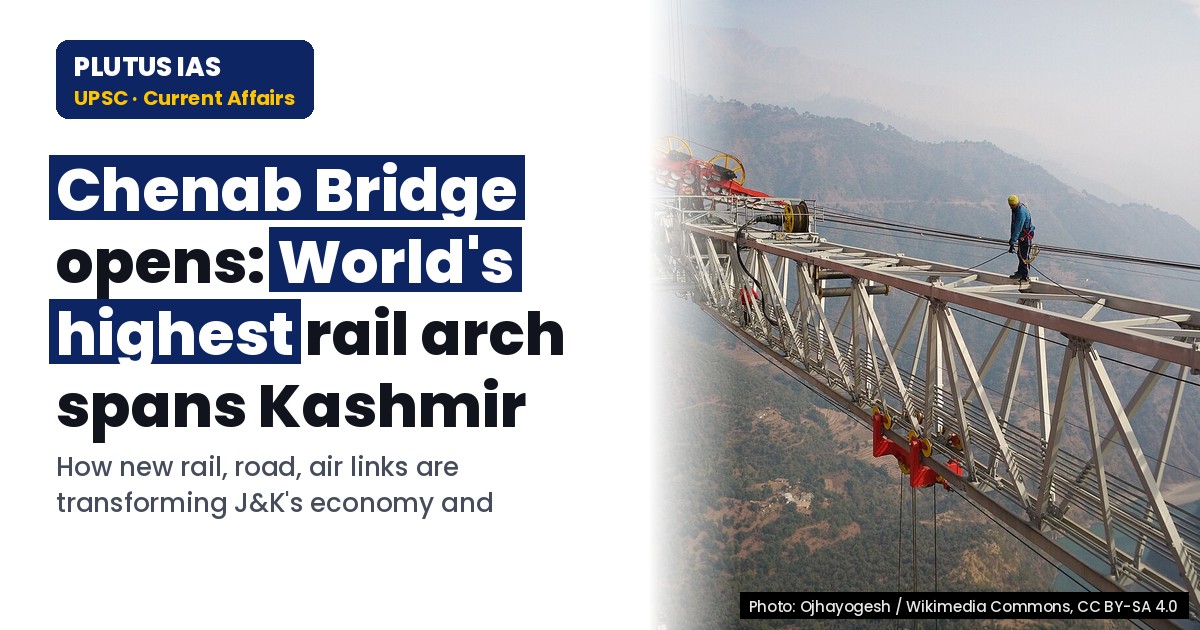
17 Oct Kashmir Connectivity: How Infrastructure is Driving Development in J&K
✎ The Udhampur-Srinagar-Baramulla Rail Link (USBRL) integrates Jammu and Kashmir with the national rail network, featuring the Chenab Bridge—the world’s highest railway arch bridge—and Vande Bharat Express services, thereby…
Subject Relevance — Where This Topic Fits
- GS Paper II — Governance, Constitution, Polity, Social Justice and International Relations (Infrastructure and Regional Connectivity) | GS Paper III — Infrastructure: Energy, Ports, Roads, Railways and Airports
- Prelims: Udhampur-Srinagar-Baramulla Rail Link (USBRL), Chenab Bridge, Zojila Tunnel, Sonmarg Tunnel, Vande Bharat Express, UDAN Scheme, Multimodal Cargo Terminals
- Essay: Regional Development through Infrastructure: Balancing Growth and Sustainability, Connectivity as a Tool for National Integration
Quick Revision: The Udhampur-Srinagar-Baramulla Rail Link (USBRL) integrates Jammu and Kashmir with the national rail network, featuring the Chenab Bridge—the world’s highest railway arch bridge—and Vande Bharat Express services, thereby enhancing economic, social, and strategic connectivity.
Why is this in the news?
The Udhampur-Srinagar-Baramulla Rail Link (USBRL), including the Chenab Bridge—the world’s highest railway arch bridge—has been inaugurated, marking a transformative phase in connectivity for Jammu and Kashmir. This development, coupled with expanded road, air, and multimodal transport infrastructure, underscores the Union Government’s sustained focus on integrating the region with the national transport network, thereby fostering economic, social, and strategic linkages.
Background
- Jammu and Kashmir’s rugged Himalayan terrain has historically posed significant challenges to infrastructure development, particularly in connectivity.
- Post-abrogation of Article 370 in 2019, the Union Government accelerated infrastructure projects to bridge the developmental gap and integrate the region with the national mainstream.
- The USBRL project, a National Project, was conceptualized to connect the Kashmir Valley with the national rail network, overcoming extreme geographical constraints.
- The Chenab Bridge, a key component of USBRL, stands as a testament to India’s engineering prowess in constructing critical infrastructure in high-altitude regions.
- Expansion of air connectivity through the UDAN scheme and upgrades to airports like Srinagar aim to enhance regional accessibility and tourism.
- Multimodal cargo terminals and improved freight services are being developed to facilitate the movement of high-value agricultural and handicraft products to national markets.
What is the Udhampur-Srinagar-Baramulla Rail Link (USBRL) Project?
- The USBRL is a 272-kilometre-long railway line connecting Udhampur in Jammu to Baramulla in the Kashmir Valley, traversing some of the most challenging Himalayan terrains.
- The project includes 36 tunnels (totaling 119 km) and 943 bridges, including the Chenab Bridge, which is the world’s highest railway arch bridge at 359 metres above the riverbed.
- The total cost of the project is approximately ₹43,780 crore, making it one of the most expensive railway projects in India.
- The railway line is fully electrified, ensuring energy efficiency and reduced carbon footprint, and includes 215 km of approach roads with 320 bridges and one tunnel.
- The project has generated over 5 crore man-days of employment, contributing significantly to local livelihoods and skill development.
- Vande Bharat Express services, introduced in June 2025, now operate between Jammu Tawi and Srinagar, reducing travel time to under five hours.
- The project enhances strategic connectivity, enabling faster troop and logistics movement in addition to civilian transport.
- The USBRL aligns with the broader vision of the National Rail Plan (NRP) 2030, aiming to expand rail connectivity across the country.
Key Features
| Feature | Significance |
|---|---|
| Udhampur–Srinagar–Baramulla Rail Link (USBRL) | Connects Kashmir Valley to India’s national rail network, enhancing multi-modal connectivity and socio-economic integration. |
| Chenab Bridge | World’s highest railway arch bridge (359 m), symbolising engineering excellence and enabling all-weather rail connectivity across the Himalayas. |
| Vande Bharat Express | Introduces semi-high-speed rail services, reducing travel time between Jammu, Udhampur, and Srinagar to under five hours. |
| Zojila and Sonamarg Tunnels | Year-round road connectivity to Ladakh, overcoming seasonal snow-blocked passes and improving strategic and economic access. |
| Srinagar Airport Expansion | Increased passenger handling capacity and integration with regional air connectivity initiatives under the UDAN scheme. |
Why it Matters
Economic Integration
- Facilitates movement of perishable agricultural produce (e.g., Kashmiri apples, saffron) to national markets, reducing post-harvest losses and increasing farmer incomes.
- Enables establishment of multimodal cargo terminals, enhancing supply chain efficiency for handicrafts and local industries.
- Promotes tourism by reducing travel time and improving accessibility to Kashmir Valley and Ladakh.
Strategic Connectivity
- Strengthens India’s territorial integration with Jammu and Kashmir, ensuring all-weather access to remote border areas.
- Supports rapid troop and logistics movement in high-altitude regions, aligning with border infrastructure development priorities.
- Reduces dependence on seasonal road networks, enhancing operational flexibility for defence and civil administration.
Social Development
- Generates employment through construction and operational phases, with over 5 crore man-days of labour engagement reported.
- Improves access to healthcare, education, and emergency services by linking remote districts to broader transport networks.
- Encourages demographic stability by reducing out-migration from the region.
Technological Advancement
- Demonstrates indigenous capability in constructing high-altitude rail infrastructure, including tunnels and bridges in seismic zones.
- Sets benchmarks for future projects in similar geographies, such as the Bilaspur–Manali–Leh Railway Line.
- Integrates modern signalling and electrification systems for sustainable and efficient operations.
Challenges
1. Geological and Topographical Constraints
- Construction in Himalayan terrain involves navigating steep gradients, seismic activity, and fragile ecosystems.
- Extreme weather conditions (avalanches, landslides) pose risks to both labour and infrastructure during execution.
- High-altitude tunnelling requires advanced geotechnical expertise to mitigate risks of rock bursts and water ingress.
UPSC Link: Geography: Physiographic divisions of India
2. Environmental and Ecological Concerns
- Large-scale infrastructure projects may impact fragile Himalayan biodiversity and protected areas.
- Construction activities can lead to soil erosion, deforestation, and disruption of local wildlife corridors.
- Need for stringent environmental impact assessments and adherence to green construction norms.
UPSC Link: Environment: Environmental Impact Assessment (EIA)
3. High Capital and Maintenance Costs
- Initial investment of ₹43,780 crore for USBRL reflects the high cost of high-altitude rail infrastructure.
- Ongoing maintenance expenses for tunnels, bridges, and tracks in harsh climatic conditions are substantial.
- Long gestation periods delay revenue generation, necessitating sustained government funding.
UPSC Link: Economy: Public Investment and Infrastructure Financing
4. Operational and Safety Challenges
- Year-round operation in snow-prone areas requires advanced de-icing systems and real-time monitoring.
- Limited redundancy in connectivity increases vulnerability to disruptions from natural disasters.
- Ensuring passenger safety in high-altitude rail corridors demands robust emergency response mechanisms.
UPSC Link: Science & Tech: Disaster Management
5. Socio-Political and Administrative Hurdles
- Coordination among multiple agencies (Railways, NHAI, state governments) can lead to delays.
- Land acquisition and rehabilitation processes in conflict-prone regions require sensitive handling.
- Balancing developmental imperatives with local aspirations and cultural sensitivities.
UPSC Link: Polity: Federalism and Centre-State Relations
Challenges — UPSC Perspective
| Issue | Concern |
|---|---|
| Seismic activity | High risk of earthquakes necessitates earthquake-resistant design and monitoring systems. |
| Avalanche zones | Critical sections like Zojila Pass require protective structures to prevent snow-related disruptions. |
| High-altitude sickness | Workforce and passengers may face health risks due to low oxygen levels and extreme cold. |
| Wildlife corridors | Construction must avoid fragmentation of habitats for species like the Himalayan brown bear. |
| Funding gaps | Public-private partnerships are essential to supplement budgetary allocations. |
| Skill shortages | Specialised labour for tunnelling and high-altitude construction is scarce, requiring training programmes. |
Government Initiatives — Must-Memorise for Prelims
- UDAN (Ude Desh Ka Aam Nagrik) Scheme
- National Infrastructure Pipeline (NIP)
- PM-Gati Shakti National Master Plan
Way Forward
- Accelerate completion of pending tunnel and bridge segments to ensure seamless connectivity across all seasons.
- Expand multimodal cargo terminals in Srinagar, Jammu, and Leh to integrate rail, road, and air freight networks.
- Develop dedicated freight corridors for agricultural and handicraft exports to reduce transit times and costs.
- Enhance disaster preparedness with real-time monitoring systems for landslides, avalanches, and seismic activity.
- Promote local employment through skill development programmes in construction, maintenance, and hospitality sectors.
- Strengthen environmental safeguards with mandatory green construction certifications and biodiversity offsets.
- Leverage Vande Bharat Express services to boost tourism by offering premium connectivity to key destinations.
- Establish a dedicated logistics corridor for perishable goods to minimise spoilage and maximise farmer incomes.
UPSC Value Addition
Keywords for Mains Answer-Writing
Jammu and Kashmir connectivity · Udhampur-Srinagar-Baramulla Rail Link (USBRL) · Chenab Bridge · Vande Bharat Express · Multi-modal cargo terminals · Srinagar Airport expansion · Zojila Tunnel · Sonamarg Tunnel · National Rail Network integration · Himalayan infrastructure development · Tourism and trade facilitation in J&K · Regional connectivity schemes · Himalayan terrain challenges · Railway electrification · Employment generation through infrastructure projects
Constitutional & Policy Linkages
- Article 3 – Formation of new states/UTs (Jammu and Kashmir Reorganisation Act, 2019).
- Seventh Schedule – Distribution of subjects (e.g., railways, roads) between Union and State lists.
Concept Flow
Limited connectivity in J&K due to Himalayan terrain and historical constraints → → Initiation of high-altitude infrastructure projects (USBRL, Zojila Tunnel) → → Engineering breakthroughs (Chenab Bridge, tunnelling technology) → → Integration with national networks (rail, road, air) → → Economic spillovers (agriculture, tourism, trade) → → Socio-economic development and strategic consolidation → → Sustainable maintenance and future expansion of connectivity corridors.
Prelims Practice Questions
Q1. Consider the following statements regarding the Udhampur-Srinagar-Baramulla Rail Link (USBRL) project:
1. The USBRL project connects Jammu and Kashmir to the national rail network.
2. The Chenab Bridge, part of the USBRL, is the world’s highest railway arch bridge.
3. The total length of the USBRL project is approximately 272 kilometres.
4. The USBRL project includes 36 tunnels with a cumulative length of 119 kilometres.
How many of the above statements are correct?
- Only one
- Only two
- Only three
- All
Answer: All — Statements 1, 2, 3, and 4 are all correct. The USBRL project connects Jammu and Kashmir to the national rail network, the Chenab Bridge is the world’s highest railway arch bridge, the total length of the project is 272 km, and it includes 36 tunnels with a cumulative length of 119 km.
Q2. Assertion (A): The Udhampur-Srinagar-Baramulla Rail Link (USBRL) project is one of the most challenging railway projects undertaken in India after independence.
Reason (R): The project traverses through the rugged Himalayan terrain, requiring extensive tunnelling and bridge construction.
Options:
A. Both A and R are true, and R is the correct explanation of A.
B. Both A and R are true, but R is NOT the correct explanation of A.
C. A is true, but R is false.
D. A is false, but R is true.
Answer: ? — Both Assertion (A) and Reason (R) are true, and Reason (R) correctly explains Assertion (A). The USBRL project is indeed one of the most challenging railway projects in India due to the difficult Himalayan terrain it traverses.
Q3. Match the following infrastructure projects in Jammu and Kashmir with their respective features:
Column I (Project) Column II (Feature)
A. Udhampur-Srinagar-Baramulla Rail Link 1. World’s highest railway arch bridge
B. Zojila Tunnel 2. Connects Ladakh to the rest of India year-round
C. Sonamarg Tunnel 3. Part of the USBRL project
D. Chenab Bridge 4. Facilitates all-weather road connectivity to Srinagar
Options:
A-1, B-2, C-4, D-3
A-3, B-2, C-4, D-1
A-3, B-4, C-2, D-1
A-1, B-4, C-2, D-3
Answer: ? — A-3 (USBRL connects Jammu and Kashmir to the national rail network), B-2 (Zojila Tunnel connects Ladakh to the rest of India year-round), C-4 (Sonamarg Tunnel facilitates all-weather road connectivity to Srinagar), D-1 (Chenab Bridge is the world’s highest railway arch bridge).
Mains Practice Question
✍ The development of connectivity infrastructure in Jammu and Kashmir represents a paradigm shift in integrating a historically isolated region with the national mainstream. Critically examine the significance of the Udhampur-Srinagar-Baramulla Rail Link (USBRL) project and other associated infrastructure initiatives in transforming the socio-economic landscape of the region. Also, analyse the challenges faced in implementing such projects in the Himalayan terrain. (15 Marks)
Approach: MODEL-ANSWER SKELETON:
1. **Introduction (2 Marks)**: Briefly introduce the USBRL project and other connectivity initiatives (e.g., Zojila Tunnel, Sonamarg Tunnel, Srinagar Airport expansion) as part of a broader strategy to integrate J&K with the national mainstream.
2. **Significance of USBRL and Connectivity Projects (6 Marks)**:
– **Economic Integration**: Facilitates movement of goods (e.g., Kashmiri saffron, apples, handicrafts) and passengers, reducing transit time and costs.
– **Tourism Boost**: Improved connectivity enhances tourist inflow, benefiting local businesses and employment.
– **Social Development**: Enhances access to education, healthcare, and markets for remote communities.
– **Strategic Importance**: Strengthens national security and territorial integrity by ensuring year-round connectivity.
– **Employment Generation**: Highlights the creation of 5 crore+ man-days of employment during construction.
– **Technological Achievement**: Cite the Chenab Bridge as a symbol of engineering excellence (world’s highest railway arch bridge) and USBRL’s electrification.
3. **Challenges in Implementation (5 Marks)**:
– **Geographical Constraints**: Rugged Himalayan terrain, seismic activity, and extreme weather conditions.
– **Environmental Concerns**: Need for sustainable construction practices to mitigate ecological damage.
– **Funding and Logistics**: High capital investment (₹43,780 crore for USBRL) and logistical challenges in transporting materials.
– **Community Displacement**: Address the socio-economic impact on local communities during construction.
– **Operational Challenges**: Maintenance of infrastructure in harsh conditions and ensuring safety standards.
4. **Conclusion (2 Marks)**: Summarise the transformative potential of connectivity infrastructure while acknowledging the need for balanced development that prioritises sustainability and inclusivity. Highlight the role of such projects in achieving the goals of ‘Sabka Saath, Sabka Vikas’.
Source: PIB (Press Information Bureau)
Jammu & Kashmir PCS (JKPSC (KAS)) — State PCS Practice
Prelims: Which of the following initiatives has been recently launched by the Government of Jammu & Kashmir to enhance connectivity and infrastructure development in the Kashmir Valley?
- A. Srinagar Ring Road Project
- B. Jammu-Udhampur-Srinagar-Baramulla Rail Link (USBRL) Project
- C. Chenani-Nashri Tunnel (Patnitop Tunnel)
- D. All of the above
Answer: D. All of the above — The Srinagar Ring Road Project, USBRL Project, and Chenani-Nashri Tunnel are all key infrastructure initiatives aimed at improving connectivity in Jammu & Kashmir, including the Kashmir Valley.
Mains: Discuss the role of infrastructure development in bridging the developmental gaps between Kashmir and other regions of Jammu & Kashmir. Highlight the challenges faced and suggest policy measures to accelerate progress.
Generated by AanyaAi for educational purpose.
Related guides on our sites
- Best economics services coaching
- Best economics optional coaching
- Best economics optional coaching for upsc
- best teacher of economics optional

- India-Australia AUSTRAHIND 2026 Exercise: Key Highlights for UPSC & State PCS - October 22, 2026
- एससीओ बैठक में भारत का आतंकवाद विरोध: क्षेत्रीय सहयोग पर जोर - October 22, 2026
- SEC Directs Strict SC Order Compliance for Andhra ULB Polls - October 22, 2026

No Comments