


24 Oct Inflation’s Second-Round Effects: RBI Policy & Economic Impact Analysis
✎ Second-round effects of inflation occur when initial supply-side price shocks lead to broader and more persistent inflation through wage-price spirals or heightened inflation expectations, necessitating tighter monetary policy to…
Subject Relevance — Where This Topic Fits
- GS Paper III — Indian Economy: Issues relating to planning, resource mobilisation, growth, development and employment; Inclusive growth and issues arising from it; Government Budgeting | GS Paper III — Money and Banking: Role of Reserve Bank of India; Monetary Policy Framework
- Prelims: Consumer Price Index (CPI), Monetary Policy Committee (MPC), Calibrated tightening stance, Headline inflation, Core inflation, Supply-side inflation, Demand-pull inflation, Second-round effects of inflation, Wholesale Price Index (WPI), Brent crude oil prices, El Niño, Rabi crops, Inflation expectations, Basis points (bps), GDP deflator
- Essay: Economic stability vs. growth: The dilemma of monetary policy in inflationary environments, The role of expectations in shaping economic outcomes: Lessons from inflation dynamics
Quick Revision: Second-round effects of inflation occur when initial supply-side price shocks lead to broader and more persistent inflation through wage-price spirals or heightened inflation expectations, necessitating tighter monetary policy to prevent unanchoring of expectations.
Why is this in the news?
The Reserve Bank of India’s (RBI) October 2026 Monetary Policy Committee (MPC) meeting has highlighted concerns over the broadening of inflationary pressures in the Indian economy, with the central bank noting signs of generalisation and elevated inflation expectations. The minutes of the meeting reveal a divergence in assessments among MPC members regarding the drivers of inflation—whether they remain supply-side dominated or are increasingly exhibiting second-round effects. Concurrently, global food price trends and the potential impact of El Niño on India’s rabi crops, alongside elevated energy prices, underscore the risks of sustained inflationary pressures. This development is significant as it raises questions about the appropriate calibration of monetary policy in an environment where inflation risks are becoming more entrenched.
Background
- The RBI’s Monetary Policy Framework, adopted in 2016, mandates the MPC to maintain consumer price inflation at 4% with a tolerance band of +/- 2% on a durable basis.
- Global commodity prices, particularly energy (e.g., Brent crude oil) and food, have exhibited volatility, with energy prices remaining elevated due to geopolitical tensions and supply constraints.
- El Niño, a periodic warming of the Pacific Ocean, is associated with below-normal rainfall in India, particularly during the rabi season, which can adversely impact agricultural output and food prices.
- The RBI’s household inflation expectation surveys are a key input for monetary policy, as they reflect public sentiment and can influence wage-price spirals if expectations become unanchored.
- The MPC’s policy stance—whether accommodative, neutral, or calibrated tightening—reflects its assessment of inflation risks and the need to balance growth and price stability.
Understanding Second-Round Effects of Inflation and the RBI’s Policy Response
- Second-round effects of inflation refer to the process by which initial price increases—often driven by supply-side shocks—trigger broader and more persistent inflationary pressures through wage-price spirals, increased production costs, or heightened inflation expectations. This phenomenon can lead to a self-reinforcing cycle where inflation becomes generalised across the economy.
- The RBI’s Monetary Policy Committee (MPC) is tasked with assessing the extent to which inflationary pressures are generalising and whether second-round effects are taking hold. This assessment influences the calibration of monetary policy tools, including interest rates and the policy stance.
- The RBI’s October 2026 policy minutes reveal a divergence among MPC members: some argue that inflation remains supply-side driven (e.g., Nagesh Kumar), while others caution that price pressures are becoming entrenched (e.g., Saugata Bhattacharya and RBI Governor Sanjay Malhotra).
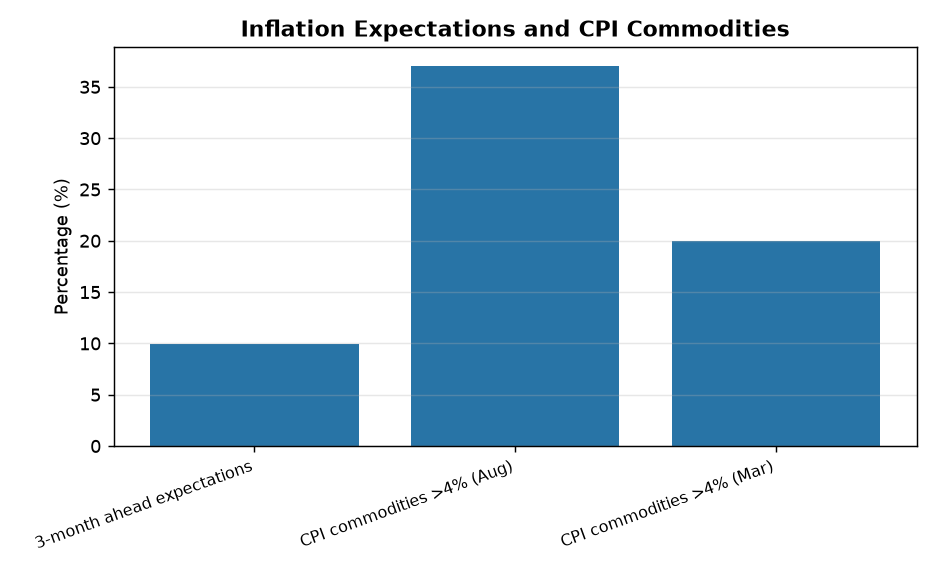
- Headline inflation, as measured by the Consumer Price Index (CPI), has shown signs of broadening, with an increasing share of commodities in the CPI basket exhibiting inflation above 4%—rising from 20% in March 2026 to 37% in August 2026.
- Inflation expectations play a critical role in the transmission mechanism of monetary policy. Unanchored expectations can lead to higher wage demands, increased production costs, and further price increases, thereby exacerbating inflationary pressures.
- The RBI’s policy response in October 2026 included a unanimous decision to raise interest rates but a split vote on changing the policy stance to ‘calibrated tightening,’ reflecting differing views on the persistence of inflationary risks.
- Global factors, such as elevated energy prices (e.g., Brent crude oil at ~$115 per barrel) and the potential impact of El Niño on rabi crops, add to the complexity of the inflation outlook, as they can amplify supply-side pressures.
- The RBI’s assessment of whether inflation is becoming generalised will determine the extent of future policy tightening, with implications for economic growth, employment, and financial stability.
Key Features
| Feature | Significance |
|---|---|
| Second-round effects of inflation | Propagation of initial price shocks through wage-price spirals, leading to generalized and self-reinforcing inflationary pressures across the economy. |
| Monetary Policy Committee (MPC) stance divergence | Differences in assessment of inflation dynamics among MPC members, particularly regarding the generalisation of price pressures and the need for calibrated tightening. |
| Household inflation expectations | Forward-looking perceptions of inflation by households, which, if elevated, can influence actual pricing behaviour and wage demands, exacerbating inflation. |
| Global food price hardening | Upward trend in international food prices, driven by supply constraints and climate factors, which can transmit to domestic food inflation. |
| El Niño impact on rabi crops | Climatic phenomenon increasing the risk of reduced agricultural output during the rabi season, thereby tightening food supply and stoking inflationary pressures. |
Why it Matters
Macroeconomic Stability
- Persistent inflation erodes purchasing power, distorts resource allocation, and undermines long-term economic growth by reducing investment and savings incentives.
- Generalised inflation complicates monetary policy calibration, as supply-side shocks require careful distinction from demand-driven pressures to avoid over-tightening or under-tightening.
- Elevated inflation expectations can become self-fulfilling, leading to a wage-price spiral that entrenches inflationary conditions beyond temporary supply shocks.
Agricultural and Food Security
- Food inflation, particularly from supply-side disruptions, disproportionately affects vulnerable sections of the population, exacerbating inequality and poverty.
- Dependence on global food markets exposes domestic prices to external shocks, necessitating robust buffer stock management and trade policy adjustments.
- Climate variability, exemplified by El Niño, underscores the need for climate-resilient agricultural practices and contingency planning in food production systems.
Monetary Policy Transmission
- The MPC’s decision to raise interest rates reflects a shift toward pre-emptive tightening to curb second-round effects, even as supply-side constraints limit the immediate impact of monetary tools.
- Divergence in MPC members’ views highlights the challenges in balancing inflation control with growth objectives, particularly when data on generalisation of inflation is mixed.
- Policy efficacy depends on the transmission of rate hikes to borrowing costs, savings behaviour, and investment decisions, which may be muted in a high-inflation, supply-constrained environment.
Global Economic Linkages
- Commodity price trends, including energy and metals, interact with domestic inflation dynamics, influencing production costs and consumer prices through multiple channels.
- India’s integration with global supply chains means that external price shocks can propagate domestically, necessitating coordinated policy responses at both national and international levels.
Challenges
1. Generalisation of Inflation
- Risk of inflation spreading beyond food and energy to core sectors, indicating entrenched price pressures and potential wage-price spirals.
- Difficulty in distinguishing between temporary supply shocks and persistent demand-side pressures, complicating monetary policy decisions.
- Elevated inflation expectations among households can become entrenched, reducing the effectiveness of monetary policy in anchoring long-term price stability.
UPSC Link: GS-III: Inflation & Monetary Policy
2. Supply-Side Constraints
- Agricultural output risks due to climate variability (e.g., El Niño) threaten food security and exacerbate inflationary pressures in the rabi season.
- Global commodity price volatility, particularly in energy and metals, transmits to domestic costs, constraining policy flexibility.
- Structural bottlenecks in logistics, storage, and distribution amplify supply-side shocks, prolonging inflationary episodes.
UPSC Link: GS-III: Agricultural Productivity & Supply Chain
3. Policy Dilemma: Growth vs. Inflation
- Calibrated tightening risks dampening economic growth, particularly in sectors sensitive to interest rates, such as manufacturing and infrastructure.
- Over-tightening monetary policy in response to supply-side inflation may prove counterproductive, as it fails to address the root causes of price pressures.
- Fiscal policy constraints limit the scope for demand-side management, necessitating a balanced approach to inflation control.
UPSC Link: GS-III: Monetary Policy & Fiscal Policy
4. Inflation Expectations Management
- Household surveys indicating rising three-month ahead inflation expectations signal potential de-anchoring of expectations, undermining price stability.
- Communication challenges for the central bank in conveying policy intent to manage public perceptions and prevent self-fulfilling inflationary dynamics.
- Lack of credible anchor for inflation expectations can lead to behavioural responses, such as hoarding or speculative pricing, exacerbating inflation.
UPSC Link: GS-III: Inflation Targeting & Expectations
5. Climate-Induced Agricultural Risks
- Increased frequency of extreme weather events, such as El Niño, disrupts agricultural cycles, reducing crop yields and tightening food supply.
- Limited adaptive capacity in smallholder farming systems exacerbates vulnerability to climate shocks, necessitating targeted interventions.
- Policy responses must balance short-term food security needs with long-term climate resilience in agricultural practices.
UPSC Link: GS-III: Climate Change & Agriculture
Challenges — UPSC Perspective
| Issue | Concern |
|---|---|
| Generalisation of inflation | Risk of entrenched price pressures and wage-price spirals, complicating monetary policy calibration. |
| Supply-side constraints in agriculture | Climate variability (e.g., El Niño) threatens rabi crop output, exacerbating food inflation. |
| Elevated global commodity prices | High energy and metal prices transmit to domestic costs, constraining policy flexibility. |
| Policy dilemma: Growth vs. inflation | Calibrated tightening risks dampening growth, while under-tightening may entrench inflation. |
| Inflation expectations de-anchoring | Rising household expectations can become self-fulfilling, undermining price stability. |
| Structural bottlenecks in supply chains | Logistics, storage, and distribution inefficiencies amplify supply-side shocks, prolonging inflation. |
Way Forward
- Enhance real-time monitoring of inflation expectations through household and business surveys to pre-empt second-round effects.
- Strengthen climate-resilient agricultural practices, including crop diversification and water management, to mitigate El Niño-induced supply shocks.
- Improve buffer stock management and trade policy flexibility to stabilise food prices during supply disruptions.
- Foster coordination between monetary and fiscal authorities to calibrate policy responses, balancing inflation control with growth objectives.
- Invest in supply chain infrastructure, including cold storage and logistics, to reduce post-harvest losses and improve market efficiency.
- Communicate monetary policy decisions transparently to anchor inflation expectations and prevent de-anchoring.
- Promote research and development in climate-smart agriculture to enhance adaptive capacity in the farming sector.
UPSC Value Addition
Keywords for Mains Answer-Writing
Inflation dynamics in India · Second-round effects of inflation · Monetary Policy Committee (MPC) · Calibrated tightening stance · Inflation expectations and monetary policy · Supply-side vs demand-side inflation · El Niño and agricultural output · Consumer Price Index (CPI) inflation · RBI’s inflation targeting framework · Generalisation of inflation · Brent crude oil prices and inflation · Household inflation expectations survey · Rabi crop output and inflation · Second-round effects in macroeconomics · Monetary policy transmission mechanism
Concept Flow
Supply-side shocks (e.g., El Niño) → Reduced agricultural output → Food price inflation → Generalisation of inflation → Wage-price spiral → Elevated inflation expectations → Elevated inflation expectations → Behavioural responses (hoarding, speculative pricing) → Monetary policy response (rate hikes) → Calibrated tightening to curb second-round effects → Policy dilemma: Growth vs. inflation → Risk of over-tightening or under-tightening → Global commodity price trends → Transmission to domestic costs → Amplification of inflation → Structural bottlenecks → Supply chain inefficiencies → Prolonged inflationary pressures
Prelims Practice Questions
Q1. Consider the following statements regarding the Monetary Policy Committee (MPC) of the Reserve Bank of India (RBI):
1. The MPC is mandated to maintain inflation at 4% with a tolerance band of +/- 2%.
2. The MPC consists of six members, three from the RBI and three external members.
3. The decision to change the policy stance to ‘calibrated tightening’ in the October 2026 policy meeting was taken unanimously by all members.
How many of the above statements are correct?
- Only one
- Only two
- All three
- None
Answer: Only two — Statement 1 is correct as the RBI Act, 1934 mandates the MPC to maintain 4% CPI inflation with a tolerance band of +/- 2%. Statement 2 is correct as the MPC comprises three RBI officials and three external members. Statement 3 is incorrect as the change in stance to ‘calibrated tightening’ was not unanimous; two members voted to retain a neutral stance.
Q2. Assertion (A): The Reserve Bank of India (RBI) raised the policy repo rate in October 2026 primarily due to concerns over the generalisation of inflation in the economy.
Reason (R): The RBI’s household inflation expectation survey indicated a sharp rise in three-month ahead inflation expectations to 9.9%, signaling potential second-round effects.
- Both A and R are true, and R is the correct explanation of A
- Both A and R are true, but R is not the correct explanation of A
- A is true, but R is false
- A is false, but R is true
Answer: Both A and R are true, but R is not the correct explanation of A — Assertion (A) is true as the RBI’s October 2026 monetary policy statement explicitly noted signs of inflation generalisation. Reason (R) is also true and directly explains the rationale behind the rate hike, as elevated inflation expectations can trigger second-round effects.
Q3. Match the following terms related to inflation dynamics with their correct descriptions:
Column I
A. Second-round effects of inflation
B. Generalisation of inflation
C. Supply-side inflation
D. Calibrated tightening stance
Column II
1. Inflation that spreads across sectors due to wage-price spirals or demand pressures
2. A monetary policy stance aimed at gradually reducing liquidity without abrupt changes
3. Inflation triggered by disruptions in production or supply chains
4. Persistent inflationary pressures that arise from initial price shocks feeding into wages and costs
Answer: ? — A-4: Second-round effects occur when initial price shocks (e.g., food or fuel) feed into wages and costs, sustaining inflation. B-1: Generalisation of inflation refers to price pressures spreading across sectors. C-3: Supply-side inflation originates from production or supply chain disruptions. D-2: Calibrated tightening is a monetary policy stance that gradually reduces liquidity.
Mains Practice Question
✍ Analyse the concept of ‘second-round effects’ in the context of inflation dynamics in India. How does the Reserve Bank of India (RBI) assess the risk of these effects, and what policy measures does it employ to mitigate them? Also, evaluate the role of global factors such as El Niño and energy prices in exacerbating inflationary pressures. (15 Marks)
Approach: MODEL-ANSWER SKELETON:
1. **Definition and Mechanism of Second-Round Effects** (2 Marks)
– Explain second-round effects as inflationary pressures that persist beyond initial supply shocks due to feedback loops (e.g., wage-price spirals, demand pressures).
– Cite the RBI’s observation in October 2026 that 37% of CPI commodities had inflation above 4% (up from 20% in March), indicating broadening price pressures.
2. **RBI’s Assessment Framework** (3 Marks)
– Discuss the RBI’s tools: Household Inflation Expectations Survey (three-month ahead expectations at 9.9%), CPI basket analysis, and monitoring of generalisation of inflation.
– Highlight the MPC’s hawkish stance in October 2026, including the shift to ‘calibrated tightening’ and the rationale behind it (e.g., concerns over entrenched inflation).
– Note the dissenting views (e.g., Nagesh Kumar’s argument about supply-side dominance vs. Saugata Bhattacharya’s caution on generalisation).
3. **Policy Measures to Mitigate Second-Round Effects** (4 Marks)
– **Monetary Policy Tools**: Repo rate hikes, withdrawal of accommodation, and stance changes to anchor inflation expectations.
– **Communication Strategy**: Transparency in policy decisions to influence household and market expectations.
– **Supply-Side Interventions**: Coordination with the government on agricultural policies, buffer stock management, and import strategies for critical commodities.
– **Data-Driven Adjustments**: Use of high-frequency indicators (e.g., CPI sub-components, WPI trends) to fine-tune policy.
4. **Role of Global Factors** (3 Marks)
– **El Niño and Rabi Crops**: Explain how El Niño can disrupt agricultural output (e.g., wheat, pulses), tightening food supply and fuelling inflation. Cite historical examples (e.g., 2015-16 El Niño impact on kharif crops).
– **Energy Prices**: Link elevated Brent crude prices (~$115/barrel) to higher fuel and transport costs, which feed into CPI via the ‘fuel and light’ component.
– **Global Food Price Trends**: Note the hardening of global food prices post-2020, which can transmit to domestic markets through trade channels.
5. **Critical Evaluation and Way Forward** (3 Marks)
– **Challenges**: Balancing growth-inflation dynamics, managing supply-side constraints, and avoiding over-tightening that could stifle growth.
– **Future Risks**: Discuss the potential for second-round effects to become entrenched if inflation expectations de-anchor further.
– **Policy Recommendations**: Suggest calibrated tightening, supply-side reforms (e.g., agricultural marketing, storage infrastructure), and global coordination on commodity prices.
Source: The Indian Express
Generated by AanyaAi for educational purpose.
Related guides on our sites
- Best economics optional coaching for upsc
- Best economics optional teacher for upsc
- How to prepare for GS paper 1 for UPSC CSE mains exam
- Best UPSC coaching for IFOS exam

- Allahabad HC Slams UP Govt Over Shop Evictions for Ayodhya Hospital - October 24, 2026
- विदेश मंत्री जयशंकर ने संयुक्त राष्ट्र चार्टर के प्रति भारत की प्रतिबद्धता दोहराई - October 24, 2026
- GRP Chiefs Conference 2024: Intelligence-Led Policing & RPF-GRP Coordination Focus - October 24, 2026

No Comments