


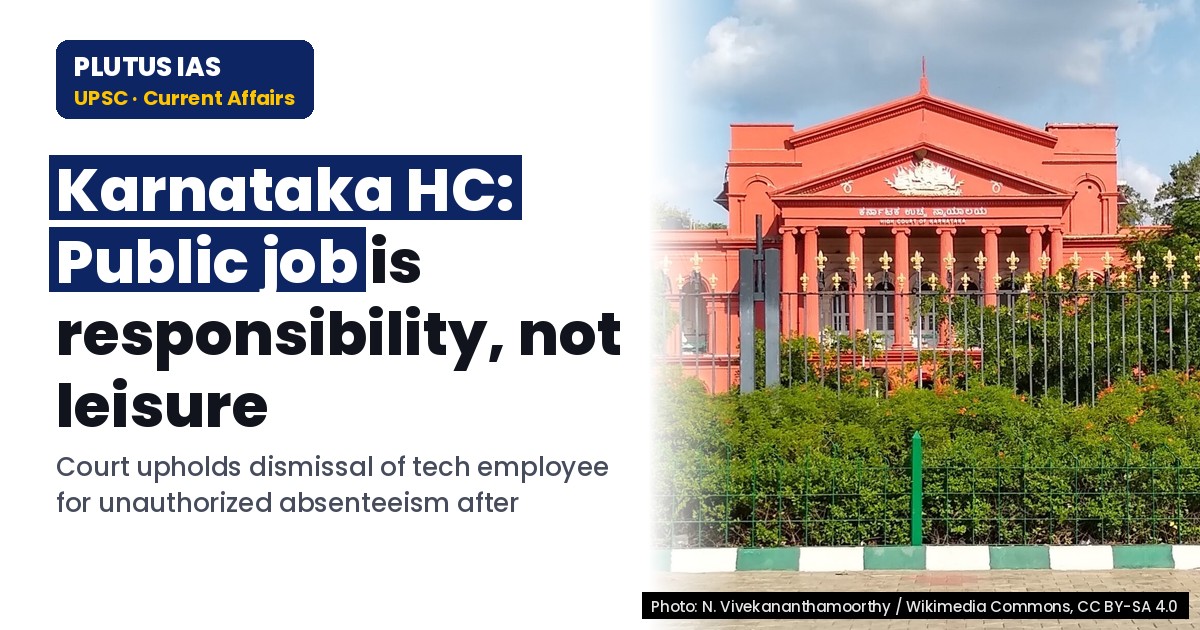
24 Oct Karnataka HC: Public Job is Responsibility, Not Leisurely Duty
✎ Public employment is a position of responsibility, not a privilege to be enjoyed at convenience; maternity benefits are protective measures, not exemptions from disciplinary obligations.
Subject Relevance — Where This Topic Fits
- GS Paper II — Constitutional and Non-Constitutional Bodies (Judiciary) | GS Paper IV — Ethics, Integrity and Aptitude (Work Culture and Professional Ethics)
- Prelims: Fundamental Duties under Article 51A, Doctrine of Proportionality in Administrative Actions, Maternity Benefit (Amendment) Act, 2017, Probationary Period in Government Service, Extraordinary Leave under Central Civil Services (Leave) Rules, 1972, Constitutional Protection of Maternity Rights under Article 15(3), Disciplinary Proceedings in Government Service
Quick Revision: Public employment is a position of responsibility, not a privilege to be enjoyed at convenience; maternity benefits are protective measures, not exemptions from disciplinary obligations.
Why is this in the news?
The Karnataka High Court, in a recent judgment, delineated the limits of maternity benefits in the context of unauthorised absence during probation. The ruling clarifies the legal framework governing the balance between protective labour rights and the disciplinary obligations incumbent upon government employees, particularly during the probationary period. This decision assumes significance in the context of evolving jurisprudence on work-life balance and administrative accountability in public service.
Background
- Public employment in India is governed by a structured legal framework that balances employee rights with institutional obligations, particularly during the probationary period.
- The Maternity Benefit (Amendment) Act, 2017, expanded maternity leave entitlements to 26 weeks for women employees in establishments with 10 or more workers, reflecting a progressive approach to gender inclusivity in the workforce.
- Government service in India operates under the principle of ‘probation’, during which employees are assessed for suitability, efficiency, and adherence to institutional norms before confirmation in service.
- The Central Civil Services (Leave) Rules, 1972, provide for various types of leave, including maternity leave, earned leave, and extraordinary leave, each with distinct eligibility criteria and procedural safeguards.
- Judicial precedents have consistently emphasised that while protective labour rights must be safeguarded, they cannot be invoked to circumvent the disciplinary framework that governs public employment.
- The case highlights the tension between the need to accommodate personal exigencies and the imperative of maintaining administrative discipline, a recurring theme in governance and public administration.
Jurisprudential Principles Governing Public Employment and Leave Entitlements
- Public employment is not a mere source of livelihood but a position of responsibility, carrying obligations of diligence, discipline, and devotion to duty, as reiterated by the Karnataka High Court.
- The protective umbrella of maternity benefits is designed to shield motherhood from the rigours of employment, not to immunise an employee from the discipline that employment necessarily demands, as held in the instant case.
- Maternity leave, though a sacrosanct right, cannot be stretched beyond its legitimate contours to justify unauthorised absence or prolonged leave without due process, as the court clarified.
- The judgment reinforces the doctrine of proportionality, wherein administrative actions must be proportionate to the objective sought to be achieved, balancing employee rights with institutional needs.
- Probationary employees are subject to heightened scrutiny, as their continued service is contingent upon meeting performance and conduct standards, distinct from permanent employees.
- The ruling aligns with the constitutional mandate under Article 15(3), which permits the State to make special provisions for women, while ensuring that such provisions do not undermine the broader framework of public service discipline.
- The decision underscores the importance of procedural fairness in disciplinary proceedings, including the need for clear communication of leave policies and consequences of unauthorised absence.
- The judgment serves as a reminder that while the State is obligated to provide a supportive work environment, employees must also uphold the standards of conduct expected in public service.
Key Features
| Feature | Significance |
|---|---|
| Public employment as a position of responsibility | Underscores that public service is not a privilege but a duty, requiring diligence, discipline, and devotion to duty, with security of tenure balanced by accountability. |
| Maternity benefits as a protective umbrella | Acknowledges that maternity leave shields motherhood from employment rigours but does not immunise an employee from post-leave employment obligations. |
| Extraordinary leave provisions | Highlights the limited scope of extraordinary leave, which cannot be invoked indefinitely to justify unauthorised absence beyond sanctioned leave. |
| Judicial balancing of rights and obligations | Demonstrates the judiciary’s role in interpreting statutory rights (e.g., maternity leave) without allowing them to be stretched into excuses for misconduct. |
| Administrative discretion in disciplinary action | Reinforces that probationary employees, despite job security, are subject to disciplinary measures for failure to discharge duties post-leave. |
Why it Matters
Governance and Public Administration
- Reinforces the principle that public employment carries inherent responsibilities, not merely rights, aligning with the constitutional ethos of service to the nation.
- Clarifies the limits of protective measures like maternity leave, ensuring they do not undermine the operational efficiency of public institutions.
- Sets a judicial precedent for balancing employee rights with institutional discipline, particularly for probationary employees.
- Emphasises the role of administrative discretion in maintaining workplace discipline, a critical aspect of public administration.
Legal and Jurisprudential
- Affirms that statutory rights (e.g., maternity leave) are not absolute but must be exercised within reasonable bounds, preventing misuse.
- Highlights the judiciary’s role in interpreting labour laws to prevent rights from being stretched into loopholes for misconduct.
- Demonstrates the application of the doctrine of proportionality in disciplinary actions against public employees.
Socio-Economic
- Underscores the scarcity of public employment opportunities and the need for employees to uphold the trust placed in them by society.
- Reinforces the societal expectation that public servants, including women on maternity leave, must return to duty to ensure continuity of public services.
- Balances gender-sensitive policies (e.g., maternity leave) with the need for institutional accountability.
Challenges
1. Balancing Employee Rights and Institutional Discipline
- Risk of rights (e.g., maternity leave) being misinterpreted as exemptions from all post-leave obligations, leading to absenteeism.
- Challenge of ensuring that protective measures do not erode workplace discipline or public service efficiency.
- Need for clear administrative guidelines on the limits of extraordinary leave and unauthorised absence.
- Potential for judicial overreach or underreach in interpreting the scope of employee rights versus institutional demands.
UPSC Link: GS-II: Role of Judiciary in Governance
2. Probationary Employees and Accountability
- Difficulty in assessing the performance and conduct of probationary employees, who may exploit leave provisions to avoid duty.
- Challenge of maintaining a balance between providing a fair chance to probationers and enforcing discipline.
- Need for robust probationary period evaluations to identify and address lapses early.
UPSC Link: GS-II: Civil Services – Probation and Training
3. Operational Continuity in Public Services
- Risk of service disruptions due to prolonged or unauthorised absences, particularly in critical sectors like healthcare or administration.
- Challenge of ensuring that public institutions can function efficiently despite employee absences.
- Need for contingency planning and cross-training to mitigate the impact of absences.
UPSC Link: GS-II: Public Administration – Challenges
Challenges — UPSC Perspective
| Issue | Concern |
|---|---|
| Misinterpretation of maternity benefits | Employees may view maternity leave as a blanket exemption from all post-leave obligations. |
| Administrative ambiguity in leave provisions | Lack of clarity on the limits of extraordinary leave and unauthorised absence. |
| Probationary employee accountability | Difficulty in enforcing discipline without discouraging new recruits. |
| Judicial balancing of rights and duties | Risk of either diluting rights or undermining institutional discipline. |
| Operational disruptions in public services | Prolonged absences may impact service delivery and institutional efficiency. |
Way Forward
- Clarify administrative guidelines on the scope and limits of extraordinary leave and unauthorised absence for public employees.
- Strengthen probationary period evaluations to identify and address lapses in conduct or performance early.
- Conduct awareness programmes for public employees on their rights and obligations, including post-maternity leave duties.
- Develop contingency plans for critical public services to mitigate the impact of employee absences.
- Encourage institutional mechanisms for cross-training and workload redistribution during absences.
- Promote gender-sensitive policies that balance maternity benefits with institutional accountability.
- Ensure transparency in disciplinary actions to maintain public trust in governance institutions.
UPSC Value Addition
Keywords for Mains Answer-Writing
Public employment · Constitutional protection of service · Discipline and diligence in service · Maternity benefits · Probationary employees · Extraordinary leave · Constitutional morality in service · Right to livelihood vs. duty to service · Administrative law · Judicial review of service conditions · Constitutional provisions on service obligations · Public trust doctrine · Doctrine of proportionality in service matters · Fundamental Duties of citizens · Article 311 of the Constitution of India · Government servant’s obligations · Work-life balance in public service · Judicial interpretation of service rules
Constitutional & Policy Linkages
- [‘Article 14: Equality before law’, ‘Ensures fair treatment in disciplinary actions.’]
- [‘Article 16: Equality of opportunity in public employment’, ‘Balances rights and obligations in public service.’]
- [‘Article 39(d): Equal pay for equal work’, ‘Reinforces the principle of duty-bound service.’]
Concept Flow
Public employment as a position of responsibility → Duties of diligence and discipline → Scarcity of opportunities → Need for accountability → Judicial interpretation of rights and obligations → Limits of maternity benefits → Post-leave obligations → Disciplinary action for unauthorised absence → Reinforcement of institutional efficiency.
Prelims Practice Questions
Q1. Consider the following statements regarding the constitutional provisions related to public employment in India: 1. Article 311(1) of the Constitution of India protects government servants from arbitrary dismissal. 2. The right to maternity leave is a fundamental right under Article 21 of the Constitution. 3. The doctrine of ‘public employment as a privilege’ was upheld by the Supreme Court in the case of Tulsidas Paul v. Union of India. How many of the above statements are correct?
- Only one
- Only two
- All three
- None
Answer: Only two — Statement 1 is correct as Article 311(1) protects civil servants from arbitrary dismissal. Statement 2 is incorrect; maternity leave is a statutory right under service rules, not a fundamental right under Article 21. Statement 3 is incorrect; the Supreme Court has consistently held that public employment is not a privilege but a position of responsibility.
Q2. Assertion (A): The Karnataka High Court in its recent judgment held that maternity benefits are intended to shield motherhood from the rigours of employment but do not immunise an employee from the discipline that employment necessarily demands. Reason (R): The judgment underscores the balance between protective rights of employees and the administrative discipline required in public employment.
- Both A and R are true, and R is the correct explanation of A
- Both A and R are true, but R is not the correct explanation of A
- A is true, but R is false
- A is false, but R is true
Answer: Both A and R are true, but R is not the correct explanation of A — Assertion (A) correctly reflects the Karnataka High Court’s observations. Reason (R) accurately explains the rationale behind the judgment, as it highlights the need to balance protective rights with service discipline.
Q3. Match the following constitutional provisions with their respective articles: Column I (Provision) | Column II (Article) 1. Protection of civil servants from arbitrary dismissal | A. Article 311 2. Right to equality before law | B. Article 14 3. Right to life and personal liberty | C. Article 21 4. Freedom of speech and expression | D. Article 19(1)(a)
- 1-A, 2-B, 3-C, 4-D
- 1-B, 2-A, 3-D, 4-C
- 1-C, 2-D, 3-A, 4-B
- 1-D, 2-C, 3-B, 4-A
Answer: 1-A, 2-B, 3-C, 4-D — Article 311 protects civil servants from arbitrary dismissal. Article 14 guarantees equality before law. Article 21 protects the right to life and personal liberty. Article 19(1)(a) guarantees freedom of speech and expression.
Mains Practice Question
✍ Public employment is not merely a source of livelihood but a position of responsibility carrying with it corresponding obligations of diligence, discipline, and devotion to duty. Critically examine this statement with reference to the constitutional framework and judicial pronouncements on service conditions in India. (15 Marks)
Approach: MODEL-ANSWER SKELETON:
1. Introduction: Define public employment and its constitutional significance (Articles 14, 16, 311).
2. Constitutional framework:
– Article 14 (equality before law) and Article 16 (equality of opportunity in public employment).
– Article 311: Protections against arbitrary dismissal, removal, or reduction in rank (Tulsidas Paul v. Union of India, 1987).
– Fundamental Duties (Article 51A): Duty to uphold the Constitution and national ideals.
3. Judicial interpretation:
– Karnataka High Court’s recent judgment: Balance between protective rights (maternity benefits) and service discipline.
– Supreme Court’s stance on probationary employees: Need for diligence and accountability (e.g., State of Punjab v. Surinder Kumar, 2020).
4. Doctrine of proportionality: Judicial review of service conditions must weigh individual rights against public interest.
5. Contemporary relevance: Rising cases of unauthorised absenteeism and their impact on public service delivery.
6. Conclusion: Public employment is a trust reposed by the state in its citizens; discipline and diligence are non-negotiable obligations. Suggest reforms to balance rights and responsibilities.
Source: The Hindu
Karnataka PCS (KPSC) — State PCS Practice
Prelims: According to the Karnataka High Court’s recent observation on public employment, which of the following best reflects its stance?
- Public employment is a position of responsibility and not a leisurely obligation
- Public employees are exempt from accountability due to their constitutional roles
- Public employment guarantees immunity from disciplinary actions
- Public employment is purely a contractual agreement with no societal obligations
Answer: Public employment is a position of responsibility and not a leisurely obligation — The Karnataka High Court emphasized that public employment carries a duty of responsibility toward society, not merely a casual obligation.
Mains: Critically analyze the Karnataka High Court’s observation that ‘public employment is no leisurely obligation, it is a position of responsibility.’ How does this principle align with the constitutional framework of public service in Karnataka? Provide suitable examples to substantiate your argument.
Generated by AanyaAi for educational purpose.
Related guides on our sites
- Current affairs for upsc 2026
- Best PSIR optional coaching for upsc
- Best PSIR optional teacher for upsc
- Best teacher of PSIR optional for upsc

- तेलंगाना का नया एयरोस्पेस और रक्षा नीति 2.0: UPSC के लिए महत्वपूर्ण जानकारी - October 24, 2026
- Agricultural Biological Resources ABS Benefits ₹1.04 Crore for Biodiversity - October 24, 2026
- ‘इंडिया केम-2026’ मुंबई में संपन्न: वैश्विक रसायन केंद्र बनने की ओर भारत - October 24, 2026

No Comments