


26 Oct ₹37.56 लाख करोड़ की 1,853 बुनियादी ढांचा परियोजनाओं पर सरकारी निगरानी
✎ The PM Gati Shakti National Master Plan’s real-time monitoring framework, operationalised through the PM Gati Shakti Portal, ensures transparent, data-driven governance of Central infrastructure projects, with a current coverage…
Subject Relevance — Where This Topic Fits
- GS Paper II — Governance, Constitution, Polity, Social Justice and International Relations (Governance mechanisms, e-infrastructure) | GS Paper III — Economy (Infrastructure Development, Investment Models, Public Expenditure Management)
- Prelims: PM Gati Shakti National Master Plan, Project Monitoring Group (PMG), e-SamikSha platform, Infrastructure project classification (Mega/Important projects), Hybrid Annuity Model (HAM), BOT (Build-Operate-Transfer), Physical vs Financial Progress in projects, Union Budget allocation for infrastructure, National Infrastructure Pipeline (NIP), Statutory provisions under the Constitution (Article 282, Article 292) relating to public expenditure
- Essay: Infrastructure as the backbone of economic growth: Challenges and opportunities in India, Role of technology in transforming governance: Case study of digital infrastructure monitoring
Quick Revision: The PM Gati Shakti National Master Plan’s real-time monitoring framework, operationalised through the PM Gati Shakti Portal, ensures transparent, data-driven governance of Central infrastructure projects, with a current coverage of 1,853 projects worth ₹37.56 lakh crore as of September 2026.
Why is this in the news?
The Press Information Bureau (PIB) released a monthly flash report on Central infrastructure projects as of September 2026, highlighting the monitoring of 1,853 projects with an aggregate estimated cost of ₹37.56 lakh crore. The report underscores the progress in expenditure (₹17.73 lakh crore, 47.21% of total cost) and the sectoral distribution, with a significant focus on transport, logistics, and energy. This reflects the operationalisation of the PM Gati Shakti National Master Plan and the role of digital platforms like the PM Gati Shakti Portal in ensuring real-time tracking and accountability in infrastructure development.
Background
- The PM Gati Shakti National Master Plan (PMGS-NMP), launched in October 2021, aims to achieve integrated and holistic infrastructure development by synchronising 16 Ministries and Departments through a digital platform.
- The Plan envisions a ‘Gati Shakti 1.0’ phase (2022-2025) and a ‘Gati Shakti 2.0’ phase (2025-2030), with a total outlay of ₹100 lakh crore for infrastructure projects.
- The Project Monitoring Group (PMG), under the Department for Promotion of Industry and Internal Trade (DPIIT), was repurposed to track and resolve bottlenecks in infrastructure projects, leveraging the PMGS portal for transparency.
- The National Infrastructure Pipeline (NIP), launched in 2019, identified 7,400 projects worth ₹111 lakh crore for implementation between 2020-2025, serving as a precursor to the PMGS-NMP.
- The e-SamikSha platform, managed by the Ministry of Statistics and Programme Implementation (MoSPI), provides real-time monitoring of Central sector projects, ensuring data-driven decision-making and inter-ministerial coordination.
- The Union Budget 2023-24 allocated ₹10 lakh crore for infrastructure, with a focus on multi-modal connectivity, energy transition, and urban infrastructure.
What is the Central Infrastructure Monitoring Framework under PM Gati Shakti?
- The framework is a digital governance mechanism established under the PM Gati Shakti National Master Plan (PMGS-NMP) to monitor Central infrastructure projects in real time, ensuring transparency, accountability, and timely completion.
- It operates through the PM Gati Shakti Portal (formerly known as the Project Monitoring Group Portal).
- The portal tracks projects across their lifecycle, from conceptualisation to completion, providing granular data on physical progress (e.g., land acquisition, construction milestones) and financial progress (expenditure against sanctioned costs).
- The framework classifies projects into Mega Projects (₹1,000 crore and above) and Important Projects (below ₹1,000 crore), enabling prioritisation and resource allocation based on scale and impact.
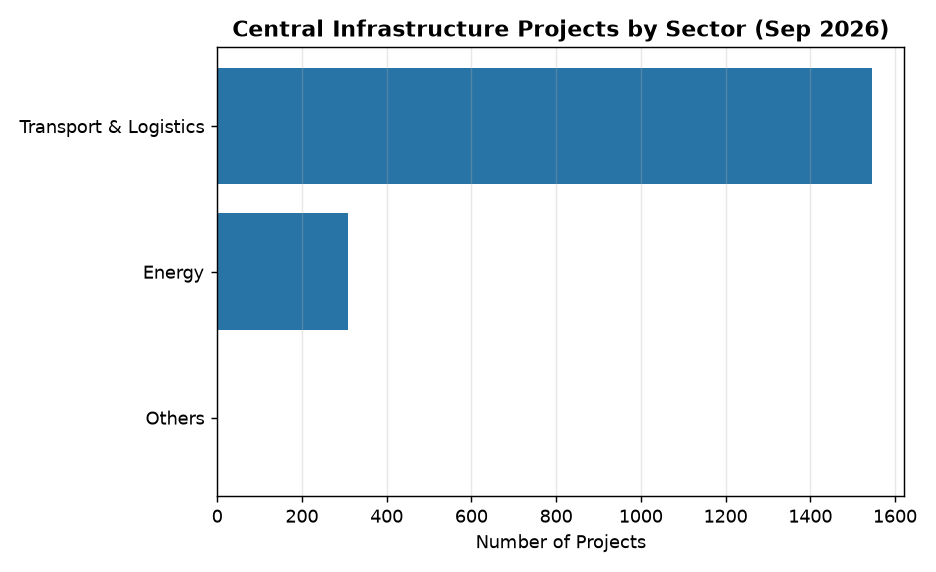
- Sectoral prioritisation is evident, with transport, logistics, and energy sectors accounting for 83.4% of the monitored projects, reflecting the Plan’s focus on multi-modal connectivity and energy security.
- The monitoring framework supports the resolution of inter-ministerial and inter-state bottlenecks through a dedicated Project Monitoring Group (PMG), which conducts weekly reviews and coordinates with state governments and project authorities.
- Data from the portal informs budgetary allocations, policy adjustments, and mid-course corrections, ensuring that infrastructure development aligns with economic and social objectives.
- The framework is a critical enabler of the ‘Gati Shakti 2.0’ phase, which aims to integrate 100 critical infrastructure gaps, reduce logistics costs, and enhance India’s global competitiveness.
Key Features
| Feature | Significance |
|---|---|
| Total monitored projects (as of September 2026) | 1,853 central infrastructure projects tracked under the PM Gati Shakti–aligned ‘e-Samiksha’ (PAiSA) portal, ensuring real-time monitoring and data-driven governance. |
| Aggregate project cost | ₹37.56 lakh crore, representing the total estimated outlay for all monitored projects, reflecting the scale of infrastructure investment. |
| Cumulative expenditure | ₹17.73 lakh crore (47.21% of total cost), indicating steady progress in fund utilisation and project execution. |
| Sectoral distribution | 83.4% (1,545 projects) fall under Transport & Logistics and Energy sectors, underscoring policy priority on connectivity and energy security. |
| Physical progress cluster | 654 projects (~35%) at ≥80% completion stage, while 338 projects (~18%) have achieved ≥80% financial closure, demonstrating balanced pipeline management. |
Why it Matters
Economic Growth and Investment
- Accelerates GDP growth by enhancing physical capital stock and reducing logistical bottlenecks through targeted infrastructure expansion.
Public Expenditure Efficiency
- Demonstrates improved fiscal governance via real-time tracking of expenditure against outlay, reducing delays and cost overruns.
Sectoral Prioritisation
- Highlights government focus on transport (roads, ports, railways) and energy (thermal, renewable integration) sectors, aligning with National Infrastructure Pipeline (NIP) objectives.
PM Gati Shakti Framework
- Serves as a critical enabler for multi-modal connectivity planning, reducing inter-ministerial silos and improving project synergy through the ‘PM Gati Shakti National Master Plan’.
Data-Driven Governance
- Leverages the ‘e-Samiksha’ (PAiSA) portal for transparent, evidence-based monitoring, enhancing accountability and stakeholder trust.
Challenges
1. Cost Overruns and Delays
- Persistent risk of cost escalation due to land acquisition delays, environmental clearances, and supply chain disruptions, as evidenced by partial financial closure in early-stage projects.
UPSC Link: Economic Survey: Infrastructure bottlenecks
2. Coordination Gaps
- Inter-ministerial and inter-state coordination challenges persist despite the PM Gati Shakti framework, particularly in projects spanning multiple jurisdictions.
UPSC Link: Concurrent List: Infrastructure
3. Environmental and Social Compliance
- Stringent environmental and forest clearance requirements often lead to project halts or redesigns, necessitating robust EIA frameworks and public consultation mechanisms.
UPSC Link: Environmental Impact Assessment
4. Financial Viability of Mega Projects
- Large-scale projects (₹1,000 crore+) face viability risks due to revenue uncertainty, particularly in sectors like ports and power transmission.
UPSC Link: Public-Private Partnerships
5. Skill and Labour Shortages
- Shortages of skilled labour and technical expertise in construction, particularly for specialised projects like slurry pipelines and high-voltage transmission lines.
UPSC Link: Skill Development: PMKVY
6. Climate Resilience
- Inadequate integration of climate adaptation measures in project design, increasing vulnerability to extreme weather events and long-term operational risks.
UPSC Link: Disaster Management: Sendai Framework
Challenges — UPSC Perspective
| Issue | Concern |
|---|---|
| Land acquisition delays | Protracted legal and administrative processes under the Right to Fair Compensation and Transparency in Land Acquisition Act (RFCTLARR), 2013, leading to project stalls. |
| Environmental clearances | Multi-stage approvals under the Environment (Protection) Act, 1986, often result in prolonged delays due to public interest litigations and expert committee reviews. |
| Supply chain disruptions | Global and domestic factors (e.g., geopolitical tensions, raw material shortages) disrupt project timelines and escalate costs. |
| Revenue model risks | Projects in sectors like ports and power transmission lack assured revenue streams, increasing dependence on viability gap funding (VGF). |
Way Forward
- Strengthen inter-ministerial coordination through the PM Gati Shakti National Master Plan by establishing dedicated nodal officers for cross-sectoral projects.
- Accelerate land acquisition processes by leveraging the ‘Land Bank’ under the Digital India Land Records Modernisation Programme (DILRMP).
- Enhance environmental clearance timelines by digitising the Environmental Impact Assessment (EIA) process under the EIA Notification, 2006.
- Promote public-private partnerships (PPPs) in mega projects to share financial risks and improve operational efficiency, aligning with the National Monetisation Pipeline (NMP).
- Integrate climate resilience into project design by mandating climate risk assessments in line with the National Action Plan on Climate Change (NAPCC).
- Expand skill development initiatives under the Skill India Mission to address labour shortages in specialised infrastructure sectors.
- Leverage the e-Samiksha (PAiSA) portal for predictive analytics to forecast delays and cost overruns, enabling pre-emptive interventions.
UPSC Value Addition
Keywords for Mains Answer-Writing
Infrastructure development · Project monitoring · PM Gati Shakti National Master Plan · Economic growth · Public expenditure · Multi-sectoral infrastructure · Project implementation · Central ministries · Physical and financial progress · Mega and major infrastructure projects
Concept Flow
Policy Framework: PM Gati Shakti National Master Plan → Institutional Mechanism: e-Samiksha (PAiSA) Portal → Implementation: 1,853 projects tracked → Monitoring: Physical & Financial Progress → Challenges: Delays, Cost Overruns → Governance Reforms: Digitisation, PPPs → Outcome: Enhanced Infrastructure Delivery → Impact: Economic Growth & Connectivity
Prelims Practice Questions
Q1. Consider the following statements regarding the PM Gati Shakti National Master Plan (NMP):
1. The NMP aims to integrate infrastructure planning across multiple sectors.
2. The NMP is implemented solely by the Ministry of Road Transport and Highways.
3. The NMP includes a digital platform for real-time monitoring of infrastructure projects.
4. The NMP prioritises connectivity-driven infrastructure development.
How many of the above statements are correct?
- Only one
- Only two
- Only three
- All
Answer: All — Statements 1, 3, and 4 are correct. Statement 2 is incorrect as the NMP involves multiple ministries and departments, not solely the Ministry of Road Transport and Highways.
Q2. Assertion (A): The ‘PM Gati Shakti’ initiative is designed to enhance the efficiency of infrastructure project implementation in India.
Reason (R): It integrates spatial planning tools with multi-modal connectivity infrastructure.
Options:
A. Both A and R are true, and R is the correct explanation of A.
B. Both A and R are true, but R is NOT the correct explanation of A.
C. A is true, but R is false.
D. A is false, but R is true.
Answer: ? — Both Assertion (A) and Reason (R) are true, and Reason (R) correctly explains Assertion (A). The PM Gati Shakti initiative integrates spatial planning tools with multi-modal connectivity infrastructure to improve project implementation efficiency.
Q3. Match the following infrastructure sectors with their respective ministries responsible for their implementation under the PM Gati Shakti framework:
Column I (Sector) | Column II (Ministry)
——————————————-|——————————————-
A. Roads and Highways | 1. Ministry of Ports, Shipping and Waterways
B. Power Transmission | 2. Ministry of Power
C. Port Modernisation | 3. Ministry of Road Transport and Highways
D. Railway Connectivity | 4. Ministry of Railways
Options:
A. A-3, B-2, C-1, D-4
B. A-1, B-2, C-3, D-4
C. A-4, B-3, C-2, D-1
D. A-2, B-1, C-4, D-3
Answer: ? — The correct matches are: A (Roads and Highways) – 3 (Ministry of Road Transport and Highways), B (Power Transmission) – 2 (Ministry of Power), C (Port Modernisation) – 1 (Ministry of Ports, Shipping and Waterways), D (Railway Connectivity) – 4 (Ministry of Railways).
Mains Practice Question
✍ The PM Gati Shakti National Master Plan (NMP) represents a paradigm shift in infrastructure development in India by integrating multi-sectoral planning and real-time monitoring. Critically examine the institutional mechanisms, technological tools, and sectoral priorities that underpin this initiative. Also, assess its potential to address India’s infrastructure deficit while ensuring fiscal discipline and time-bound implementation. (15 Marks)
Approach: Introduction (2 marks): Define the PM Gati Shakti NMP, its objectives, and its alignment with the broader goal of ‘Viksit Bharat 2047’. Mention the scale of infrastructure projects (₹37.56 lakh crore across 1,853 projects) and the role of the Ministry of Statistics and Programme Implementation (MoSPI) in monitoring via the ‘PM Gati Shakti’ portal. Institutional Mechanisms (4 marks): Explain the multi-ministerial coordination framework under the NMP, including the role of the Empowered Group of Secretaries (EGoS) and the Network Planning Group (NPG). Highlight the integration of the NMP with the ‘One District, One Product’ (ODOP) scheme and the ‘Bharatmala’ and ‘Sagarmala’ programmes. Technological Tools (3 marks): Discuss the role of the ‘PM Gati Shakti’ digital platform in real-time monitoring, data-driven decision-making, and inter-ministerial coordination. Mention the use of GIS-based spatial planning tools and the integration with the ‘Bhu-Naksha’ and ‘Gati Shakti Sanchar’ platforms. Sectoral Priorities (3 marks): Analyse the focus on connectivity-driven infrastructure (transport, logistics, and energy sectors) and the emphasis on mega-projects (₹1,000 crore and above). Highlight the progress in physical and financial terms (e.g., 654 projects at 80% physical progress, 338 projects at 80% financial progress). Challenges and Way Forward (3 marks): Critically examine the challenges such as land acquisition delays, environmental clearances, inter-ministerial coordination gaps, and fiscal constraints. Suggest measures like streamlining approval processes, leveraging public-private partnerships (PPPs), and enhancing state-level implementation capacity.
Source: PIB (Press Information Bureau)
Generated by AanyaAi for educational purpose.
Related guides on our sites
- Best PSIR optional coaching for upsc
- Best PSIR optional teacher for upsc
- Best teacher of PSIR optional for upsc
- Best PSIR optional coaching in delhi for UPSC

- IMD Forecasts Cyclone Activity in Bay of Bengal, Arabian Sea - November 7, 2026
- आरबीआई के नए स्वर्ण ऋण नियम: पात्रता, मूल्यांकन और चुकौती में बदलाव - November 7, 2026
- Karnataka HC: ED Not ‘Super Cop’, PMLA Powers Derivative - November 7, 2026

No Comments