


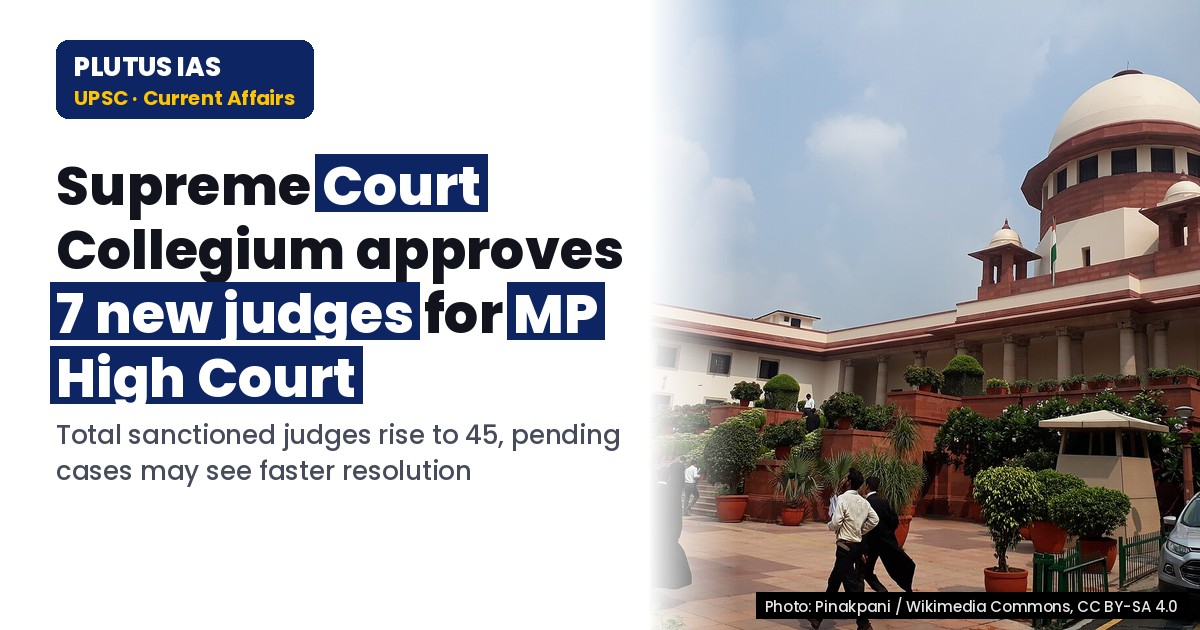
27 Oct MP High Court to Get 7 New Judges: Collegium Approves, Total Rises to 45
✎ The Collegium System, as evolved through judicial precedents, is the mechanism for appointing judges to the higher judiciary in India, with the Supreme Court Collegium playing a pivotal role in recommending names, which are then…
Subject Relevance — Where This Topic Fits
- GS Paper II — Polity and Governance — Judiciary and Judicial Reforms | GS Paper II — Polity and Governance — Constitutional and Statutory Bodies
- Prelims: Collegium System, Judicial Appointments Commission, Article 217, Judicial Vacancy Management, High Court Judges (Number) Act, 1954
- Essay: Judicial Reforms and Governance in India: Balancing Efficiency and Independence
Quick Revision: The Collegium System, as evolved through judicial precedents, is the mechanism for appointing judges to the higher judiciary in India, with the Supreme Court Collegium playing a pivotal role in recommending names, which are then processed through executive and constitutional formalities before formal appointment.
Why is this in the news?
The Supreme Court Collegium has approved the appointment of seven new judges to the Madhya Pradesh High Court, increasing the working strength from 38 to 45 judges. This development is significant as it addresses the persistent issue of judicial vacancies in high courts, which often leads to delays in the disposal of cases and affects judicial efficiency. The process highlights the role of the collegium system in judicial appointments and the procedural steps required for formalising such recommendations.
Background
- The Madhya Pradesh High Court, established in 1956, is one of the oldest high courts in India and serves as the highest judicial authority in the state.
- The sanctioned strength of judges in the Madhya Pradesh High Court is 53, as per the High Court Judges (Number) Act, 1954, though the current working strength has historically fallen short of this number.
- Judicial vacancies in high courts are a persistent challenge, with the Supreme Court Collegium periodically approving appointments to fill these gaps.
- The collegium system, evolved through judicial pronouncements such as the Second and Third Judges Cases (1993 and 1998), is the mechanism for judicial appointments and transfers in the higher judiciary.
- The Union Ministry of Law and Justice, along with the President of India, plays a formal role in the appointment process after the Collegium’s recommendation.
- The appointment of advocates as judges is governed by Article 217 of the Constitution, which stipulates eligibility criteria, including a minimum of ten years’ practice as an advocate.
What is the Collegium System and How Does It Function?
- The Collegium System is a judicial innovation that emerged from the Supreme Court’s interpretation of constitutional provisions, particularly Articles 124(2) and 217, which deal with the appointment and transfer of judges in the higher judiciary.
- It comprises the Chief Justice of India and the four seniormost judges of the Supreme Court, who collectively recommend names for appointments and transfers of judges to high courts and the Supreme Court.
- The system was formalised through the Supreme Court’s judgments in the Second Judges Case (1993) and the Third Judges Case (1998), which expanded the role of the judiciary in the appointment process, reducing executive interference.
- The Collegium evaluates candidates based on their legal acumen, integrity, and experience, including their contributions to legal scholarship, public interest litigation, and pro bono work.
- Once the Collegium approves a recommendation, it is forwarded to the Union Ministry of Law and Justice for administrative clearance, followed by the President’s assent, which is a constitutional formality.
- The final step involves the swearing-in of the appointees by the Governor of the respective state, after which they assume office as judges of the high court.
- The system aims to ensure judicial independence by insulating the appointment process from political or executive influence, though it has faced criticism for its opacity and lack of accountability.
- The Collegium’s recommendations are not subject to judicial review, reinforcing the principle of judicial primacy in matters of judicial appointments.
Key Features
| Feature | Significance |
|---|---|
| Appointment of 7 new judges | Increases the sanctioned strength of Madhya Pradesh High Court from 38 to 45 judges, enhancing judicial capacity for faster disposal of cases. |
| Collegium system approval | Demonstrates the functioning of the Supreme Court Collegium in recommending judicial appointments, ensuring transparency and merit-based selection. |
| Vacancy reduction | Reduces the number of vacant judicial posts from 15 to 8, improving the ratio of judges to pending cases. |
| Post-appointment process | Involves administrative formalities by the Law Ministry and the President before the appointees assume office, ensuring constitutional compliance. |
| Impact on pendency | Expected to accelerate the resolution of pending cases by increasing the number of judges, thereby reducing judicial backlog. |
Why it Matters
Judicial Administration
- Strengthens the judiciary’s capacity to handle the increasing caseload, particularly in Madhya Pradesh High Court.
- Enhances the efficiency of the judicial system by reducing the judge-to-case ratio.
- Supports the constitutional mandate of timely justice delivery under Article 21 of the Constitution.
Governance and Policy
- Demonstrates the operational efficiency of the Supreme Court Collegium system in judicial appointments.
- Highlights the role of the executive (Law Ministry and President) in formalising judicial appointments.
- Underscores the importance of judicial infrastructure in ensuring effective governance and rule of law.
Legal Profession
- Recognises the contributions of senior advocates by elevating them to judicial positions, fostering a meritocratic system.
- Encourages experienced legal professionals to contribute to the judiciary, bridging the gap between the bar and the bench.
Challenges
1. Judicial Vacancies and Pendency
- Despite the increase in sanctioned strength, 8 posts remain vacant, indicating persistent challenges in filling judicial positions.
- High pendency of cases in High Courts, including Madhya Pradesh, continues to strain the judicial system.
- Delays in administrative formalities (e.g., Law Ministry clearance) may further postpone the assumption of office by appointees.
UPSC Link: Judicial Pendency and Appointments
2. Collegium System Criticisms
- Lack of transparency in the Collegium’s decision-making process remains a contentious issue.
- Perceived delays in recommendations and appointments can undermine judicial efficiency.
- Need for a more structured and time-bound process to ensure timely judicial appointments.
UPSC Link: Collegium System and Judicial Reforms
3. Judicial Infrastructure
- Inadequate physical and digital infrastructure in High Courts may limit the impact of increased judicial strength.
- Need for better court management systems to optimise the utilisation of additional judges.
UPSC Link: Judicial Infrastructure and Reforms
Challenges — UPSC Perspective
| Issue | Concern |
|---|---|
| Vacant judicial posts | Persistent shortage of judges despite sanctioned strength increases. |
| Case pendency | High number of pending cases in High Courts, including Madhya Pradesh. |
| Administrative delays | Potential bottlenecks in the Law Ministry and President’s office formalising appointments. |
| Collegium transparency | Lack of clear criteria and transparency in the Collegium’s selection process. |
| Judicial infrastructure | Inadequate courtrooms, staff, and digital systems to support additional judges. |
Way Forward
- Streamline the administrative process for judicial appointments to minimise delays between Collegium recommendations and oath-taking.
- Enhance transparency in the Collegium system by publishing detailed criteria and evaluation metrics for judicial appointments.
- Strengthen judicial infrastructure in High Courts, including digital case management systems and additional courtrooms.
- Conduct regular reviews of judicial vacancies and pendency to identify and address systemic bottlenecks.
- Promote alternative dispute resolution mechanisms (e.g., mediation, Lok Adalats) to reduce the burden on High Courts.
- Ensure adequate training and orientation for newly appointed judges to familiarise them with court procedures and case management.
- Explore measures to attract and retain qualified legal professionals in the judiciary, such as competitive remuneration and career growth opportunities.
UPSC Value Addition
Keywords for Mains Answer-Writing
Judicial Appointments · Supreme Court Collegium System · High Court Judges · Judicial Vacancies · Judicial Reforms · Judicial Accountability · Constitutional Provisions for Judicial Appointments · Judicial Vacancy Reduction · Judicial Workload Management · Judicial Independence · Appointment of Advocates as Judges · Judicial Collegium Process · Judicial Infrastructure · Judicial Pendency · Judicial Appointment Criteria
Constitutional & Policy Linkages
- Article 216: Constitution of High Courts and appointment of judges.
- Article 224: Appointment of additional and acting judges in High Courts.
Concept Flow
Supreme Court Collegium recommends judicial appointments based on merit and seniority. → Collegium’s recommendation is forwarded to the Law Ministry and President for administrative approval. → Law Ministry and President formalise appointments through official notification. → Appointees take oath and assume office as High Court judges. → Increased judicial strength enhances case disposal capacity, reducing pendency. → Judicial efficiency improves, supporting constitutional guarantees of timely justice.
Prelims Practice Questions
Q1. Consider the following statements regarding the Supreme Court Collegium System in India:
1. The Collegium System was established by the Constitution of India.
2. The Collegium consists of the Chief Justice of India and four senior-most judges of the Supreme Court.
3. The Collegium recommends the appointment and transfer of judges to the Supreme Court and High Courts.
4. The recommendations of the Collegium are binding on the Central Government.
How many of the above statements are correct?
- Only one
- Only two
- Only three
- All four
Answer: Only three — Statements 2 and 3 are correct. The Collegium System is a convention evolved through judicial pronouncements, not established by the Constitution. The recommendations of the Collegium are not binding on the Central Government, which can raise objections or seek clarifications.
Q2. Assertion (A): The appointment of judges to High Courts in India is solely based on seniority within the judiciary.
Reason (R): The Collegium System ensures that only the most senior judges are appointed to the High Courts.
In the context of the above two statements, which one of the following is correct?
- Both A and R are true, and R is the correct explanation of A
- Both A and R are true, but R is not the correct explanation of A
- A is true, but R is false
- A is false, but R is true
Answer: A is false, but R is true — Assertion (A) is false. The appointment of judges to High Courts is not solely based on seniority; it also considers merit, integrity, and representation from the bar. Reason (R) is also false as the Collegium System does not exclusively rely on seniority.
Q3. Match the following columns regarding judicial appointments in India:
Column I
A. Article 217
B. Article 224
C. Article 124(2)
D. Article 216
Column II
1. Appointment of Additional Judges to High Courts
2. Appointment of Judges to the Supreme Court
3. Appointment of Chief Justice of a High Court
4. Constitution of High Courts
Select the correct match:
- A-3, B-1, C-2, D-4
- A-4, B-1, C-2, D-3
- A-3, B-2, C-1, D-4
- A-1, B-3, C-2, D-4
Answer: A-3, B-1, C-2, D-4 — The correct matches are: A (Article 217) – 3 (Appointment of Chief Justice of a High Court), B (Article 224) – 1 (Appointment of Additional Judges to High Courts), C (Article 124(2)) – 2 (Appointment of Judges to the Supreme Court), D (Article 216) – 4 (Constitution of High Courts).
Mains Practice Question
✍ The Supreme Court Collegium’s recommendation for the appointment of seven new judges to the Madhya Pradesh High Court reflects the evolving dynamics of judicial appointments in India. Critically examine the constitutional and institutional framework governing judicial appointments to High Courts, highlighting the role of the Collegium System and its implications for judicial independence and accountability. (15 Marks)
Approach: MODEL-ANSWER SKELETON:
1. **Constitutional Framework** (4 points):
– Articles 216-224 of the Constitution govern the establishment and functioning of High Courts and the appointment of judges.
– Article 217(1) specifies the appointment of judges to High Courts, including Chief Justices and puisne judges.
– Article 224 addresses the appointment of additional judges to High Courts.
– The President of India appoints judges based on the recommendations of the Supreme Court Collegium.
2. **Collegium System: Evolution and Composition** (4 points):
– Originated from the Supreme Court’s judgments in the **Second and Third Judges Cases (1993, 1998)**, which interpreted Articles 124(2) and 217 to assert primacy of the judiciary in appointments.
– Composition: The Collegium consists of the Chief Justice of India (CJI) and four senior-most judges of the Supreme Court.
– Functions: Recommends appointments, transfers, and elevations of judges to the Supreme Court and High Courts.
– **Judicial Independence vs. Executive Role**: The Collegium System was developed to insulate judicial appointments from executive interference, addressing concerns of politicisation.
3. **Process of Appointment** (3 points):
– The Collegium identifies suitable candidates from the bar and judicial services.
– Recommendations are sent to the Central Government, which may raise objections or seek clarifications.
– Final approval is given by the President after due process, including consultation with the Governor of the state concerned.
4. **Implications for Judicial Independence and Accountability** (4 points):
– **Judicial Independence**: The Collegium System ensures that judges are appointed based on merit and integrity, reducing executive influence.
– **Accountability**: Criticisms include lack of transparency, absence of a formalised criteria for selection, and potential for nepotism or favouritism.
– **Judicial Pendency**: Appointment of judges aims to address vacancies and reduce backlog of cases, as seen in the Madhya Pradesh High Court (38 judges for 53 sanctioned posts).
– **Balancing Act**: The system seeks to balance judicial independence with accountability, though challenges persist in ensuring diversity and representation.
5. **Conclusion** (2 points):
– The Collegium System, while imperfect, remains a cornerstone of judicial appointments in India, safeguarding judicial independence.
– Reforms such as transparency in selection criteria and grievance redressal mechanisms could enhance accountability without compromising independence.
Source: amarujala.com
Generated by AanyaAi for educational purpose.
Related guides on our sites
- Best PSIR optional coaching for upsc
- Best PSIR optional teacher for upsc
- Best teacher of PSIR optional for upsc
- Best PSIR optional coaching in delhi for UPSC

- MP High Court to Get 7 New Judges: Collegium Approves, Total Rises to 45 - October 27, 2026
- गलत चक्रवात अलर्ट पर कानूनी कार्रवाई: ओडिशा सरकार की चेतावनी - October 27, 2026
- ESIC Karnataka dispute resolved: 37 contract workers reinstated with ₹7.4L dues paid - October 27, 2026

No Comments