


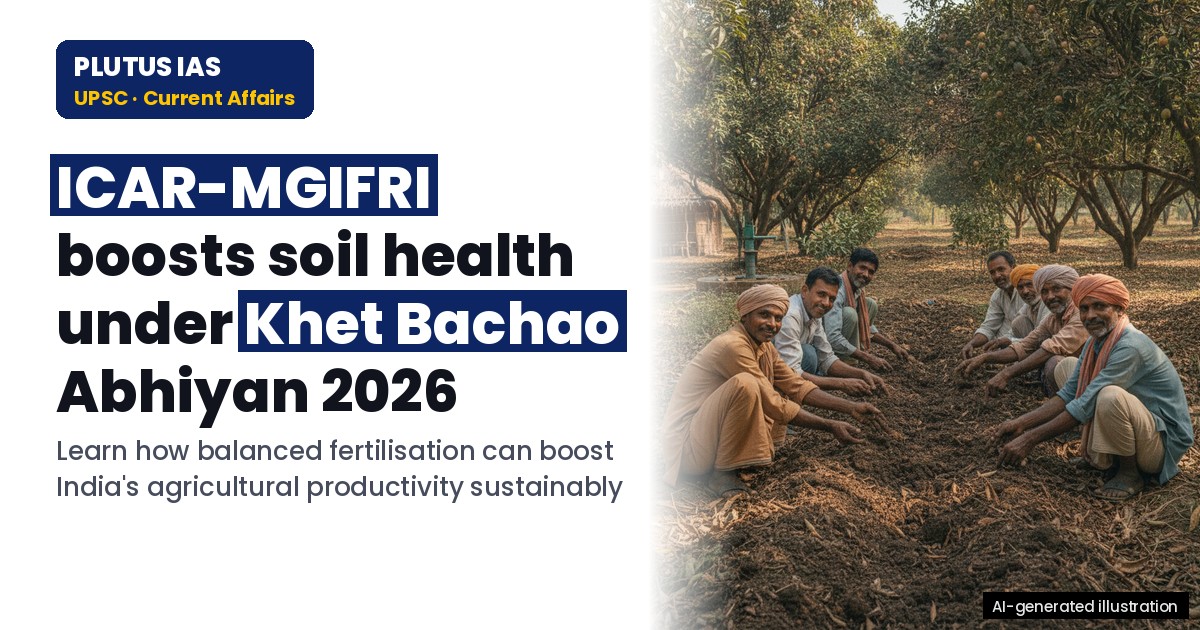
27 Oct ICAR-MGIFRI’s Soil Health Initiative Under Khet Bachao Abhiyan 2026
✎ Integrated Nutrient Management (INM) under the ICAR-MGIFRI initiative combines chemical fertilisers with organic amendments and biofertilisers to restore soil health, enhance nutrient use efficiency, and reduce environmental…
Subject Relevance — Where This Topic Fits
- GS Paper III — Agriculture | GS Paper III — Environment and Sustainable Development | GS Paper III — Science and Technology
- Prelims: Soil Health Card Scheme, Balanced Fertilisation, Integrated Nutrient Management, Sustainable Agriculture, Soil Organic Carbon, Orchard Management, ICAR, MGIFRI
- Essay: Sustainability in Agriculture: Balancing Productivity and Environmental Stewardship, The Role of Science and Technology in Transforming Indian Agriculture
Quick Revision: Integrated Nutrient Management (INM) under the ICAR-MGIFRI initiative combines chemical fertilisers with organic amendments and biofertilisers to restore soil health, enhance nutrient use efficiency, and reduce environmental degradation in orchards.
Why is this in the news?
The Indian Council of Agricultural Research (ICAR) – Mahatma Gandhi Integrated Farming Research Institute (MGIFRI) has launched a targeted initiative under the Khet Bachao Abhiyan 2026 to promote soil health, balanced fertilisation, and sustainable orchard management. This initiative aligns with national priorities for climate-resilient agriculture and aligns with the objectives of the Soil Health Card Scheme and the National Mission for Sustainable Agriculture (NMSA). The initiative is significant as it integrates scientific research with field-level implementation to address the twin challenges of soil degradation and declining orchard productivity in India.
Background
- Soil degradation affects approximately 30% of India’s total geographical area, with nutrient depletion and erosion being critical concerns in horticultural and agricultural systems.
- The Soil Health Card Scheme (launched in 2015) provides farmers with soil health reports and recommendations for balanced fertilisation, yet adoption remains uneven due to awareness gaps and logistical constraints.
- India is the world’s second-largest producer of fruits, after China, with horticulture contributing significantly to agricultural GDP; however, orchard productivity is constrained by imbalanced fertiliser use and declining soil organic carbon levels.
- The National Mission for Sustainable Agriculture (NMSA) under the National Action Plan on Climate Change (NAPCC) aims to promote sustainable agricultural practices, including integrated nutrient management and climate-smart agriculture.
- The Khet Bachao Abhiyan (Farmers’ Rescue Campaign) is a government-led initiative to revitalise agricultural productivity through soil health restoration, water conservation, and adoption of sustainable farming techniques.
- ICAR-MGIFRI, a premier research institute under ICAR, focuses on integrated farming systems, including orchard management, soil health, and agroforestry, to enhance farm profitability and ecological resilience.
What is the ICAR-MGIFRI initiative under Khet Bachao Abhiyan 2026?
- The initiative is a multi-pronged programme designed to enhance soil health in orchards through scientific soil testing, balanced fertilisation, and organic matter enrichment, thereby improving nutrient use efficiency and reducing chemical fertiliser dependency.
- It promotes Integrated Nutrient Management (INM) by recommending site-specific nutrient doses based on soil health card data, integrating chemical fertilisers with organic amendments (compost, vermicompost, green manure) and biofertilisers (Rhizobium, Azotobacter, PSB).
- The programme includes capacity-building for farmers, agricultural extension workers, and cooperatives on sustainable orchard management practices, such as mulching, cover cropping, and precision irrigation to conserve soil moisture and reduce erosion.
- A key component is the establishment of demonstration plots in major horticultural belts (e.g., mango, citrus, apple, and grape orchards) to showcase the economic and ecological benefits of balanced fertilisation and soil health restoration.
- The initiative leverages digital tools, including mobile applications for real-time soil health monitoring and decision support systems, to facilitate data-driven fertiliser recommendations and track progress at the farm level.
- The programme also addresses gender inclusivity by training women farmers in soil health management and sustainable orchard practices, recognising their pivotal role in agricultural decision-making.
- Research under MGIFRI provides evidence-based insights into soil-plant-microbe interactions, aiding the development of region-specific fertiliser schedules and organic amendment protocols for different agro-climatic zones.
Key Features
| Feature | Significance |
|---|---|
| Promotion of balanced fertilisation | Mitigates soil degradation by reducing over-reliance on chemical fertilisers, thereby enhancing long-term soil fertility and crop productivity. |
| Sustainable orchard management practices | Integrates agroecological principles to improve biodiversity, water retention, and carbon sequestration in fruit orchards. |
| Soil health assessment under Khet Bachao Abhiyan 2026 | Provides a framework for systematic soil testing and nutrient mapping to tailor fertiliser use to local agro-climatic conditions. |
| Capacity-building for farmers and extension workers | Ensures dissemination of scientific knowledge on precision agriculture techniques and integrated nutrient management systems. |
| Institutional collaboration via ICAR-MGIFRI | Leverages research expertise of the Indian Council of Agricultural Research (ICAR) and the Mahatma Gandhi Institute of Farming and Rural Innovation (MGIFRI) to standardise best practices. |
Why it Matters
Agricultural Productivity and Food Security
- Sustainable soil management directly contributes to the National Mission for Sustainable Agriculture (NMSA) by reducing input costs and improving yield stability.
- Balanced fertilisation aligns with the objectives of the Soil Health Card Scheme by providing data-driven recommendations to farmers.
- Long-term soil health preservation is critical for achieving the target of doubling farmer incomes by 2024-25, as envisaged in the Union Budget.
Environmental Sustainability
- Reduces nutrient runoff and groundwater contamination, thereby mitigating the adverse effects of agricultural pollution on ecosystems.
- Promotes carbon sequestration through organic matter enrichment, contributing to India’s Nationally Determined Contributions (NDCs) under the Paris Agreement.
- Supports the National Mission for Clean Ganga (NMCG) by preventing soil erosion and sediment flow into river systems.
Institutional and Policy Framework
- Demonstrates the role of agricultural research institutions (ICAR, MGIFRI) in translating scientific findings into field-level interventions.
- Reinforces the importance of convergence between the Ministry of Agriculture and Farmers’ Welfare, the Ministry of Environment, Forest and Climate Change, and state agricultural universities.
- Provides a model for integrating climate-smart agriculture (CSA) practices into national agricultural policies.
Challenges
1. Farmer Adoption and Behavioural Resistance
- Traditional reliance on high-input agriculture may hinder acceptance of balanced fertilisation practices among small and marginal farmers.
- Lack of awareness about soil health benefits and long-term economic returns may limit participation in soil testing programmes.
UPSC Link: Agricultural Extension Services
2. Infrastructure and Logistical Bottlenecks
- Limited availability of soil testing laboratories and mobile soil health clinics in remote and tribal regions.
- Inadequate cold chain and storage facilities for organic inputs (e.g., vermicompost, biofertilisers) in orchard-dominated districts.
UPSC Link: Agricultural Marketing and Supply Chain
3. Policy Coordination and Implementation Gaps
- Fragmented implementation across states due to varying priorities in agricultural policies and resource allocation.
- Delayed disbursement of subsidies under schemes like PM-KISAN and Soil Health Card may reduce farmer participation.
UPSC Link: Centre-State Relations
4. Climate Variability and Resource Constraints
- Erratic rainfall and drought conditions may disrupt the timing and efficacy of soil health interventions.
- High cost of organic inputs and limited access to credit for smallholders constrain adoption of sustainable practices.
UPSC Link: Climate Change and Agriculture
Challenges — UPSC Perspective
| Issue | Concern |
|---|---|
| Farmer awareness and extension services | Low adoption of balanced fertilisation due to lack of knowledge and trust in new practices. |
| Soil testing infrastructure | Insufficient laboratory capacity and delayed reporting of soil health data. |
| Subsidy disbursement delays | Financial constraints reduce farmer participation in soil health programmes. |
| Market linkages for organic inputs | Absence of assured procurement channels for biofertilisers and compost. |
| Climate-smart adaptation | Extreme weather events disrupt soil management schedules and reduce efficacy. |
Government Initiatives — Must-Memorise for Prelims
- Soil Health Card Scheme
- Paramparagat Krishi Vikas Yojana (PKVY)
Way Forward
- Strengthen the Soil Health Card Scheme by integrating real-time soil data analytics and AI-driven recommendations for precision fertilisation.
- Expand the network of mobile soil health clinics and establish regional soil testing hubs in collaboration with ICAR and state agricultural universities.
- Launch targeted awareness campaigns through Krishi Vigyan Kendras (KVKs) and Farmer Producer Organisations (FPOs) to demonstrate economic benefits of balanced fertilisation.
- Develop climate-resilient soil management modules tailored to agro-climatic zones, incorporating drought and flood-resistant practices.
- Enhance market linkages for organic inputs by partnering with agri-cooperatives and startups to ensure affordable and accessible supply chains.
- Integrate soil health data with the National Agriculture Market (e-NAM) platform to provide farmers with data-driven input procurement options.
- Establish a monitoring and evaluation framework under Khet Bachao Abhiyan 2026 to track adoption rates, yield improvements, and environmental outcomes.
- Promote public-private partnerships (PPPs) for the production and distribution of biofertilisers and organic amendments.
UPSC Value Addition
Keywords for Mains Answer-Writing
Soil Health Card Scheme · Balanced Fertilisation · Sustainable Orchard Management · Khet Bachao Abhiyan 2026 · ICAR-MGIFRI · Integrated Nutrient Management · Precision Agriculture · Soil Degradation · Organic Farming · Agroforestry · Zero Budget Natural Farming · Fertiliser Subsidy Rationalisation · Nutrient Deficiency in Soils · Soil Health Index · Climate-Smart Agriculture · Agro-Ecological Practices · Soil Microbiome · Soil Organic Carbon · Government of India Schemes for Agriculture · Sustainable Agriculture Policy
Concept Flow
Decline in soil health due to excessive chemical fertiliser use → Increased soil acidification and nutrient depletion → Reduced crop productivity and farmer incomes → Khet Bachao Abhiyan 2026 introduces balanced fertilisation and soil health assessments → Farmers receive tailored recommendations via Soil Health Cards → Adoption of sustainable orchard management practices → Improved biodiversity, water retention, and carbon sequestration in fruit-growing regions → Enhanced soil organic matter and reduced runoff → Mitigation of agricultural pollution and contribution to climate change adaptation → Long-term soil health and climate resilience → Sustainable agricultural productivity and alignment with national food security goals
Prelims Practice Questions
Q1. Consider the following statements regarding the Soil Health Card Scheme in India:
1. It is a centrally sponsored scheme launched in 2015.
2. The scheme aims to provide soil health cards to all farmers across the country.
3. The card provides recommendations on the balanced use of fertilisers based on soil testing.
4. The scheme is implemented by the Ministry of Agriculture and Farmers’ Welfare in collaboration with State Governments.
How many of the above statements are correct?
- Only one
- Only two
- Only three
- All
Answer: All — Statements 1, 2, and 3 are correct. The Soil Health Card Scheme was launched in 2015 and aims to provide soil health cards to all farmers. The card includes recommendations for balanced fertiliser use based on soil testing. Statement 4 is incorrect as the scheme is implemented by the Department of Agriculture, Cooperation & Farmers’ Welfare under the Ministry of Agriculture and Farmers’ Welfare, along with State Governments.
Q2. Assertion (A): Integrated Nutrient Management (INM) promotes the balanced use of chemical fertilisers, organic manures, and bio-fertilisers to maintain soil health.
Reason (R): The Soil Health Card Scheme mandates the use of chemical fertilisers alone to address nutrient deficiencies in soils.
In the context of the above two statements, which one of the following is correct?
- Both A and R are true, and R is the correct explanation of A
- Both A and R are true, but R is NOT the correct explanation of A
- A is true, but R is false
- A is false, but R is true
Answer: A is true, but R is false — Assertion (A) is correct as Integrated Nutrient Management (INM) advocates a balanced approach to nutrient supply. Reason (R) is incorrect because the Soil Health Card Scheme does not mandate the use of chemical fertilisers alone; it promotes balanced fertilisation including organic and bio-fertilisers.
Q3. Match the following initiatives with their respective objectives:
Column I (Initiative) Column II (Objective)
A. Soil Health Card Scheme 1. To promote organic farming practices
B. Paramparagat Krishi Vikas Yojana 2. To provide soil health cards and fertiliser recommendations
C. National Mission for Sustainable Agriculture 3. To enhance agricultural productivity through climate-smart practices
D. Zero Budget Natural Farming 4. To support natural farming without the use of chemical inputs
Select the correct match:
- A-2, B-1, C-3, D-4
- A-1, B-2, C-3, D-4
- A-3, B-1, C-2, D-4
- A-4, B-3, C-1, D-2
Answer: A-2, B-1, C-3, D-4 — The correct matching is: A-2 (Soil Health Card Scheme provides soil health cards and fertiliser recommendations), B-1 (Paramparagat Krishi Vikas Yojana promotes organic farming), C-3 (National Mission for Sustainable Agriculture enhances productivity through climate-smart practices), and D-4 (Zero Budget Natural Farming supports natural farming without chemical inputs).
Mains Practice Question
✍ Critically examine the significance of balanced fertilisation and sustainable orchard management in addressing soil degradation and ensuring long-term agricultural productivity in India. Also, discuss the role of the Khet Bachao Abhiyan 2026 in promoting these practices. (15 Marks)
Approach: MODEL-ANSWER SKELETON:
1. **Introduction (2 marks)**: Define soil degradation and its causes (e.g., excessive chemical fertiliser use, monocropping, erosion). Briefly introduce balanced fertilisation and sustainable orchard management as solutions.
2. **Balanced Fertilisation (4 marks)**:
– Explain the concept: Integrated Nutrient Management (INM) combining chemical, organic, and bio-fertilisers.
– Cite the Soil Health Card Scheme (2015) as a tool for soil testing and fertiliser recommendations.
– Discuss benefits: Improved soil health, reduced input costs, mitigation of nutrient deficiencies (e.g., NPK imbalance), and environmental sustainability.
– Reference: ICAR-MGIFRI’s role in promoting balanced fertilisation under Khet Bachao Abhiyan 2026.
3. **Sustainable Orchard Management (4 marks)**:
– Define: Practices like agroforestry, organic mulching, cover cropping, and precision irrigation.
– Link to orchard productivity: Enhanced soil organic carbon, water retention, and biodiversity.
– Reference: ICAR-MGIFRI’s initiatives in sustainable orchard management (e.g., site-specific nutrient management, reduced tillage).
4. **Khet Bachao Abhiyan 2026 (3 marks)**:
– Outline the campaign’s objectives: Soil health restoration, farmer awareness, and adoption of sustainable practices.
– Discuss institutional mechanisms: Collaboration between ICAR, state agricultural universities, and farmer cooperatives.
– Highlight challenges: Farmer reluctance due to short-term yield concerns, lack of access to organic inputs, and policy gaps.
5. **Critical Analysis (2 marks)**:
– Weigh the trade-offs: Balanced fertilisation may reduce immediate yields but ensures long-term soil health.
– Discuss scalability: Challenges in replicating ICAR-MGIFRI’s model across diverse agro-climatic zones.
– Suggest policy measures: Subsidies for organic inputs, farmer training programs, and market linkages for organic produce.
Source: PIB (Press Information Bureau)
Generated by AanyaAi for educational purpose.
Related guides on our sites
- Best PSIR optional coaching for upsc
- Best PSIR optional teacher for upsc
- Best teacher of PSIR optional for upsc
- Best PSIR optional coaching in delhi for UPSC

- ICAR-MGIFRI’s Soil Health Initiative Under Khet Bachao Abhiyan 2026 - October 27, 2026
- जल शक्ति मंत्री ने गंगा संरक्षण और नदी विकास परियोजनाओं की समीक्षा की - October 27, 2026
- Delhi HC Upholds Cash Aid for EWS Uniforms: Key RTE Policy Insight - October 27, 2026

No Comments