


27 Oct BRICS Presiding Officers Meet: Key Takeaways for UPSC & State PCS
✎ The BRICS Parliamentary Forum is a multilateral platform for parliamentarians to deliberate on shared governance challenges, with the Rajya Sabha playing a key role in hosting and facilitating such engagements to enhance India’s…
Subject Relevance — Where This Topic Fits
- GS Paper II — International Relations — Bilateral, Regional and Global Groupings and Agreements involving India and/or affecting India’s interests | GS Paper II — Parliament and State Legislatures — Structure, Functioning, Conduct of Business, Powers & Privileges and Issues Arising out of these
- Prelims: Rajya Sabha, BRICS Parliamentary Forum, Presiding Officers, Multilateral Diplomacy, Parliamentary Diplomacy
- Essay: The evolving architecture of multilateral governance: The interplay between national sovereignty and global cooperation
Quick Revision: The BRICS Parliamentary Forum is a multilateral platform for parliamentarians to deliberate on shared governance challenges, with the Rajya Sabha playing a key role in hosting and facilitating such engagements to enhance India’s parliamentary diplomacy.
Why is this in the news?
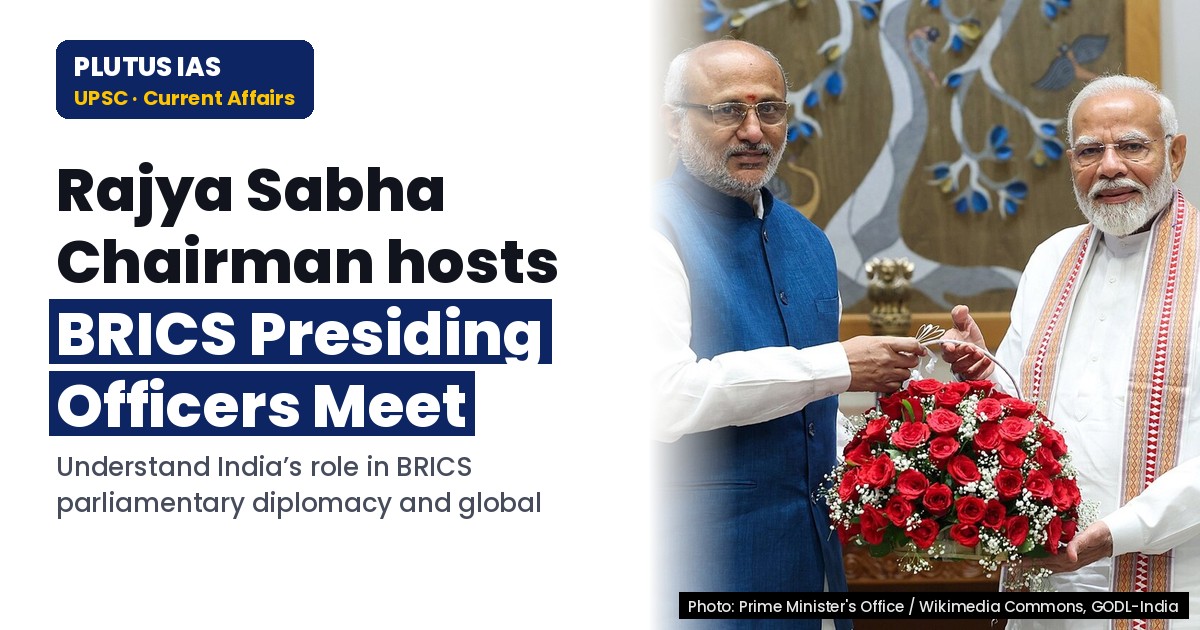
The Chairman of the Rajya Sabha hosted a luncheon for Presiding Officers and leaders of delegations from BRICS member and partner countries, coinciding with the conclusion of the 12th BRICS Parliamentary Forum in New Delhi. This event underscores the institutional role of the Rajya Sabha in fostering parliamentary diplomacy within multilateral frameworks, particularly in the context of India’s engagement with BRICS—a grouping that represents a significant segment of the global population and economy.
Background
- The BRICS grouping, originally comprising Brazil, Russia, India, and China, was established in 2009 to promote economic cooperation and political dialogue among major emerging economies.
- The BRICS Parliamentary Forum serves as a platform for parliamentarians from member countries to deliberate on shared challenges, legislative best practices, and avenues for parliamentary cooperation.
- India, as a founding member of BRICS, has consistently emphasized the importance of parliamentary engagement in complementing governmental and diplomatic initiatives within the grouping.
- The Rajya Sabha, as the Council of States in India’s bicameral Parliament, plays a pivotal role in foreign policy oversight and fostering inter-parliamentary relations.
- The 12th BRICS Parliamentary Forum, held in New Delhi in October 2026, adopted a Joint Declaration, reflecting the outcomes of deliberations on themes such as sustainable development, digital governance, and parliamentary oversight of economic policies.
- Institutional hospitality and diplomatic engagements, such as the luncheon hosted by the Chairman of the Rajya Sabha, are integral to strengthening parliamentary ties and enhancing mutual understanding among member nations.
What is the BRICS Parliamentary Forum and its significance?
- The BRICS Parliamentary Forum is an annual multilateral platform established to facilitate dialogue among parliamentarians from BRICS member countries and partner nations, aimed at promoting legislative cooperation and shared governance solutions.
- The Forum operates under the aegis of the BRICS Inter-Parliamentary Alliance, which was formalised in 2015 to institutionalise parliamentary engagement within the grouping.
- Key objectives of the Forum include fostering mutual learning on legislative frameworks, addressing global challenges such as climate change and digital transformation through parliamentary oversight, and enhancing South-South parliamentary cooperation.
- The Forum’s deliberations culminate in a Joint Declaration, which outlines common positions on global governance issues and serves as a reference for national legislatures in aligning domestic policies with multilateral commitments.
- India’s participation in the Forum is guided by its commitment to multilateralism and its role as a bridge between developed and developing nations, leveraging parliamentary diplomacy to advance shared interests.
- The Rajya Sabha, as the upper house of India’s Parliament, plays a critical role in this process by hosting delegations, facilitating discussions, and ensuring that parliamentary perspectives inform India’s engagement with BRICS.
- The Forum also serves as a platform for parliamentarians to engage with non-member countries, including those invited as observers or partners, thereby broadening the scope of multilateral parliamentary cooperation.
- Institutional events such as luncheons and cultural exchanges, as exemplified by the recent event hosted by the Chairman of the Rajya Sabha, are designed to foster informal dialogue and strengthen interpersonal relationships among participants.
Key Features
| Feature | Significance |
|---|---|
| Hosting of Luncheon by Rajya Sabha Chairman | Demonstrates institutional diplomacy and fosters interpersonal trust among BRICS Presiding Officers and delegation leaders. |
| BRICS Parliamentary Forum Participation | Provides a platform for parliamentary engagement on global governance, legislative cooperation, and multilateral consensus-building. |
| Joint Declaration Adoption | Signifies formal agreement on shared parliamentary priorities, enhancing collective voice in international forums. |
| Cultural and Diplomatic Exchange | Facilitates soft power projection and mutual understanding through structured interactions beyond formal proceedings. |
Why it Matters
Institutional Diplomacy
- Reinforces the role of parliamentary institutions in multilateral diplomacy, complementing executive-led international engagements.
- Strengthens inter-parliamentary networks, enabling knowledge-sharing on legislative best practices and governance models.
- Enhances India’s soft power by showcasing its parliamentary traditions and institutional hospitality.
Multilateral Governance
- BRICS parliamentary forums serve as a bridge between national legislatures and global governance mechanisms, particularly on issues like climate change, trade, and sustainable development.
- Facilitates coordinated legislative responses to transnational challenges, such as cybersecurity, terrorism financing, and pandemic preparedness.
- Provides a non-binding yet influential platform for consensus-building on shared policy objectives.
Legislative Cooperation
- Promotes exchange of expertise on parliamentary procedures, committee systems, and legislative drafting among member states.
- Encourages harmonisation of domestic laws with international commitments, particularly in areas like human rights, gender equality, and environmental protection.
- Fosters long-term partnerships between parliamentary research institutions and think tanks.
Challenges
1. DIVERGENT POLICY PRIORITIES
- Member states may prioritise divergent national interests, complicating consensus on joint declarations.
- Differences in political systems and governance models can hinder effective collaboration.
- Balancing sovereignty with collective action remains a persistent challenge in multilateral forums.
UPSC Link: GS-II: Multilateralism
2. LANGUAGE AND CULTURAL BARRIERS
- Diverse linguistic and cultural backgrounds may impede seamless communication and mutual understanding.
- Requires investment in translation services and intercultural training for delegates.
- Potential for misinterpretation of legislative or diplomatic nuances.
UPSC Link: GS-II: Global Governance
3. RESOURCE AND CAPACITY CONSTRAINTS
- Smaller or developing member states may face limitations in participating actively due to financial or logistical constraints.
- Unequal access to research and policy expertise can skew outcomes in favour of better-resourced nations.
- Need for capacity-building initiatives to ensure equitable participation.
UPSC Link: GS-II: International Institutions
4. FOLLOW-UP AND IMPLEMENTATION GAPS
- Joint declarations often lack binding enforcement mechanisms, leading to poor implementation.
- Absence of a dedicated monitoring framework to track progress on agreed commitments.
- Requires stronger institutional linkages between parliamentary forums and executive branches.
UPSC Link: GS-II: International Treaties
Challenges — UPSC Perspective
| Issue | Concern |
|---|---|
| Policy Divergence | Risk of diluted consensus due to conflicting national interests. |
| Implementation Deficit | Lack of binding mechanisms to enforce joint declarations. |
| Resource Asymmetry | Unequal participation capacity among member states. |
| Communication Barriers | Linguistic and cultural differences affecting deliberations. |
| Institutional Coordination | Gaps between parliamentary forums and executive action. |
Way Forward
- Establish a dedicated secretariat within the Rajya Sabha Secretariat to coordinate follow-up actions on BRICS parliamentary forum outcomes.
- Develop a structured capacity-building programme for parliamentarians from developing BRICS member states.
- Introduce multilingual digital platforms for seamless communication and documentation sharing.
- Strengthen linkages between BRICS parliamentary forums and the BRICS Summit process for policy coherence.
- Institutionalise a peer-review mechanism to assess implementation progress on joint declarations.
- Promote thematic working groups on shared challenges (e.g., climate change, digital governance) to deepen collaboration.
- Enhance public diplomacy efforts to highlight the role of parliamentary diplomacy in global governance.
UPSC Value Addition
Keywords for Mains Answer-Writing
BRICS Parliamentary Forum · Rajya Sabha Chairperson · Presiding Officers · Parliamentary diplomacy · Multilateral parliamentary engagement · Institutional role of Parliament · International parliamentary cooperation · BRICS mechanisms · Legislative diplomacy · Inter-parliamentary forums
Constitutional & Policy Linkages
- [‘Article 80’, ‘Rajya Sabha as a Council of States.’]
- [‘Article 105’, ‘Powers and privileges of Parliament.’]
Concept Flow
BRICS parliamentary engagement → Hosting of luncheon by Rajya Sabha Chairman → Informal trust-building → Joint declaration adoption → Formalisation of shared priorities → Implementation challenges → Need for institutional follow-up.
Prelims Practice Questions
Q1. Consider the following statements about the BRICS Parliamentary Forum:
1. It is a platform for parliamentarians of BRICS member countries to exchange views on common interests.
2. The 12th BRICS Parliamentary Forum was held in New Delhi in October 2026.
3. The forum is mandated by the BRICS Charter to function as a permanent body.
4. The forum adopts joint declarations to reflect consensus on key issues.
How many of the above statements are correct?
- Only one
- Only two
- Only three
- All
Answer: All — Statements 1, 2, and 4 are correct. The BRICS Parliamentary Forum serves as a platform for parliamentarians to exchange views on common interests, the 12th forum was held in New Delhi in October 2026, and it adopts joint declarations. Statement 3 is incorrect as the forum is not a permanent body mandated by the BRICS Charter.
Q2. Assertion (A): The Rajya Sabha Chairperson plays a pivotal role in hosting international parliamentary delegations.
Reason (R): The Rajya Sabha Secretariat is responsible for facilitating parliamentary diplomacy and inter-parliamentary cooperation.
Options:
A. Both A and R are true, and R is the correct explanation of A.
B. Both A and R are true, but R is not the correct explanation of A.
C. A is true but R is false.
D. A is false but R is true.
Answer: ? — Both Assertion (A) and Reason (R) are true. The Rajya Sabha Chairperson hosts international parliamentary delegations as part of parliamentary diplomacy, and the Rajya Sabha Secretariat facilitates such interactions.
Q3. Match the following international parliamentary forums with their respective host countries:
Column I (Forum) Column II (Host Country)
A. BRICS Parliamentary Forum 1. Geneva, Switzerland
B. Inter-Parliamentary Union (IPU) 2. New Delhi, India
C. G20 Parliamentary Speakers’ Summit 3. Berlin, Germany
D. Commonwealth Parliamentary Association 4. Jakarta, Indonesia
Options:
A. A-2, B-1, C-3, D-4
B. A-2, B-1, C-4, D-3
C. A-4, B-1, C-2, D-3
D. A-1, B-2, C-3, D-4
Answer: ? — The correct matches are: A-2 (BRICS Parliamentary Forum was hosted in New Delhi, India in 2026), B-1 (IPU is headquartered in Geneva, Switzerland), C-3 (G20 Parliamentary Speakers’ Summit is hosted by the country holding the G20 presidency, which was Germany in 2017), and D-4 (Commonwealth Parliamentary Association is headquartered in London but regional offices exist; Jakarta hosts the ASEAN Inter-Parliamentary Assembly).
Mains Practice Question
✍ The institutionalisation of inter-parliamentary forums such as the BRICS Parliamentary Forum reflects the evolving nature of parliamentary diplomacy in contemporary international relations. Critically examine the significance of such forums for India’s foreign policy and parliamentary democracy. (15 Marks)
Approach: MODEL-ANSWER SKELETON:
1. **Definition and Context**: Define inter-parliamentary forums and their role in parliamentary diplomacy. Highlight the BRICS Parliamentary Forum as a multilateral platform for parliamentarians to exchange views on common interests.
2. **India’s Engagement**: Discuss India’s active participation in the BRICS Parliamentary Forum, including hosting the 12th edition in New Delhi (October 2026). Explain how such engagements align with India’s foreign policy objectives, such as promoting multipolarity, South-South cooperation, and institutional reforms in global governance.
3. **Parliamentary Diplomacy**: Elaborate on the concept of parliamentary diplomacy and its distinction from traditional state-led diplomacy. Discuss the role of the Rajya Sabha Chairperson and the Rajya Sabha Secretariat in facilitating such engagements.
4. **Benefits for Parliamentary Democracy**: Analyse how participation in these forums enhances India’s parliamentary democracy by fostering legislative exchanges, sharing best practices, and promoting transparency and accountability in governance.
5. **Challenges and Limitations**: Critically examine the challenges, such as the lack of binding outcomes, limited enforcement mechanisms, and the potential for forum shopping in multilateral engagements.
6. **Conclusion**: Summarise the strategic importance of inter-parliamentary forums for India’s foreign policy and parliamentary democracy, while acknowledging their limitations.
Key Points to Include:
– Reference to the BRICS Parliamentary Forum’s joint declarations and consensus-building mechanisms.
– Role of the Rajya Sabha in hosting international delegations (e.g., the luncheon hosted by the Chairman, Rajya Sabha).
– India’s foreign policy objectives: multipolarity, South-South cooperation, and institutional reforms.
– Comparative examples of other inter-parliamentary forums (e.g., IPU, G20 Parliamentary Speakers’ Summit).
– Critical analysis of the effectiveness of such forums in achieving tangible outcomes.
Source: PIB (Press Information Bureau)
Generated by AanyaAi for educational purpose.
Related guides on our sites
- Current affairs for upsc 2026
- Best PSIR optional coaching for upsc
- Best PSIR optional teacher for upsc
- Best teacher of PSIR optional for upsc

- BRICS Presiding Officers Meet: Key Takeaways for UPSC & State PCS - October 27, 2026
- राज्यसभा अध्यक्ष ने रूसी संसदीय प्रतिनिधिमंडल से की बैठक, जानिए मुख्य बिंदु - October 27, 2026
- Ethiopia-Kenya Border Conflict: 36,600 Flee as UN Steps In - October 27, 2026

No Comments