


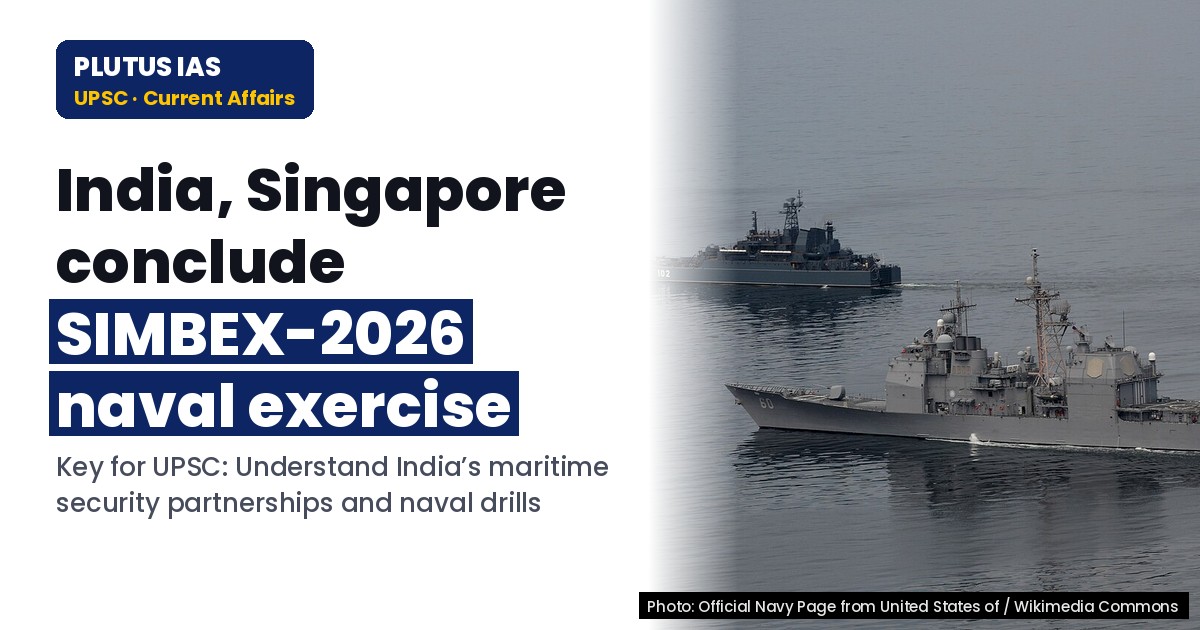
27 Oct SIMBEX-2026: India-Singapore Maritime Exercise Enhances Strategic Ties
✎ SIMBEX is India’s longest-running bilateral maritime exercise, enhancing naval interoperability and maritime security cooperation with Singapore in the Indo-Pacific.
Subject Relevance — Where This Topic Fits
- GS Paper II — International Relations: Bilateral, Regional and Global Groupings and Agreements involving India and/or affecting India’s interests | GS Paper III — Security: Challenges to Internal Security through External State and Non-State Actors
- Prelims: SIMBEX, Indo-Pacific Strategy, Maritime Security, ASEAN-India Strategic Partnership, Exclusive Economic Zone (EEZ), Anti-Piracy Operations, Maritime Domain Awareness (MDA), Choke Points in Indian Ocean
- Essay: India’s Role in Ensuring Maritime Security in the Indo-Pacific: Challenges and Opportunities, The Significance of Strategic Partnerships in India’s Foreign Policy: A Case Study of Singapore
Quick Revision: SIMBEX is India’s longest-running bilateral maritime exercise, enhancing naval interoperability and maritime security cooperation with Singapore in the Indo-Pacific.
Why is this in the news?
The conclusion of the 33rd edition of the Singapore-India Maritime Bilateral Exercise (SIMBEX-2026) marks a significant milestone in the maritime cooperation between India and Singapore, underscoring the evolving dynamics of maritime security in the Indo-Pacific region. This exercise, conducted annually since 1994, serves as a platform for enhancing interoperability, joint operational capabilities, and strategic trust between the naval forces of both nations, particularly in the context of rising geopolitical tensions and maritime challenges in the region.
Background
- The Singapore-India Maritime Bilateral Exercise (SIMBEX) was initiated in 1994 as a bilateral naval exercise between the Indian Navy and the Republic of Singapore Navy (RSN), reflecting the growing strategic partnership between the two countries.
- Singapore, a key maritime hub in Southeast Asia, holds strategic importance for India due to its location along critical sea lanes of communication (SLOCs) in the South China Sea and the Strait of Malacca, which are vital for India’s trade and energy security.
- The exercise has evolved from a basic anti-submarine warfare (ASW) drill to a comprehensive multi-domain exercise involving surface, sub-surface, and air operations, including maritime security operations such as anti-piracy and maritime domain awareness.
- India’s ‘Act East Policy’ and Singapore’s ‘Indo-Pacific Strategy’ align closely, with both nations emphasising the importance of a rules-based order, freedom of navigation, and peaceful resolution of disputes in the maritime domain.
- The exercise is conducted under the framework of the ‘India-Singapore Defence Cooperation Agreement’ (2003) and the ‘Memorandum of Understanding on Defence Cooperation’ (2017), which provide the legal and institutional basis for joint military engagements.
- Recent geopolitical developments, including China’s assertive maritime posture in the South China Sea and the Indian Ocean, have further necessitated robust maritime cooperation between India and Singapore to ensure regional stability.
What is the Singapore-India Maritime Bilateral Exercise (SIMBEX)?
- SIMBEX is an annual bilateral naval exercise conducted between the Indian Navy and the Republic of Singapore Navy (RSN), designed to enhance maritime security cooperation and interoperability between the two forces.
- The exercise is conducted alternately in the waters of the South China Sea and the Andaman Sea, with SIMBEX-2026 concluding in Singaporean waters, reflecting the rotational hosting arrangement agreed upon by both nations.
- SIMBEX encompasses a wide range of naval operations, including anti-submarine warfare (ASW), anti-air warfare (AAW), maritime security operations, maritime domain awareness (MDA), and humanitarian assistance and disaster relief (HADR) drills.
- Key components of the exercise include joint patrolling, tactical manoeuvres, live-fire drills, and simulated scenarios such as counter-piracy operations and search-and-rescue missions, aimed at improving operational readiness and response capabilities.
- The exercise also includes professional exchanges, subject matter expert discussions, and training in advanced naval technologies, fostering a deeper understanding of each other’s operational doctrines and best practices.
- SIMBEX serves as a platform for both navies to share best practices in maritime domain awareness, cybersecurity in maritime operations, and the integration of unmanned systems for surveillance and reconnaissance.
- The exercise is conducted under the aegis of the ‘India-Singapore Defence Cooperation Agreement’ and aligns with broader regional frameworks such as the ‘ASEAN Outlook on the Indo-Pacific’ and the ‘Quadrilateral Security Dialogue (Quad)’ principles.
- SIMBEX-2026, like its predecessors, underscores the commitment of both nations to upholding a rules-based maritime order, ensuring freedom of navigation, and promoting stability in the Indo-Pacific region.
Key Features
| Feature | Significance |
|---|---|
| Joint Harbour Phase | Enhances interoperability between Indian and Singaporean naval forces through coordinated port visits and harbour drills. |
| Sea Phase | Focuses on advanced maritime operations including anti-submarine warfare, air defence, and maritime interdiction. |
| Air Defence Exercises | Strengthens integrated air defence capabilities through simulated engagements and real-time coordination. |
| Maritime Domain Awareness | Improves situational awareness through joint surveillance, information sharing, and threat assessment. |
| Humanitarian Assistance and Disaster Relief (HADR) | Demonstrates joint capability in responding to maritime disasters and humanitarian crises. |
Why it Matters
Strategic Security
- Reinforces maritime security cooperation in the Indian Ocean Region (IOR), a critical zone for global trade and energy flows.
- Demonstrates India’s commitment to a rules-based maritime order and freedom of navigation in accordance with UNCLOS.
- Enhances deterrence against non-state and state actors in the maritime domain through joint exercises and capability building.
Diplomatic Relations
- Deepens strategic partnership with Singapore, a key ASEAN nation and a hub for maritime trade and logistics.
- Strengthens defence diplomacy as part of India’s Act East Policy and broader Indo-Pacific outreach.
- Facilitates high-level engagements that support broader regional security architectures like the ASEAN Defence Ministers’ Meeting (ADMM) Plus.
Operational Preparedness
- Provides a platform for Indian naval forces to train alongside a technologically advanced partner, improving operational readiness.
- Exposes Indian forces to diverse operational scenarios, including asymmetric threats and hybrid warfare tactics.
- Validates interoperability of platforms, systems, and doctrines between the two navies.
Economic Implications
- Safeguards critical sea lanes of communication (SLOCs) that underpin India’s trade and energy security.
- Supports India’s vision of a blue economy by ensuring secure maritime environments for commercial shipping.
- Encourages defence industry collaboration and technology transfer in maritime security domains.
Challenges
1. Asymmetric Threats in the Indian Ocean
- Rise of non-state actors such as pirates and armed groups necessitates adaptive maritime security strategies.
- Need for real-time intelligence sharing and coordinated responses to threats like piracy and terrorism.
- Limited resources may constrain sustained joint patrolling and rapid deployment capabilities.
UPSC Link: GS-III: Security Challenges
2. Technological Interoperability
- Differences in naval platforms, sensors, and communication systems may hinder seamless joint operations.
- Requirement for standardised protocols and interoperable command-and-control systems.
- Continuous upgradation of indigenous technologies to match partner capabilities.
UPSC Link: GS-III: Science & Technology
3. Geopolitical Complexities
- Balancing strategic partnerships with multiple nations without escalating regional tensions.
- Navigating the influence of extra-regional powers in the Indian Ocean.
- Ensuring exercises remain inclusive and do not inadvertently contribute to bloc-based rivalries.
UPSC Link: GS-II: International Relations
4. Resource Allocation
- Sustaining high-intensity naval exercises amid competing demands for budgetary allocations.
- Ensuring adequate training cycles and maintenance schedules for participating ships and aircraft.
- Addressing manpower constraints and rotational deployment challenges for naval personnel.
UPSC Link: GS-III: Defence & Security
5. Environmental and Legal Constraints
- Adhering to international environmental regulations during joint exercises, particularly in sensitive maritime zones.
- Ensuring compliance with maritime laws, including UNCLOS, during operations.
- Managing potential disputes arising from overlapping maritime claims in the region.
UPSC Link: GS-II: International Law
Challenges — UPSC Perspective
| Issue | Concern |
|---|---|
| Piracy and Armed Robbery | Increased risk to merchant shipping and energy supplies in the Indian Ocean. |
| Maritime Boundary Disputes | Potential for friction in overlapping Exclusive Economic Zones (EEZs). |
| Climate Change Impact | Rising sea levels and extreme weather events affecting naval operations and infrastructure. |
| Cyber Threats | Vulnerability of naval command-and-control systems to cyber-attacks. |
| Defence Industrial Base | Limited indigenous production capacity for advanced maritime platforms. |
| Regional Power Rivalries | Risk of exercises being perceived as alignment with specific geopolitical blocs. |
Way Forward
- Enhance joint maritime domain awareness through integrated surveillance systems and AI-driven analytics.
- Expand participation in multilateral maritime exercises to include more ASEAN and Quad partner nations.
- Invest in indigenous development of advanced naval platforms, sensors, and communication systems.
- Strengthen cybersecurity frameworks for naval command-and-control networks and data-sharing platforms.
- Establish a dedicated maritime security fund to support sustained joint exercises and capability building.
- Promote academic and research collaborations in maritime security studies between Indian and Singaporean institutions.
- Develop standard operating procedures (SOPs) for rapid humanitarian assistance and disaster relief (HADR) operations.
- Increase frequency of harbour phases to improve logistical coordination and interoperability.
UPSC Value Addition
Keywords for Mains Answer-Writing
Maritime Security · Indo-Pacific Strategy · Defence Diplomacy · Maritime Exercises · SIMBEX · Defence Cooperation · Maritime Domain Awareness · Regional Stability · Maritime Multilateralism · Indo-Singapore Relations · Maritime Law · UNCLOS · Blue Economy · Maritime Infrastructure · Naval Diplomacy
Concept Flow
Geopolitical imperatives in the Indian Ocean Region (IOR) → India’s Act East Policy and Indo-Pacific outreach → Singapore’s strategic location and maritime capabilities → Initiation of SIMBEX to enhance naval interoperability. → Joint exercises (Harbour and Sea Phases) → Validation of operational doctrines and platforms → Improved maritime domain awareness and threat response → Enhanced deterrence and crisis management. → Strengthened defence diplomacy → Deeper strategic partnership with ASEAN nations → Support for regional security architectures → Reinforcement of rules-based maritime order. → Operational preparedness gains → Indigenous technology upgradation → Self-reliance in defence production → Contribution to Atmanirbhar Bharat in maritime security. → Economic implications → Secured sea lanes of communication (SLOCs) → Safeguarded trade and energy supplies → Contribution to national economic security.
Prelims Practice Questions
Q1. Consider the following statements regarding the Singapore-India Maritime Bilateral Exercise (SIMBEX):
1. SIMBEX is conducted under the aegis of the ASEAN Defence Ministers’ Meeting (ADMM).
2. The exercise focuses exclusively on anti-submarine warfare operations.
3. SIMBEX-2026 concluded in the Andaman Sea.
4. The exercise includes participation from both naval and air forces of both countries.
How many of the above statements are correct?
- Only one
- Only two
- Only three
- All four
Answer: Only three — Statements 3 and 4 are correct. SIMBEX is a bilateral maritime exercise between India and Singapore, not under ADMM (Statement 1 is incorrect). While anti-submarine warfare is a component, the exercise is not exclusively limited to it (Statement 2 is incorrect).
Q2. Assertion (A): The conclusion of SIMBEX-2026 underscores India’s commitment to enhancing maritime security in the Indo-Pacific region.
Reason (R): Maritime exercises like SIMBEX contribute to building interoperability and trust between navies, thereby promoting regional stability.
Options:
A. Both A and R are true, and R is the correct explanation of A.
B. Both A and R are true, but R is not the correct explanation of A.
C. A is true, but R is false.
D. A is false, but R is true.
Answer: ? — Both Assertion (A) and Reason (R) are true, and Reason (R) correctly explains Assertion (A). SIMBEX enhances maritime security through interoperability and trust-building, aligning with India’s Indo-Pacific strategy.
Q3. Match the following maritime exercises with their respective partner countries:
Column I (Exercise) Column II (Partner Country)
A. SIMBEX 1. France
B. Varuna 2. Singapore
C. AUSINDEX 3. Australia
D. INDRA 4. Russia
Options:
A. A-2, B-1, C-3, D-4
B. A-3, B-2, C-1, D-4
C. A-4, B-3, C-2, D-1
D. A-1, B-4, C-3, D-2
Answer: ? — SIMBEX is with Singapore (A-2), Varuna is with France (B-1), AUSINDEX is with Australia (C-3), and INDRA is with Russia (D-4).
Mains Practice Question
✍ The conclusion of the 33rd edition of the Singapore-India Maritime Bilateral Exercise (SIMBEX-2026) reflects the evolving nature of defence diplomacy in the Indo-Pacific. Critically examine the significance of such maritime exercises for India’s strategic objectives in the region. (15 Marks)
Approach: MODEL-ANSWER SKELETON:
1. **Strategic Significance of Maritime Exercises**
– Define maritime exercises as instruments of defence diplomacy and confidence-building.
– Highlight India’s Indo-Pacific strategy and the role of maritime security in it.
2. **Specific Contributions of SIMBEX**
– Interoperability: Enhancing operational coordination between Indian and Singaporean navies (e.g., joint drills in anti-submarine warfare, air defence, and maritime domain awareness).
– Maritime Domain Awareness (MDA): Strengthening surveillance and information-sharing mechanisms.
– Legal and Normative Framework: Reinforcing adherence to UNCLOS and promoting rules-based maritime order.
3. **Broader Geopolitical Context**
– Quadrilateral Security Dialogue (Quad) and India’s partnerships with ASEAN nations.
– Countering non-traditional threats (piracy, illegal fishing, smuggling) in the Indo-Pacific.
4. **Challenges and Limitations**
– Resource constraints: Balancing participation in multiple exercises with operational readiness.
– Geopolitical sensitivities: Ensuring exercises do not exacerbate tensions with other regional actors.
5. **Conclusion**
– Reiterate the strategic value of SIMBEX in India’s defence diplomacy toolkit.
– Emphasise the need for sustained engagement to address evolving maritime challenges.
Source: PIB (Press Information Bureau)
Generated by AanyaAi for educational purpose.
Related guides on our sites
- Current affairs for upsc 2026
- Best PSIR optional coaching for upsc
- Best PSIR optional teacher for upsc
- Best teacher of PSIR optional for upsc

- SIMBEX-2026: India-Singapore Maritime Exercise Enhances Strategic Ties - October 27, 2026
- आयुष मंत्रालय ने विशेष अभियान 6.0 में 309 शिकायतों का निपटारा किया - October 27, 2026
- Corporate Affairs Ministry Exceeds Cleanliness Campaign 6 Targets - October 27, 2026

No Comments