


28 Oct Uttarakhand Introduces New Fire Safety Law: Key Provisions for UPSC & PCS
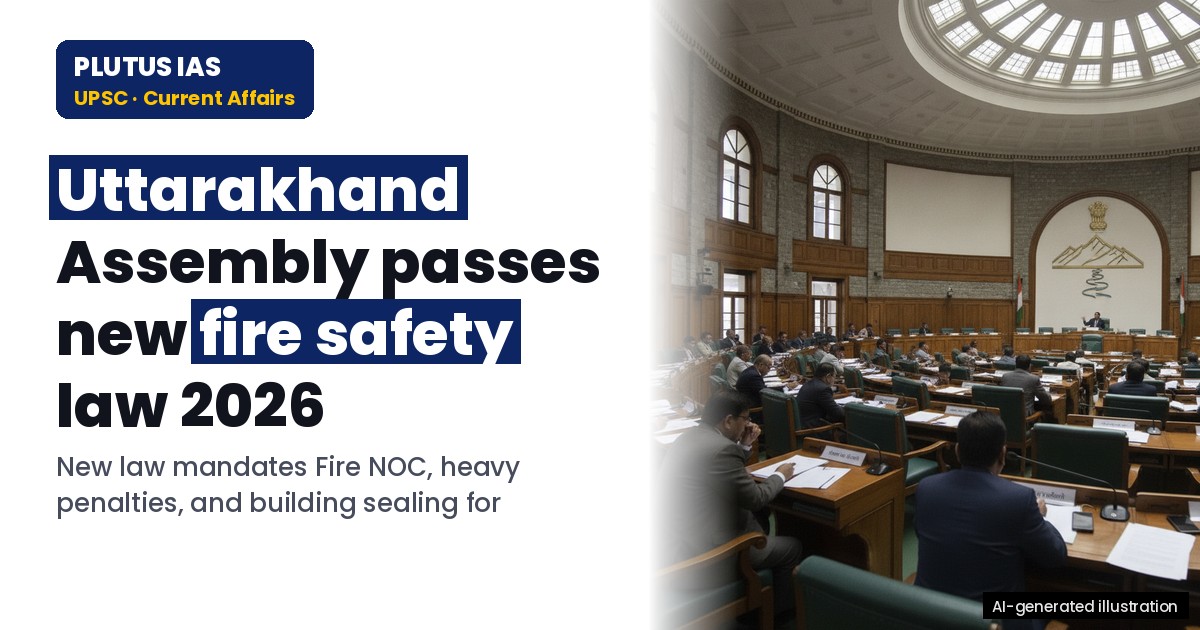
✎ The Uttarakhand Fire and Emergency Services Bill, 2026, mandates Fire Safety Certificates for high-risk buildings, empowers authorities to seal non-compliant premises, and imposes heavy penalties, including criminal liability…
Subject Relevance — Where This Topic Fits
- GS Paper II — Governance, Constitution and Polity (State Legislatures and State Executive) | GS Paper III — Disaster Management (Prevention and Mitigation)
- Prelims: Fire Safety Certificate (FSC), National Building Code (NBC) 2016, Fire and Emergency Services Act, 2016, Indian Justice Code (IJC), Disaster Management Act, 2005
- Essay: Role of State Legislatures in Ensuring Public Safety: A Case Study of Fire Safety Regulations, Balancing Economic Development and Public Safety: Lessons from Urban Fire Prevention Policies
Quick Revision: The Uttarakhand Fire and Emergency Services Bill, 2026, mandates Fire Safety Certificates for high-risk buildings, empowers authorities to seal non-compliant premises, and imposes heavy penalties, including criminal liability, for violations leading to fatalities or severe injuries.
Why is this in the news?
The Uttarakhand State Legislature introduced the Uttarakhand Fire and Emergency Services Bill, 2026, in its winter session, proposing sweeping reforms to fire safety regulations. The Bill seeks to replace the existing Uttarakhand Fire and Emergency Services, Fire Prevention and Fire Safety Act, 2016, with a more stringent legal framework that mandates Fire Safety Certificates (FSC) for high-risk buildings, empowers authorities to seal non-compliant premises, and imposes heavy penalties for violations, including criminal liability in cases of fatalities or severe injuries due to negligence.
Background
- The Uttarakhand Fire and Emergency Services, Fire Prevention and Fire Safety Act, 2016, currently governs fire safety in the state but has been criticised for inadequate enforcement and outdated provisions.
- Fire safety regulations in India are primarily governed by the National Building Code (NBC) 2016, issued by the Bureau of Indian Standards (BIS), which provides guidelines for fire safety in buildings.
- State governments are empowered under the Disaster Management Act, 2005, to formulate and enforce local fire safety laws, subject to compliance with the NBC and other central guidelines.
- Recent fire incidents in Uttarakhand, particularly in high-density urban and tourist areas, have highlighted the need for stricter enforcement and modernised regulatory mechanisms.
- The proposed Bill aligns with global best practices in fire safety, including mandatory FSC issuance, periodic inspections, and severe penalties for non-compliance.
- The Bill reflects a broader trend in Indian states to strengthen disaster preparedness and emergency response frameworks in the wake of increasing urbanisation and climate-related risks.
What is the Uttarakhand Fire and Emergency Services Bill, 2026?
- The Bill aims to replace the Uttarakhand Fire and Emergency Services, Fire Prevention and Fire Safety Act, 2016, with a more comprehensive and stringent legal framework for fire safety and emergency response.
- It introduces mandatory Fire Safety Certificates (FSC) for high-risk buildings, including residential buildings over 12 metres in height or 500 square metres in area, hotels, hospitals, schools, offices, malls, and warehouses exceeding specified thresholds.
- The Bill empowers the fire department to seal non-compliant buildings immediately, ensuring public safety by preventing occupancy of unsafe structures.
- Penalties for non-compliance include fines up to ₹10 per square metre of the building area or up to 1.5 times the cost of required safety equipment, in addition to criminal liability under the Bharatiya Nyaya Sanhita (BNS) for cases involving fatalities or severe injuries due to negligence.
- False reporting of fire incidents is also criminalised, with provisions for strict action against offenders.
- The Bill mandates regular inspections and audits of high-risk buildings to ensure ongoing compliance with fire safety standards.
- It introduces a graded enforcement mechanism, with escalating penalties for repeated violations and systemic non-compliance.
- The proposed legislation is aligned with the National Building Code (NBC) 2016 and incorporates international standards for fire safety in urban infrastructure.
Key Features
| Feature | Significance |
|---|---|
| Mandatory Fire NOC | Legal requirement for high-risk buildings (residential, commercial, educational, healthcare) to obtain Fire No Objection Certificate (NOC) before occupancy or operation. |
| Height & Area Thresholds | Applies to buildings ≥12m height or ≥500 sqm area (residential), ≥9m height or ≥500 sqm (hotels, schools), ≥9m height or ≥1000 sqm (hospitals), ≥10m height (offices, malls), and ≥250 sqm (warehouses). |
| Sealing Powers | Fire department empowered to seal premises immediately upon detection of severe fire safety violations, ensuring preventive compliance. |
| Penal Provisions | Monetary penalties: ₹10 per sqm for non-compliance or 1.5x cost of required safety equipment; criminal liability under Bharatiya Nyaya Sanhita (BNS) for deaths/serious injuries due to negligence. |
| False Alarm Penalty | Strict action for filing false fire incident reports, deterring misuse of emergency services. |
Why it Matters
Public Safety & Governance
- Enhances structural resilience against fire hazards in high-density and high-risk zones, reducing loss of life and property.
- Institutionalises a proactive regulatory framework, shifting from post-incident response to pre-emptive enforcement.
- Aligns with constitutional directive principles (Article 48A) to protect and improve the environment and safeguard public health.
Legal & Institutional
- Replaces the Uttarakhand Fire Prevention and Fire Safety Act, 2016, with a modernised statute incorporating contemporary safety standards and enforcement mechanisms.
- Empowers the Fire Department with quasi-judicial powers (sealing, penalties) while ensuring due process through defined thresholds and penalties.
Economic & Urban Planning
- Reduces long-term economic losses from fire incidents in critical infrastructure (hospitals, schools, commercial hubs).
- Supports sustainable urban development by mandating compliance in high-occupancy structures, aligning with smart city initiatives.
Challenges
1. Enforcement Capacity
- Risk of overburdening the Fire Department due to increased inspections, certification, and penalty imposition workload.
- Need for specialised training and infrastructure to handle technical assessments of fire safety measures in diverse building typologies.
UPSC Link: GS3: Disaster Management
2. Public Awareness & Compliance
- Low awareness among building owners, tenants, and local authorities about fire safety norms and certification processes.
- Resistance from stakeholders due to perceived high costs of retrofitting existing structures to meet new standards.
UPSC Link: GS2: Governance
3. Inter-Agency Coordination
- Coordination gaps between the Fire Department, municipal bodies, and urban planning authorities may lead to regulatory overlaps or enforcement gaps.
- Delays in approvals and certifications due to bureaucratic hurdles or lack of standardised SOPs across districts.
UPSC Link: GS2: Federalism
4. Technological & Resource Constraints
- Limited availability of certified fire safety auditors and equipment suppliers in remote or hilly regions like Uttarakhand.
- Dependence on external agencies for safety equipment (sprinklers, alarms) may increase costs and lead to quality concerns.
UPSC Link: GS3: Science & Tech
5. Legal & Ethical Dilemmas
- Balancing strict penalties with the socio-economic status of building owners, particularly in informal or low-income settlements.
- Ensuring transparency in penalty imposition and appeal mechanisms to prevent misuse of sealing powers.
UPSC Link: GS4: Ethics
Challenges — UPSC Perspective
| Issue | Concern |
|---|---|
| Resource Allocation | Fire Department may lack manpower, equipment, or funds to enforce the law uniformly across districts. |
| Retrofitting Costs | Existing buildings may face financial strain to comply with new safety standards, especially in heritage or unorganised sectors. |
| Data Gaps | Lack of a centralised database of high-risk buildings hampers targeted enforcement and risk assessment. |
| Climate Vulnerability | Hilly regions like Uttarakhand face unique fire risks (forest fires, landslides) requiring tailored safety protocols. |
| Public Resistance | Perception of the law as an additional regulatory burden may lead to non-compliance or delayed implementation. |
Way Forward
- Constitute a multi-stakeholder task force (Fire Dept, Municipal Bodies, Urban Planning) to draft SOPs for certification and inspections.
- Launch mass awareness campaigns in regional languages, targeting building owners, tenants, and local bodies via digital and print media.
- Develop a digital portal for Fire NOC applications, real-time tracking, and grievance redressal to reduce bureaucratic delays.
- Allocate dedicated funds for retrofitting incentives (subsidies/loans) for low-income or heritage buildings to ease compliance costs.
- Establish a state-level fire safety audit cadre with periodic capacity-building programs to ensure technical competence.
- Integrate fire safety norms with building bye-laws and land-use policies to streamline enforcement across agencies.
- Conduct mock drills and fire safety drills in schools, hospitals, and commercial complexes to foster a culture of preparedness.
UPSC Value Addition
Keywords for Mains Answer-Writing
Fire Safety Act · Fire NOC · Fire Prevention · Fire Emergency Services · Building Safety Regulations · Fire Safety Audit · Indian Penal Code (IPC) vs Indian Justice Code (IJC) · Disaster Management · Constitutional Provisions for Safety · Public Safety Laws · Sealing of Buildings · Fire Safety Penalties · Fire Safety Standards · Emergency Response Mechanisms
Constitutional & Policy Linkages
- Article 48A: Directive Principle on environmental protection and public health.
- Article 21: Right to Life and Personal Liberty (interpreted to include safe living and working conditions).
Concept Flow
High-risk building construction → Mandatory Fire NOC requirement → Fire Department inspection → Certification or penalties/sealing → Compliance or legal action → Reduced fire incidents and safer urban spaces.
Prelims Practice Questions
Q1. Consider the following statements regarding the proposed Uttarakhand Fire Safety Bill, 2026:
1. The Bill mandates a Fire NOC for all residential buildings irrespective of their height or area.
2. A penalty of ₹10 per square metre is proposed for non-compliance with fire safety measures.
3. The Bill empowers the fire department to seal buildings immediately upon detection of serious fire safety violations.
4. False reporting of fire incidents is punishable under the Indian Penal Code (IPC), 1860.
How many of the above statements are correct?
- Only one
- Only two
- Only three
- All four
Answer: Only three — Statements 2 and 3 are correct. Statement 1 is incorrect as the Bill applies fire NOC requirements only to buildings meeting specific height and area thresholds. Statement 4 is incorrect as the Bill refers to the Indian Justice Code (IJC), not the IPC.
Q2. Assertion (A): The proposed Uttarakhand Fire Safety Bill, 2026, introduces stricter penalties for fire safety violations compared to the Uttarakhand Fire Prevention and Fire Safety Act, 2016.
Reason (R): The new Bill includes provisions for sealing buildings and imposes penalties up to 1.5 times the cost of required safety equipment, whereas the 2016 Act did not have such provisions.
In the context of the above two statements, which one of the following is correct?
- Both A and R are true, and R is the correct explanation of A
- Both A and R are true, but R is not the correct explanation of A
- A is true, but R is false
- A is false, but R is true
Answer: Both A and R are true, but R is not the correct explanation of A — Both the Assertion and Reason are true. The new Bill indeed introduces stricter penalties and sealing powers, and the Reason correctly explains why the Assertion holds true.
Q3. Match the following categories of buildings with their respective fire safety NOC applicability thresholds as proposed in the Uttarakhand Fire Safety Bill, 2026:
Column I (Building Type) | Column II (Applicability Threshold)
—————————————-|————————————–
A. Residential buildings | 1. Height ≥ 9 metres or floor area ≥ 500 sq. m
B. Hotels, Home Stays, Resorts | 2. Height ≥ 12 metres or floor area ≥ 500 sq. m
C. Schools and Colleges | 3. Height ≥ 9 metres or floor area ≥ 500 sq. m
D. Hospitals and Nursing Homes | 4. Height ≥ 9 metres or floor area ≥ 1000 sq. m
E. Offices, Banks, IT Parks, Malls | 5. Height ≥ 10–12 metres or any floor area
F. Warehouses | 6. Floor area ≥ 250 sq. m
Answer: ? —
Mains Practice Question
✍ The proposed Uttarakhand Fire Safety Bill, 2026 seeks to replace the existing Uttarakhand Fire Prevention and Fire Safety Act, 2016 by introducing stricter fire safety norms, mandatory Fire NOCs, and severe penalties for non-compliance. Critically examine the necessity, provisions, and potential challenges in the implementation of this Bill. (15 Marks)
Approach: MODEL-ANSWER SKELETON:
1. **Necessity of the Bill**:
– Rising urbanisation and high-rise constructions in Uttarakhand increase fire risks.
– Recent fire incidents (e.g., Nainital 2023, Joshimath 2024) highlight gaps in enforcement under the 2016 Act.
– Need for alignment with National Building Code (NBC) 2016 and National Disaster Management Authority (NDMA) guidelines.
2. **Key Provisions of the Bill**:
– Mandatory Fire NOC for specified categories (height/area thresholds).
– Powers to fire departments: immediate sealing of buildings, penalties up to ₹10/sq. m or 1.5x cost of safety equipment.
– Criminal liability under the Indian Justice Code (IJC) for fatalities due to negligence.
– False reporting of fire incidents punishable.
3. **Comparative Analysis with 2016 Act**:
– 2016 Act lacked mandatory NOCs and sealing powers; penalties were less stringent.
– New Bill introduces proactive measures (sealing, higher penalties) and broader coverage.
4. **Potential Challenges in Implementation**:
– **Administrative**: Limited capacity of fire departments in hilly regions (e.g., Chamoli, Uttarkashi).
– **Legal**: Overlap with existing municipal laws (e.g., Uttarakhand Municipality Act) and need for inter-departmental coordination.
– **Economic**: High compliance costs for small businesses and hotels; risk of informal settlements bypassing norms.
– **Public Awareness**: Low awareness among stakeholders (builders, residents) about fire safety standards.
5. **Suggestions for Effective Implementation**:
– Capacity building of fire departments with modern equipment and training.
– Periodic fire safety audits and public-private partnerships for compliance.
– Awareness campaigns for builders, residents, and local bodies.
– Gradual phasing of penalties to ease compliance burden.
6. **Conclusion**: The Bill is a progressive step toward reducing fire risks but requires robust implementation mechanisms and stakeholder engagement to overcome challenges.
Source: amarujala.com
Generated by AanyaAi for educational purpose.
Related guides on our sites
- Current affairs for upsc 2026
- Best PSIR optional coaching for upsc
- Best Law optional coaching for upsc
- Best PSIR optional teacher for upsc

- Uttarakhand Introduces New Fire Safety Law: Key Provisions for UPSC & PCS - October 28, 2026
- राजस्थान में नदियों का प्रदूषण: उद्योगों की लापरवाही और सरकारी विफलता - October 28, 2026
- India’s Infrastructure Boom: Decarbonisation Choices for UPSC & State PCS - October 28, 2026

No Comments