


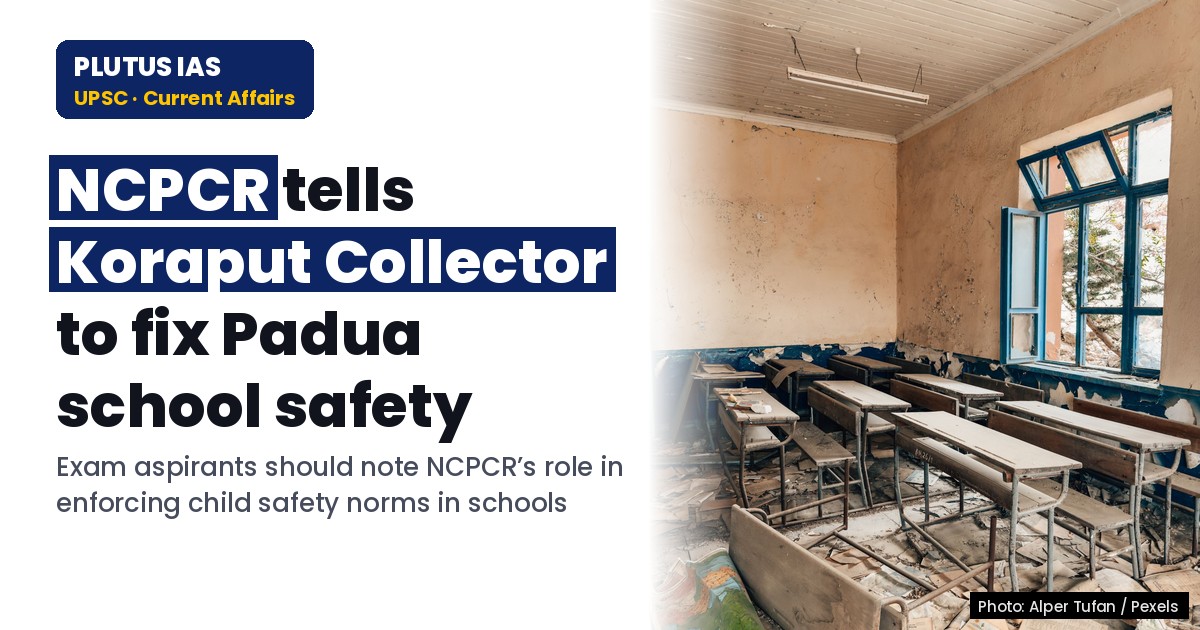
29 Oct NCPCR Directs Koraput Collector to Fix Padua PM SHRI School Safety Issues
✎ The PM SHRI scheme mandates compliance with the RTE Act, 2009, and Article 21A of the Constitution, ensuring child safety, infrastructure standards, and community participation in school governance.
Subject Relevance — Where This Topic Fits
- GS Paper II — Governance, Transparency and Accountability | GS Paper IV — Ethics in Governance (Accountability and Responsibility of Public Institutions)
- Prelims: PM SHRI Scheme, National Commission for Protection of Child Rights (NCPCR), Right to Education (RTE) Act, 2009, Article 21A of the Constitution, Child Safety Regulations in Schools
- Essay: The Role of Institutions in Safeguarding Fundamental Rights, Balancing Educational Access and Infrastructure Quality in India
Quick Revision: The PM SHRI scheme mandates compliance with the RTE Act, 2009, and Article 21A of the Constitution, ensuring child safety, infrastructure standards, and community participation in school governance.
Why is this in the news?
The National Commission for Protection of Child Rights (NCPCR) has issued a directive to the Koraput Collector, Odisha, to enforce child safety and infrastructure standards at the Padua PM SHRI Higher Secondary School following reports of deteriorating conditions, including leaking roofs, dilapidated buildings, and unhygienic surroundings. This action underscores the institutional mechanisms in place to monitor compliance with child welfare norms in government-aided educational institutions.
Background
- The PM SHRI (PM Schools for Rising India) scheme, launched in 2022, aims to upgrade 14,500 existing schools across India into model schools with improved infrastructure, technology integration, and quality education.
- The scheme operates under the aegis of the Ministry of Education, Government of India, and mandates adherence to the Right to Education (RTE) Act, 2009, which guarantees free and compulsory education to children aged 6–14 years.
- The National Commission for Protection of Child Rights (NCPCR) is a statutory body constituted under the Commissions for Protection of Child Rights (CPCR) Act, 2005, to monitor the implementation of child rights across India.
- Article 21A of the Constitution of India enshrines the Right to Education as a fundamental right, while the RTE Act, 2009, provides the legal framework for its implementation, including infrastructure and safety standards.
- Reports of infrastructure deficiencies in schools, such as those highlighted in Padua PM SHRI School, are not isolated incidents but reflect systemic challenges in ensuring uniform quality across diverse geographical and administrative contexts.
- The directive by NCPCR follows a complaint lodged by a human rights activist, demonstrating the role of civil society in holding public institutions accountable for compliance with child welfare norms.
What is the PM SHRI Scheme?
- The PM SHRI scheme is a centrally sponsored initiative launched in September 2022 to transform 14,500 existing government schools into model schools with state-of-the-art infrastructure, digital resources, and enhanced pedagogical practices.
- The scheme targets schools in both rural and urban areas, with a focus on improving learning outcomes, teacher training, and community engagement to ensure holistic development of students.
- PM SHRI schools are required to adhere to the norms and standards prescribed under the RTE Act, 2009, including provisions for safe and hygienic learning environments, adequate classrooms, and child-friendly facilities.
- The scheme emphasizes the integration of technology in education, with provisions for smart classrooms, digital libraries, and online learning resources to bridge the digital divide.
- Funding for the scheme is shared between the central and state governments, with the central government providing 60% of the cost for general states and 90% for northeastern states and union territories.
- The scheme also mandates the establishment of School Management Committees (SMCs) under the RTE Act, comprising parents, teachers, and local authorities, to oversee the school’s functioning and ensure community participation.
- Monitoring and evaluation of PM SHRI schools are conducted through a robust framework, including third-party assessments and periodic reviews by state and central authorities.
- The scheme aligns with the National Education Policy (NEP) 2020, which advocates for equitable access to quality education and the development of a knowledge-based economy.
Key Features
| Feature | Significance |
|---|---|
| PM SHRI Scheme | A centrally sponsored scheme launched in 2022 to upgrade 14,500 schools across India into model schools, emphasizing holistic development, safety, and quality education. |
| NCPCR Directive | The National Commission for Protection of Child Rights (NCPCR) acts as a statutory watchdog under the Commissions for Protection of Child Rights Act, 2005, to ensure child rights compliance. |
| District Administration Role | The Koraput Collector, as the head of district administration, is responsible for implementing central and state schemes, including safety and infrastructure compliance in schools. |
| Child Safety Regulations | Mandate for schools to maintain hygienic, hazard-free environments, including structural integrity, pest control, and sanitation, as per Right to Education (RTE) Act, 2009. |
| Compliance Documentation | Requirement to upload photographs and progress reports on official portals to ensure transparency and accountability in implementation. |
Why it Matters
Governance and Accountability
- Demonstrates the role of statutory bodies like NCPCR in enforcing child rights and safety standards in educational institutions.
- Highlights the administrative hierarchy in India, where district collectors are key functionaries for implementing central schemes at the grassroots level.
- Emphasizes the importance of inter-departmental coordination between education, health, and local governance for holistic school development.
Right to Education (RTE) Act, 2009
- The RTE Act guarantees free and compulsory education to children aged 6–14, with norms for infrastructure, pupil-teacher ratios, and safety standards.
- Schools failing to meet these norms are in violation of statutory obligations, as seen in the case of Padua PM SHRI School.
- The Act empowers parents, activists, and commissions to seek redressal for non-compliance.
PM SHRI Scheme Implementation
- The scheme aims to transform schools into vibrant learning spaces with modern facilities, but ground-level execution remains a challenge due to resource constraints.
- Inadequate infrastructure in schools undermines the scheme’s objectives, necessitating urgent corrective measures.
- The directive to the Koraput Collector underscores the need for proactive monitoring in PM SHRI schools.
Challenges
1. Infrastructure Deficit in Government Schools
- A persistent issue across India, particularly in tribal and remote areas, where schools lack basic amenities like safe buildings, sanitation, and pest control.
- Leads to health hazards (e.g., reptile infestations), absenteeism, and poor learning outcomes.
- Exacerbated by limited funding, bureaucratic delays, and lack of local oversight.
UPSC Link: GS-II: Governance, Education (RTE Act)
2. Compliance and Enforcement Gaps
- Despite statutory provisions, schools often flout safety norms due to weak monitoring mechanisms.
- The NCPCR’s intervention highlights the need for stronger grievance redressal systems and periodic audits.
- Delays in implementation of directives can further deteriorate conditions, as seen in the case of Padua PM SHRI School.
UPSC Link: GS-II: Statutory Bodies (NCPCR)
3. Resource Allocation and Utilization
- Funds allocated under schemes like PM SHRI may not reach the intended beneficiaries due to leakages, corruption, or poor planning.
- Tribal districts like Koraput face additional challenges, including geographical remoteness and socio-economic disparities.
- Requires efficient fund utilization and community participation for sustainable development.
UPSC Link: GS-III: Resource Mobilization
4. Stakeholder Engagement and Awareness
- Parents, students, and local communities often remain unaware of their rights under the RTE Act or the PM SHRI scheme.
- Lack of awareness leads to underutilization of available resources and delayed reporting of violations.
- Activists and NGOs play a crucial role in bridging this gap, as evidenced by the complaint filed in this case.
UPSC Link: GS-II: Social Sector (Education)
Challenges — UPSC Perspective
| Issue | Concern |
|---|---|
| Structural Integrity | Dilapidated buildings pose direct safety risks to students, including collapse hazards. |
| Hygiene and Sanitation | Unsanitary conditions and pest infestations affect student health and learning outcomes. |
| Fund Utilization | Delayed or inadequate release of funds hampers timely infrastructure upgrades. |
| Monitoring Mechanisms | Weak oversight allows non-compliance to persist without consequences. |
| Community Involvement | Low awareness among parents and students limits their ability to demand accountability. |
Government Initiatives — Must-Memorise for Prelims
- PM SHRI (Pradhan Mantri Schools for Rising India) Scheme
- Right to Education (RTE) Act, 2009
Way Forward
- Conduct a rapid infrastructure audit of the Padua PM SHRI School to identify critical safety hazards and prioritize repairs.
- Ensure timely release and utilization of funds under the PM SHRI scheme, with transparent tracking of expenditures.
- Strengthen local monitoring by involving school management committees (SMCs) and parent-teacher associations (PTAs) in oversight.
- Organize awareness campaigns for parents, students, and local communities on their rights under the RTE Act and PM SHRI scheme.
- Establish a grievance redressal mechanism at the district level, with periodic reporting to NCPCR for compliance verification.
- Collaborate with tribal welfare departments to address socio-economic barriers affecting school infrastructure in Koraput.
- Leverage technology, such as geo-tagging of school facilities, to enhance transparency and accountability in fund utilization.
UPSC Value Addition
Keywords for Mains Answer-Writing
National Commission for Protection of Child Rights (NCPCR) · PM SHRI Schools · Right to Education Act, 2009 · Child safety in schools · School infrastructure standards · District Collector’s role in education · Article 21A of the Constitution · Sarva Shiksha Abhiyan · Child Rights Protection Framework · School safety regulations · Public accountability in education · Panchayati Raj Institutions and education
Constitutional & Policy Linkages
- Article 21A (Right to Education) – Ensures free and compulsory education for children aged 6–14.
- Article 45 (Directive Principles) – Mandates early childhood care and education for all children.
- Article 15(3) (Protective Discrimination) – Allows special provisions for marginalized groups, including tribal children.
Concept Flow
Inadequate school infrastructure (dilapidated buildings, poor sanitation) → Violation of RTE Act norms → Complaint filed by activist → NCPCR registers case → Directive issued to district administration → Compliance documentation required → Implementation and monitoring phase. → PM SHRI scheme aims to upgrade schools → Poor ground-level execution in Koraput → NCPCR intervention → District administration’s role in compliance → Long-term sustainability depends on resource allocation and community engagement. → Child safety regulations under RTE Act → Structural and hygiene deficits in Padua PM SHRI School → Health and learning outcomes affected → NCPCR’s directive to Koraput Collector → Corrective measures initiated. → Statutory body (NCPCR) enforces child rights → District administration implements directives → Transparency via documentation → Accountability in governance. → Tribal district (Koraput) faces unique challenges → Socio-economic disparities → Limited resources → Need for targeted interventions under PM SHRI and tribal welfare schemes.
Prelims Practice Questions
Q1. Consider the following statements regarding the National Commission for Protection of Child Rights (NCPCR):
1. It is a statutory body established under the Commissions for Protection of Child Rights Act, 2005.
2. It functions under the administrative control of the Ministry of Women and Child Development, Government of India.
3. The Commission has the power to take suo motu cognizance of matters relating to child rights violations.
4. The Commission can only issue recommendations and has no power to enforce compliance.
How many of the above statements are correct?
- Only one
- Only two
- Only three
- All four
Answer: Only three — Statements 1, 2, and 3 are correct. The NCPCR is a statutory body under the Commissions for Protection of Child Rights Act, 2005, and functions under the Ministry of Women and Child Development. It has suo motu powers. Statement 4 is incorrect as the Commission can issue binding directions under Section 13(3) of the Act.
Q2. Assertion (A): The Right to Education Act, 2009 mandates that all schools must provide a safe and hygienic environment for children.
Reason (R): The Act empowers the National Commission for Protection of Child Rights (NCPCR) to monitor compliance with child safety norms in schools.
Options:
A. Both A and R are true, and R is the correct explanation of A.
B. Both A and R are true, but R is not the correct explanation of A.
C. A is true, but R is false.
D. A is false, but R is true.
- A
- B
- C
- D
Answer: B — Both Assertion (A) and Reason (R) are true. The Right to Education Act, 2009 explicitly mandates safe and hygienic school environments under Section 19. The NCPCR, as the monitoring authority under Section 31 of the RTE Act, is empowered to ensure compliance with child safety norms.
Q3. Match the following columns with reference to child rights and education governance in India:
Column I
A. Article 21A of the Constitution
B. Sarva Shiksha Abhiyan
C. PM SHRI Schools Scheme
D. District Collector’s role in education
Column II
1. Ensures free and compulsory education for children aged 6-14
2. A centrally sponsored scheme for universalising elementary education
3. A centrally sponsored scheme for upgrading schools to model standards
4. Ensures implementation of education policies at the district level
Options:
A B C D
1 2 3 4
2 1 4 3
3 2 1 4
4 3 2 1
- A-1, B-2, C-3, D-4
- A-2, B-1, C-4, D-3
- A-3, B-2, C-1, D-4
- A-4, B-3, C-2, D-1
Answer: A-1, B-2, C-3, D-4 — Correct matching: A-1 (Article 21A guarantees free and compulsory education), B-2 (Sarva Shiksha Abhiyan is the universalisation scheme), C-3 (PM SHRI Schools Scheme upgrades schools), D-4 (District Collector ensures policy implementation at district level).
Mains Practice Question
✍ The safety and infrastructure standards of schools are fundamental to the realisation of the constitutional right to education under Article 21A. In light of the recent directive issued by the National Commission for Protection of Child Rights (NCPCR) to the Koraput Collector regarding the Padua PM SHRI School, critically examine the role of district-level authorities in ensuring child safety and educational quality in government schools. (15 Marks)
Approach: MODEL-ANSWER SKELETON:
1. **Constitutional and Legal Framework** (4 points):
– Article 21A and the Right to Education Act, 2009: obligations on the state to provide safe, equitable, and quality education.
– Role of NCPCR under the Commissions for Protection of Child Rights Act, 2005: suo motu powers and binding directions.
– Sarva Shiksha Abhiyan (SSA) and PM SHRI Schools Scheme: their objectives and monitoring mechanisms.
– District-level governance: the Collector’s role under the District Primary Education Programme (DPEP) and SSA.
2. **Institutional Mechanisms and Challenges** (5 points):
– District Education Officers (DEO) and Block Education Officers (BEO): their functional responsibilities and constraints.
– Role of Panchayati Raj Institutions (PRIs): devolution of powers under 73rd Amendment and local accountability.
– Monitoring and grievance redressal: School Management Committees (SMCs) under RTE Act, Section 21.
– Financial and administrative bottlenecks: fund utilisation, delayed approvals, and multi-level clearances.
– Data gaps: lack of real-time monitoring systems and underreporting of infrastructure deficiencies.
3. **Contemporary Issues and Way Forward** (6 points):
– Recent NCPCR directives and their legal enforceability: Section 13(3) of the CPCR Act.
– Role of civil society and media in highlighting violations: examples from recent reports.
– Need for convergence between education, health, and sanitation departments for holistic school safety.
– Strengthening SMCs: capacity building and community participation.
– Digital governance: use of platforms like DIKSHA and e-Saksham for real-time monitoring.
– Accountability mechanisms: penal provisions for non-compliance under RTE Rules, 2010.
Balance of views: Highlight both the strengths of existing frameworks (e.g., RTE Act, PM SHRI) and systemic gaps (e.g., weak district-level implementation, lack of political will). Conclude with a balanced assessment of the way forward.
Source: orissapost.com
Generated by AanyaAi for educational purpose.
Related guides on our sites

- NCPCR Directs Koraput Collector to Fix Padua PM SHRI School Safety Issues - October 29, 2026
- ईएसआईसी ने नई अम्नेस्टी योजना 2025 की अवधि बढ़ाई: जानें नए नियम - October 29, 2026
- Disinvestment as Economic Strategy: UPSC & State PCS Insights - October 29, 2026

No Comments