


30 Oct CAQM’s PAVAN-I3C: UPSC’s New Tool for Real-Time Air Pollution Tracking
✎ The PAVAN-I3C platform, under the CAQM, integrates real-time air quality and emissions data from multiple sources to enable proactive pollution control through a 'detect-analyse-act' framework, enhancing inter-agency coordination…
Subject Relevance — Where This Topic Fits
- GS Paper III — Environment and Pollution Control | GS Paper III — Science and Technology (Data Analytics and Digital Governance) | GS Paper II — Governance, Transparency and Accountability in Public Institutions
- Prelims: Commission for Air Quality Management (CAQM), Integrated Command and Control Centre (I3C), PAVAN Platform, Continuous Ambient Air Quality Monitoring Stations (CAAQMS), Air Quality Index (AQI), National Clean Air Programme (NCAP), Environmental Impact Assessment (EIA) 2006
- Essay: The Role of Technology in Environmental Governance: Balancing Efficiency and Accountability, Public Policy and Inter-State Coordination: Lessons from Air Pollution Management in the Delhi-NCR
Quick Revision: The PAVAN-I3C platform, under the CAQM, integrates real-time air quality and emissions data from multiple sources to enable proactive pollution control through a ‘detect-analyse-act’ framework, enhancing inter-agency coordination in the Delhi-NCR.
Why is this in the news?
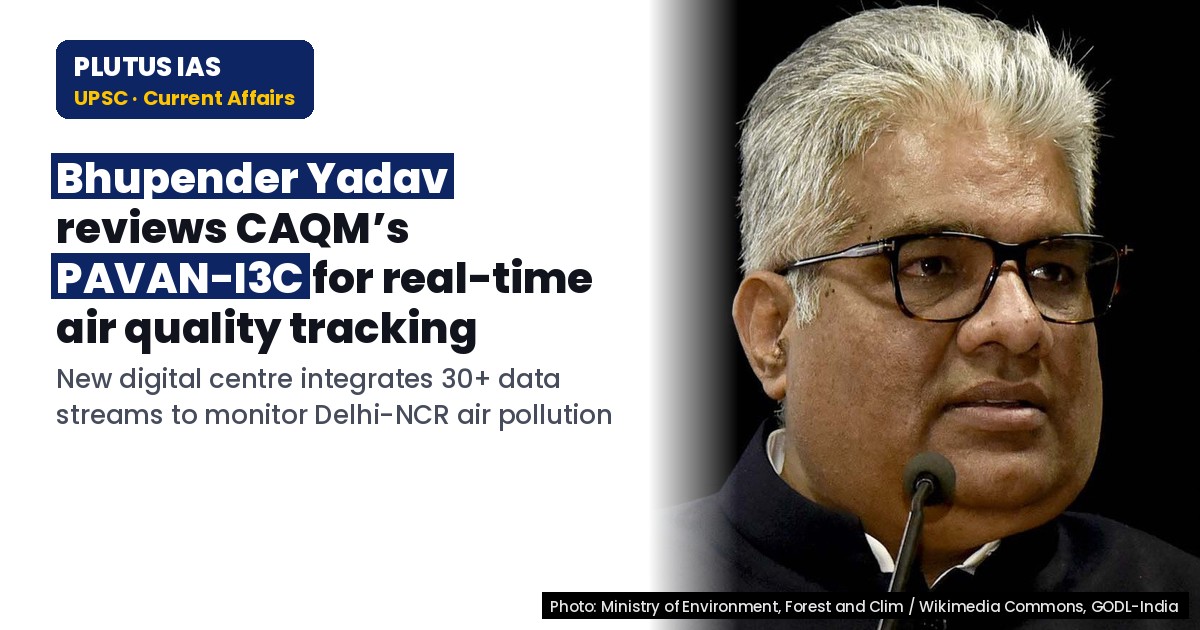
The Union Minister for Environment, Forest and Climate Change recently reviewed the operational readiness of the Commission for Air Quality Management’s (CAQM) new Integrated Command and Control Centre (I3C) named PAVAN (Platform for Air Quality Vigilance and Analytics for NCR). This digital nerve centre integrates over 30 data streams from multiple agencies to enable real-time monitoring, analysis, and enforcement of air pollution control measures across the Delhi-National Capital Region (NCR), marking a significant advancement in institutionalised, data-driven environmental governance.
Background
- Air pollution in the Delhi-NCR has been a persistent environmental and public health challenge, exacerbated by factors such as vehicular emissions, industrial activity, construction dust, crop residue burning, and meteorological conditions.
- The Commission for Air Quality Management (CAQM) was established in 2020 under the Commission for Air Quality Management in National Capital Region and Adjoining Areas Act, 2021, to replace the erstwhile Environment Pollution (Prevention and Control) Authority (EPCA).
- The CAQM Act provides a statutory framework for coordinated action across multiple states (Delhi, Punjab, Haryana, Rajasthan, Uttar Pradesh) and Union Territories within the NCR.
- The National Clean Air Programme (NCAP), launched in 2019, sets a national target of 20–30% reduction in particulate matter (PM10 and PM2.5) concentrations by 2024, with 2017 as the base year.
- Real-time air quality monitoring has been progressively strengthened through the establishment of Continuous Ambient Air Quality Monitoring Stations (CAAQMS) across urban centres, including 111 stations in the NCR.
- The integration of digital platforms such as I3Cs represents a shift from reactive to proactive environmental governance, leveraging data analytics and inter-agency coordination.
What is the Integrated Command and Control Centre (I3C) under the CAQM?
- The I3C is a centralised digital platform designed to aggregate, analyse, and visualise real-time environmental data from multiple sources to enable timely decision-making and enforcement in air quality management.
- The newly launched PAVAN-I3C integrates over 30 data streams, including air quality data from 111 CAAQMS, emissions data from 2,300 industries, construction site data from 3,200 active sites, traffic hotspot data, meteorological information, satellite imagery, and citizen complaints.
- The platform enables the monitoring of 12 critical modules in real time, including ambient air quality, crop residue burning, construction and demolition activities, vehicular pollution, industrial emissions, landfill management, and action plans of state governments.
- The core operating principle of PAVAN-I3C is ‘detect, analyse, act’, facilitating rapid identification of pollution sources, assessment of compliance status, and initiation of corrective measures.
- The I3C serves as a nerve centre for coordination among multiple agencies, including state pollution control boards, municipal corporations, traffic police, and agricultural departments, ensuring unified enforcement under the CAQM’s statutory mandate.
- The platform supports predictive analytics and scenario modelling, enabling authorities to anticipate pollution episodes and implement preventive measures such as temporary restrictions on construction or industrial activity.
- The I3C framework is aligned with the National Clean Air Programme (NCAP) and the Environment Impact Assessment (EIA) Notification, 2006, by providing data-driven inputs for policy formulation and compliance monitoring.
- The establishment of PAVAN-I3C follows the operationalisation of a similar centre by the Delhi Pollution Control Committee (DPCC), reflecting a broader trend toward institutionalising digital governance in environmental management.
Key Features
| Feature | Significance |
|---|---|
| Integrated Command and Control Centre (I3C) named PAVAN | Centralised real-time monitoring platform for air quality management in Delhi-NCR, integrating multi-agency data streams for unified action. |
| Integration of 30+ APIs and data streams | Enables seamless data exchange across air quality, emissions, meteorological, satellite, camera, mobility, complaint, and compliance datasets. |
| Live monitoring of 111 ambient air quality stations | Provides granular, real-time data on pollutant concentrations across the NCR for targeted interventions. |
| Coverage of 2,300 industries and 3,200 construction sites | Facilitates enforcement of pollution control norms through continuous surveillance of industrial and construction activities. |
| Twelve operational modules (e.g., crop residue burning, vehicular pollution, landfill management) | Allows prioritised tracking of key pollution sources and state-specific action plans for coordinated governance. |
Why it Matters
Institutional Governance
- Demonstrates the institutionalisation of data-driven environmental governance through the CAQM, a statutory body under the Commission for Air Quality Management (CAQM) Act, 2021.
- Enhances inter-agency coordination by consolidating inputs from multiple stakeholders (DPCC, state governments, municipal bodies) under a single digital framework.
- Strengthens the role of the Union Environment Ministry in steering pollution control measures through technological oversight and real-time auditing.
Policy Implementation
- Supports the enforcement of the National Clean Air Programme (NCAP) targets by providing actionable intelligence on pollution hotspots and non-compliance.
- Aligns with the Graded Response Action Plan (GRAP) by enabling dynamic, evidence-based trigger mechanisms for pollution control measures.
- Facilitates evidence-based policy formulation by generating high-resolution data on pollution sources, trends, and compliance gaps.
Technological Innovation
- Leverages the Internet of Things (IoT), satellite remote sensing, and AI-driven analytics to transform air quality management from reactive to predictive governance.
- Demonstrates India’s capacity for indigenous development of environmental monitoring infrastructure, reducing reliance on foreign systems.
- Sets a precedent for scalable digital public infrastructure in environmental governance, applicable to other urban centres facing similar challenges.
Public Accountability
- Enhances transparency by making pollution data and enforcement actions publicly accessible, fostering citizen engagement and trust in regulatory processes.
- Enables real-time grievance redressal through integrated complaint modules, bridging the gap between public reporting and administrative response.
- Supports judicial oversight by providing verifiable data for litigation on environmental violations under the National Green Tribunal (NGT).
Challenges
1. Data Integration and Interoperability
- Ensuring seamless data flow across disparate agencies with varying technical standards and legacy systems.
- Addressing gaps in real-time data availability from non-urban areas or informal sectors (e.g., brick kilns, small industries).
- Maintaining data integrity and cybersecurity to prevent tampering or misuse of sensitive environmental datasets.
UPSC Link: GS-III: Environmental Governance
2. Enforcement Bottlenecks
- Overcoming jurisdictional overlaps between state pollution control boards, municipal authorities, and the CAQM.
- Balancing stringent enforcement with economic activities, particularly in construction, transport, and industrial sectors.
- Ensuring timely action on flagged violations despite bureaucratic delays or political sensitivities.
UPSC Link: GS-II: Centre-State Relations
3. Public Participation and Awareness
- Encouraging citizen reporting and compliance through awareness campaigns, given low initial engagement in pollution monitoring.
- Overcoming scepticism about the efficacy of digital platforms in delivering tangible environmental improvements.
- Addressing digital divide issues to ensure equitable access to pollution data and grievance redressal mechanisms.
UPSC Link: GS-II: Citizen Centric Governance
4. Sustainability of Infrastructure
- Ensuring long-term funding and maintenance of the I3C platform, including upgrades for evolving technological needs.
- Mitigating the risk of system obsolescence by adopting modular, scalable architectures.
- Preventing over-reliance on centralised systems that could create single points of failure during crises.
UPSC Link: GS-III: Science & Technology
Challenges — UPSC Perspective
| Issue | Concern |
|---|---|
| Jurisdictional conflicts | Overlap between CAQM, state boards, and municipal authorities may delay enforcement actions. |
| Data gaps in informal sectors | Brick kilns, small industries, and rural areas may lack real-time monitoring infrastructure. |
| Public apathy | Low awareness or trust in digital platforms may limit citizen participation in pollution reporting. |
| Technological obsolescence | Rapid advancements may render the platform outdated without continuous upgrades. |
| Economic trade-offs | Strict enforcement could disrupt livelihoods in sectors heavily dependent on polluting practices. |
Way Forward
- Institutionalise cross-agency data-sharing protocols to standardise inputs from DPCC, state boards, and municipal bodies.
- Expand the network of ambient air quality monitors to cover underserved areas, including peri-urban and rural regions.
- Develop AI-driven predictive models to forecast pollution episodes and pre-emptively deploy mitigation measures.
- Launch targeted awareness campaigns to educate citizens on using the PAVAN platform for reporting violations.
- Establish a dedicated grievance redressal mechanism with time-bound resolution to build public trust.
- Conduct periodic audits of the I3C’s operational efficiency to identify bottlenecks and areas for improvement.
- Collaborate with academic institutions to refine data analytics and enhance the platform’s predictive capabilities.
- Ensure sustainable financing through public-private partnerships or dedicated environmental cess for long-term maintenance.
UPSC Value Addition
Keywords for Mains Answer-Writing
Air Quality Management in Delhi-NCR · Commission for Air Quality Management (CAQM) · Integrated Command and Control Centre (I3C) · PAVAN platform · real-time air pollution monitoring · ambient air quality monitoring stations · crop residue burning · construction and demolition waste management · mechanical road sweeping · brick kiln monitoring · industrial emissions · Delhi-NCR air pollution governance · multi-agency data integration · environmental compliance and enforcement · meteorological and satellite data integration
Constitutional & Policy Linkages
- [‘Article 256’, ‘Imposes a duty on states to ensure compliance with Union laws on air quality standards.’]
- [‘Seventh Schedule’, “Lists ‘Environmental Protection’ under Concurrent List, enabling Centre-state coordination.”]
Concept Flow
Pollution sources (industries, vehicles, construction) → Data collection (sensors, satellites, citizen reports) → Integration (PAVAN-I3C) → Real-time analysis (AI, dashboards) → Flagging (violations, hotspots) → Enforcement (GRAP, NCAP) → Impact (reduced AQI, improved compliance)
Prelims Practice Questions
Q1. Consider the following statements regarding the Commission for Air Quality Management (CAQM) in the National Capital Region (NCR):
1. CAQM operates under the aegis of the Ministry of Environment, Forest and Climate Change.
2. The PAVAN platform integrates data from over 111 continuous ambient air quality monitoring stations.
3. The PAVAN-I3C is the first Integrated Command and Control Centre established by CAQM in Delhi-NCR.
4. The PAVAN platform includes modules for monitoring vehicular pollution, crop residue burning, and industrial emissions.
How many of the above statements are correct?
- Only one
- Only two
- Only three
- All four
Answer: Only three — Statements 1, 2, and 4 are correct. Statement 3 is incorrect as the PAVAN-I3C is the second such centre in Delhi-NCR, following the one operationalised by the Delhi Pollution Control Committee (DPCC).
Q2. Assertion (A): The PAVAN platform developed by the Commission for Air Quality Management (CAQM) integrates data from multiple agencies to enable real-time monitoring of air pollution in the Delhi-NCR.
Reason (R): The integration of meteorological, satellite, and compliance data is essential for effective air quality management and enforcement of pollution control measures.
In the context of the above two statements, which of the following is correct?
- Both A and R are true, and R is the correct explanation of A
- Both A and R are true, but R is not the correct explanation of A
- A is true, but R is false
- A is false, but R is true
Answer: Both A and R are true, and R is the correct explanation of A — Both Assertion (A) and Reason (R) are true, and R correctly explains A. The PAVAN platform’s integration of diverse data streams is designed to enable real-time monitoring and enforcement, which is a core objective of CAQM’s air quality governance framework.
Q3. Match the following modules of the PAVAN-I3C platform with their respective functions:
Column I (Module) | Column II (Function)
——————————————————|——————————————————–
A. Ambient air quality | 1. Tracks emissions from industrial stacks and units
B. Crop residue burning | 2. Monitors real-time air quality indices
C. Industrial emissions | 3. Detects and flags instances of farm fires
D. Mechanical road sweeping machines | 4. Ensures compliance with solid waste management rules
Select the correct match:
- A-2, B-3, C-1, D-4; A-1, B-2, C-3, D-4; A-4, B-3, C-1, D-2; A-2, B-1, C-3, D-4
- answer_type_override_012345678910111213141516171819202122232425262728293031323334353637383940414243444546474849505152535455565758596061626364656667686970717273747576777879808182838485868788899091929394959697989900000102
- answer_type_override_012345678910111213141516171819202122232425262728293031323334353637383940414243444546474849505152535455565758596061626364656667686970717273747576777879808182838485868788899091929394959697989900000102
Answer: A-2, B-3, C-1, D-4; A-1, B-2, C-3, D-4; A-4, B-3, C-1, D-2; A-2, B-1, C-3, D-4 — Correct matches: A-2 (Ambient air quality monitors real-time air quality indices), B-3 (Crop residue burning detects farm fires), C-1 (Industrial emissions tracks emissions from stacks and units), D-4 (Mechanical road sweeping machines ensures compliance with solid waste management rules).
Mains Practice Question
✍ Critically examine the institutional framework for air quality management in the Delhi-National Capital Region (NCR), with particular reference to the role of the Commission for Air Quality Management (CAQM) and its Integrated Command and Control Centre (I3C), namely the PAVAN platform. Also assess the challenges in ensuring effective multi-agency coordination and real-time enforcement of pollution control measures. (15 Marks)
Approach: MODEL-ANSWER SKELETON:
1. **Institutional Framework**:
– Constitutional basis: Entry 13 (prevention and control of air pollution) under the Concurrent List (Seventh Schedule).
– Statutory foundation: Air (Prevention and Control of Pollution) Act, 1981, and the Commission for Air Quality Management (CAQM) Act, 2021 (replacing the erstwhile EPCA).
– Composition of CAQM: Multi-stakeholder body with representation from central and state governments, technical experts, and civil society.
– Powers and functions: Coordination, enforcement, research, and data dissemination.
2. **PAVAN-I3C Platform**:
– Technological innovation: Integration of 30+ APIs and data streams (air quality, emissions, meteorology, satellite, camera, mobility, complaints, compliance).
– Data sources: 111 continuous ambient air quality monitoring stations, 2,300 industries, 3,200 construction sites, traffic hotspots.
– Functional modules: Ambient air quality, crop residue burning, construction and demolition, weather and meteorology, landfill management, vehicular pollution, citizen grievances, mechanical road sweeping, industrial emissions, brick kiln monitoring, and state action plans.
– Operational principle: Detect-analyse-act in real time.
3. **Multi-Agency Coordination**:
– Stakeholders: Central Pollution Control Board (CPCB), state pollution control boards (SPCBs), municipal corporations, DPCC, IMD, ISRO, traffic police, and local authorities.
– Challenges: Jurisdictional overlaps, data silos, delayed enforcement, lack of standardised protocols, and resource constraints.
– Examples: Conflicts between state and central agencies, delayed response to crop residue burning, and enforcement gaps in industrial zones.
4. **Real-Time Enforcement**:
– Strengths: Centralised monitoring, automated alerts, and data-driven decision-making.
– Limitations: Over-reliance on technology, inadequate ground-level enforcement capacity, and resistance from polluting industries.
5. **Way Forward**:
– Strengthening institutional capacity: Capacity building for SPCBs and municipal bodies.
– Legal reforms: Harmonising state and central laws, and empowering CAQM with stronger enforcement tools.
– Public participation: Leveraging citizen grievances and awareness campaigns.
– Inter-state coordination: Formal mechanisms for Punjab, Haryana, Rajasthan, and Uttar Pradesh to align agricultural and industrial policies.
Source: The Indian Express
Generated by AanyaAi for educational purpose.
Related guides on our sites
- Current affairs for upsc 2026
- Best PSIR optional coaching in delhi for UPSC
- How to prepare for GS paper 1 for UPSC CSE mains exam
- Best UPSC coaching for IFOS exam

- Finance Commission Grant: Kochi Panel’s ₹84 Crore Lapse Raises Questions - October 31, 2026
- दिल्ली उच्च न्यायालय के न्यायाधीशों के बीच बेल देने में अंतर क्यों? जानिए कारण और प्रभाव - October 31, 2026
- ISRO launches NVS-03 satellite to strengthen India’s NavIC GPS system - October 31, 2026

No Comments